
FILM-420 · Lesson 11 of 12 · 25 min
Rights in the age of AI, digital replicas and platforms
Generative artificial intelligence, voice cloning and digital replicas raise three legal questions for image makers. Who owns material produced with AI tools? Is it lawful to train AI systems on existing photographs, films and recordings? And what rights does a person have when their face or voice is recreated synthetically? At the same time, most image makers now distribute their work through platforms whose terms of service, content-identification systems and policies shape their rights as much as any statute. This lesson surveys the law as it stood in October 2026, which is changing quickly.
PHOT-420 lesson 11 covers content credentials, watermarking, detection and the laws on synthetic sexual images and election deepfakes. PHOT-420 lesson 10 covers professional practice and disclosure when using generative tools. This lesson concentrates on copyright, personality rights and contracts.
Copyright in AI-assisted work
Copyright protects works of human authorship. When a person uses AI as a tool, the person's creative contributions, such as selection, arrangement, editing, compositing and original elements, can be protected. Material generated by a machine in response to a prompt, without sufficient human creative control over the expression, may not be.
The US Copyright Office requires human authorship and will not register material generated by AI without sufficient human control. Its January 2025 report on copyrightability concluded that prompts alone generally do not give enough control, while human selection, arrangement, modification and expressive inputs can be protected, and applicants must disclose AI-generated material that is more than minimal. In Thaler v Perlmutter, the federal appeals court in Washington held in 2025 that a work generated autonomously by an AI system cannot be registered, and the Supreme Court declined to review the case in March 2026. The Office's earlier decision on the graphic novel Zarya of the Dawn (2023) protected the author's text and arrangement but not the AI-generated images themselves.
| Element | Likely protected? | Why |
|---|---|---|
| Image generated from a short text prompt, unedited | Unlikely | Insufficient human control over expression |
| Photographer's own photograph, retouched with AI tools | Yes, for the human contribution | Human authorship of the underlying work |
| Composite combining AI elements with original artwork | Partly | Human selection, arrangement and original parts |
| Film edited by a person from AI-generated clips | Partly | Human selection and arrangement; individual clips doubtful |
| Script co-written with an AI assistant and heavily revised | Partly to largely | Human expression in revisions and structure |
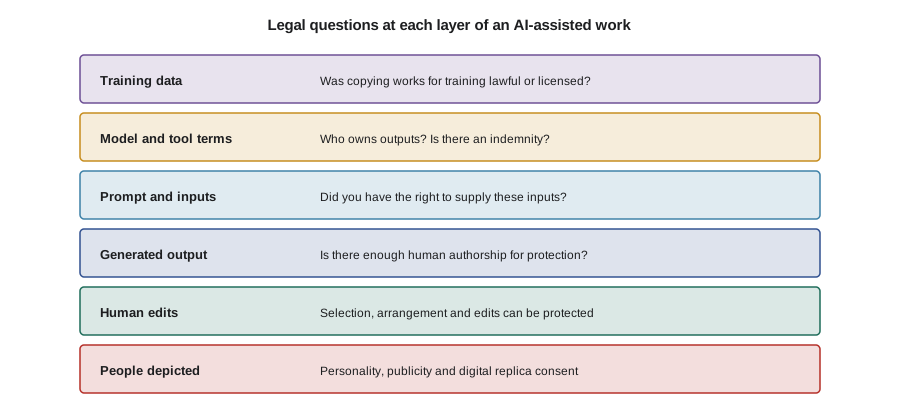
For producers, the practical consequence is that heavily AI-generated elements may be hard to protect and harder to insure. Distributors and insurers increasingly ask producers to disclose AI use, describe the tools and their terms, and warrant that outputs do not infringe. Keep records of prompts, sources, human edits and the tools' license terms.
Training AI systems on existing works
AI image, video and voice systems are trained on vast collections of existing works, many of them protected by copyright. Whether copying works to train a model is lawful, and whether a model's outputs infringe the works it learned from, are among the most litigated questions in copyright today.
American courts have begun to apply fair use to AI training, with mixed results. In June 2025, a federal judge in Bartz v Anthropic held that training on lawfully acquired books was fair use but that building a library of pirated books was not; the case then settled for 1.5 billion dollars, with final court approval in July 2026. In Kadrey v Meta, a different judge ruled for Meta on fair use in June 2025 on the record before him, while emphasizing that market harm could change the result; the case continues on other claims. In Thomson Reuters v Ross (2025), a court found that copying legal headnotes to build a competing non-generative tool was not fair use. The Copyright Office's 2025 report on training said some training uses are likely fair and others are not, depending especially on market effects.
For image makers, these cases matter in two ways. As rights holders, photographers and filmmakers may be able to license their archives for training, opt out where platforms allow it, or join litigation. As users, producers who use generative tools should prefer tools trained on licensed or public domain data, read the tools' terms, and check whether the tool provider offers an indemnity against infringement claims.
Digital replicas and synthetic performers
A digital replica is a realistic, computer-generated representation of a person's voice or likeness that the person did not actually perform. Replicas can extend a performance, de-age an actor, dub a film into other languages in the actor's own voice, or create entirely new performances. They also enable impersonation and abuse.
Several states now regulate digital replicas. Tennessee's ELVIS Act (2024) protects voice, including simulated voice, as part of the right of publicity. California's AB 2602 (2024) makes contract terms allowing digital replicas of performers unenforceable unless the intended uses are reasonably specifically described and the performer was represented, and AB 1836 (2024) restricts digital replicas of deceased personalities. A federal bill, the NO FAKES Act, was reintroduced in May 2026 and approved by the Senate Judiciary Committee in June 2026; it would create a federal right in voice and likeness with a notice-and-takedown system, but it was not law as of October 2026. SAG-AFTRA's 2023 agreements require informed consent and compensation for digital replicas.
Worked problem
Using a voice clone for dubbing
An American producer wants to use an AI system to dub a documentary narrator's voice into Spanish and Mandarin for international sales. The narrator signed a standard narration agreement in 2022 granting rights in "the recorded performance in all media". Can the producer proceed?
Show solution
- The agreement grants rights in the recorded performance, not in new performances synthesized from the narrator's voice; the grant probably does not cover a replica.
- Synthesizing new speech uses her voice, which may engage state publicity laws, such as Tennessee's ELVIS Act or California's statutes, and union terms if she is a union member.
- The safest path is a new written agreement describing the replica, the languages, the uses and the payment, with the narrator's informed consent.
Answer: The producer should not rely on the 2022 agreement. It should negotiate a specific digital replica agreement, or use human voice actors for the dubbed versions.
AI terms in contracts
Contracts now routinely address AI. Producers, photographers and their clients should check AI clauses in both directions.
- Grants from contributors: does the agreement allow the producer to use the contributor's work, voice or likeness to train AI or create replicas? Many union agreements and some statutes require specific, informed consent.
- Grants to clients: does a photography or footage license allow the client to use the material to train AI, to alter it with generative tools or to create derivative images? Licensors may want to prohibit or price these uses.
- Warranties: may the work contain AI-generated material, and must it be disclosed? Distributors and insurers increasingly require disclosure and warranties that the producer has the right to use the tools' outputs.
- Tool terms: does the AI tool's terms of service grant the user ownership of outputs, restrict commercial use, or claim a license to the user's inputs?
When drafting, describe AI uses specifically rather than relying on broad language such as "all technologies now known or later devised", which courts and statutes increasingly read narrowly where personal likeness and voice are concerned.
Platforms and their terms
Uploading work to a social network or video platform gives the platform a license under its terms of service, usually a broad, non-exclusive, royalty-free, worldwide license to host, display, distribute and sometimes adapt the content in connection with the service. Creators keep their copyright, but they cannot easily negotiate these terms. Read the terms of platforms you rely on, especially for any rights to use content to train AI systems or in advertising.
Platforms also run private enforcement systems on top of copyright law: content identification, strike policies and monetization rules. They can remove or demonetize content quickly and are often the decisive forum for disputes about clips and music. Keeping licenses, releases and source files lets you respond to claims and disputes efficiently.
American law shields platforms from most liability for users' content under section 230 of the Communications Decency Act, but that shield does not cover intellectual property claims, which is why copyright disputes on platforms run through the DMCA notice-and-takedown system (Lesson 4). State laws on minors' social media use and on synthetic content in elections add further platform rules.
Practical guidance for image makers
Until the law settles, image makers can manage AI-related risks with a few practices. Keep records of your creative process and of any AI tools used. Prefer tools with clear license terms and, where available, indemnities. Do not use AI to imitate a living artist's distinctive style for commercial work, or a real person's voice or likeness, without permission. Review contracts for AI clauses before signing. Disclose AI use to clients, buyers and insurers. And use content credentials (PHOT-420) to document how your images were made.
Style, likeness and the limits of protection
Copyright protects expression, not style. A painter's general manner, a photographer's preferred lighting or a filmmaker's visual signature cannot be owned as such, which is why AI tools that imitate styles raise difficult questions. Using AI to produce images that copy a particular work's protected expression can still infringe, and marketing a product by naming a living artist or photographer whose style it imitates can raise passing off, trademark or false endorsement concerns. Separately, a person's face, voice and identity are protected by personality and publicity rights, not copyright, which is why digital replica laws focus on consent and compensation rather than ownership of a style.
For working image makers, the most reliable protections are contractual and practical: license terms that restrict training and synthetic uses of your work, platform settings that limit AI training where offered, content credentials that document authorship, and careful records of your own creative process. Industry groups in both countries continue to press for transparency about training data, consent for training and compensation for creators, and the law in this area is likely to change during the life of this course.
Checklist for an AI-assisted project
Before using generative tools on a commercial project, answer these questions in writing: which tools were used and under what terms; what inputs were supplied and whether you had the rights to supply them; what human contributions shaped the final work; whether any real person's likeness or voice was generated and, if so, what consent was obtained; whether the client, distributor and insurer require disclosure; and how the use will be credited. Keeping this record with the clearance log makes the answers easy to provide when a buyer or insurer asks.
Ethics beyond the law
Even where the law allows a synthetic use, ethical questions remain. Recreating the voice of a deceased person for a documentary, generating images of real events that were never photographed, or altering archive footage to make it look more dramatic can mislead audiences and harm trust in documentary as a form. Many broadcasters and festivals now require disclosure of synthetic or materially altered material, and documentary organizations have published guidelines encouraging transparency, restraint and consent. Following them is part of professional practice.
Common mistakes
MistakeAssuming that anything an AI tool produces is protected by copyright
InsteadHuman creative contribution is needed; keep records of your contributions.
MistakeTreating "all media" grants as permission to create digital replicas
InsteadGet specific, informed consent for replicas of voice or likeness.
MistakeIgnoring the AI tool's terms of service
InsteadCheck ownership, permitted uses, input licenses and indemnities.
MistakeAssuming the AI training cases have settled the law
InsteadRulings are mixed and still developing; check current decisions.
MistakeForgetting that platform terms grant the platform a license
InsteadRead terms for rights to adapt, advertise or train on your content.
Summary and key terms
- Copyright protects human contributions to AI-assisted works, not purely machine-generated material.
- The United States requires human authorship and disclosure; Canada has no decision yet.
- Whether AI training is lawful is being decided case by case, with mixed results.
- Digital replicas engage personality, publicity and union rights, and new laws are emerging.
- Contracts increasingly contain specific AI clauses in both directions.
- Platform terms and enforcement systems shape creators' rights alongside the law.
- Records, careful tool choice, specific consent and disclosure manage most AI risks.
- Generative AI
- Systems that generate text, images, audio or video in response to prompts.
- Human authorship
- The requirement that a protected work reflect human creative expression.
- Training data
- The works and data used to train an AI model.
- Text and data mining
- Automated analysis of large collections of works and data.
- Digital replica
- A realistic computer-generated representation of a person's voice or likeness.
- Voice clone
- A synthetic reproduction of a specific person's voice.
- Informed consent
- Agreement given with a clear understanding of what is being agreed to.
- Tool indemnity
- A promise by an AI tool provider to defend users against certain infringement claims.
- Terms of service
- The contract governing use of a platform or tool.
- Content credentials
- Signed metadata recording how an image or video was created and edited.
Practice problems
Work each problem on paper first, then reveal the answer to check.
Can an image generated from a short prompt alone usually be registered in the United States?
Show answer
Generally no, because it lacks sufficient human authorship.
What parts of an AI-assisted work are most likely protected?
Show answer
The human contributions, such as selection, arrangement and edits.
Has a Canadian court decided whether AI-generated works are protected?
Show answer
Not as of October 2026.
What did Bartz v Anthropic decide about training on pirated books?
Show answer
That building a library of pirated books was not fair use.
What is a digital replica?
Show answer
A realistic computer-generated representation of a person's voice or likeness.
Does a 2022 grant of rights in a recorded performance cover a voice clone?
Show answer
Probably not; get specific consent.
Name one American state law addressing synthetic voice.
Show answer
For example, Tennessee's ELVIS Act.
Was the NO FAKES Act law as of October 2026?
Show answer
No, it had passed the Senate Judiciary Committee but was not enacted.
What should a producer check in an AI tool's terms?
Show answer
Output ownership, permitted uses, input licenses and indemnities.
Why should creators read platform terms of service?
Show answer
Uploading grants the platform a license that may include adaptation or training.
Lesson quiz · 5 questions
Score 60% or more to complete this lesson.
Create a free account to save your progress, take quizzes and earn a certificate.