
FILM-420 · Lesson 6 of 12 · 26 min
Clearances: music, artwork, trademarks and footage
Clearance is the practical work of finding every third-party element in a project, deciding whether permission is needed, and getting it or changing the project. It runs from the script stage to final delivery. On a well-run production, a clearance coordinator or the producer reviews the script for problems, tracks what appears on set, logs every song, clip and photograph in the edit, and assembles the documents that buyers and insurers ask for. This lesson covers the four areas that generate most clearance work: music, artwork and design, trademarks, and footage and stills.
FILM-310 lesson 10 covers how music is chosen, temped and scored and how cue sheets are prepared. FILM-410 covers the budget and the errors and omissions insurance that clearance supports. This lesson focuses on the rights themselves and how to clear them.
Music: two copyrights in every recording
Every piece of recorded music contains at least two separately owned works: the musical work, which is the composition (melody and lyrics), usually owned by the songwriter's music publisher; and the sound recording, also called the master, usually owned by the record label or the artist. Using a recording in a film requires a license from both, and each can say no or set its own price.
- A synchronization license, from the publisher, allows the composition to be recorded in timed relation with moving images.
- A master use license, from the label, allows the specific recording to be used.
- Public performance of the music when the finished work is broadcast, streamed or shown publicly is usually licensed separately, through performing rights organizations, and is usually the broadcaster's or exhibitor's responsibility rather than the producer's.
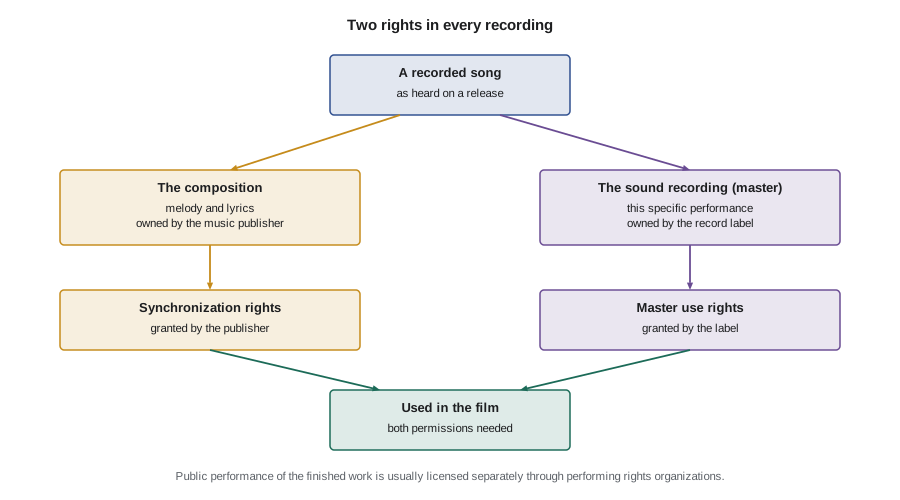
If the producer re-records the song with new musicians, a master license is not needed, because the production owns the new recording, but a synchronization license for the composition still is. If the composition is in the public domain, only the recording needs clearing; a new recording of a public domain composition by the production needs nothing, although a modern arrangement may have its own copyright.
In the United States, synchronization rights are negotiated directly with publishers, and master rights with labels. ASCAP, BMI, SESAC and GMR license public performance to broadcasters and streaming services, which rely on the producer's cue sheet to distribute royalties to writers and publishers. American cinemas generally do not pay performance royalties for film music, so music used in theatrical films is often licensed with that in mind.
Music license terms
Music licenses are defined by the same variables as other licenses: media, territory, term and the nature of the use. The fee depends heavily on these terms and on how the music is used: visual vocal (a performer singing on screen) costs more than background instrumental, a theme or title song costs more than a short cue, and a famous song costs more than an unknown one.
| Variable | Cheaper option | More expensive option |
|---|---|---|
| Media | Festivals only | All media now known or later devised |
| Territory | One country | Worldwide |
| Term | Five years | Perpetuity |
| Use | Background instrumental, 20 seconds | Featured vocal over opening titles |
| Exclusivity | Non-exclusive | Exclusive in a category |
| Trailer and promotion | Not included | In-context and out-of-context trailer use |
A common strategy for independent films is to license festival rights with an option to buy broader rights at a pre-agreed price. This keeps the initial cost low while protecting the producer if the film sells. Another is most favored nations, which means each rights holder for a cue receives terms no worse than any other, so the publisher and label are paid equally. Production music libraries offer pre-cleared tracks under blanket or per-track licenses, which is the simplest route for many projects; check that the library license covers the media and territories you need.
Music traps
Several music situations cause repeated problems. Music playing on set, such as a radio in a bar scene, ends up recorded in the dialogue and needs clearing or replacing. Performers singing a song on camera, even a few lines of a famous song, need a synchronization license. Happy Birthday to You is in the public domain in the United States following a 2015 court decision and a 2016 settlement, and its copyright has expired in Canada as well, but many other celebratory songs are not. Cover versions on streaming platforms do not come with film rights. And temp music used in the edit tends to become hard to replace once the director and editors have lived with it, so producers set expectations early.
Artwork and design on screen
Paintings, posters, photographs, sculptures, murals, set dressing, wallpaper patterns and graphic designs are all protected works. When they appear in a film or photograph, the question is whether the appearance requires permission. The answer depends on how prominent the work is, whether it was deliberately included and whether an exception applies (Lesson 5).
- Featured artwork, such as a painting that the camera dwells on or that is part of the story, needs permission or replacement.
- Background artwork that is recognizable and deliberately placed by the art department is usually cleared, because it was not incidental.
- Artwork that appears briefly and by chance in a location shot is often acceptable, but broadcasters and insurers may still ask for it to be cleared or blurred.
- Set dressing created by the production's own art department belongs to the production if the designers' agreements transfer it.
Art departments manage this by commissioning original art, renting cleared art from prop houses and art clearance services that provide licenses, using public domain works, or getting releases from artists. A tattoo on an actor can raise the same issue: tattoo artists have successfully claimed copyright in tattoos reproduced in video games and films, so productions sometimes cover or clear distinctive tattoos.
Trademarks and brands
Trademarks protect names, logos, slogans and other signs that identify the source of goods and services. Unlike copyright, trademark law does not give the owner control over every appearance of the mark. It protects against uses that confuse consumers about source, sponsorship or approval, and in some cases against uses that tarnish or dilute a famous mark. Showing a character drinking a brand of soda is usually not trademark infringement, because no one thinks the film is made by the soda company.
American trademark law, under the Lanham Act, prohibits uses likely to cause confusion and, for famous marks, dilution by blurring or tarnishment. For expressive works, courts long applied the Rogers v Grimaldi test, which protects uses that are artistically relevant and not explicitly misleading. In Jack Daniel's Properties v VIP Products (2023), the Supreme Court held that Rogers does not apply when the defendant uses the mark as a designation of source for its own goods, such as on merchandise, which matters for film titles and spin-off products.
Practical risks with brands are less about infringement and more about relationships and accuracy. A brand shown in a negative light, such as a product causing injury in a story, may provoke a complaint. A brand that appears prominently may look like paid product placement, which raises disclosure obligations covered in CRE courses. Broadcasters often ask producers to avoid or obscure logos that are not cleared, and some prefer fictional brands, which art departments can design.
Footage, stills and archive material
Archive footage and stills are among the most expensive and time-consuming elements to clear in documentaries. Sources include news agencies, broadcasters, stock libraries, film archives, private collections, user-generated video and government works.
- Commercial archives and stock libraries license footage by the second or by clip, for defined media, territory and term, and may require separate clearance of people, music or artwork in the footage.
- News footage often includes underlying rights that the news organization cannot grant, such as music, logos or interviews; the license usually says what is and is not covered.
- User-generated footage from social media is owned by the person who shot it, not the platform; get a written license from the creator.
- Old footage may be in the public domain in one country but not another, and restored or colorized versions may carry new rights.
Works created by employees of the United States federal government as part of their official duties are not protected by copyright and can be used freely, including much footage from NASA and the National Archives. Works by contractors, state governments and cities can be protected, and federal archives may hold material created by others that remains protected, so check each item.
Worked problem
Clearing an archive sequence
A documentary editor has cut a two-minute sequence using: (a) 30 seconds of a 1985 television news report, (b) 40 seconds of a space launch filmed by a federal government agency, (c) a 1990s home video shot by a participant's father, and (d) a 25-second social media clip of a protest. What must the producer clear?
Show solution
- (a) License the news report from the broadcaster or its archive agent, and check the license for underlying music and interviews.
- (b) If the footage was filmed by a federal agency employee as part of official duties, it is in the public domain in the United States; confirm the source and keep a record. Footage from a foreign government may need permission.
- (c) The father, or his estate, owns the home video; get a written license, plus releases from identifiable people where needed.
- (d) The person who filmed the protest owns the clip; find and license from them, and consider privacy for identifiable protesters.
Answer: Three of the four items need written licenses, and the government footage needs either a license or a documented public domain check.
Script clearance and title reports
For scripted work, clearance starts with the screenplay. A script clearance report reviews names of characters, businesses, places, products and real people, phone numbers and addresses, and flags potential conflicts, for example a fictional criminal who shares a name with a real person in the same city. Producers change names or details where needed. A title report searches existing titles and trademarks to assess whether the film's title could cause confusion with an existing work or brand. Titles are generally not protected by copyright, but a confusingly similar title can raise trademark or passing off claims.
Errors and omissions insurers usually require these reports, along with written agreements for all rights and a clearance log, before they will cover a film. FILM-410 explains when to buy the policy; the clearance procedures described in this lesson are what make it possible to buy.
The clearance log in practice
A clearance log is a spreadsheet or database listing every third-party element. It should record what the element is, where it appears (episode, timecode or page), the rights holder, the rights needed, the status of the clearance, the cost, the document reference and any restrictions. It is updated through the edit, checked at picture lock and delivered with the film.
log = [
    {"item": "Song: Northern Lights", "type": "music", "sync": True, "master": True, "status": "cleared"},
    {"item": "Painting in kitchen scene", "type": "artwork", "status": "pending"},
    {"item": "News clip 1985", "type": "footage", "status": "cleared"},
    {"item": "Song: Radio in bar", "type": "music", "sync": True, "master": False, "status": "pending"},
    {"item": "Logo on van", "type": "trademark", "status": "no permission needed"},
]
for row in log:
    problems = []
    if row["status"] == "pending":
        problems.append("not cleared")
    if row["type"] == "music" and not (row.get("sync") and row.get("master")):
        problems.append("missing sync or master rights")
print(f"{row['item']:28} {'OK' if not problems else '; '.join(problems)}")Song: Northern Lights OK Painting in kitchen scene not cleared News clip 1985 OK Song: Radio in bar not cleared; missing sync or master rights Logo on van OK
A real log tracks many more fields, but even a simple check like this catches the two most common problems at picture lock: items still pending and music with only one of its two licenses.
Common mistakes
MistakeLicensing only the composition or only the recording
InsteadClear both the synchronization license and the master use license, unless one is not needed.
MistakeLetting music playing on set end up in the dialogue track
InsteadTurn off background music on set and add cleared music in post.
MistakeAssuming a brand on screen is always trademark infringement
InsteadTrademark law targets confusion and certain harms; clear prominent or negative portrayals and follow broadcaster rules.
MistakeAssuming a platform can license users' footage
InsteadLicense from the person who shot it.
MistakeLeaving title and script clearance until delivery
InsteadRun script clearance and title reports during development.
Summary and key terms
- Clearance identifies third-party elements and obtains permission or confirms that none is needed.
- Recorded music needs a synchronization license for the composition and a master license for the recording.
- Music fees depend on media, territory, term and how prominently the music is used.
- Featured or deliberately placed artwork usually needs permission; incidental background art often does not.
- Trademark law targets confusion and certain harms, not every appearance of a brand.
- Archive footage needs licenses from the true owner and may carry underlying rights.
- Script clearance, title reports and a clearance log support errors and omissions insurance.
- Synchronization license
- Permission from a publisher to use a composition in timed relation with images.
- Master use license
- Permission from the owner of a sound recording to use that recording.
- Cue sheet
- A list of every music cue in a production, with writers, publishers and durations.
- Production music library
- A catalog of pre-cleared music licensed on standard terms.
- Most favored nations
- A clause guaranteeing a rights holder terms no worse than others for the same item.
- Visual vocal
- Music performed on screen with vocals, usually the most expensive use.
- Crown copyright
- Copyright held by the Canadian government in works made by or for it.
- Script clearance report
- A review of names, places and details in a script for legal conflicts.
- Title report
- A search of existing titles and trademarks similar to a proposed title.
- Errors and omissions insurance
- Insurance against claims such as infringement, defamation and privacy arising from a production.
Practice problems
Work each problem on paper first, then reveal the answer to check.
What two licenses does a producer usually need to use a commercial recording in a film?
Show answer
A synchronization license and a master use license.
If the production re-records a protected song, which license is still needed?
Show answer
The synchronization license for the composition.
Who usually licenses public performance of the finished film's music?
Show answer
Performing rights organizations, through broadcasters and exhibitors.
Why is a festival license with an option to buy broader rights useful?
Show answer
It keeps costs low while protecting the producer if the film sells.
What should an art department do with a featured painting?
Show answer
Clear it, replace it with original or cleared art, or reframe.
Is showing a character drinking a branded soda usually trademark infringement?
Show answer
No, unless it causes confusion or certain harms.
Who owns a protest clip posted on social media?
Show answer
The person who filmed it.
What does a script clearance report check?
Show answer
Names, businesses, places, products and real people for potential conflicts.
What are the two most common problems a clearance log catches at picture lock?
Show answer
Items still pending and music missing one of its two licenses.
Why do insurers require clearance procedures?
Show answer
They reduce the risk of claims the policy covers.
Lesson quiz · 5 questions
Score 60% or more to complete this lesson.
Create a free account to save your progress, take quizzes and earn a certificate.