
FILM-410 · Lesson 6 of 12 · 26 min
Budgeting II: labor, unions and fringes
People are the largest cost on most films. On a low-budget feature, wages for cast and crew, plus the payroll costs that come with them, often account for half or more of the budget. Getting labor right is therefore central to budgeting: the producer must know who will be hired, under what agreements, at what rates, for how long, and what each hour of work really costs once overtime, fringe benefits and payroll taxes are added.
This lesson explains how crews are organized and paid, how union and guild agreements shape labor costs, how overtime and turnaround work, and how to calculate fringes. Rates in this lesson are illustrative. Real rates come from the applicable collective agreements, which are renegotiated regularly, and from the local market. Producers should always budget from the current agreement and confirm details with the union or a payroll service.
How a film crew is organized
A feature crew is organized into departments, each led by a head of department who hires and manages their team. Typical departments include production (producers, production manager, coordinators, assistants), assistant directors, camera, grip, electric, art, set decoration, props, construction, wardrobe, hair and makeup, sound, locations, transport, catering and craft services, and post-production. On a low-budget film, departments are small and people often cover several roles. On a large film, each department may have dozens of members.
Crew are usually hired for the duration of their involvement: department heads may start weeks before the shoot to prepare, most crew are hired for the shooting weeks plus a few days of preparation and wrap, and post-production crew are hired later. Each person's prep, shoot and wrap time appears in the budget as weeks or days at a rate. Getting these periods right matters: a production designer hired two weeks too late may not be ready; one hired too early costs money for nothing.
| Role | Prep | Shoot | Wrap |
|---|---|---|---|
| Line producer | 8 weeks | 4 weeks | 3 weeks |
| Production manager | 6 weeks | 4 weeks | 2 weeks |
| First assistant director | 3 weeks | 4 weeks | 2 days |
| Director of photography | 2 weeks | 4 weeks | 2 days |
| Production designer | 5 weeks | 4 weeks | 1 week |
| Costume designer | 4 weeks | 4 weeks | 1 week |
| Location manager | 6 weeks | 4 weeks | 1 week |
| Sound mixer | 2 days | 4 weeks | 1 day |
| Grips and electrics | 2 to 5 days | 4 weeks | 1 to 2 days |
Unions and guilds
Most professional film work in Canada and the United States is covered by collective agreements between producers' associations or individual producers and unions or guilds representing performers, writers, directors and crew. These agreements set minimum rates, working conditions, overtime, meal breaks, rest periods, safety obligations, benefits and, for creative guilds, credits and residuals. A producer who signs an agreement, or whose production company is a signatory, must follow it for covered workers.
In the United States, performers are represented by SAG-AFTRA, which offers a set of independent and low-budget agreements with different rates and terms depending on the film's budget, from ultra low budget to larger independent tiers. Directors, unit production managers and assistant directors are represented by the Directors Guild of America (DGA), which has a low-budget agreement for qualifying features. Crew are represented by IATSE locals and, for drivers and some location and casting staff, by the Teamsters. IATSE offers low-budget theatrical terms with tiers by budget. Writers are represented by the Writers Guild of America. Union agreements require contributions to pension and health plans on top of wages.
Producers sometimes consider making a film non-union to save money. This is a significant decision with trade-offs. Union agreements bring experienced professionals, clear rules and access to talent who will work only under union terms, while some financiers, distributors and insurers expect union coverage. Non-union productions may pay lower rates, but they still must follow employment standards, health and safety law and payroll tax obligations. Producers should take advice before deciding.
Rates, hours and overtime
Crew rates may be expressed per hour, per day or per week. Many agreements guarantee a minimum number of hours per day, such as 10 or 12, and pay overtime at higher multiples for hours beyond a threshold. Common patterns include time and a half after a set number of hours and double time beyond a further threshold, with higher rates for work on rest days or holidays. Exact thresholds and multiples differ between agreements and regions.
Rest periods are just as important. Turnaround is the minimum rest between the end of one day's work and the start of the next, often 10 or 12 hours or more for crew and performers. Cutting turnaround short usually triggers penalties and, more importantly, creates fatigue, which is a safety risk, particularly for crew who drive home after long days. Meal breaks must be given at set intervals; late meals trigger meal penalties. These penalties look small individually but add up quickly on a production that runs long every day.
Long hours are a choice the producer controls through the schedule. A schedule that assumes 12-hour days every day, with company moves and night shoots, will generate overtime and penalties and push people to exhaustion. Industry campaigns for reasonable hours have made clear that fatigue causes accidents and that producers bear responsibility for setting achievable days. FILM-320 lesson 8 discusses this from the director's side, and CINE-340 covers hours and safety in detail.
Fringes
Fringes are the costs an employer pays on top of wages: payroll taxes, statutory benefits, vacation pay, union benefit contributions and workers' compensation premiums. They are often budgeted as a percentage of wages, by category of worker, and can add 15 to 30 percent or more to labor costs depending on the jurisdiction and agreement.
| Item | Employer cost | Notes |
|---|---|---|
| Social Security | 6.2% of wages up to 184,500 | Part of FICA |
| Medicare | 1.45% of all wages | Part of FICA |
| Federal unemployment (FUTA) | 0.6% on the first 7,000 of wages, after credits | Higher in some states with outstanding federal loans |
| State unemployment (SUTA) | Rate and wage base set by each state | New employers often pay a default rate |
| Workers' compensation | Premium set by insurers or state funds by job classification | Varies widely by state |
| Union pension and health | Contributions per hour or percent of wages, set by each agreement | Often the largest fringe for union crew |
Many productions use an entertainment payroll service, which acts as the employer of record for cast and crew, handles payroll taxes, union reporting and residuals, and charges a fee, often a small percentage of payroll. Payroll services also simplify multi-jurisdiction shoots, where workers may be subject to different provincial or state rules.
hourly = 42.00           # straight-time rate for a camera assistant (illustrative)
days = [12, 11, 13, 12, 10]   # hours worked each day in a five-day week
ot_after = 8             # time and a half after 8 hours (illustrative agreement)
dt_after = 12            # double time after 12 hours
fringe_rate = 0.22       # payroll taxes, vacation pay and benefits as a share of wages

wages = 0
for h in days:
    straight = min(h, ot_after)
    ot = max(0, min(h, dt_after) - ot_after)
    dt = max(0, h - dt_after)
    wages += hourly * (straight + 1.5 * ot + 2 * dt)
fringes = wages * fringe_rate
straight_only = hourly * sum(days)
print(f"Hours worked: {sum(days)}")
print(f"Wages with overtime: {wages:,.2f}")
print(f"Wages if every hour were straight time: {straight_only:,.2f}")
print(f"Overtime premium: {wages - straight_only:,.2f} ({(wages - straight_only) / straight_only:.0%})")
print(f"Fringes at {fringe_rate:.0%}: {fringes:,.2f}")
print(f"Total cost of the week: {wages + fringes:,.2f}")
print(f"Effective cost per hour worked: {(wages + fringes) / sum(days):,.2f}")Hours worked: 58 Wages with overtime: 2,835.00 Wages if every hour were straight time: 2,436.00 Overtime premium: 399.00 (16%) Fringes at 22%: 623.70 Total cost of the week: 3,458.70 Effective cost per hour worked: 59.63
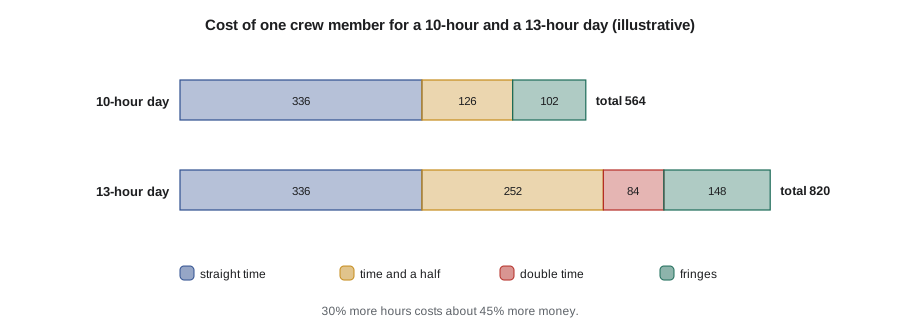
Overtime and fringes turn a 42-dollar rate into an effective cost of almost 60 dollars per hour worked in this illustration, an increase of about 42 percent. Multiply that across a crew of 30 for four weeks and the difference between a 10-hour and a 12-hour day becomes one of the largest variables in the budget. Producers who budget only straight-time rates will run out of money.
Cast costs
Performers are paid under different structures from crew. Principal performers usually receive a negotiated fee, often for a guaranteed number of days or weeks, at or above the union minimum, plus fringes and sometimes an agent's commission handled within the deal. Day players are paid per day. Background performers, or extras, are paid at lower rates, sometimes under separate union categories. Performer agreements also govern rehearsal days, fittings, travel, overtime, meal periods, nudity and stunts, and the use of the performance in different media, which can trigger later payments.
Use payments and residuals are an important difference between performer and crew costs. Performer and writer agreements typically require additional payments when a film is exploited in certain markets or beyond an initial period. Producers must budget any up-front payments and track obligations for later payments, which usually come from distribution revenue. Lesson 11 returns to residuals when discussing distribution deals.
Worked problem
Budgeting a principal performer
Stillwater Road's lead is engaged for 18 shooting days plus 2 rehearsal days and 1 fitting day, at a negotiated fee above the union minimum. The agreement requires performer fringes of about 20 percent on fees (illustrative) and the production must also pay for travel and accommodation for an actor living in another city. How should the producer budget this?
Show solution
- Start from the deal: the negotiated fee covers the guaranteed period; confirm whether rehearsal and fitting days are included or paid separately.
- Add fringes as required by the agreement on all covered fees.
- Add travel, per diems and accommodation for the full engagement, including travel days.
- Allow for overtime or additional days if the schedule might slip, and record any obligations for later use payments.
Answer: The budget shows the fee, fringes, travel, living costs and an allowance for possible extra days, each as a separate line, so the cost of the engagement is visible and controllable.
Negotiating and managing labor costs
Labor costs can be managed without cutting pay or safety. The most effective tool is the schedule: fewer company moves, sensible day lengths, grouping scenes by location and cast, and realistic page counts all reduce overtime. Hiring local crew reduces travel and accommodation. Careful prep reduces time wasted on set. Clear communication about call times, wrap times and changes avoids paying people to wait.
Some costs are better protected than cut. Paying people on time builds trust and is often a legal requirement. Budgeting adequate crew for safety-critical roles, such as stunt coordinators, safety officers, medics and drivers, protects people and the production. A producer who saves money by under-crewing a dangerous scene takes a risk no financier or insurer will accept.
| Lever | Saves money by | Caution |
|---|---|---|
| Realistic day lengths | Reducing overtime and penalties | Requires disciplined scheduling |
| Fewer company moves | Saving set-up and travel time | May constrain creative choices |
| Local hiring | Avoiding travel and accommodation | Depends on local crew depth |
| Low-budget agreement tiers | Lower minimum rates | Eligibility rules and caps apply |
| Cutting turnaround or safety roles | Nothing worth having | Causes fatigue, accidents and penalties |
Common mistakes
MistakeBudgeting crew at straight-time rates only
InsteadBudget realistic hours with overtime, penalties and fringes for each role.
MistakeTreating turnaround penalties as a small cost
InsteadSchedule proper rest; fatigue is a safety risk and penalties add up.
MistakeUsing last year's union rates
InsteadBudget from the current agreement and confirm with the union or a payroll service.
MistakeForgetting later use payments and residuals
InsteadTrack performer and writer payment obligations triggered by distribution.
MistakeDeciding to go non-union without advice
InsteadWeigh talent access, financier expectations and legal obligations before deciding.
Summary and key terms
- Labor is the largest cost on most films, so getting it right is central to budgeting.
- Crews are organized in departments, each hired for its own prep, shoot and wrap period.
- Collective agreements set minimum rates, hours, overtime, rest, benefits and, for guilds, credits and residuals.
- Overtime, meal penalties and turnaround rules make long days expensive as well as dangerous.
- Fringes such as payroll taxes, vacation pay, workers' compensation and union benefits add a large percentage to wages.
- Performer costs include fees, fringes, travel and obligations for later use payments.
- The schedule is the strongest tool for managing labor costs; safety roles and prompt pay should be protected.
- Head of department
- The person who leads and hires a department, such as camera or wardrobe.
- Collective agreement
- A contract between producers and a union or guild setting terms for covered workers.
- Turnaround
- The minimum rest period between one day's work and the next.
- Meal penalty
- A payment owed when a meal break is given late.
- Overtime
- Pay at higher multiples for hours beyond a set threshold.
- Fringes
- Employer costs on top of wages, such as payroll taxes, vacation pay and benefits.
- Payroll service
- A company that acts as employer of record and handles payroll, taxes and union reporting.
- Day player
- A performer engaged and paid by the day.
- Residuals
- Additional payments to performers, writers or directors for later uses of a production.
- Low-budget agreement
- A union agreement or tier with reduced terms for qualifying productions.
Practice problems
Work each problem on paper first, then reveal the answer to check.
Why is labor often the largest budget cost?
Show answer
Cast and crew wages plus fringes make up much of the spending on most films.
What does turnaround protect?
Show answer
Rest between working days, reducing fatigue and accidents.
Name two fringes an employer pays in your country.
Show answer
For example, in Canada CPP, EI, vacation pay or workers' compensation; in the US, Social Security, Medicare, FUTA, SUTA or workers' compensation.
Why does a 12-hour day cost more than 20 percent more than a 10-hour day?
Show answer
Overtime multiples and fringes rise with the extra hours.
What does a payroll service do?
Show answer
Acts as employer of record and handles payroll taxes, union reporting and residuals.
Give one reason a producer might choose a union production.
Show answer
Access to experienced talent, clear rules or financier and distributor expectations.
What are use payments or residuals?
Show answer
Additional payments for later uses of a production.
Name one effective way to reduce labor costs without cutting pay.
Show answer
For example, a realistic schedule, fewer company moves or local hiring.
Why should safety roles not be cut to save money?
Show answer
Under-crewing dangerous work risks injury and is unacceptable to insurers and financiers.
Where do real union rates come from?
Show answer
The current collective agreement, confirmed with the union or a payroll service.
Lesson quiz · 5 questions
Score 60% or more to complete this lesson.
Create a free account to save your progress, take quizzes and earn a certificate.