
FILM-410 · Lesson 3 of 12 · 25 min
Financing models
A film's finance plan is the producer's answer to the question every financier asks first: where is the rest of the money coming from? Very few independent films are paid for by a single source. Instead, producers assemble a structure from several pieces, each with its own conditions, timing and claims on the film's future income. The finance plan lists these pieces and shows that together they cover the full budget. This lesson describes the main sources of film finance, how they fit together, and the costs that financing itself adds to a budget. Lesson 4 looks closely at public funding and tax credits, which are central to Canadian production and important in many American states.
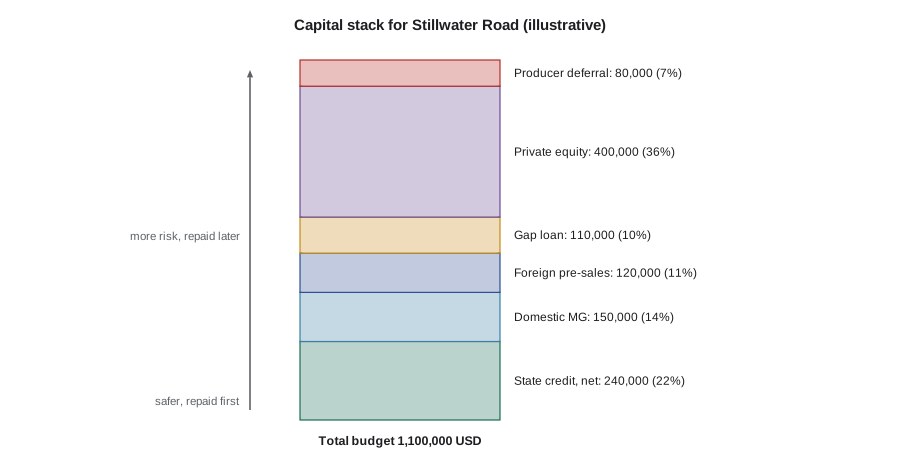
A useful way to picture a finance plan is as a stack of capital. At the bottom sit the safest sources, those most likely to be repaid or that never need repaying, such as tax credits and certain public funds. In the middle sit sources secured by contracts, such as pre-sales and minimum guarantees. At the top sit the riskiest sources, such as gap loans and equity, which are repaid last and therefore expect the highest return. Understanding where each piece sits helps a producer negotiate and helps financiers judge their risk.
Equity
Equity is money invested in exchange for ownership of the film's income. Equity investors take the greatest risk: they are usually repaid only after lenders and certain other financiers, and if the film earns little, they may lose most or all of their investment. In return, equity typically recoups first among the profit participants with a premium, often 20 percent or more, and then shares in profits, commonly splitting net profits with the producer.
Equity comes from private individuals, family offices, production companies, film funds and strategic partners such as distributors or streamers. Raising equity from private investors is regulated, because a film investment is a security in most jurisdictions. Producers who solicit investors must comply with securities law, which may require offering documents, investor qualification and filings. FILM-420 covers the legal side; the practical rule for producers is to get legal advice before asking anyone for an investment.
In the United States, film investments are generally securities under federal law. Many independent films raise money under exemptions in Regulation D, which limit offerings mainly to accredited investors, or through Regulation Crowdfunding, which lets a broader public invest small amounts through registered online portals. State securities laws may also apply.
Pre-sales and minimum guarantees
A pre-sale is a contract in which a distributor agrees, before the film is made, to pay a fixed amount for the rights to distribute it in a territory. The payment is usually made on delivery of the finished film, not up front. Because the producer needs cash to make the film, pre-sale contracts are taken to a bank, which lends against them. The bank is repaid when the distributors pay on delivery.
A minimum guarantee, or MG, is a similar commitment, often made by a distributor or sales agent: a guaranteed advance against the film's future revenue in a territory. The distributor recoups the MG, plus its fees and expenses, from the film's income before paying anything more to the producer. MGs can be paid at signing, during production or on delivery, depending on the deal.
Pre-sales depend on the package. A film with a well-known director or cast in a genre that travels, such as thrillers or family films, may pre-sell to several territories. A quiet character drama with an unknown cast may pre-sell only to its home territory, or not at all. Producers rely on sales agents' estimates of what each territory might pay, but estimates are not commitments, and markets change quickly.
Loans: interim financing, gap and bridge
Several kinds of loans fill timing gaps in a finance plan. Interim financing lends against confirmed sources that will pay later, such as tax credits and pre-sale contracts. Because tax credits are paid only after the film is completed and audited, banks lend against them during production, discounting the expected credit to protect themselves. Gap financing lends against unsold territories, using a sales agent's estimates as security. It is riskier for the lender, so it costs more and is usually limited to a modest share of the budget. Bridge loans cover short gaps, such as cash needed before a funder's first installment arrives.
Loans add costs. Banks charge interest, set-up fees and legal fees, and often require an interest reserve in the budget. Gap lenders charge higher interest and fees and may require a completion bond and insurance. All these costs must be budgeted; lesson 5 shows where they appear in the top sheet.
credit = 380000          # expected tax credits receivable
advance_rate = 0.85      # bank lends 85% of the expected credit
months = 14              # from first draw to receipt of the credit
annual_rate = 0.085      # interest rate
setup_fee_rate = 0.015   # set-up fee on the facility
legal = 9000             # lender's legal costs charged to the production

loan = credit * advance_rate
# assume the loan is drawn in equal monthly amounts over the first 4 months
draws = [loan / 4] * 4 + [0] * (months - 4)
balance = 0
interest = 0
for d in draws:
    balance += d
    interest += balance * annual_rate / 12
fees = loan * setup_fee_rate + legal
print(f"Loan amount: {loan:,.0f}")
print(f"Interest over {months} months: {interest:,.0f}")
print(f"Fees: {fees:,.0f}")
print(f"Total financing cost: {interest + fees:,.0f} ({(interest + fees) / credit:.1%} of the credit)")
print(f"Cash shortfall the producer must cover (credit not advanced): {credit - loan:,.0f}")Loan amount: 323,000 Interest over 14 months: 28,599 Fees: 13,845 Total financing cost: 42,444 (11.2% of the credit) Cash shortfall the producer must cover (credit not advanced): 57,000
Borrowing against a credit is common and useful, but it is not free. In this illustration, more than a tenth of the credit's value goes to financing costs and the unadvanced portion must be covered from another source until the credit is paid. Producers therefore push to shorten the time between completion and receipt of credits, by keeping accounts audit-ready and filing promptly.
Deferrals, in-kind support and crowdfunding
Some costs can be deferred: people agree to be paid later, out of the film's income, instead of during production. Deferrals are common on micro-budget films, where cast and crew may defer part of their fees. They help a film get made but create obligations in the recoupment schedule, and unions limit how deferrals may be used for their members. Producers should treat deferrals as real debts, not favors.
In-kind support, such as discounted equipment, donated locations or free post-production time, reduces cash needs. It should be documented, because some funders and tax credit programs count only certain costs and require proof of fair value.
Crowdfunding raises money from many people, usually in exchange for rewards rather than ownership. It can fund a short film, a proof of concept or a micro-budget feature, and it builds an audience before release. Platforms charge fees, and rewards cost money to make and ship. Equity crowdfunding, where backers buy a share of the film, is regulated as a securities offering in both Canada and the United States.
Co-productions
A co-production is a film made by producers from more than one country, sharing the costs and the rights.
The United States has no official audiovisual co-production treaties. American producers can still partner with foreign producers, but the film does not become a national production in the partner country under a treaty. Instead, American producers often bring in foreign partners who access their own countries' incentives, or shoot abroad to use foreign production services credits, which are available to foreign-owned productions in many countries, including Canada's production services credits.
Building the finance plan
The finance plan is a table that lists each source, its amount, its status (confirmed, in negotiation or estimated), its conditions and when the cash arrives. It must add up to the budget exactly. Financiers read the plan to judge how much is truly confirmed and what risks remain. A plan with many estimated sources is a plan that will probably change.
| Source | Amount | Share | Status |
|---|---|---|---|
| State film tax credit (net of transfer discount) | 240,000 | 21.8% | Estimated, audited after completion |
| Domestic distributor minimum guarantee | 150,000 | 13.6% | Deal memo signed |
| Foreign pre-sales via sales agent | 120,000 | 10.9% | Two territories signed |
| Gap loan against unsold territories | 110,000 | 10.0% | Term sheet |
| Private equity | 400,000 | 36.4% | Committed in principle |
| Producer fee and overhead deferral | 80,000 | 7.3% | Confirmed |
| Total | 1,100,000 | 100.0% |
Every plan carries assumptions. Tax credit estimates assume the budget is spent where the program requires. Pre-sale amounts assume the film is delivered as promised. Equity commitments assume investors actually wire the money. Experienced producers stress-test the plan: what happens if one source falls away, or a credit comes in lower than expected? A plan with no cushion is fragile.
Worked problem
Closing a financing gap
Three weeks before Stillwater Road's planned start of prep, the producer learns that one source covering about 8 percent of the budget will not close in time. The producer has the remaining sources confirmed. What options are available?
Show solution
- Ask whether the source is delayed or gone. A delay may be covered by a bridge loan secured against the commitment.
- Look for a replacement: another distributor, a broadcaster or an equity investor willing to come in on similar terms.
- Reduce the budget: cut a shooting day, simplify a location or defer part of the producer fee, without harming safety or the film's core.
- Consider whether gap financing against unsold territories is available, and at what cost.
- Talk to the other financiers early; most will accept a sensible solution but will not accept surprises.
Answer: The producer combines solutions, perhaps a smaller bridge loan plus a modest budget reduction, and documents the change for every financier before prep begins.
Financing costs and closing
Financing adds its own costs to a film: interest and loan fees, legal fees for all the financing agreements, the completion bond fee, insurance required by lenders, collection account management fees and sometimes finder's fees. On a small film, these costs can reach a meaningful share of the budget. They must be included, because a budget that ignores them will run out of money.
Closing is the moment when all the financing agreements are signed and the money becomes available. On an independent film, closing often involves an interparty agreement among the producer, the bank, the completion guarantor, the distributors and sometimes funders, setting out who gets paid in what order and what happens if things go wrong. Closing can take weeks of legal work, and productions sometimes begin prep before it is complete, which is a risk the producer must weigh carefully.
Common mistakes
MistakeTreating sales estimates as committed money
InsteadDistinguish confirmed contracts from estimates and stress-test the plan for missing sources.
MistakeForgetting that tax credits arrive after completion
InsteadPlan interim financing against credits and budget its interest and fees.
MistakeSoliciting private investors without legal advice
InsteadComply with securities law before asking anyone to invest.
MistakeTreating deferrals as favors rather than debts
InsteadRecord deferrals in the recoupment schedule and honor them.
MistakeLeaving financing costs out of the budget
InsteadBudget interest, fees, legal costs, insurance and the completion bond.
Summary and key terms
- Independent films are financed by combining several sources into a finance plan that equals the budget.
- The capital stack orders sources by risk; lower layers are safer and repaid first.
- Equity takes the most risk and expects a premium and a share of profits.
- Pre-sales and minimum guarantees are distributor commitments, often paid on delivery and borrowed against.
- Loans against tax credits, pre-sales and unsold territories fill timing gaps but add interest and fees.
- Co-productions share costs and rights across countries; treaties make them national productions in each partner country where they exist.
- Financing and closing costs are real budget items, and closing can take weeks of legal work.
- Finance plan
- A table showing each source of a film's money, its amount, status and conditions.
- Capital stack
- The ordering of financing sources from safest to riskiest.
- Equity
- Money invested in exchange for a share of the film's income and profits.
- Pre-sale
- A contract for a distributor to pay a fixed amount for a territory, usually on delivery.
- Minimum guarantee
- A guaranteed advance against a film's revenue in a territory, recouped by the distributor.
- Interim financing
- A loan against confirmed sources that pay later, such as tax credits.
- Gap financing
- A loan secured against estimated sales of unsold territories.
- Deferral
- A fee that is paid later out of the film's income instead of during production.
- Co-production
- A film made by producers from more than one country who share costs and rights.
- Interparty agreement
- A contract among financiers, the producer and the guarantor setting payment order and remedies.
Practice problems
Work each problem on paper first, then reveal the answer to check.
Why is equity usually the riskiest source of film finance?
Show answer
It is repaid after lenders and other financiers, so it may lose money if income is low.
When is a pre-sale usually paid?
Show answer
On delivery of the finished film.
Why do banks discount tax credits when lending against them?
Show answer
Credits arrive after audit, and the final amount can be lower than estimated.
What is gap financing secured against?
Show answer
Estimated sales of unsold territories.
Name two costs that financing adds to a budget.
Show answer
For example, interest, loan fees, legal fees, the completion bond fee or insurance.
What must a producer do before soliciting private investors?
Show answer
Get legal advice and comply with securities law.
How should deferrals be treated in the recoupment schedule?
Show answer
As real obligations repaid from income.
What does a co-production treaty allow, where one exists?
Show answer
Each partner's producer can access its own country's funding and incentives as a national production.
What does an interparty agreement set out?
Show answer
Who gets paid in what order and what happens if things go wrong.
Give one way to close a late financing gap.
Show answer
For example, a bridge loan, a replacement source, a budget cut or gap financing.
Lesson quiz · 5 questions
Score 60% or more to complete this lesson.
Create a free account to save your progress, take quizzes and earn a certificate.