
FILM-410 · Lesson 12 of 12 · 25 min
Capstone: a production package for a low-budget feature
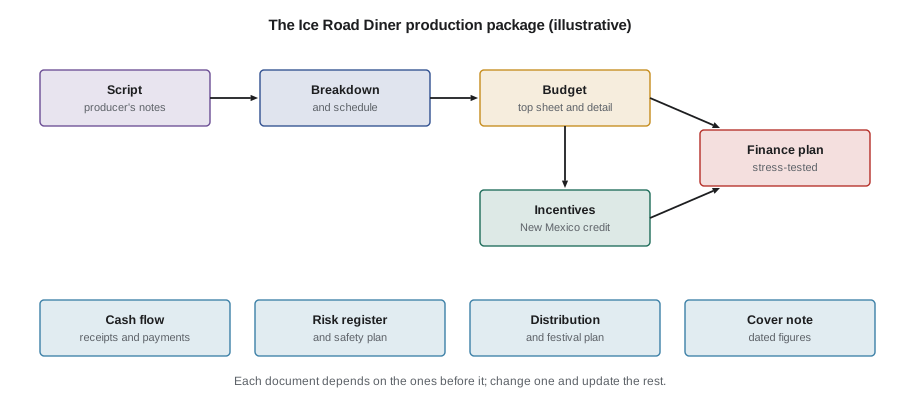
This final lesson brings the course together in a single exercise: preparing a production package for an invented low-budget feature. A production package is the set of documents a producer takes to financiers, funders and partners to show that a film can be made, for how much, on what schedule, and with what money. It is also the producer's own plan. Building one tests every skill in the course: reading a script as a producer, scheduling, budgeting, estimating incentives, assembling a finance plan, managing risk and planning distribution.
The project is Ice Road Diner, one of the projects on the slate in lesson 2. It is a contained winter drama: over one night in a snowstorm, a waitress, a long-haul driver and a teenage runaway are trapped in a roadside diner while the road is closed. The screenplay runs 86 pages. Most of the action takes place inside the diner, with some exterior scenes in the parking lot and on the highway. The cast has six speaking roles and a handful of background performers. All figures are illustrative and should be treated as a worked example of method, not as current market rates.
Step 1: Read the script as a producer
The producer begins by reading the script for its production implications. Ice Road Diner has strengths for a low budget: one main location, a small cast and a contained timeframe. It also has challenges. Snow and night exteriors are expensive and weather-dependent; the story happens in one night, so continuity of snow, light and wardrobe must be controlled carefully; and the teenage character raises the rules on minors' working hours described in FILM-320 lesson 9.
The producer meets the director and writer to discuss these challenges. Together they decide to build the diner interior in a real roadside restaurant that is closed for renovation, to shoot exteriors on two planned nights with snow effects, and to cast an adult performer who can play younger for the runaway role if the story allows, or, if a minor is cast, to schedule within the applicable limits. These decisions are recorded because they shape the schedule and budget.
| Script feature | Implication | Producer's response |
|---|---|---|
| One main interior location | Few company moves, efficient schedule | Secure a closed restaurant for the full shoot |
| Night and snow exteriors | Lighting, snow effects, cold-weather safety | Limit to two exterior nights; budget snow effects and warming areas |
| Story in one night | Strict continuity | Script supervisor and wardrobe continuity planning |
| Teenage character | Possible minors' hours rules | Cast an adult who can play younger, or schedule within the law |
| Small cast | Lower cast costs and fewer holds | Group each actor's scenes tightly |
Step 2: Break down and schedule
The first assistant director breaks the script into 58 scenes. Interior diner scenes total about 74 pages, parking lot exteriors 7 pages, and highway exteriors 5 pages, with complexity factors for the night snow work. Using a target of about six pages a day, weighted for the slower night snow work, the first draft schedule comes to about 15 shooting days, with the interior used as weather cover if the exterior nights are lost.
blocks = [
    # description, pages, complexity, pages per day for that kind of work
    ("Diner interior, dialogue", 74, 1.0, 6.0),
    ("Parking lot exterior, night snow", 7, 1.2, 6.0),
    ("Highway exterior, night snow", 5, 1.3, 6.0),
]
total = 0
for name, pages, cx, ppd in blocks:
    days = pages * cx / ppd
    total += days
    print(f"{name:<36} pages {pages:>3}  days {days:>5.2f}")
print(f"Estimated shooting days: {total:.1f}, rounded up to {int(-(-total // 1))}")Diner interior, dialogue pages 74 days 12.33 Parking lot exterior, night snow pages 7 days 1.40 Highway exterior, night snow pages 5 days 1.08 Estimated shooting days: 14.8, rounded up to 15
The calculation gives about 14.8 days, which rounds to 15: 13 days in the diner and 2 exterior nights, achieved by moving two short exterior moments inside the diner, shot looking out through the windows, which the director prefers creatively. The schedule is then built on a stripboard, with the exteriors placed in week two so that the cast is comfortable in their roles before the hardest nights, and with the diner interior available as cover.
Step 3: Build the budget
The budget follows from the schedule and the deals. Above the line includes the rights and screenplay, modest fees for the producers and director, and a small cast. Below the line includes a lean crew for three weeks of shooting plus prep and wrap, the diner location and restoration, snow effects, cold-weather equipment and warming areas, and post-production with a short music budget. Other costs include insurance, legal, financing costs and audit, and the budget carries a 10 percent contingency on production and post-production.
sections = {
    "Above the line": 140_000,
    "Production": 250_000,
    "Post-production": 95_000,
    "Other costs": 58_000,
}
contingency = 0.10 * (sections["Production"] + sections["Post-production"])
subtotal = sum(sections.values()) + contingency
total = subtotal
for k, v in sections.items():
    print(f"{k:<16}{v:>10,}")
print(f"{'Contingency':<16}{contingency:>10,.0f}")
print(f"{'Total budget':<16}{total:>10,.0f}")Above the line 140,000 Production 250,000 Post-production 95,000 Other costs 58,000 Contingency 34,500 Total budget 577,500
Because the budget is small and the financing structure does not include a gap loan, the producer decides not to carry a completion bond, which is acceptable to the financiers in this example. On a larger film with bank lending, a bond would almost certainly be required. The producer documents this decision and the reasons for it.
Step 4: Estimate incentives and assemble the finance plan
Ice Road Diner will shoot in New Mexico, which offers a base credit and uplifts for certain spending and resident hiring. The producer estimates qualifying spending at about 430,000 and a credit near 30 percent after uplifts, subject to the state's current rules. The finance plan combines the state credit, a domestic distributor's minimum guarantee, one foreign pre-sale, private equity and producer deferrals.
budget = 577_500
qualified = 430_000
credit = qualified * 0.30
plan = {
    "New Mexico film credit (est.)": round(credit, -3),
    "Domestic distributor MG": 90_000,
    "Foreign pre-sale": 45_000,
    "Private equity": 280_000,
    "Producer deferrals": 0,
}
plan["Producer deferrals"] = budget - sum(plan.values())
for k, v in plan.items():
    print(f"{k:<32}{v:>10,.0f}{v / budget:>8.1%}")
print(f"{'Total':<32}{sum(plan.values()):>10,.0f}")New Mexico film credit (est.) 129,000 22.3% Domestic distributor MG 90,000 15.6% Foreign pre-sale 45,000 7.8% Private equity 280,000 48.5% Producer deferrals 33,500 5.8% Total 577,500
The finance plan closes with a modest deferral by the producers. Before presenting it, the producer stress-tests it: if the credit came in 10 percent lower, the gap would be covered by further deferrals or a small cut; if the distributor's guarantee fell through, the producer would need to find a replacement before prep. The plan notes which sources are confirmed and which are applied for or estimated.
Step 5: Plan cash flow, risk and safety
The producer prepares a simple cash flow showing when each source pays, and identifies the gap between spending in post-production and the receipt of tax credits. On a film this size, the producer may arrange a small interim loan or negotiate timing with funders. A risk register lists the main risks: losing the exterior nights to weather or extreme cold, the location owner reopening early, a key cast member's availability, and post-production overruns. For each risk, the register records a response, such as weather cover, a written location agreement with penalties, a backup casting choice and a protected post budget.
Cold-weather night work needs a safety plan: warming areas, appropriate clothing, limits on exposure, safe vehicle movement on snowy roads, and a qualified person to manage snow effects. The producer budgets these measures and schedules realistic turnaround after night shoots. Safety is part of the package because financiers, insurers and the crew all need to see it.
| Risk | Likelihood | Impact | Response |
|---|---|---|---|
| Exterior nights lost to weather | Medium | Medium | Diner interior as cover; two backup nights in the schedule |
| Extreme cold endangers crew | Medium | High | Cold-weather safety plan, warming areas, exposure limits |
| Location reopens early | Low | High | Signed agreement covering full dates, with penalties |
| Key actor unavailable | Low | High | Backup casting choice; pay-or-play only once financing closes |
| Post-production overrun | Medium | Medium | Protected post budget and firm picture lock date |
Step 6: Plan distribution and festivals
The package ends with a distribution and festival plan. Ice Road Diner is a contained character drama with a strong premise and roles that may attract notable actors. The producer plans to premiere at a major festival with a market if possible, or at a strong national festival, with a sales agent handling international territories and the domestic distributor releasing the film in cinemas in a limited way followed by digital and streaming windows. The plan includes a festival budget and the producer's expectations for each territory, labeled as estimates.
Finally, the producer writes a short cover note summarizing the project, the team, the budget, the finance plan, the schedule and the key risks, with dates for each figure. Financiers often decide whether to read the rest of a package based on this note.
Worked problem
Presenting the package to a financier
A financier reviewing the Ice Road Diner package asks three questions: Why is there no completion bond? What happens if the distributor's guarantee falls through? Why should the exteriors be shot at night in winter at all?
Show solution
- On the bond: explain that the budget is small, there is no gap loan or bank lending requiring a bond, the producer has a track record of delivering on budget, and the contingency is intact; offer to discuss a bond if the financier requires it.
- On the guarantee: explain the alternative sources being pursued and the deferral or budget adjustment that would close a gap, and confirm that prep will not begin until it is resolved.
- On the exteriors: explain the creative reason, the limited number of nights, the weather cover and the safety plan.
- Offer supporting documents: the schedule, budget detail, risk register and safety plan.
Answer: The producer answers each question directly, shows that risks have been considered and gives the financier confidence that the package is honest and complete.
Bringing it together
A production package is never finished; it changes as financing closes, cast is confirmed and the schedule is refined. What matters is that every part is consistent with every other part, that each figure is dated and explained, and that the producer can defend each decision. A producer who can build and defend a package like this is ready to take a project into the market and, eventually, into production.
The skills in this course connect to every other course in the Film stream. FILM-210 gives producers the eye to judge scripts; FILM-320 explains the director the producer supports; FILM-220 and FILM-310 describe the post-production the producer manages; and FILM-420 covers the contracts and rights that hold the package together. Producing is the discipline that turns all of these crafts into a film that exists, reaches an audience and pays back the people who believed in it.
Common mistakes
MistakeBuilding the budget before reading the script for production implications
InsteadIdentify the script's cost drivers and risks first, and decide how to handle them.
MistakePresenting a finance plan without stress-testing it
InsteadTest what happens if a source falls through or a credit comes in lower.
MistakeLeaving safety out of the package
InsteadInclude safety plans and their costs, which financiers and insurers need to see.
MistakeUsing undated or unexplained figures
InsteadDate every figure and explain assumptions in notes.
MistakeTreating the package as finished once submitted
InsteadUpdate every part consistently as financing, cast and schedule change.
Summary and key terms
- A production package shows financiers that a film can be made, for how much, when and with what money.
- The producer reads the script for cost drivers and risks before scheduling and budgeting.
- The breakdown and schedule drive the budget, which drives the incentive estimates and finance plan.
- Finance plans must equal the budget, distinguish confirmed from estimated sources and be stress-tested.
- Cash flow, risk and safety plans are part of the package, not afterthoughts.
- A distribution and festival plan shows how the film will reach audiences and repay financiers.
- Every figure should be dated, explained and consistent across the package.
- Production package
- The documents a producer presents to show how a film will be made and financed.
- Cover note
- A short summary at the front of a production package.
- Risk register
- A list of risks with likelihood, impact and planned responses.
- Stress test
- Checking how a plan holds up if key assumptions fail.
- Weather cover
- An interior scene or location ready if weather stops exterior work.
- Regional bonus
- An extra tax credit percentage for shooting outside a major center.
- Contained film
- A film set mainly in one location with a small cast.
- Cold-weather safety plan
- Measures to protect cast and crew working in extreme cold.
- Confirmed source
- A financing source backed by a signed commitment.
- Estimated source
- A financing source not yet committed, such as an expected credit or sales estimate.
Practice problems
Work each problem on paper first, then reveal the answer to check.
What is a production package?
Show answer
The documents showing how a film will be made, for how much, when and with what money.
Why read the script for production implications first?
Show answer
To identify cost drivers and risks that shape the schedule and budget.
What makes Ice Road Diner suitable for a low budget?
Show answer
One main location, a small cast and a contained timeframe.
What are the main challenges of its exteriors?
Show answer
Night work, snow, weather dependence and cold-weather safety.
Why place the exterior nights in week two?
Show answer
So the cast is comfortable in their roles before the hardest nights, with interior cover available.
Why might a small film proceed without a completion bond?
Show answer
No bank lending requires it, and financiers accept the producer's track record and contingency.
What should a stress test of the finance plan examine?
Show answer
What happens if a source falls through or a credit is lower than expected.
Name two items in a risk register for this film.
Show answer
For example, lost exterior nights, extreme cold, the location reopening or cast unavailability.
What does the cover note do?
Show answer
Summarizes the project so financiers decide whether to read further.
Why must every figure in the package be dated?
Show answer
Rates and terms change, so dates show what assumptions were used.
Lesson quiz · 5 questions
Score 60% or more to complete this lesson.
Create a free account to save your progress, take quizzes and earn a certificate.