
FILM-220 · Lesson 8 of 12 · 28 min
Editing documentary and unscripted material
In scripted drama, the story is written before the camera rolls. In documentary, reality television and much corporate and news work, the story is found in the edit. Editors face dozens or hundreds of hours of interviews, observational footage and archive, and must discover a structure that is true to events and compelling to watch. Documentary editors are often credited as writers in all but name. This lesson covers the working methods of unscripted editing: organizing large volumes of material, transcripts and paper edits, building string-outs, shaping interviews, using observational footage and archive, and the ethics that come with the power to rearrange real people's words. The documentary form itself, its modes and history, is studied in CINE-320; here the focus is the cutting room.
The scale of unscripted material
Unscripted projects routinely have very high shooting ratios, because filmmakers cannot know in advance which moments will matter. An observational feature might record hundreds of hours to produce 90 minutes. A reality series may run many cameras for weeks. The first challenge is simply managing the volume.
| Project type | Illustrative ratio | Notes |
|---|---|---|
| Scripted feature | 10:1 to 30:1 | Depends on coverage and takes |
| Interview-led documentary | 30:1 to 60:1 | Long interviews, selective use |
| Observational documentary | 100:1 or more | Waiting for events to happen |
| Multi-camera reality series | 200:1 or more | Many cameras running continuously |
Worked problem
Shooting ratio and storage for an observational feature
An observational feature records 180 hours of footage for a 90-minute film. The production stores camera originals in ProRes 422 HQ at 23.976 fps 1080p, about 176 megabits per second, and creates ProRes Proxy copies at about 36 megabits per second for editing. What is the shooting ratio, and how much storage do the originals and proxies need?
Show solution
- Shooting ratio: \( 180 \times 60 / 90 = 120 \), so 120:1.
- Original data rate: \( 176 / 8 = 22 \) megabytes per second, or \( 22 \times 3600 = 79\,200 \) megabytes, about 79 GB per hour.
- Originals: \( 180 \times 79.2 \approx 14\,256 \) GB, about 14.3 TB.
- Proxies: \( 36 / 8 = 4.5 \) MB/s, about 16.2 GB per hour, so \( 180 \times 16.2 \approx 2\,916 \) GB, about 2.9 TB.
Answer: A ratio of 120:1, about 14.3 TB of originals and 2.9 TB of proxies, before audio, backups and graphics. With the usual rule of keeping at least two copies of originals, the project needs well over 30 TB of storage. Lesson 10 covers media management in detail.
Logging and transcripts
Because no one can remember hundreds of hours, unscripted editing depends on logs and transcripts. A log describes each clip: who, where, what happens and notable moments, with timecodes. A transcript records every word of interviews and important dialogue, again with timecodes. At the time of writing, automatic speech-to-text tools built into editing systems and standalone services produce usable transcripts quickly, though they need checking for names, technical terms and accents. Searchable transcripts let editors find every moment a subject mentions a topic.
Worked problem
Estimating transcript length
A documentary has 40 hours of interviews. People speak at roughly 150 words per minute, but interviews include pauses and questions, so assume 110 words per minute of the subject's speech overall. How many words of transcript will there be, and how many pages at 400 words per page?
Show solution
- Minutes of interviews: \( 40 \times 60 = 2\,400 \).
- Words: \( 2\,400 \times 110 = 264\,000 \).
- Pages: \( 264\,000 / 400 = 660 \).
Answer: About 264,000 words or 660 pages, roughly the length of three or four novels. A finished 90-minute film might use only 5,000 to 8,000 words of interview, so the editor will use about 2 to 3 percent of what was said.
The paper edit
A paper edit is a written plan of the film built from transcripts and logs before, or alongside, cutting on the timeline. The editor or director selects passages of interview, arranges them in order, and notes the observational scenes and archive that will go between them. The paper edit lets the team test structure quickly, since reordering text is faster than reordering media.
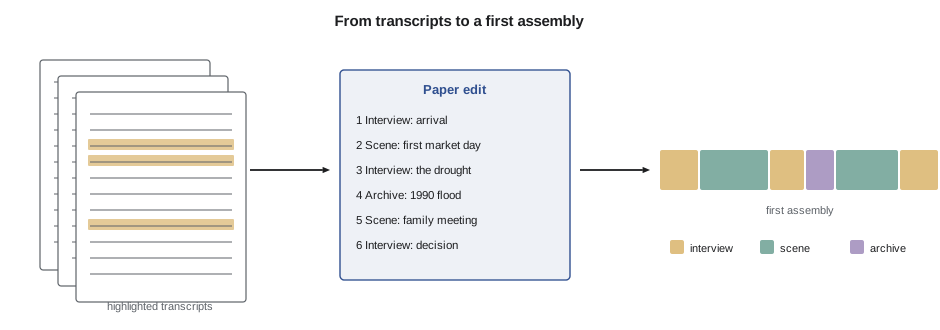
- Highlight strong passages in transcripts, coding them by theme or character.
- Arrange selected passages into a sequence that tells the story.
- Note where observational scenes, archive or graphics will carry the story without interview.
- Estimate running time using the speaking rate, then cut on the timeline.
String-outs and selects
On the timeline, editors often begin with string-outs: sequences that string together all the usable material on a topic, a character or a location. A string-out of every moment in which a family argues, for example, lets the editor see the full range before choosing. From string-outs, editors make selects sequences of the strongest moments. These become the raw material for scenes. On reality series, story producers often build string-outs to guide editors, who then craft the scenes.
Shaping interviews
Interviews in documentary are edited heavily. Answers are trimmed, hesitations removed and long thoughts condensed. Cuts within an answer are usually covered with B-roll, footage that illustrates what the speaker is describing, or with a cutaway to the interviewer or to another angle. When a cut stays visible, editors may use a jump cut, a short dissolve or a white flash to signal that time has been removed, a convention that some documentary traditions prefer because it is honest about the edit.
- Cover internal cuts with B-roll or cutaways where possible.
- Use multicamera interviews to cut between angles at edit points.
- Keep the speaker's meaning intact, even when condensing.
- Let strong moments play on camera; audiences trust faces.
Ethics of rearranging real words
Because editors can combine words from different moments, they can make a subject appear to say something they never said. A sentence built from fragments spoken at different times is sometimes called a frankenbite, a term from reality television. Many editors consider small condensations acceptable when they preserve meaning, but combining words to change meaning, or placing a reaction after a question it was not responding to, can mislead audiences and harm subjects. Broadcasters and journalistic organizations have standards on this, and documentary editors share a strong professional ethic.
| Edit | Usually considered | Why |
|---|---|---|
| Removing ums and repeated words | Acceptable | Preserves meaning, improves clarity |
| Condensing a long answer | Generally acceptable if meaning is kept | Common practice; check with the subject's intent |
| Moving a reaction to a different question | Problematic | Changes what the subject appears to respond to |
| Combining fragments into a new sentence | Problematic unless meaning is preserved and minimal | Risk of putting words in someone's mouth |
| Reordering events to change cause and effect | Misleading | Distorts the factual record |
The Kuleshov principle from lesson 2 applies with extra force here. In fiction, placing a reaction after a different line shapes a performance. In documentary, the same edit can misrepresent a real person. A useful test is to ask whether the subject, seeing the cut, would recognize it as a fair representation of what they meant.
Archive and rights
Many documentaries use archive footage, photographs and news clips. Each item must be cleared for use, which means obtaining permission from the rights holder and paying a license fee, unless an exception in copyright law applies. Editors track every archive clip used, with its source and duration, so the production can clear it. Rules differ between countries.
In the United States, copyright law includes the fair use doctrine, which courts assess using four factors, including the purpose of the use and its effect on the market. Documentary filmmakers' organizations have published best-practice statements on fair use, but productions usually rely on legal advice and errors and omissions insurance, and most archive is licensed.
Worked problem
Counting archive costs
A rough cut uses 47 archive clips with a total duration of 6 minutes 30 seconds. One archive charges an illustrative license of 60 dollars per second for worldwide rights. If 4 minutes of the archive come from that source, what is the license cost, and how much would trimming those clips by 25 percent save?
Show solution
- Seconds from that source: \( 4 \times 60 = 240 \).
- Cost: \( 240 \times 60 = 14\,400 \) dollars.
- Trimming by 25 percent saves \( 0.25 \times 14\,400 = 3\,600 \) dollars.
Answer: About 14,400 dollars, with 3,600 dollars saved by trimming. Rates vary widely by archive, territory and term; the numbers here are illustrative. Archive budgets often force editors to shorten clips or find alternatives.
Finding the story
The deepest skill in unscripted editing is finding the story. Editors watch for character arcs, conflicts, turning points and moments of revelation. They often discover that the story the production set out to tell is not the strongest one in the footage. A good working relationship with the director, who knows the subjects and the context, is essential. Many documentary editors build multiple rough versions, each testing a different spine, before committing to one.
- Identify the central question the film asks and answers.
- Find characters whose changes carry the story.
- Look for scenes with tension and stakes, not just information.
- Use interviews to connect and explain, but let scenes carry emotion.
Narration and title cards
Documentaries use several devices to supply information that interviews and scenes cannot. Narration can be written and recorded late in the edit once the structure is known, which gives the editor flexibility. Title cards can state dates, places and facts briefly and neutrally. Graphics and maps can explain complex processes or geography. Each device changes the film's voice: narration feels authoritative and guiding, title cards feel restrained, and a film with no narration at all asks the audience to infer more. Editors and directors choose the balance that suits the subject and the film's relationship with its audience.
Working with subjects and directors
In documentary the editor rarely meets the subjects, while the director may have spent months or years with them. That distance can be an advantage: the editor sees only what is on screen, as the audience will, and can tell when a moment the director treasures does not play. It can also be a risk, because the editor may misread context that the director understands. Good documentary partnerships combine the director's knowledge with the editor's fresh eyes, and many editors ask directors to watch rough cuts specifically for accuracy and fairness to subjects.
Reality television workflows
Reality series run on industrial schedules. Story producers review footage and write story outlines; assistant editors organize and sync multicamera material; editors cut scenes and acts to tight deadlines; and supervising editors maintain consistency across episodes. Because footage volumes are huge and schedules short, clear logs and searchable transcripts are essential. Ethical questions about frankenbites and misleading reactions are especially pressing in this genre, and many networks have standards for how real people may be portrayed.
Common mistakes
MistakeStarting to cut before organizing the material
InsteadLog, transcribe and build string-outs before assembling scenes
MistakeRelying on uncorrected automatic transcripts
InsteadCheck names, terms and accents before using transcripts for structure
MistakeCombining words in ways that change meaning
InsteadCondense only when the subject's meaning is preserved
MistakeForgetting to track archive use
InsteadLog every clip with source and duration for clearance
MistakeHolding on to the planned story
InsteadLet the footage reveal the strongest story and test alternatives
Summary and key terms
- Unscripted projects have high shooting ratios and large storage needs.
- Logs and transcripts make large volumes of footage searchable.
- Paper edits test structure in text before cutting media.
- String-outs and selects organize material by topic or character.
- Interviews are condensed and covered with B-roll or cutaways.
- Editors must preserve the meaning of real people's words.
- Archive must be logged and cleared; exceptions in copyright law vary by country.
- Paper edit
- A written plan of a film assembled from transcripts and logs
- Transcript
- A written record of spoken words with timecodes
- Log
- A description of each clip's content and timecodes
- String-out
- A sequence of all usable material on one topic or character
- B-roll
- Supporting footage that illustrates or covers interview
- Frankenbite
- A sentence built from words spoken at different times
- Story producer
- A reality television role that shapes story from footage
- Archive clearance
- Obtaining permission to use footage owned by others
- Fair dealing or fair use
- Copyright exceptions that allow some uses without permission
- Errors and omissions insurance
- Insurance against claims arising from content, such as rights issues
Practice problems
Work each problem on paper first, then reveal the answer to check.
120 hours of footage produce a 60-minute film. What is the ratio?
Show answer
120:1.
How many GB per hour does ProRes Proxy at about 36 Mb/s use?
Show answer
About 16.2 GB.
How many words are in 10 hours of interview at 110 words per minute?
Show answer
66,000 words.
What is a string-out?
Show answer
A sequence collecting all usable material on one topic or character.
Why cover internal interview cuts with B-roll?
Show answer
To hide jumps in picture while keeping the condensed answer.
What test helps judge whether an interview edit is fair?
Show answer
Ask whether the subject would recognize it as fair to their meaning.
At an illustrative 50 dollars per second, what does 90 seconds of archive cost?
Show answer
4,500 dollars.
How much storage do 50 hours of ProRes 422 HQ at 23.976 fps 1080p need?
Show answer
About 50 times 79 GB, about 4 TB.
What does a paper edit allow?
Show answer
Fast testing of structure before cutting media.
Why build several rough versions in documentary?
Show answer
To test different spines before committing.
Lesson quiz · 5 questions
Score 60% or more to complete this lesson.
Create a free account to save your progress, take quizzes and earn a certificate.