
FILM-220 · Lesson 2 of 12 · 33 min
Editing theory in practice
Every cut is a small argument about meaning. When one shot follows another, the audience connects them, and the connection can be smooth or jarring, obvious or surprising. Film editors have argued about how cuts work for more than a century. In FILM-101 you met the two great traditions: the continuity system, which hides cuts so the story flows, and montage, which makes cuts visible so the collision of images creates ideas. This lesson takes those theories into the cutting room. Instead of asking only what the theorists said, we ask how working editors use their ideas to decide where to cut, which shot to use and what the audience should feel at each moment. By the end you should be able to explain a cut decision in terms a director, a producer or a fellow editor will recognize.
The Kuleshov effect in the cutting room
In the early 1920s the Soviet filmmaker Lev Kuleshov ran experiments that suggested audiences read emotion into a neutral face depending on the shot placed next to it. Accounts of the original experiment vary, and later researchers have debated how strong the effect is, but the principle matters every day in editing: meaning comes from juxtaposition. A shot does not have one fixed meaning; its meaning depends on context.
Editors use this constantly. A reaction shot recorded during one moment of a scene can be placed after a different line, and it will appear to react to that line. A character's blank stare can read as grief, guilt or desire depending on what precedes it. This power carries responsibility, especially in documentary, which lesson 8 discusses. In fiction it is one of the editor's most useful tools for rescuing a scene or strengthening a performance.
Worked problem
Building meaning from a neutral reaction
You have a close-up of an actor looking off screen with an unreadable expression, held for four seconds. Describe three edits that would make the same shot mean three different things.
Show solution
- Precede it with a shot of an empty chair at a funeral: the look reads as grief.
- Precede it with a shot of a police car pulling up outside: the look reads as fear or guilt.
- Precede it with a shot of another character laughing across a room: the look reads as attraction or envy.
Answer: The same four seconds of performance can carry three different emotions depending on the preceding image. Editors exploit this to shape performance, but they must keep the result truthful to the story and to the actor's work.
Eisenstein's montage as a toolkit
Sergei Eisenstein argued that meaning arises from the collision of shots, not their smooth linking. He described several kinds of montage, which editors still find useful as a vocabulary even when cutting conventional fiction.
| Method | Basis of the cut | Modern example |
|---|---|---|
| Metric | Shot lengths set by a fixed count, regardless of content | A trailer cut exactly to music bars |
| Rhythmic | Length shaped by movement and content within shots | A chase where cuts follow motion |
| Tonal | Emotional tone of shots, such as light, mood or shape | A sequence that darkens steadily as a crisis builds |
| Overtonal | Combination of metric, rhythmic and tonal effects | Complex climactic sequences |
| Intellectual | Juxtaposition that creates an abstract idea | Cutting from a politician's speech to a flock of sheep, implying a comparison |
Few narrative editors cut in the overt intellectual style Eisenstein championed, because it draws attention to the editor. But rhythmic and tonal montage are everywhere: in music videos, sports highlights, title sequences and the emotional build of a film's final act. Lesson 7 returns to montage sequences in detail.
Worked problem
Cutting a metric sequence to music
A 20-second promo is cut to a track at 120 beats per minute in 4/4 time. The director wants one cut per bar. How many shots are needed, and how many frames long is each at 24 fps?
Show solution
- At 120 beats per minute, one beat lasts \( 60 / 120 = 0.5 \) seconds, so one bar of four beats lasts 2 seconds.
- Number of bars in 20 seconds: \( 20 / 2 = 10 \), so 10 shots.
- Each shot is \( 2 \times 24 = 48 \) frames.
Answer: Ten shots of 48 frames each. This is pure metric montage: the content of each shot does not change its length. In practice editors often shift cuts a frame or two earlier than the beat so the cut feels on the beat, because viewers perceive the change slightly after it happens.
The continuity system as working rules
The classical continuity system developed in the studio era to make cuts invisible. Its aim is that the audience follows the story without noticing the editing. Its main tools are the 180-degree rule, eyeline matches, match on action, shot-reverse-shot and establishing shots. You met these in FILM-101; lesson 4 shows how to apply them with real coverage. Here the important idea is why they work. Continuity editing respects the audience's sense of space and time. When spatial relationships stay stable and actions carry across cuts, the brain fills the gap and accepts the edited world as continuous.
Continuity is not a set of laws. Editors break it deliberately to disorient, to signal a change of state or to create energy. The point is to break it on purpose, not by accident.
Bazin and the case against cutting
Not every theory celebrates the cut. The French critic André Bazin argued that the long take and deep-focus composition respect the ambiguity of reality, letting the viewer choose where to look rather than having the editor choose for them. He admired directors who held shots and staged action in depth. For editors this is a useful counterweight. Sometimes the best edit is no edit: a scene that plays in one sustained shot can carry a tension that cutting would release. When a director has shot a scene as a long take with a safety coverage pass, the editor must decide whether the cut version is genuinely better or merely more conventional. The answer often depends on whether the performances hold up across the full take and whether the scene's rhythm demands a change of view.
- Favor the long take when the scene depends on real time, sustained tension or the relationship between characters in one space.
- Favor cutting when the scene needs emphasis, compression of time or control over what the viewer notices.
- Test both versions when coverage allows, and watch each at full speed before deciding.
Murch's rule of six
The editor Walter Murch, in his book In the Blink of an Eye, proposed a ranking of six criteria for an ideal cut. He suggested that a cut should satisfy all six, but when it cannot, the higher criteria matter more than the lower ones. The percentages he attached were deliberately approximate, meant to show priority rather than precise weighting.
| Rank | Criterion | Approximate weight | Question to ask |
|---|---|---|---|
| 1 | Emotion | 51 % | Does the cut serve what the audience should feel now? |
| 2 | Story | 23 % | Does it advance the story? |
| 3 | Rhythm | 10 % | Does it happen at a moment that feels rhythmically right? |
| 4 | Eye trace | 7 % | Is the audience's eye in the right place on screen across the cut? |
| 5 | Two-dimensional plane of screen | 5 % | Is screen direction and the line of action respected? |
| 6 | Three-dimensional space | 4 % | Are physical positions and continuity consistent? |
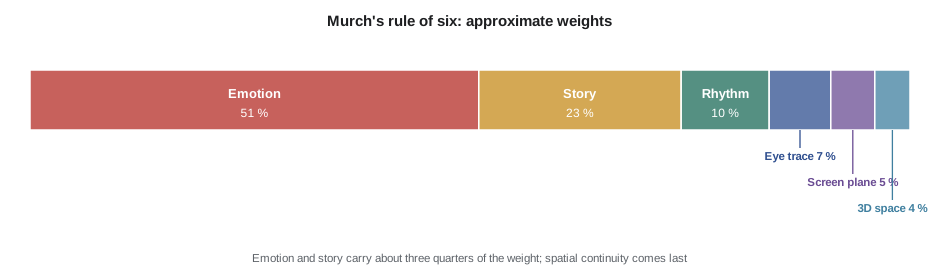
The striking point is that emotion and story together account for about three quarters of the weight, while the technical continuity concerns that beginners worry about most come last. Audiences forgive a glass that jumps from left hand to right hand if the moment is emotionally gripping; they will not forgive a technically perfect cut that kills the emotion.
Worked problem
Choosing between two cut points
In a farewell scene, take 4 has a perfect hand-position match with the wide shot but a flat performance on the key line. Take 7 has a mismatch: the actor's hand is on the table in the wide but near her face in the close-up. Take 7's performance is the most moving. Using Murch's ranking, which do you choose?
Show solution
- Score the options against the top criteria first. Take 7 wins on emotion (51 %) and story (23 %).
- Take 4 wins only on three-dimensional continuity (4 %).
- Consider whether the mismatch can be hidden: cut during movement, or cut to the close-up after the hand begins to move.
Answer: Choose take 7. Its emotional truth outweighs the continuity error, which most viewers will not notice, especially if you cut on movement. This is the practical lesson of the rule of six.
Eye trace across the cut
Eye trace means where the viewer's eye is looking on the screen at the moment of the cut. If the important subject jumps from the far left of one frame to the far right of the next, the viewer must search, and the cut feels rough. If the subject in the incoming shot sits roughly where the eye already was, the cut feels smooth. Editors watch where they are looking and place cuts accordingly.
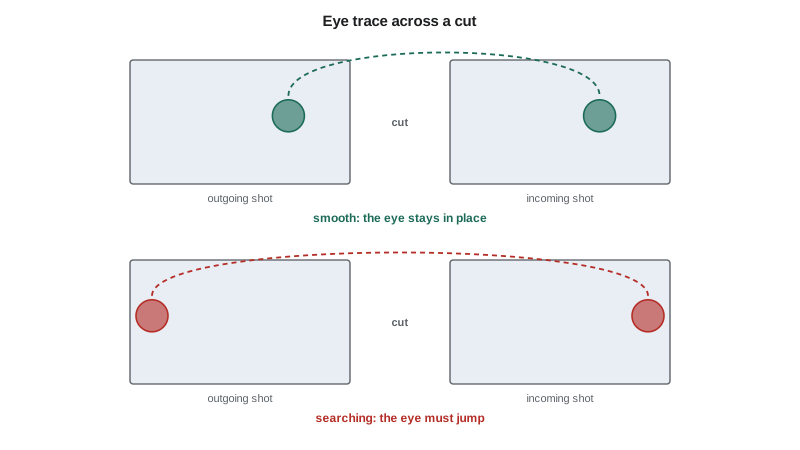
In fast action, editors sometimes break eye trace deliberately to create jolts. In quiet drama, they usually respect it so the audience stays inside the emotion. Screen size matters too: a jump that feels gentle on a phone can feel large on a cinema screen, where the eye must physically travel farther. Editors who know their film will play theatrically often check key cuts on a large monitor or projector.
Blinks and the timing of cuts
Murch also suggested that good cut points often coincide with moments when a character, or the viewer, would naturally blink: when a thought completes and attention shifts. Whether or not the blink theory is literally true, it points to a useful practice. Cut when the meaning of a shot has been absorbed and attention is ready to move, not before and not long after. That moment differs for each shot and each audience, which is why editing is felt as much as calculated.
Worked problem
How many frames is half a second?
You want to extend a reaction shot by about half a second. How many frames is that at 24 fps, at 25 fps and at 29.97 fps?
Show solution
- At 24 fps: \( 0.5 \times 24 = 12 \) frames.
- At 25 fps: \( 0.5 \times 25 = 12.5 \), so 12 or 13 frames.
- At 29.97 fps: \( 0.5 \times 29.97 \approx 15 \) frames.
Answer: About 12, 12 to 13, and 15 frames. Editors think in frames because a difference of two or three frames can change how a cut feels.
Invisible and visible editing styles
Every film sits somewhere on a spectrum from invisible to visible editing. Classical drama favors invisibility. Music videos, some thrillers and much experimental work favor visibility, with jump cuts, flash frames and rapid montage. Neither is better; the right choice depends on the film's genre, tone and point of view. A useful exercise is to watch a scene with the sound off and count the cuts you notice. In invisible editing you notice few, even if there are many. In visible editing the cuts become part of the experience.
- Invisible style: continuity rules, matched action, motivated cuts, smooth eye trace.
- Visible style: jump cuts, discontinuity, graphic collisions, rhythmic cutting to music.
- Mixed style: most contemporary films stay invisible most of the time and become visible at key moments for effect.
A well-known example of visible editing used inside an otherwise classical film is the jump cut in the French New Wave. In one celebrated film of that movement, the director cut out pieces of continuous shots of a couple talking in a car, so the background jumped while the conversation continued. Critics have described the effect as restless and modern. The same technique, used today in online video to remove pauses from a presenter's speech, has become so common that many viewers no longer notice it, which shows how visible techniques can become invisible through familiarity.
From theory to a working method
Editors rarely think in theoretical terms while cutting. Instead, theory becomes instinct. A practical method that draws on all these ideas is to ask, for every cut: what should the audience feel here, what do they need to know, where is their eye, and is the timing right? If the answers are clear, the cut usually works. If a cut feels wrong but you cannot see why, check these questions in Murch's order, starting with emotion.
- Watch the scene down without stopping before you judge any cut.
- Mark cuts that jolt you and ask whether the jolt is intended.
- Try the alternative take or a different cut point, then compare at full speed.
- Trust the full-speed viewing over frame-by-frame analysis; audiences watch at full speed.
Being able to explain a choice also matters professionally. Directors and producers give notes in emotional language, such as "this drags" or "I don't believe her here." Translating a note into editing terms, such as rhythm, choice of take or eye trace, helps you find the fix. Lesson 12 returns to the notes process.
Common mistakes
MistakeThinking a shot has one fixed meaning
InsteadRemember that juxtaposition changes meaning, as the Kuleshov principle shows
MistakePrioritizing perfect continuity over emotion
InsteadRank emotion and story above spatial matching, following Murch's priorities
MistakeTreating continuity rules as laws
InsteadUse continuity to keep the audience oriented and break it deliberately when the story benefits
MistakeIgnoring where the viewer's eye is at the cut
InsteadPlace the incoming subject near the outgoing point of interest unless a jolt is intended
MistakeJudging cuts only frame by frame
InsteadWatch at full speed, because that is how audiences experience the edit
Summary and key terms
- Juxtaposition creates meaning; the same shot reads differently in different contexts.
- Eisenstein's metric, rhythmic, tonal, overtonal and intellectual montage give editors a vocabulary for rhythm and collision.
- The continuity system keeps space and time coherent so cuts feel invisible, while Bazin reminds editors that a long take can be stronger than a cut.
- Murch's rule of six ranks emotion, story, rhythm, eye trace, screen plane and three-dimensional space.
- Eye trace makes cuts smooth when the point of interest stays in a similar place.
- Good cuts often come when the meaning of a shot has been absorbed.
- Editing styles range from invisible to visible, chosen to suit the film.
- Kuleshov effect
- Viewers read meaning into a shot from the shot placed beside it
- Montage
- Editing that builds meaning from the collision or accumulation of shots
- Metric montage
- Cutting to fixed lengths regardless of shot content
- Rhythmic montage
- Cutting shaped by movement and content within shots
- Rule of six
- Murch's ranking of emotion, story, rhythm, eye trace, screen plane and space
- Eye trace
- Where the viewer's eye is on screen at the moment of a cut
- Continuity system
- Rules that keep space and time coherent across cuts
- Invisible editing
- Cutting designed so the audience does not notice the cuts
- Jump cut
- A visible cut within continuous action that skips time
- Long take
- A sustained shot that plays a scene or action without cutting
Practice problems
Work each problem on paper first, then reveal the answer to check.
How many frames are in 0.75 seconds at 24 fps?
Show answer
\( 0.75 \times 24 = 18 \) frames.
According to Murch, which matters more, eye trace or emotion?
Show answer
Emotion, which ranks first; eye trace ranks fourth.
Give an example of tonal montage.
Show answer
A sequence where shots grow darker and quieter as a character's hope fades.
Why might an editor cut on movement?
Show answer
Movement draws attention and hides small continuity mismatches.
What does the Kuleshov principle imply about reaction shots?
Show answer
A reaction can be placed after a different line and appear to respond to it.
A track runs at 100 beats per minute in 4/4. How long is one bar?
Show answer
One beat is 0.6 s, so a bar is 2.4 s, or about 58 frames at 24 fps.
Why watch a scene at full speed before judging cuts?
Show answer
Audiences watch at full speed, and frame-by-frame review can mislead.
About what share of Murch's weighting do emotion and story carry together?
Show answer
About 74 %, roughly three quarters.
What did Bazin value that editors should remember?
Show answer
The long take and deep focus, which let viewers choose where to look.
How many frames is one second at 29.97 fps, rounded?
Show answer
About 30 frames.
Lesson quiz · 5 questions
Score 60% or more to complete this lesson.
Create a free account to save your progress, take quizzes and earn a certificate.