
FAT-210 · Lesson 7 of 12 · 19 min
Single-stage and two-stage systems
Eastview General Hospital doesn't evacuate when its fire alarm operates. Patients in intensive care, operating rooms and the birthing unit can't simply walk out, so the hospital's fire safety plan relies on staff moving patients horizontally away from the fire, behind fire separations, while the rest of the building stays put. The fire alarm is designed to support that plan, and it starts in a different way from the alarm in an office tower. Sasha spends a week at Eastview with Gerry and the hospital's own facilities team. 'In most buildings, any alarm means everybody leaves,' the facilities manager tells her. 'Here, the first signal tells staff to act. The second one, if it comes, is the one that says the building is in real trouble.' This lesson covers single-stage and staged systems, the timers and controls that make them work, and how the panel is programmed for each.
Single-stage systems
In a single-stage system, any alarm signal, from a detector, a pull station or a waterflow switch, operates the evacuation signal throughout the building at once. Everyone hears the same temporal-three signal and everyone leaves. Single-stage systems are simple, easy to understand and easy to test, and they are the normal arrangement for offices, schools, warehouses and apartment buildings of moderate height. Tamarind House, Willowbank School and Cartwright Distribution Center all use single-stage systems. The panel's programming is straightforward: every alarm input operates every notification circuit, plus the building's control functions.
Staged and staff-first responses in the US
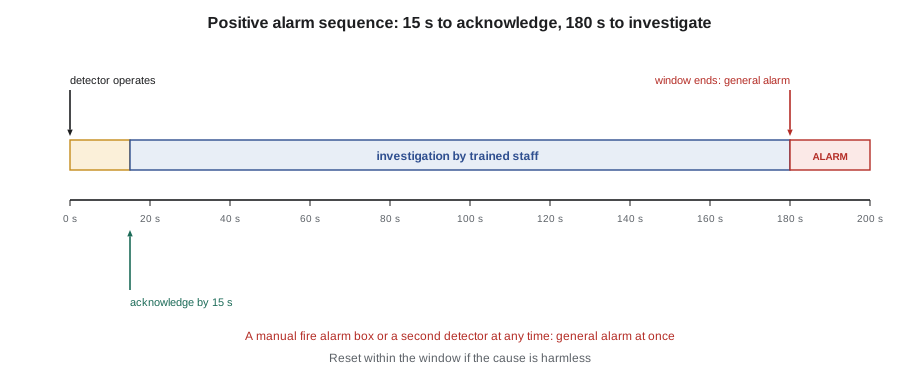
NFPA 72 offers two ways to put trained staff ahead of a general evacuation where the authority approves. Positive alarm sequence applies to automatic detectors: when one operates, the signal goes first to trained staff, who must acknowledge it within 15 seconds and then have up to 180 seconds to investigate and reset the system if the cause is harmless. If they don't acknowledge in time, if the investigation time runs out, or if a second automatic detector or any manual fire alarm box operates, the general alarm sounds at once. The presignal feature, used mainly in facilities with a constantly staffed control point, sends the initial signal only to staff and the general alarm requires a human action. Hospitals also use private-mode notification to staff areas under NFPA 101 and the approved fire plan.
At Eastview, positive alarm sequence is approved for the corridor and patient room smoke detectors on the inpatient floors, where nurses are always present. Manual fire alarm boxes and waterflow switches go straight to the general alarm, as NFPA 72 requires for manual boxes under positive alarm sequence, and the hospital's fire plan tells staff exactly who acknowledges and who investigates on each unit.
# Positive alarm sequence: acknowledge within 15 s, investigate up to 180 s (times in seconds)
ACK_LIMIT, INVESTIGATE = 15, 180
def run(events):
    log, acked = ["0 s: automatic detector operates -> signal to trained staff only"], None
    for t, what in events:
        if what == "acknowledge" and t <= ACK_LIMIT and acked is None:
            acked = t
            log.append(f"{t} s: staff acknowledge -> investigation time starts")
        elif what in ("second detector", "manual box"):
            log.append(f"{t} s: {what} -> general alarm immediately")
            return log
        elif what == "reset" and acked is not None and t <= INVESTIGATE:
            log.append(f"{t} s: cause found, system reset -> no general alarm")
            return log
    if acked is None:
        log.append(f"{ACK_LIMIT} s: not acknowledged -> general alarm")
    else:
        log.append(f"{INVESTIGATE} s: investigation time over -> general alarm")
    return log
for name, ev in [("Toast in a staff kitchen", [(8, "acknowledge"), (95, "reset")]),
                 ("Nobody answers", []),
                 ("Real fire", [(10, "acknowledge"), (70, "manual box")])]:
    print(name)
    for line in run(ev):
print(" ", line)Toast in a staff kitchen 0 s: automatic detector operates -> signal to trained staff only 8 s: staff acknowledge -> investigation time starts 95 s: cause found, system reset -> no general alarm Nobody answers 0 s: automatic detector operates -> signal to trained staff only 15 s: not acknowledged -> general alarm Real fire 0 s: automatic detector operates -> signal to trained staff only 10 s: staff acknowledge -> investigation time starts 70 s: manual box -> general alarm immediately
The three runs show the possible paths. When staff acknowledge and find a harmless cause, they reset the system and no general alarm sounds. When nobody acknowledges within 15 seconds, the general alarm sounds. When a person pulls a manual box during the investigation, the general alarm sounds at once, whatever the timer says.
Zones, floors and staged evacuation
Staging can also be about where, not just when. In a high-rise building such as Riverlight Tower, the evacuation strategy may sound the alarm on the fire floor, the floor above and the floor below first, and an alert or a different message on the other floors, so the stairs aren't overwhelmed and firefighters can work. This kind of staging is usually done with voice communication, which FAT-310 covers, but it relies on the same panel features: notification circuits divided by floor, programming that knows which floor each device is on, and controls for firefighters to extend the alarm to more floors or the whole building.
Whatever the staging, the panel's programming must handle the case where devices on more than one floor operate. A fire that spreads up a shaft, or smoke that travels through a corridor, can put detectors on several floors into alarm. The sequence of operations must say clearly what happens then, usually extending the alarm to every affected floor and the floors around them, and the acceptance test must include it.
Alarm verification versus staging
Two-stage systems and positive alarm sequence are sometimes confused with alarm verification, but they solve different problems. Alarm verification, described in FAT-120, is an automatic check on a single smoke detector: the panel resets the detector and confirms the signal before acting, which filters out momentary nuisance signals. It involves no people. Staging, in contrast, is about who hears the first signal and when people are called to act. A building can use both: verification on the smoke detectors to filter brief nuisance signals, and a staged response for confirmed signals. The programming must make sure the total delay before an alarm is within what the code allows, and verification is never applied to manual stations or waterflow switches.
| Feature | Who acts | Main purpose | Applies to |
|---|---|---|---|
| Alarm verification | Nobody; the panel | Filter brief smoke detector signals | Smoke detectors only |
| Positive alarm sequence | Trained staff | Investigate before evacuating | Automatic detectors only |
| Floor-by-floor staging | Panel and firefighters | Control who moves first in tall buildings | Notification by floor or zone |
| Cross-zoning | Nobody; the panel | Confirm before releasing suppression | Releasing systems |
Controls, keys and records
Staged systems depend on people doing the right thing at the right time, so the controls must be clear and the records complete. Acknowledge, general alarm and silence controls are labeled at the panel and every annunciator. Keys for second-stage stations are kept where the fire safety plan says, and the plan lists who is trained to use them. The panel's event history records each signal, each acknowledgment and each escalation with the time, so that after any event the hospital can see how long staff took to respond. Eastview's fire safety committee reviews these records after every alarm, and slow acknowledgments are followed up with training.
Because positive alarm sequence and presignal features depend on staff, the authority having jurisdiction must approve them and the fire department must know how they work. Captain Helen Strand of the fire marshal's office reviews Eastview's sequence each year with the hospital, and any change to the timing or the escalation controls goes through her office before it is programmed.
Programming and testing a staged system
In the panel, a staged response is built from timers, logic and output groups. The program defines which inputs start the first stage, which outputs the first stage operates, the timer that escalates automatically, the inputs and controls that escalate immediately, and what the second stage operates. It also defines what acknowledge does, whether it can be done from annunciators as well as the panel, and how the system returns to normal. Testing covers every path: the automatic escalation with no acknowledgment, the acknowledged and investigated path, immediate escalation from each second-stage control, and the case of a second device operating during the first stage. Each path is timed with a stopwatch and recorded.
Worked problem
An alert that turned into an alarm
At Eastview, a corridor smoke detector on the fourth floor operates at 02:14 under positive alarm sequence. The panel records acknowledge at 02:14:22 and the general alarm at 02:14:15. The night staff say they acknowledged as soon as they heard the signal. What happened?
Show solution
- The general alarm sounded 15 seconds after the first signal, which is the acknowledge limit working as designed.
- Acknowledgment came at 22 seconds, too late.
- The delay was in reaching the acknowledge control: the nursing station's annunciator had no acknowledge function, so staff had to walk to the floor's control point.
- The fix is to add acknowledgment at the nursing station annunciator, if the design and the authority allow it, and to review the night staffing.
Answer: The system worked exactly as programmed; the people's route to the control was the problem. Ravi designs an annunciator change for the nursing station, the authority approves it, and Sasha tests the new acknowledge control with a stopwatch before it goes into service.
Training and drills for staged systems
A staged system is only as good as the people who answer it. Staff on every shift need to know what the first signal sounds like, where the nearest acknowledge control is, who investigates, what they look for, how to escalate, and what to do if they find a fire. The fire safety plan sets this out, and fire drills, held at the frequency the fire code requires, test it with real people and a stopwatch. At Eastview, drills are run on every unit and every shift through the year, and the panel's event history from each drill is printed and reviewed with the unit's staff, so a slow acknowledgment becomes a lesson rather than a surprise.
Drills also test the system's programming in a way an acceptance test can't, because they show how the staging behaves in a building full of people. Staff sometimes find that an acknowledge control is behind a locked door at night, that the alert signal can't be heard in a noisy area, or that the escalation key is kept somewhere nobody can reach in time. Each finding goes back to the designer and the authority, because fixing it may mean a programming change, a new annunciator or a change to the plan. Bramwell's technicians attend Eastview's large drills so they can see these problems first-hand.
When a staged response is not allowed
Staging is never used to delay the response to a fire someone has already seen. That is why manual fire alarm boxes and waterflow switches go straight to the general alarm under positive alarm sequence, and why the acknowledge and investigation limits exist: the delay can last only as long as trained staff are actively responding. Buildings without staff present at all hours, or whose fire plans can't support an investigation, use single-stage systems. Where a building's use changes, for example when a hospital wing becomes offices, the design must be reviewed, because a staged response may no longer be appropriate.
Finally, any staged sequence is written so that the fire department can always override it. Arriving firefighters may want the whole building evacuated at once, whatever the first stage was doing, so the general alarm control at the main annunciator works at any time, in any stage, with one action. The test plan includes pressing it in the middle of each stage to prove it.
Common mistakes
MistakeTreating a staged first signal as a supervisory signal.
InsteadThe first stage is an alarm signal that starts a staged response.
MistakeAdding staging without the authority's approval.
InsteadStaged responses must be approved and in the fire safety plan.
MistakeApplying verification or staging delays to manual stations.
InsteadManual stations act at once as the code requires.
MistakeTesting only the normal path.
InsteadTest every path, including no acknowledgment and second devices.
MistakeLeaving staff without a nearby way to acknowledge.
InsteadPut acknowledge controls where staff can reach them in time.
Summary and key terms
- Single-stage systems sound the evacuation signal everywhere on any alarm.
- Positive alarm sequence gives staff 15 seconds to acknowledge and up to 180 seconds to investigate before the general alarm.
- A second detector or any manual fire alarm box sounds the general alarm at once.
- Floor-by-floor staging in tall buildings uses divided notification and firefighter controls.
- Alarm verification filters single detector signals; staging decides who acts first.
- Every staged path is programmed with timers and logic and tested with a stopwatch.
- Single-stage system
- A system in which any alarm sounds the evacuation signal throughout the building.
- Positive alarm sequence
- An approved delay that lets trained staff acknowledge and investigate an automatic detector signal.
- Acknowledge
- An action that tells the panel staff have seen the signal; in staged systems it stops an automatic escalation.
- Automatic transfer
- The panel moving from the first stage to the general alarm when a timer runs out.
- Staged evacuation
- Moving people floor by floor rather than all at once.
- Fire safety plan
- The building's approved plan for what staff and occupants do in a fire.
Practice problems
Work each problem on paper first, then reveal the answer to check.
A detector operates at 10:00:00 under positive alarm sequence and isn't acknowledged. When does the general alarm sound?
Show answer
At 10:00:15.
Staff acknowledge at 10:00:10. By when must they reset the system to avoid the general alarm?
Show answer
Within 180 seconds of the first signal, by 10:03:00.
What happens if a manual fire alarm box is pulled during the investigation?
Show answer
The general alarm sounds at once.
Which devices does positive alarm sequence apply to?
Show answer
Automatic fire detectors only.
Lesson quiz · 5 questions
Score 60% or more to complete this lesson.
Create a free account to save your progress, take quizzes and earn a certificate.