
ELEC-220 · Lesson 1 of 12 · 36 min
Feeders and services
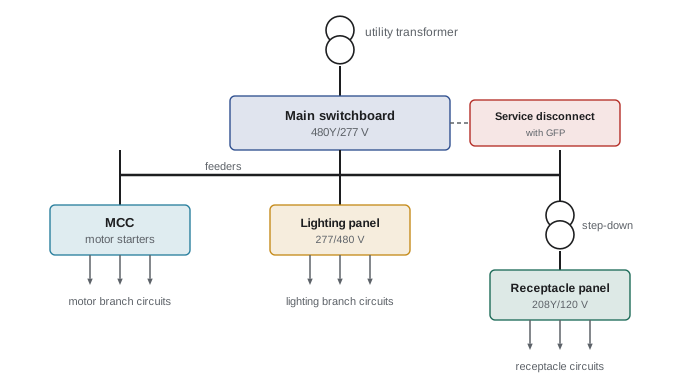
In residential work (ELEC-130), the electrician typically installs one service, one panel and a set of branch circuits. Commercial and industrial buildings are larger and more varied: a utility transformer or customer-owned substation feeds switchboards, which feed distribution panels, motor control centers and transformers through feeders, which in turn feed branch circuit panels throughout the building. This course applies the code to commercial and industrial installations. This first lesson covers calculating loads for non-dwelling occupancies, sizing services and feeders, continuous loads, voltage drop, neutral sizing, feeder taps, parallel conductors and service equipment requirements, including ground fault protection. The section at the end of this lesson shows how the twelve lessons fit together.
References in this course are to the 2023 edition of the National Electrical Code (NFPA 70), the edition most widely adopted in 2026. The 2026 edition, published in 2025, reorganized some provisions, so always check the edition and local amendments in force where you work.
The distribution system
A typical commercial or industrial distribution system includes:
- The service: the conductors and equipment that deliver energy from the utility to the building's wiring, ending at the service disconnecting means.
- Main switchboard or switchgear: the service disconnect, metering and overcurrent devices for the feeders.
- Feeders: circuit conductors between the service equipment (or a separately derived system) and the final branch circuit overcurrent devices.
- Distribution and branch circuit panelboards, motor control centers, and dry-type transformers that step down voltage for lighting and receptacles.
- Branch circuits: the conductors between the final overcurrent device and the outlets.
Common US commercial systems are 480Y/277 V three-phase four-wire, with 277 V lighting and 480 V motors, plus 208Y/120 V from step-down transformers for receptacles; smaller buildings use 208Y/120 V services directly. Industrial plants may take service at 4.16 kV, 13.2 kV or other medium voltages.
Calculated loads for non-dwelling occupancies
For occupancies other than dwellings, Article 220 sets the minimum calculated load. Part II requires a general lighting load based on floor area from Table 220.12 (for example, 1.3 VA/ft² for office buildings), plus receptacle loads at 180 VA per receptacle outlet (220.14(I)), with a minimum of 1 VA/ft² for receptacles in banks and offices where the number is not known (220.14(K)). Receptacle loads over 10 kVA may be reduced to 100% of the first 10 kVA plus 50% of the remainder (220.44). Motor, heating, air-conditioning and other loads are added at their actual ratings.
Worked problem
Office building service load
A new office building has 40,000 ft² of floor area. Using 1.3 VA/ft² for general lighting and 1 VA/ft² for receptacles, plus 180 kVA of air-conditioning and 60 kVA of other equipment, estimate the calculated load and the current on a 480 V three-phase service.
Show solution
- Lighting: \(40{,}000 \times 1.3 = 52{,}000\) VA. Receptacles: 40,000 VA; with 220.44: \(10{,}000 + 0.5 \times 30{,}000 = 25{,}000\) VA.
- Total: \(52 + 25 + 180 + 60 = 317\) kVA. Lighting is continuous, so for service conductors add 25% of it: \(+13\) kVA, giving 330 kVA.
- Current: \(330{,}000/(\sqrt3 \times 480) = 397\) A.
Answer: About 397 A, so a 400 A service would be the minimum and 600 A would usually be chosen to allow for growth. Office lighting loads calculated this way are generous compared with modern LED lighting; energy codes limit installed lighting power to well below the Table 220.12 values.
Continuous loads
A continuous load is one where the maximum current is expected to continue for three hours or more, such as lighting in a store, office HVAC or a data center load. Because overcurrent devices and their terminations heat up under sustained current, the code limits their continuous loading:
215.2(A)(1) and 215.3 require feeder conductors and overcurrent devices to be rated at least 100% of the noncontinuous load plus 125% of the continuous load, unless the assembly including the overcurrent device is listed for operation at 100% of its rating. The same rule applies to services (230.42) and branch circuits (210.19 and 210.20).
Worked problem
Feeder for a continuous load
A feeder supplies a continuous lighting load of 120 A and a noncontinuous load of 40 A. What is the minimum overcurrent device rating for standard equipment and for an assembly listed for 100% operation?
Show solution
- Standard: \(1.25 \times 120 + 40 = 190\) A, so the next standard size is 200 A.
- 100% rated: \(120 + 40 = 160\) A, so a 175 A device (or 200 A).
Answer: A 200 A standard device, or a 175 A device rated for 100% continuous operation. Conductors must have ampacity at least equal to the calculated load (190 A or 160 A), checked at the terminal temperature rating, and protected by the chosen device. 100%-rated breakers are mainly available in larger frame sizes and cost more, but save conductor and equipment size for large continuous loads such as data centers.
Voltage drop
Conductors that are adequate for heating may still cause excessive voltage drop on long feeders, starving motors and lighting of voltage. For a three-phase circuit:
where \(R_L\) is the resistance of the conductor length (ohms per unit length times one-way length).
The NEC recommends, in informational notes to 210.19 and 215.2, a maximum voltage drop of 3% in a feeder or branch circuit and 5% overall; these notes are not mandatory in most cases, but energy codes and specifications often make them so, and voltage drop limits are mandatory for some systems such as fire pumps.
Worked problem
Voltage drop on a long feeder
A 480 V three-phase feeder carries 150 A over 400 ft using 3/0 AWG copper (resistance 0.0801 Ω per 1000 ft). Estimate the voltage drop and check it against 3%.
Show solution
- \(R_L = 0.0801 \times 0.4 = 0.0320\ \Omega\).
- \(V_{drop} = \sqrt3 \times 150 \times 0.0320 = 8.3\) V \(= 1.7\%\) of 480 V.
Answer: About 8 V, or 1.7%, within 3%. At 208 V the same current and length would be a 4% drop, which is one reason large buildings distribute at 480 V and step down near the loads.
Neutral sizing and harmonics
In a three-phase four-wire system with balanced linear loads, the neutral carries little current, and the code allows the neutral to be sized for the maximum unbalanced load, with a demand reduction for the portion above a threshold. However, nonlinear loads such as LED drivers, computer power supplies and variable-frequency drives produce triplen harmonic currents (3rd, 9th, ...) that add in the neutral rather than canceling (ELEC-210), so the neutral may carry more current than the phases.
220.61 permits the feeder or service neutral load to be the maximum unbalance, with a 70% demand factor on the portion above 200 A, but not for the portion consisting of nonlinear loads supplied from a 4-wire wye system. 310.15(E) requires the neutral to be counted as a current-carrying conductor when a major portion of the load is nonlinear.
Worked problem
Neutral current from triplen harmonics
A 208Y/120 V panel feeds computer loads on all three phases, each drawing 100 A rms with a third harmonic component of 60 A. Estimate the neutral current.
Show solution
- Fundamental currents cancel in the neutral when balanced.
- Third harmonic currents are in phase on all three phases and add: \(3 \times 60 = 180\) A.
Answer: The neutral carries about 180 A, 1.8 times the phase current. Panels and feeders serving large nonlinear loads use full-size or double-size neutrals, and K-rated or harmonic-mitigating transformers feed them.
Feeder taps
A tap is a conductor with an ampacity smaller than the rating of the overcurrent device protecting the feeder it connects to. The code permits short taps without overcurrent protection at the point of connection, provided they are short, protected from damage and end at an overcurrent device:
240.21(B) allows feeder taps without overcurrent protection at the tap point, including the 10 ft tap rule (ampacity not less than the combined calculated load and not less than the rating of the device it supplies, and not less than one-tenth of the feeder overcurrent device rating for field installations leaving the enclosure) and the 25 ft tap rule (ampacity at least one-third of the feeder overcurrent device rating, terminating in a single overcurrent device, protected from physical damage). Further rules cover taps supplying transformers and high-bay manufacturing buildings.
Worked problem
A 25 ft (7.5 m) tap
A feeder protected at 600 A is tapped to supply a panel with a 200 A main breaker, 6 m (20 ft) away. What is the minimum tap conductor ampacity under the longer-tap rule?
Show solution
- One-third of 600 A \(= 200\) A.
- The tap must also be at least the rating of the overcurrent device it terminates in (200 A) and the calculated load.
Answer: At least 200 A, terminating in the 200 A main breaker, run in a raceway or otherwise protected from damage. If the panel were 40 m away, a tap rule could not be used, and the feeder to it would need its own 200 A overcurrent device at the switchboard.
Parallel conductors
Large feeders and services carry currents too large for a single conductor per phase, so several conductors are run in parallel. To share current equally they must be the same length, conductor material, size, insulation type and termination, and each parallel set in separate raceways must contain all phases and the neutral, to avoid induced heating in metal raceways.
310.10(G) permits conductors of size 1/0 AWG and larger to be run in parallel under these conditions, and 250.122(F) requires a full-size equipment grounding conductor in each parallel raceway.
Worked problem
Parallel sets for a service
A 1200 A, 480 V service uses 500 kcmil copper conductors with a 75 °C ampacity of 380 A each (Table 310.16). How many parallel sets are needed? Assume no derating.
Show solution
- \(1200/380 = 3.16\), so 4 sets (4 × 380 = 1520 A).
- With 3 sets: \(3 \times 380 = 1140\) A, less than the 1200 A rating, so three sets are not enough.
Answer: Four sets of 500 kcmil (or three sets of 600 kcmil, 420 A each, giving 1260 A). Each set runs in its own conduit with all phase conductors and the neutral, all of identical length.
Service equipment and ground fault protection
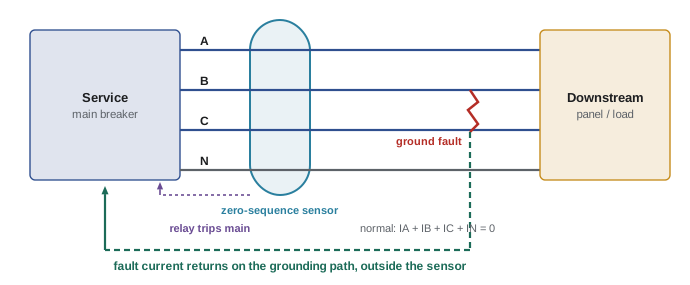
Large solidly grounded wye services can have arcing ground faults that draw too little current to trip the service overcurrent device quickly but release enough energy to destroy switchgear and start fires. Ground fault protection (GFP) senses the vector sum of the phase and neutral currents and trips the service disconnect when ground fault current exceeds its setting.
230.95 requires ground fault protection of equipment for each service disconnect rated 1000 A or more on a solidly grounded wye system with more than 150 V to ground but not more than 600 V phase-to-phase (such as 480Y/277 V), with a maximum setting of 1200 A and a maximum time of 1 s for currents of 3000 A or more. Fire pump services and continuous industrial processes where a shutdown would be more hazardous are exempt. 215.10 requires similar protection for large feeders in some cases, and 240.87 requires arc energy reduction (such as zone-selective interlocking or energy-reducing maintenance switches) for breakers rated or adjustable to 1200 A or more.
Service equipment must also be rated for the available fault current at its line terminals, marked with that value, and installed with the required working space in front of it (ELEC-130). In large services, the utility's available fault current can exceed 50 kA, requiring equipment and series ratings chosen accordingly.
How this course is organized
The twelve lessons cover the code requirements that set commercial and industrial work apart:
- Lesson 1 (this lesson): loads, feeders, services, voltage drop, taps, parallel conductors and ground fault protection.
- Lesson 2: wiring methods: raceways, cables, conduit and box fill, cable trays, busways and firestopping.
- Lesson 3: motor circuits, protection, disconnects, controls and drives.
- Lesson 4: overcurrent protection, available fault current, equipment ratings, transformers and arc flash.
- Lesson 5: hazardous locations.
- Lesson 6: grounding and bonding in commercial and industrial systems.
- Lesson 7: special occupancies and equipment: health care, pools, EV charging, solar and storage, fire pumps and IT rooms.
- Lesson 8: industrial control panels, machine safety and lockout.
- Lesson 9: emergency and standby power systems.
- Lesson 10: fire alarm, communication and low-energy systems.
- Lesson 11: commercial lighting, controls and energy codes.
- Lesson 12: permits, inspection, testing and a commercial design project.
Common mistakes
MistakeSizing feeders for continuous loads at 100% with standard equipment.
InsteadUse 125% of the continuous load unless the assembly is rated for 100% continuous operation.
MistakeIgnoring voltage drop on long feeders.
InsteadCheck the 3% feeder and 5% total limits, and upsize conductors or raise voltage.
MistakeReducing the neutral for nonlinear loads.
InsteadSize neutrals fully, or larger, where triplen harmonics are present.
MistakeRunning parallel sets with different lengths or splitting phases between raceways.
InsteadKeep sets identical and each raceway complete with all phases and neutral.
MistakeOmitting GFP on large wye services.
InsteadProvide GFP under 230.95 for 1000 A and larger services on 480Y/277 V systems.
Summary and key terms
- Commercial systems distribute from the service through switchboards and feeders to panels and branch circuits.
- Article 220 gives lighting loads per square foot, receptacle loads and demand factors for non-dwelling occupancies.
- Feeders and services are sized at 125% of continuous load plus noncontinuous load unless 100%-rated.
- Voltage drop should not exceed 3% in a feeder or branch circuit and 5% overall.
- Triplen harmonics add in the neutral; neutrals for nonlinear loads must not be reduced.
- Feeder tap rules allow short unprotected taps under strict length and ampacity conditions.
- Parallel conductors (1/0 and larger) must be identical, with complete sets in each raceway.
- Services of 1000 A and more on solidly grounded wye systems above 150 V to ground need ground fault protection.
- Service
- The conductors and equipment delivering energy from the supply authority to the premises wiring.
- Feeder
- Conductors between the service equipment and final branch circuit overcurrent devices.
- Calculated load
- The minimum load determined by code rules for sizing services and feeders.
- Continuous load
- A load whose maximum current continues for three hours or more.
- Demand factor
- The ratio of maximum demand to connected load.
- Voltage drop
- The reduction in voltage along conductors due to their impedance.
- Nonlinear load
- A load drawing non-sinusoidal current, producing harmonics.
- Tap conductor
- A conductor smaller than the feeder overcurrent device rating, connected without protection at the tap point.
- Parallel conductors
- Two or more conductors electrically joined at both ends to act as one.
- Ground fault protection
- A system that opens a disconnect when ground fault current exceeds a setting.
Practice problems
Work each problem on paper first, then reveal the answer to check.
An office of 25,000 ft² at 1.3 VA/ft² lighting. Lighting load?
Show answer
32.5 kVA.
Calculated load of 300 kVA at 480 V three-phase. Current?
Show answer
361 A.
Continuous load 80 A plus noncontinuous 30 A, standard equipment. Minimum overcurrent device?
Show answer
1.25 × 80 + 30 = 130 A; next standard size 150 A.
Why are some breakers rated for 100% continuous operation?
Show answer
They and their enclosures are tested to carry rated current continuously without overheating, saving the 125% factor.
A 208 V three-phase feeder carries 100 A over a conductor resistance of 0.04 Ω. Voltage drop and percent?
Show answer
√3 × 100 × 0.04 = 6.9 V = 3.3%.
Phase currents of 50 A each with 25 A of third harmonic. Neutral current?
Show answer
75 A.
Feeder protected at 400 A; tap of 6 m to a single breaker. Minimum tap ampacity?
Show answer
One-third of 400 A = 133 A (and at least the load and the terminating device rating).
Smallest conductor size permitted in parallel?
Show answer
1/0 AWG.
Why must each parallel raceway contain all phases and the neutral?
Show answer
To cancel magnetic fields; otherwise induced currents heat metal raceways and enclosures.
A 1200 A, 480Y/277 V service. Is GFP required?
Show answer
Yes: rated 1000 A or more, solidly grounded wye, more than 150 V to ground.
Lesson quiz · 5 questions
Score 60% or more to complete this lesson.
Create a free account to save your progress, take quizzes and earn a certificate.