
ELE-499 · Lesson 3 of 12 · 22 min
Concept generation and trade studies
With the requirements baselined, the team faced the question every design project reaches early: what kind of system should this be? There are many ways to combine solar panels, a battery and chargers on a site with a limited grid connection. The danger at this stage is to fall in love with the first idea. This lesson covers how Leo's team generated a range of concepts, screened them, compared the survivors in a weighted decision matrix, tested how robust the choice was, and recorded the decision so that reviewers could see how it was made.
Generating concepts
The team began with a functional decomposition. Rather than listing hardware, they listed what the system must do: collect solar energy, store energy, draw energy from the grid without exceeding the limit, deliver energy to vehicles at the right rate, prevent export, keep a storm reserve, report status, and protect people and equipment. For each function they brainstormed several ways to do it, and arranged the options in a morphological chart, a table with functions as rows and means as columns. A concept is one choice from each row.
Brainstorming works best with simple rules: generate many ideas before judging any, build on each other's ideas, include some that seem unlikely, and write everything down. The team's chart had six to eight options per function, including some that were quickly discarded, such as a diesel generator for storm backup (it fails the client's sustainability goal), a hydrogen fuel cell (far too costly at this scale) and a mechanical flywheel (too little energy for the storm reserve). Recording discarded options matters, because reviewers will ask whether they were considered.
Screening
Combining options from the chart gave dozens of possible concepts, too many to analyze in depth. The team screened them against go or no-go criteria taken directly from the requirements: could the concept meet R2's grid limit and R4's storm reserve at all, and could it be built and certified for the site? Concepts that failed any must-have criterion were dropped, which left three distinct architectures worth comparing in detail.
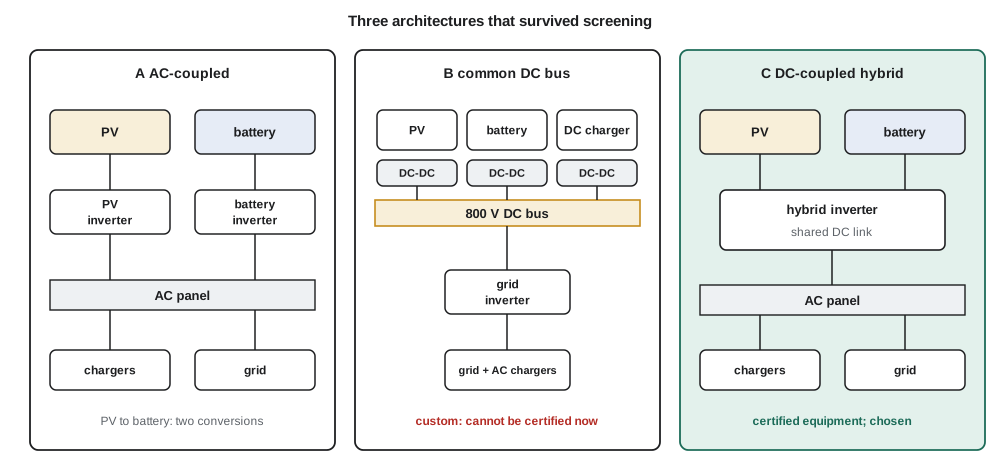
Concept A, AC-coupled, uses separate commercial products: a solar inverter, a battery inverter and chargers, each connected to a common AC panel. Every piece is a standard certified product, but energy from the panels to the battery passes through two conversions, DC to AC and back to DC, and coordinating several products from different vendors is awkward. Concept B, a common DC bus, connects the solar array, the battery and the fast charger's output stage to one high-voltage DC bus through their own DC-DC converters, with a single bidirectional inverter to the grid. It is the most efficient and the most elegant, and it can keep the fast charger running from the battery and solar during an outage without forming an AC island. But it would be a custom system, and nothing like it could be certified for installation at a utility yard within the project. Concept C, a DC-coupled hybrid, uses a commercial hybrid inverter in which the solar array and the battery share the inverter's internal DC link, with the chargers on the AC side. It gives up some of B's efficiency but uses certified equipment.
The weighted decision matrix
To compare the three, the team built a weighted decision matrix, sometimes called a Pugh-style matrix when scores are relative to a datum, or a weighted scoring model. They agreed the criteria and weights with the client first, before scoring, so that nobody could tune the weights to favor a preferred concept afterwards. Efficiency, storm resilience and use of certified equipment were judged most important, each 20 %; capital cost 15 %; maintainability and expandability 10 % each; and fit to the team's own scope and skills 5 %. Each concept was scored from 1 (poor) to 5 (excellent) on each criterion, with a sentence of justification for every score.
# Weighted decision matrix for the three architectures, with a weight-sensitivity check
crit = {  # criterion: weight
    'conversion efficiency': 0.20, 'storm resilience': 0.20, 'certified equipment': 0.20,
    'capital cost': 0.15, 'maintainability': 0.10, 'expandability': 0.10, 'team scope fit': 0.05}
score = {  # 1 (poor) to 5 (excellent)
    'A  AC-coupled':        [3, 2, 5, 4, 4, 3, 2],
    'B  common DC bus':     [5, 5, 1, 3, 2, 4, 5],
    'C  DC-coupled hybrid': [4, 4, 4, 3, 4, 4, 4]}
w = list(crit.values()); assert abs(sum(w) - 1) < 1e-9
def total(s, w): return sum(a * b for a, b in zip(s, w))
for k, s in score.items(): print(f"{k:22s} {total(s, w):.2f}")
# sensitivity: change one weight by +50 % and renormalize, see whether the ranking changes
names = list(crit)
for i, n in enumerate(names):
    w2 = w[:]; w2[i] *= 1.5; t = sum(w2); w2 = [x / t for x in w2]
    best = max(score, key=lambda k: total(score[k], w2))
    print(f"weight of {n:22s} x1.5 -> best is {best.split()[0]}")
w0 = w[:]; w0[2] = 0; t = sum(w0); w0 = [x / t for x in w0]
for k, s in score.items(): print(f"ignoring certification: {k:22s} {total(s, w0):.2f}")A AC-coupled 3.40 B common DC bus 3.50 C DC-coupled hybrid 3.85 weight of conversion efficiency x1.5 -> best is C weight of storm resilience x1.5 -> best is C weight of certified equipment x1.5 -> best is C weight of capital cost x1.5 -> best is C weight of maintainability x1.5 -> best is C weight of expandability x1.5 -> best is C weight of team scope fit x1.5 -> best is C ignoring certification: A AC-coupled 3.00 ignoring certification: B common DC bus 4.12 ignoring certification: C DC-coupled hybrid 3.81
Concept C scored 3.85, ahead of B at 3.50 and A at 3.40. The sensitivity check matters as much as the totals. Increasing any single weight by half and renormalizing never changed the winner, so the choice did not hang on one debatable weight. The last lines show what happens if certification is removed altogether: B wins clearly. That is the honest summary of the trade study. The common DC bus is the better technical design; the hybrid is the better design for this client, on this site, now, because a utility cannot install uncertified equipment in its own yard.
Worked problem
Score one concept
Weights are 0.4, 0.35 and 0.25 for cost, performance and risk. A concept scores 3, 5 and 2. What is its weighted score?
Show solution
- \[S = 0.4 \times 3 + 0.35 \times 5 + 0.25 \times 2\]
- \[S = 1.2 + 1.75 + 0.5 = 3.45\]
Answer: The weighted score is 3.45 out of 5.
Pitfalls in decision matrices
Decision matrices give a false sense of precision if used carelessly. Scores of 1 to 5 are judgments, so a difference of 0.1 in the total means nothing; only clear margins, confirmed by sensitivity checks, should drive a decision. Criteria must be independent: if \"efficiency\" and \"energy losses\" are both listed, the same property is counted twice. Criteria must also be ones on which the concepts actually differ; a criterion where everything scores 4 adds nothing but dilutes the others. And must-have requirements belong in screening, not in the matrix, because a high score elsewhere should never compensate for failing a requirement.
Where scores rest on numbers, calculate the numbers. The team did not guess efficiencies. Aisha estimated the conversion chain for each concept from typical device efficiencies: about 96 % solar-to-battery for the AC-coupled path, which converts twice, against about 98 % for a DC-DC path. That difference compounds every day over the system's life, and it is why efficiency scored 3 for A, 4 for C and 5 for B. Cost scores came from rough budget quotations for the major equipment, not from intuition.
Scoring as a team
The team scored the concepts in a single two-hour meeting with Marguerite and Doug present, and the way they ran it is worth copying. Each member scored every concept privately first, writing a sentence of justification for each score, so that nobody anchored on the first opinion voiced. The scores were then put side by side. Where all four agreed within one point, they took the average and moved on. Where they disagreed by two points or more, the person with the highest and the person with the lowest score each explained their reasoning, and the group agreed a score and recorded why. Most disagreements turned out to be about facts, not judgment: Mateo had scored Concept A's storm resilience at 3 because he assumed its battery inverter could form an island, while Hannah had scored it 1 because the product the team had priced could not. Checking the datasheet settled it at 2.
Having the client in the room changed two scores. Doug rated maintainability more harshly for the custom common DC bus than the students had, because Larchmont's electricians maintain everything in the yard and had no experience with custom power converters; when something failed at two in the morning, the nearest expert would be a student who had graduated. That kind of knowledge comes only from people who will live with the system, and it is why the client should take part in scoring rather than simply receive the result.
Resilience in an outage
Storm resilience carried a fifth of the weight, so the team looked at what each concept would actually do when the grid failed. In Concept A, the solar inverter would shut down with the grid, as anti-islanding rules require, and only a battery inverter able to form its own AC supply could keep any charger running; most low-cost battery inverters cannot. In Concept B, the DC bus never depends on the grid, so the battery and solar could keep the fast charger running directly, the most resilient arrangement. In Concept C, the hybrid inverter can disconnect from the grid with its own internal transfer switch and supply a backed-up panel from the battery and solar, which can carry the Level 2 chargers for the storm trucks. That difference, full fast charging in B against two Level 2 chargers in C, is what the scores of 5 and 4 express.
Keeping the best idea alive
The team did not simply drop Concept B. They saw that the project could deliver two things: a design package for the full-size canopy based on Concept C with certified equipment, which Larchmont could actually tender and build; and a laboratory demonstrator of the most interesting part of Concept B, a bidirectional DC-DC converter between a battery and a high-voltage DC bus, together with the site energy controller that every concept needed. The demonstrator would let Aisha and Mateo do real power electronics and embedded design, and give Larchmont evidence for a future generation of the design. This split, recommended by Professor Gagnon at the PDR, is common in capstones whose full-scale systems are too large or too regulated for students to build.
Risk as a criterion
Some teams add technical risk as a criterion. Leo's team handled it separately, with a short risk register for each surviving concept listing what could go wrong, how likely it was and how bad it would be. Concept B's register was dominated by a single risk, certification, rated almost certain and severe. Concept C's main risks were the hybrid inverter's ability to enforce zero export quickly enough and the lead time for the battery cabinet. Both were manageable: the first by a separate export-protection relay, the second by ordering early. Lesson 6 returns to the relay; lesson 9 to lead times.
Recording the decision
The trade study ended with a two-page decision record: the functions, the morphological chart, the screening criteria and results, the matrix with justifications, the sensitivity results, the risk summaries and the recommendation. The client and advisor signed it at the PDR. Writing it took an afternoon. It paid for itself twice: once when a reviewer at the CDR asked why the team had not used a common DC bus, and again in the final report, where the chapter on concept selection was largely the decision record, tidied up.
| Criterion | Weight | A | B | C | Justification for C |
|---|---|---|---|---|---|
| Conversion efficiency | 0.20 | 3 | 5 | 4 | one conversion from PV to battery, two to the AC side |
| Storm resilience | 0.20 | 2 | 5 | 4 | hybrid inverter can island its own AC panel |
| Certified equipment | 0.20 | 5 | 1 | 4 | listed hybrid inverter and battery; one custom controller |
| Capital cost | 0.15 | 4 | 3 | 3 | hybrid inverter costs more than a PV inverter |
| Maintainability | 0.10 | 4 | 2 | 4 | standard products with vendor support |
| Expandability | 0.10 | 3 | 4 | 4 | battery cabinets and chargers can be added |
| Team scope fit | 0.05 | 2 | 5 | 4 | controller and demonstrator give real design work |
Common mistakes
MistakeChoosing weights after scoring.
InsteadAgree criteria and weights with the client before scoring the concepts.
MistakeTreating a 0.1 difference in totals as decisive.
InsteadRely on clear margins confirmed by sensitivity checks.
MistakePutting must-have requirements in the matrix.
InsteadScreen out concepts that fail must-haves before scoring.
MistakeDiscarding the losing concept without a record.
InsteadRecord why it lost, and consider whether part of it can be demonstrated.
Summary and key terms
- Decompose the system into functions before choosing hardware.
- A morphological chart combines means for each function into concepts.
- Screen concepts against must-have requirements, then compare the survivors.
- Agree weights with the client before scoring, and justify every score.
- Sensitivity checks show whether the choice depends on a single weight.
- A capstone can deliver a full-scale design with certified equipment and a demonstrator of the most novel part.
- A signed decision record explains the choice to reviewers and readers.
- Functional decomposition
- Breaking a system into the functions it must perform, independent of hardware.
- Morphological chart
- A table of functions and alternative means used to generate concepts.
- Screening
- Removing concepts that fail must-have criteria.
- Weighted decision matrix
- A table scoring concepts against weighted criteria.
- Sensitivity analysis
- Checking how a result changes when assumptions or weights change.
- AC coupling
- Connecting PV and storage through separate inverters on a common AC bus.
- DC coupling
- Connecting PV and storage on a shared DC link before a single inverter.
Practice problems
Work each problem on paper first, then reveal the answer to check.
Why list functions before hardware?
Show answer
So that alternative means for each function are considered rather than the first idea.
Concept C scores 3.85 and B 3.50. If both totals were within 0.1, what should the team do?
Show answer
Treat them as tied and decide on other evidence or further analysis.
Why does certification dominate this client's choice?
Show answer
A utility cannot install uncertified equipment in its yard.
Give one reason efficiency scored higher for DC coupling.
Show answer
PV energy reaches the battery through one DC-DC conversion instead of two.
Where should a must-have requirement be applied?
Show answer
In screening, before the matrix.
What two deliverables did the team define after the trade study?
Show answer
A design package for the full-size canopy and a laboratory demonstrator of the battery converter and controller.
Lesson quiz · 5 questions
Score 60% or more to complete this lesson.
Create a free account to save your progress, take quizzes and earn a certificate.