
DCE-210 · Lesson 10 of 12 · 32 min
Telecommunications facilities, power and timing
Data centers grew up alongside an older kind of building: the telephone company central office. Telecommunications facilities have their own engineering traditions, many of which still shape data center practice: −48 V DC power plants with hours of battery reserve, equipment standards that demand survival through earthquakes and fires, and an obsession with precise timing. Today the two worlds are converging, as carriers turn their central offices into edge data centers and data center operators host carrier equipment. This lesson explains telecommunications facilities, the networks that connect homes and mobile phones, how DC plants are sized, and how networks keep time.
Central offices and edge sites
A central office (CO), or telephone exchange, is a carrier building that terminates the copper or fiber lines from the homes and businesses around it, typically within a few kilometers in a city, and connects them to the carrier's backbone. Large cities have dozens of COs, often in windowless buildings built decades ago with heavy floors, battery rooms and cable vaults.
Three trends are changing these buildings:
- Old copper switching and transmission equipment is being retired, freeing space and power.
- Fiber access and mobile networks need compact, distributed equipment close to users.
- Latency-sensitive services, such as mobile network functions, content caches and industrial applications, want computing within a few milliseconds of users.
As a result, carriers are converting COs into small edge data centers running standard servers, while data center operators build edge sites of their own. Edge sites face distinctive constraints: limited space and power (often tens to a few hundred kilowatts), existing buildings with limited cooling, little or no on-site staff, and the need to be managed remotely.
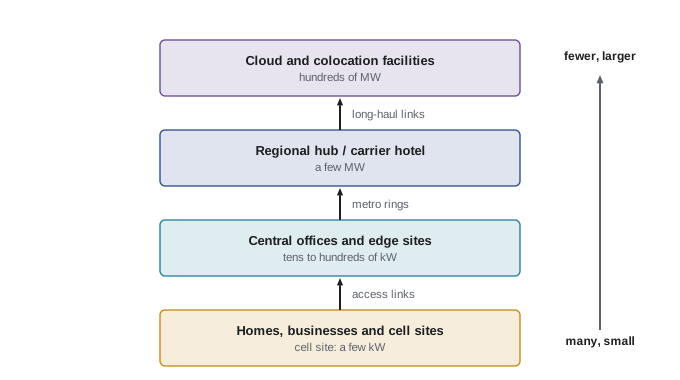
Access networks: how users connect
Fiber to the home
Most new fixed broadband uses passive optical networks (PONs). A single fiber from an optical line terminal (OLT) in the CO is split by unpowered optical splitters, typically 1:32 or 1:64, to reach many homes, each with an optical network terminal. Downstream, the OLT broadcasts to all homes on the split; upstream, the homes take turns in time slots. Generations include GPON (2.5 Gb/s down, 1.25 Gb/s up), XGS-PON (10 Gb/s symmetric) and the emerging 25G and 50G PON.
Worked problem
Bandwidth on a shared PON
An XGS-PON port (10 Gb/s downstream, about 8.5 Gb/s usable after overhead) serves 64 homes through a 1:64 split. Each home buys a 1 Gb/s plan. At the evening peak, an average of 30% of homes are active, each using 120 Mb/s on average. (a) What is the oversubscription of sold bandwidth? (b) What is the peak load on the port?
Show solution
- (a) Sold bandwidth: \(64 \times 1 = 64\) Gb/s on an 8.5 Gb/s port: about 7.5:1 oversubscription.
- (b) Active homes: \(0.30 \times 64 = 19.2\). Load: \(19.2 \times 120 = 2{,}304\) Mb/s, about 2.3 Gb/s.
Answer: The port is oversubscribed 7.5:1 on paper but runs at only about 27% of usable capacity at peak, because users rarely use their full plan at once. Like data center fabrics (Lesson 3), access networks rely on statistical multiplexing, and operators watch peak utilization to know when to split a PON or upgrade it.
Mobile networks
A mobile network has three parts: the radio access network (RAN) of antennas and radios on towers and rooftops, the transport network that connects cell sites to the core (fronthaul from radios to baseband processing and backhaul onward), and the core network that handles authentication, mobility and connections to the internet. In 5G, the core runs as software on servers in data centers, and parts of the RAN baseband processing can be centralized in edge sites, which is a major driver of edge data center demand. Macro cell sites draw a few kilowatts each, supplied by small DC power plants with batteries in a cabinet or shelter at the base of the tower.
The −48 V DC power plant
Telecommunications equipment has traditionally run on −48 V DC rather than AC. The voltage is low enough to be considered relatively safe to touch (below about 60 V DC) yet high enough to keep currents manageable. The positive terminal is grounded and the supply is negative with respect to ground, because a negative potential reduces electrolytic corrosion of outside cables and connections. The key advantage is that batteries can float directly on the DC bus with no inverter between them and the load, making the power path very simple and reliable.
A DC plant consists of:
- Rectifiers: modular AC-to-DC converters, typically 2 kW to 4 kW each, hot-swappable and installed with N+1 or better redundancy.
- Batteries: strings of cells, traditionally 24 vented or valve-regulated lead-acid cells of 2 V, increasingly lithium-ion. They float at about 54 V (2.25 V per cell for lead-acid) and supply the load instantly if AC fails.
- Distribution: busbars, fuse panels and breakers feeding the equipment, often through battery distribution fuse bays (BDFBs) near the equipment rows.
- Controller: monitors voltages, currents, temperatures and alarms, and manages charging and low-voltage disconnects.
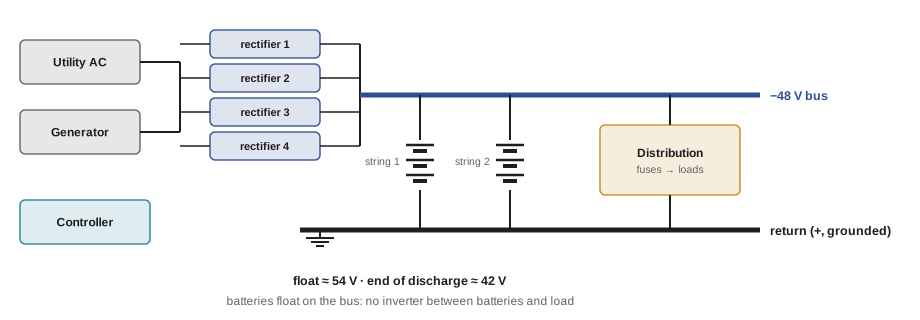
Because there are no inverters and the batteries are always connected, a DC plant's availability is very high. Its main weakness is that low voltage means high current: a 100 kW load at 48 V draws over 2,000 A, requiring large copper conductors, and voltage drop must be controlled carefully (ELEC-110, Lesson 11).
Worked problem
Sizing a DC plant
An edge site has 30 kW of −48 V equipment and needs 4 hours of battery reserve. Rectifiers are 3 kW modules. Batteries are discharged from 54 V to a minimum of 42 V, so the average discharge voltage is about 48 V. (a) What is the load current at 48 V? (b) How many rectifiers with N+1 redundancy, allowing battery recharge at 10% of load? (c) What battery capacity is needed, before aging and temperature factors?
Show solution
- (a) \(I = 30{,}000 / 48 = 625\) A.
- (b) Rectifier output needed: load plus 10% for recharge, \(30 \times 1.1 = 33\) kW, so \(33/3 = 11\) modules, plus one redundant: 12.
- (c) Energy: \(30 \times 4 = 120\) kWh; capacity at 48 V: \(120{,}000/48 = 2{,}500\) Ah.
- With two parallel strings for redundancy, each string must be at least 1,250 Ah, or each larger if one string must carry the full reserve alone.
Answer: 625 A, 12 rectifiers and about 2,500 Ah of battery capacity at the 4-hour rate. In practice the capacity is increased by an aging factor (often 1.25) and corrected for temperature and discharge rate, using the manufacturer's tables, as in DCE-200. The battery bank of a large CO can weigh tens of metric tons, so floor loading is a structural concern.
Data centers have adopted some DC ideas: open rack designs distribute 48 V DC or higher-voltage DC within racks, and some facilities use 380 V DC distribution. Carrier equipment installed in colocation facilities often still requires −48 V, so carrier-neutral data centers provide DC plants in their meet-me rooms and carrier spaces.
Telecom equipment standards
Equipment installed in North American carrier facilities is traditionally required to meet NEBS (Network Equipment-Building System) criteria, originally developed by Bellcore and later published by Telcordia, as GR-63-CORE (physical protection: temperature, humidity, altitude, earthquake, fire spread, airborne contaminants, acoustic noise) and GR-1089-CORE (electromagnetic compatibility, lightning and power-fault protection, and electrical safety). NEBS equipment must, for example, survive simulated earthquakes for the highest seismic zone and operate for short periods at temperatures up to 55 °C. Data center equipment is generally not NEBS-certified, which is one reason why carriers and data center operators sometimes struggle to share space.
In the US, the FCC regulates interstate telecommunications, manages spectrum with NTIA, and requires carriers to report significant outages through its Network Outage Reporting System (NORS). Equipment must be FCC-authorized, and carriers must meet requirements for emergency backup power at cell sites in some states.
Timing and synchronization
Networks need time in two senses. Frequency synchronization keeps every device's clock ticking at the same rate; phase or time synchronization keeps them showing the same time. Mobile networks need both: 5G networks using time-division duplexing, in which uplink and downlink share a channel in alternating slots, require neighboring cell sites to be aligned within about ±1.5 µs or they interfere. Financial trading systems must timestamp trades to microsecond accuracy for regulators, and distributed databases use synchronized clocks to order transactions.
Time is distributed from primary references in a hierarchy:
- GNSS (global navigation satellite systems, such as GPS) receivers provide time traceable to UTC within tens of nanoseconds, from antennas with a view of the sky.
- PTP (Precision Time Protocol, IEEE 1588) carries time across a packet network. A grandmaster clock, locked to GNSS, sends timestamped messages; switches along the path act as boundary or transparent clocks that correct for their own delays, achieving sub-microsecond accuracy across a network. Telecom profiles (ITU-T G.8275.1) define how to do this for mobile networks.
- Synchronous Ethernet (SyncE) distributes frequency through the physical layer of Ethernet links.
- NTP (Network Time Protocol) distributes time to ordinary servers to within about a millisecond over the internet, or much better on a local network.
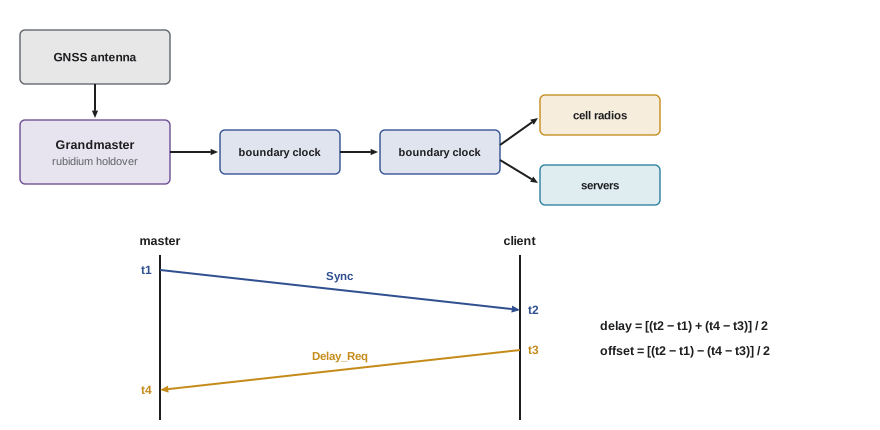
PTP's calculation assumes the path delay is the same in both directions:
Any asymmetry, such as different fiber lengths in the two directions, appears directly as a time error of half the difference, so timing networks are engineered and calibrated carefully.
Holdover and GNSS vulnerability
GNSS signals are extremely weak at the earth's surface and can be lost to antenna faults, local interference, deliberate jamming or spoofing, which has become common near conflict zones and is sometimes caused by illegal personal jammers near highways. When the reference is lost, clocks enter holdover, running on their own oscillators, whose frequency error causes time to drift.
Worked problem
How long can a clock hold over?
A cell site must stay within 1.1 µs of true time (allowing margin within the ±1.5 µs budget). After losing GNSS, its clock has a constant frequency error of \(1 \times 10^{-11}\) (a good rubidium oscillator) or \(1 \times 10^{-8}\) (a basic quartz oscillator). How long until the limit is reached?
Show solution
- Time error grows as frequency error × elapsed time.
- Rubidium: \(1.1 \times 10^{-6} / 10^{-11} = 1.1 \times 10^{5}\) s, about 30 hours.
- Quartz: \(1.1 \times 10^{-6} / 10^{-8} = 110\) s, under 2 minutes.
Answer: About 30 hours with rubidium but under 2 minutes with basic quartz. (Real oscillators also age and respond to temperature, so actual holdover is usually shorter.) This is why critical sites use high-quality oscillators, multiple GNSS constellations and antennas, and terrestrial time distributed over fiber from national time laboratories as backup.
Satellites
Satellites reach places that fiber and cellular networks do not: ships, aircraft, remote communities and disaster areas. Geostationary satellites orbit at 35,786 km, so a signal traveling up and down for a request and again for the reply covers at least four times that distance: the minimum round-trip time is about 480 ms, and practical latency is 550 ms to 700 ms. Low-earth-orbit (LEO) constellations such as Starlink, Eutelsat OneWeb and Amazon's Project Kuiper orbit at a few hundred to about 1,200 km, giving round-trip times of roughly 25 ms to 60 ms in practice. LEO constellations connect to the internet through ground stations, which are often located at or near data centers and carrier hotels.
Worked problem
Speed of light to orbit
Calculate the minimum round-trip time for a request and reply via (a) a geostationary satellite at 35,786 km and (b) a LEO satellite at 550 km directly overhead. Use the speed of light in a vacuum, 300,000 km/s.
Show solution
- A round trip from user to ground station and back crosses the user-satellite and satellite-ground legs twice each: four times the altitude at minimum.
- (a) \(4 \times 35{,}786 / 300{,}000 = 0.477\) s, about 477 ms.
- (b) \(4 \times 550 / 300{,}000 = 0.0073\) s, about 7.3 ms.
Answer: About 477 ms for geostationary and 7.3 ms for LEO at minimum. Real LEO latency is higher because satellites are rarely overhead, traffic may hop between satellites, and ground stations may be far from the destination, but it is still comparable to terrestrial broadband.
Common mistakes
MistakeTreating −48 V as harmless because the voltage is low.
InsteadDC plants deliver thousands of amperes; short circuits cause severe arc flash and burns. Use insulated tools and follow the safety procedures.
MistakeSizing DC conductors for current only.
InsteadCheck voltage drop as well; at 48 V every volt lost is 2% of the supply.
MistakeRelying on a single GNSS antenna for timing.
InsteadProvide multiple constellations, good oscillators for holdover, and terrestrial backup.
MistakeIgnoring path asymmetry in PTP.
InsteadAsymmetry appears directly as time error; calibrate it.
MistakeAssuming carrier equipment will run on data center AC power and cooling.
InsteadCheck DC power, NEBS and environmental requirements before accepting carrier equipment.
Summary and key terms
- Central offices are becoming edge data centers; edge sites are small, remote and constrained.
- PONs split one fiber among many homes; mobile networks run their core and some RAN functions in data centers.
- −48 V DC plants float batteries on the bus with rectifiers, giving simple, reliable power at high current.
- NEBS GR-63 and GR-1089 set physical and electrical requirements for carrier equipment.
- GNSS, PTP, SyncE and NTP distribute time; 5G TDD needs about ±1.5 µs alignment.
- Holdover performance depends on oscillator quality; GNSS jamming and spoofing are real risks.
- Geostationary satellites add about half a second of latency; LEO constellations about 25–60 ms.
- Central office
- A carrier building that terminates local lines and connects them to the backbone.
- Edge data center
- A small data center close to users for latency-sensitive services.
- PON
- Passive optical network: one fiber split among many users.
- Rectifier
- An AC-to-DC converter feeding a DC plant.
- Float voltage
- The voltage at which batteries are maintained while fully charged.
- NEBS
- Requirements for equipment in North American carrier facilities.
- PTP
- Precision Time Protocol (IEEE 1588) for sub-microsecond time over packet networks.
- Grandmaster
- The primary PTP clock, usually locked to GNSS.
- Holdover
- A clock running on its own oscillator after losing its reference.
- LEO
- Low earth orbit, a few hundred to about 2,000 km up.
Practice problems
Work each problem on paper first, then reveal the answer to check.
Why is the −48 V supply negative with respect to ground?
Show answer
To reduce electrolytic corrosion of outside cables and connections.
GPON split 1:32 with 2.5 Gb/s down. Average share per home if all are active?
Show answer
About 78 Mb/s.
Current of a 12 kW load at 48 V?
Show answer
250 A.
12 kW for 8 hours at 48 V. Battery capacity?
Show answer
2,000 Ah.
What does GR-63-CORE cover?
Show answer
Physical protection: environment, earthquake, fire, contaminants, noise.
Why do 5G TDD sites need tight phase alignment?
Show answer
So neighboring sites switch between uplink and downlink at the same time and do not interfere.
PTP: t2 − t1 = 52 µs, t4 − t3 = 48 µs. Delay and offset?
Show answer
Delay 50 µs; offset 2 µs.
A 40 m fiber asymmetry (about 0.2 µs) causes what time error?
Show answer
About 0.1 µs, half the asymmetry.
Holdover with frequency error 5 × 10⁻¹¹ to reach 1 µs?
Show answer
20,000 s, about 5.6 hours.
Minimum round trip via a LEO satellite at 1,100 km?
Show answer
About 14.7 ms.
Lesson quiz · 5 questions
Score 60% or more to complete this lesson.
Create a free account to save your progress, take quizzes and earn a certificate.