
CSCO-121 · Lesson 12 of 12 · 31 min
Practice: network security scenarios
▶ Video coming soon A video version of this lesson is on the way.
In mid-January 2027, Keisha planned to give Jordan a different kind of afternoon. Instead of teaching, she would hand him a stack of real situations from Brightline's last few months, lightly disguised, and ask him to talk through each one as if he were on his own. She would only listen and ask questions. "The exam asks short questions," she told him, "but every one of them is a small scenario. If you can reason through a messy real one, the tidy exam ones will feel easy." This lesson follows that plan. Each scenario draws on several earlier lessons, and each ends with the reasoning Keisha expects.
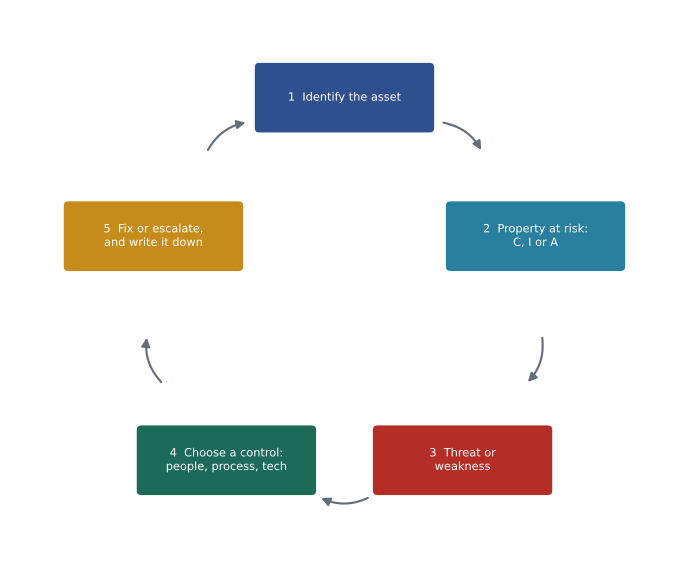
Work through each scenario before reading the steps. Ask the same questions every time: what is being protected, which property is at risk, what kind of threat or weakness is involved, which control fits, and whether this is something to fix or something to escalate. Those questions are the method behind every answer in this course.
Scenario 1: the bakery cutover
The night before the bakery's new zones went live, a temporary firewall rule was added so that the point-of-sale vendor could reach the POS server remotely while it tested the new layout. The rule allowed any source address to reach the POS server on the vendor's remote-support port. Two weeks later, the bakery is running smoothly and nobody has mentioned the rule. What should Jordan notice, and what should he do?
Writing it down
Every scenario ended the same way: record what was found and what was done. Keisha asked Jordan to write a short note for each one as if it were a real ticket in Brightline Desk, with the time, the systems involved, the reasoning and the actions taken. Several of his notes went straight into Brightline's procedure library as examples for new technicians. Good notes are a skill the exam cannot fully test, but they are what employers notice first.
Worked problem
Reasoning through scenario 1
A temporary rule allows any internet address to reach the POS server on a remote-support port.
Show solution
- Asset: the POS server, which holds card transaction data. Properties at risk: confidentiality and integrity, and availability if ransomware gets in.
- Weakness: an overly broad inbound rule from the internet to the most sensitive zone, left in place after its purpose ended. Remote-support tools exposed to the internet are common entry points for attackers.
- Control: remove the rule. If the vendor needs ongoing access, replace it with a remote-access VPN or vendor portal that requires multi-factor sign-in, restricted to the vendor's known addresses and enabled only when needed.
- Process: open a change ticket, record why the rule existed and when it was removed, and add an expiry date to any future temporary rules.
- Check the firewall and POS server logs for connections from unknown addresses while the rule was open; if there are any, escalate to Keisha as a possible incident.
Answer: Remove the temporary rule, provide controlled vendor access if needed, check the logs for misuse, and record the change.
Scenario 2: a veterinarian working from home
Dr. Olsen at Prairie Paws asks whether she can reach the practice-management application from home on weekends to check test results. Her home computer is a family laptop shared with her children. The clinic does not currently allow remote access. What would a secure answer look like?
Worked problem
Reasoning through scenario 2
A veterinarian wants weekend access to medical records from a shared family laptop.
Show solution
- Asset: animal and owner records in the practice-management application. Properties: confidentiality first, then integrity.
- Weaknesses: an unmanaged, shared home device that may carry malware; a sign-in that could be phished; data that could be left on the laptop.
- Controls: provide a clinic-managed laptop or tablet with full-disk encryption; connect through a remote-access VPN or the vendor's secure portal with multi-factor sign-in; give her role-based access only to what she needs; and log access.
- If a managed device is not possible, a web portal that keeps data on the server and blocks downloads is better than a full VPN from a shared laptop.
- Write down the decision and any residual risk the clinic's manager accepts.
Answer: Yes, with a managed device or a portal that keeps data on the server, multi-factor sign-in, least privilege and logging.
Scenario 3: an unusual sign-in
On a Sunday morning, Brightline's monitoring flags that a Riverside Family Law account signed in successfully from another continent, 20 minutes after the same account signed in from the lawyer's home. The firm's MFA rollout is scheduled but not yet complete, and this user has not yet enrolled. What should the on-call technician do?
Worked problem
Reasoning through scenario 3
Two successful sign-ins for one account, from places too far apart for one person to travel between, 20 minutes apart, without MFA.
Show solution
- This pattern is often called impossible travel and is a strong sign that the password has been stolen. Treat it as a probable account compromise, an incident.
- Asset: a lawyer's mailbox and documents, with privileged client information. Property: confidentiality, with legal reporting duties.
- Escalate immediately to Keisha, who leads incident handling; do not wait until Monday.
- Containment steps she is likely to direct: disable sign-in or reset the password, end active sessions, check for new mailbox forwarding rules and enroll the user in MFA before restoring access.
- Record times, addresses and actions. The firm may need to assess whether privacy law requires notifying clients; CSCO-122 covers incident handling from here.
Answer: Escalate at once as a probable incident, contain the account, preserve the records and complete MFA enrollment.
Scenario 4: an access point in the gym
During a walk-around at the Northfield Community Center, Dev's phone shows an unfamiliar network called NFC-Coaches with a strong signal in the gym. The staff network and the guest network are both where they should be. A coach mentions that he bought a small router so the coaches' office would have better Wi-Fi. What is the risk and what is the right response?
Worked problem
Reasoning through scenario 4
A staff member has plugged a consumer router into a wall port in the gym.
Show solution
- This is a rogue access point: an unauthorized wireless device connected to the internal network.
- Weaknesses: the router probably has a default administrator password and weak wireless security, and it bridges anyone who joins it onto the network the wall port connects to, bypassing the guest zone.
- Immediate step: with the manager's agreement, unplug it and record the port, the device and what was found.
- Fix the cause, not just the symptom: the coaches needed better coverage. Add a managed access point broadcasting the existing staff or guest network in the gym.
- Prevent recurrence: disable unused wall ports, consider 802.1X on switch ports, enable the access points' rogue detection, and remind staff that network devices go through Brightline.
Answer: Remove the rogue access point, fix the coverage gap properly, and add controls that detect or block unmanaged devices.
Scenario 5: reading a rule list
Jordan is asked to check an extended ACL on the bakery's router that was written by a previous provider. It reads, in order: permit tcp any any eq 443; deny ip 10.20.30.0 0.0.0.255 10.20.20.0 0.0.0.255; permit ip 10.20.10.0 0.0.0.255 any. The guest subnet is 10.20.30.0/24, POS is 10.20.20.0/24 and staff is 10.20.10.0/24. Can a guest device reach the POS server on TCP 443? Can a guest reach a staff PC on TCP 445?
Worked problem
Reasoning through scenario 5
Apply first-match processing to two packets.
Show solution
- Packet A: guest to POS on TCP 443. Rule 1 matches any TCP traffic to port 443, so the packet is permitted. Rule 2 is never reached for it.
- Packet B: guest to a staff PC on TCP 445. Rule 1 does not match because the port is 445. Rule 2 does not match because the destination is staff, not POS. Rule 3 does not match because the source is guest, not staff. The implicit deny drops the packet.
- The problem is rule 1: it is too broad, and it shadows rule 2 for HTTPS traffic, letting guests reach the POS server.
- Fix: move the guest-to-POS deny to the top, replace rule 1 with specific permits for what is needed, and rely on the implicit deny for the rest.
Answer: Guest to POS on 443 is permitted by the overly broad first rule; guest to staff on 445 is dropped by the implicit deny. Reorder and narrow the rules.
Scenario 6: the cheapest fix with the biggest effect
Owen asks Keisha which single improvement would most reduce risk across all four regular clients next quarter, given a small budget. Jordan is asked to argue a case before Keisha gives hers. Which control should he propose, and why?
Worked problem
Reasoning through scenario 6
Choose one control with the largest effect across several small organizations.
Show solution
- List the most likely threats from earlier lessons: phishing, password attacks, credential stuffing and remote access abuse. Most lead to a stolen account.
- Compare candidate controls by how many of those threats they reduce: MFA reduces nearly all of them; segmentation reduces spread after compromise; training reduces clicks but not to zero.
- Check cost: MFA is included in most cloud email and identity plans the clients already pay for, and the main cost is staff time to enroll users.
- Propose MFA for every account at every client, with phishing-resistant methods for administrators, followed by segmentation and backups as next steps.
Answer: Multi-factor authentication everywhere gives the largest risk reduction for the cost; it addresses the most common way small organizations are breached.
Exam habits
Keisha closed the afternoon with a few habits for the exam itself. Read the whole question, including the last line, before looking at the options; many questions turn on a single word such as best, first or most secure. When asked what to do first, prefer actions that preserve evidence and escalate over actions that fix quietly. When asked for the most secure option, prefer the one that removes a weakness over one that hides it: replacing Telnet beats moving it to another port, enterprise Wi-Fi beats hiding the network name, and default deny beats a list of blocked items. When two options both seem right, look for the one that follows least privilege.
She also reminded Jordan that the exam is timed at 50 minutes, so spending three minutes on one question costs time for others. Flag hard questions if the exam interface allows it and return to them. CSCO-190 practices these skills with timed sets. Most of all, she told him, trust the method: asset, property, threat, control, fix or escalate. It works on the exam and it works on a Sunday morning when an alert arrives.
| Clue in a question | Usually points to |
|---|---|
| Data seen by the wrong person | Confidentiality: encryption, access control |
| Data or settings changed without approval | Integrity: hashing, signatures, change control |
| Service down or slow | Availability: redundancy, DDoS protection, backups |
| Many failed sign-ins across accounts | Password spraying: MFA, alerts |
| Plain-text management protocol | Replace with SSH, HTTPS or SNMPv3 |
| Guests reaching internal devices | Segmentation and firewall rules |
| Shared passphrase for staff Wi-Fi | WPA3-Enterprise with 802.1X |
| Broad rule near the top of an ACL | First match wins; reorder and narrow |
| Former employee still has access | Leaver process and access reviews |
| Asked what to do first in a possible breach | Escalate and preserve evidence |
Common mistakes
MistakeFixing a possible incident quietly.
InsteadEscalate first and preserve records; fixes come as part of the response.
MistakeLeaving temporary rules without an end date.
InsteadEvery temporary change needs an owner and an expiry.
MistakeRemoving a rogue device without addressing the need behind it.
InsteadFix the coverage gap properly so it does not return.
MistakeChoosing an option that hides a weakness.
InsteadPrefer the option that removes it.
MistakeSpending too long on one question.
InsteadFlag it and return; the exam is 50 minutes.
Summary and key terms
- A repeatable method: identify the asset, the property at risk, the threat or weakness, a control, and whether to fix or escalate; write it down.
- Temporary firewall rules must be removed or replaced with controlled access, and logs checked for misuse.
- Remote access to sensitive data needs managed devices or server-side portals, MFA, least privilege and logging.
- Impossible travel sign-ins indicate probable compromise and need immediate escalation.
- Rogue access points must be removed and the underlying need met with managed equipment.
- Read ACLs with first-match logic and the implicit deny in mind.
- MFA is often the single most effective control for small organizations.
- Impossible travel
- Sign-ins from places too far apart for one person to travel between in the time available.
- Change ticket
- A record of a requested change, its reason, approval and outcome.
- Temporary rule
- A firewall rule added for a limited purpose that must be removed when the purpose ends.
- Rogue access point
- An unauthorized wireless device connected to the network.
- Escalation
- Passing a matter to someone with more authority or expertise.
Practice problems
Work each problem on paper first, then reveal the answer to check.
What are the five steps of the scenario method?
Show answer
Asset, property at risk, threat or weakness, control, fix or escalate, with a written record.
A rule allows any source to reach the POS server. What two things should happen besides removing it?
Show answer
Check logs for misuse and record the change.
What does impossible travel suggest?
Show answer
A stolen password and a probable account compromise.
Why add a managed access point after removing a rogue one?
Show answer
To meet the coverage need so staff do not install their own again.
In an exam question asking what to do first after a possible breach, what is usually right?
Show answer
Escalate and preserve evidence.
Which single control most reduces account compromise for small organizations?
Show answer
Multi-factor authentication.
Lesson quiz · 5 questions
Score 60% or more to complete this lesson.
Create a free account to save your progress, take quizzes and earn a certificate.