
CRE-320 · Lesson 6 of 12 · 28 min
Claims and substantiation: performance, green and origin claims
Disclosure tells the audience that a post is commercial. Substantiation is about whether what the post says is true and supported. Every objective claim in a sponsored post, whether made by the brand or by the creator in their own words, must be backed by evidence that exists before the claim is made. This lesson explains how to identify claims, including implied claims, what level of evidence different claims require, and the special rules for comparative, environmental and country-of-origin claims. Health and other regulated product claims, which carry extra rules, are covered in lesson 7.
What counts as a claim
A claim is any statement or impression about a product that the audience could treat as a fact. Claims can be express, stated directly in words, or implied, conveyed through images, demonstrations, context or what is left out.
- Express: "This charger fills your phone in 15 minutes." "Removes 99 % of stains."
- Implied: a video showing a creator drinking a tea and then visibly relaxing, captioned "my anxiety fix," implies that the tea treats anxiety.
- Demonstrations: a before-and-after video implies that the product produced the change shown.
- Omissions: describing a phone plan's price without mentioning a mandatory activation fee implies the price is complete.
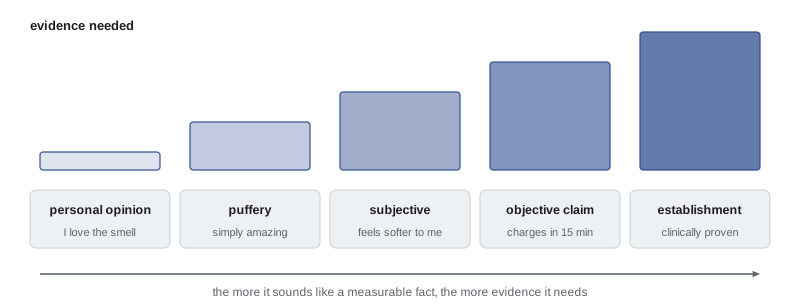
Opinions and obvious exaggeration are treated differently. "I love the smell" is a personal opinion that needs no test. Puffery, such as "the best coffee in the universe," is generally not treated as a factual claim because no reasonable person takes it literally. But puffery has limits: "the fastest-charging phone on the market" or "Canada's most trusted brand" sound like facts that can be measured and must be supported.
Substantiation must come first
The core principle in both countries is that evidence must exist before the claim is made. A brand cannot make a claim and look for proof only if someone complains. For creators, this means asking brands for the basis of any objective claim they want you to make, and not inventing claims of your own about how a product performs.
In the United States, the FTC's 1984 Policy Statement Regarding Advertising Substantiation requires advertisers to have a reasonable basis for objective claims before they are disseminated. What counts as a reasonable basis depends on factors such as the type of claim, the product, the consequences of a false claim, the benefits of a truthful one, the cost of developing substantiation and what experts in the field would consider reasonable. If an ad says or implies a specific level of support, such as "clinically proven" or "tests show," the advertiser must have that level of evidence; these are called establishment claims.
| Claim type | Example | Evidence typically needed |
|---|---|---|
| Personal opinion | I love the color | Genuine opinion only |
| Puffery | Simply amazing | None, if no one would take it literally |
| Performance | Charges in 15 minutes | Controlled tests that reflect real use |
| Comparative | Lasts twice as long as Brand X | Head-to-head tests on comparable products |
| Establishment | Clinically proven to reduce redness | The clinical evidence the claim describes |
| Health | Supports sleep | Evidence meeting health product rules (lesson 7) |
The creator's own claims
Creators often add their own claims to sponsored content, sometimes without realizing it. "This changed my life," "my skin has never been clearer" or "this saved me $200 a month" are statements of personal experience. They are acceptable if they are true for the creator and do not imply typical results that the brand cannot support. Problems arise when creators generalize: "this will clear your skin," "you'll save $200 a month." Those are product claims that need the brand's substantiation. A useful habit is to speak in the first person about real experiences and leave general product claims to the brand's approved, substantiated wording.
Worked problem
Building a substantiation checklist
A brand of portable power banks asks a creator to say in a video: (a) "It charges my phone three times on one charge," (b) "It's the lightest 20,000 mAh power bank you can buy," (c) "Airline approved," and (d) "I take it everywhere." What should the creator ask for before agreeing?
Show solution
- (a) Ask for test results showing three full charges for common phone models, and confirm the creator's own phone actually gets three; otherwise say what the creator's phone gets.
- (b) "Lightest you can buy" is a comparative superiority claim; ask for a current comparison of weights against competing 20,000 mAh models.
- (c) Ask for the basis: battery capacity in watt-hours and the airline or aviation authority limits it relies on; "approved" may overstate a general size limit.
- (d) Personal use; fine if true.
Answer: Ask for test data for (a), current competitive comparison for (b) and the specific aviation basis for (c), and keep the claims within what the evidence supports; (d) needs only to be true.
Comparative claims
Comparisons with competitors are lawful in both countries, and can be useful to consumers, but they must be fair and supported. A comparison must compare like with like, use tests that reflect real use, be current and not create a misleading overall impression, for example by choosing the one feature where the product wins and implying general superiority. Disparaging a competitor with false claims can also lead to lawsuits by the competitor. Creators should be careful about naming competitors in sponsored content; the brand should supply and stand behind any comparison.
Environmental claims
Environmental claims, often called green claims, are a growing area of enforcement. Vague words such as "eco-friendly," "green," "natural," "sustainable" or "planet-friendly" are risky because they imply broad environmental benefits that are rarely true across a product's whole life cycle. Specific, qualified claims, such as "packaging made from 80 % recycled paper," are safer when they are true and supported.
In the United States, the FTC's Guides for the Use of Environmental Marketing Claims, known as the Green Guides, were last revised in 2012. They advise against unqualified general claims such as "eco-friendly," explain how to qualify claims about recyclable, compostable, degradable and recycled content, and caution that carbon offset claims must be supported by competent and reliable scientific evidence and must not be double-counted. The FTC began a review of the Green Guides in December 2022; at the time of writing, revised guides had not been issued. Some states add their own rules: California, for example, restricts the use of recycling symbols and "recyclable" claims under a 2021 law, and a 2023 law requires disclosures about carbon-neutral and net-zero claims made in the state.
- Avoid general claims such as "eco-friendly" unless you can qualify them specifically and clearly.
- Specify whether a claim refers to the product, the packaging or part of either.
- Do not overstate: "made with recycled materials" when only 5 % is recycled is misleading.
- Treat "carbon neutral," "net zero" and "climate positive" claims with particular care; ask what emissions are included, how reductions were measured and whether offsets are relied on.
- Do not imply environmental certifications or seals that the product does not have.
Worked problem
Testing a green claim
A clothing brand asks a creator to say its hoodie is "sustainable and eco-friendly." The brand's information shows the hoodie is 60 % recycled polyester and 40 % virgin cotton, made in a factory powered by 30 % renewable energy, and shipped in plastic bags. What should the creator say instead?
Show solution
- "Sustainable and eco-friendly" are vague, unqualified general claims that imply broad benefits the product does not have.
- The specific, supported facts are: 60 % recycled polyester; factory 30 % renewable energy.
- The plastic packaging means even a qualified "eco" claim about the whole product would mislead.
- A supported alternative: "This hoodie is made with 60 % recycled polyester."
Answer: Replace the vague claims with a specific, true statement such as "made with 60 % recycled polyester," and avoid implying the product as a whole is environmentally beneficial.
Country-of-origin claims
Claims that a product is made in a particular country influence many buyers, so both countries regulate them.
In the United States, the FTC's Made in USA Labeling Rule, in force since 2021, makes it unlawful to label a product "Made in USA" unless the final assembly or processing occurs in the United States, all significant processing occurs in the United States and all or virtually all ingredients or components are made and sourced in the United States. Violations of the rule carry civil penalties. Qualified claims such as "Made in USA of imported parts" or "Assembled in USA" are allowed when accurate. Products such as cars and textiles have additional specific labeling laws.
Worked problem
Checking a Made in USA claim
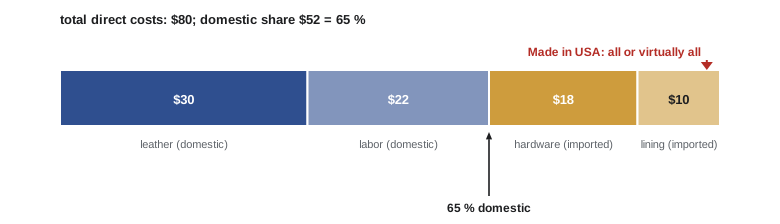
A brand's leather bag costs $80 in total manufacturing costs: US leather $30, imported hardware $18, US labor $22 and imported lining $10. It is cut and sewn in Texas. Can the brand or a creator say "Made in USA"?
Show solution
- US content: $30 + $22 = $52, or 65 % of costs.
- The rule requires all or virtually all components to be made and sourced in the United States; 35 % imported content, including hardware and lining, is far from negligible.
- Final assembly in Texas supports a qualified claim.
- Acceptable alternatives include "Made in USA of US and imported materials" or "Assembled in USA."
Answer: An unqualified "Made in USA" claim would not be supported; a qualified claim such as "Made in USA of US and imported materials" is accurate.
Prices, savings and "free"
Price claims are common in creator content: discount codes, "save 50 %," "was $100, now $50," "free shipping," "free trial." They must be accurate. A "was" or "regular" price must be a genuine price at which the product was actually sold, not an inflated figure invented to make a discount look large. A "free" offer must really be free, with any conditions, such as a required purchase, subscription or shipping charge, stated clearly next to the offer. Creators should confirm the details of any price or savings claim with the brand and avoid exaggerating discounts in their own words.
Demonstrations and before-and-after content
Demonstrations are powerful because seeing feels like proof. That is why they must show what the product actually does, under conditions the audience would recognize. A stain remover tested on a fresh stain should not be presented as removing a stain that set for a week, and a vacuum shown picking up dry cereal should not imply equal performance on deep carpet. Mock-ups, such as using mashed potato instead of ice cream under hot lights, are generally acceptable only if they do not exaggerate the product's qualities being advertised. Before-and-after content needs particular care: the conditions in both shots, such as lighting, angle, makeup and time between shots, should be the same, the product should be the only meaningful difference, and the results should be typical of what users can expect or be clearly qualified. If you cannot honestly show a before-and-after without those safeguards, do not show it.
Common mistakes
MistakeTreating "it's the best" style claims as always safe puffery.
InsteadMeasurable superiority claims need evidence.
MistakeGeneralizing personal results into product promises.
InsteadSpeak about your own experience; leave product claims to substantiated wording.
MistakeUsing vague green words like "eco-friendly".
InsteadMake specific, qualified, supported environmental claims.
MistakeSaying "Made in" when only assembly happened locally.
InsteadCheck origin thresholds and use qualified claims.
MistakeAccepting "clinically proven" without asking for the study.
InsteadEstablishment claims need the evidence they describe.
Summary and key terms
- Claims can be express or implied, including by images and omissions.
- Objective claims need evidence that exists before the claim is made.
- The level of evidence depends on the claim; establishment claims need what they describe.
- Creators should speak about genuine personal experience and avoid generalizing.
- Comparative claims must be fair, current and like-for-like.
- Environmental claims should be specific, qualified and supported.
- Country-of-origin and price claims follow specific rules.
- Express claim
- A claim stated directly.
- Implied claim
- A claim conveyed by images, context or omission.
- Puffery
- Obvious exaggeration no reasonable person takes literally.
- Reasonable basis
- The evidence required before making an objective claim.
- Establishment claim
- A claim stating a specific level of support, like clinically proven.
- Comparative claim
- A claim comparing a product with a competitor.
- Green Guides
- FTC guidance on environmental marketing claims.
- Carbon offset
- A credit representing emission reductions elsewhere.
- Made in USA Labeling Rule
- The FTC rule requiring all or virtually all US content.
- Assembled in USA
- A qualified origin claim for final assembly.
Practice problems
Work each problem on paper first, then reveal the answer to check.
Give an example of an implied claim.
Show answer
A before-and-after video implying the product caused the change.
When must substantiation exist?
Show answer
Before the claim is made.
What is an establishment claim?
Show answer
A claim stating a level of support, such as clinically proven.
Is "the fastest phone on the market" puffery?
Show answer
No, it is measurable and must be supported.
When were the Green Guides last revised?
Show answer
2012; a review began in December 2022.
Why are carbon neutral claims risky?
Show answer
They need reliable evidence and offsets must not be double-counted.
What does Made in USA require?
Show answer
All or virtually all US content and US final processing.
Name an accurate qualified origin claim.
Show answer
Assembled in USA, or Made in USA of imported parts.
What should a creator say instead of "eco-friendly"?
Show answer
A specific, supported claim such as made with 60 % recycled material.
What makes a "was" price lawful?
Show answer
It must be a genuine price at which the product was sold.
Lesson quiz · 5 questions
Score 60% or more to complete this lesson.
Create a free account to save your progress, take quizzes and earn a certificate.