
CRE-320 · Lesson 1 of 12 · 31 min
Advertising law, ethics and the creator
Every time a creator mentions a product they were paid for, sent free or earn commission on, they step into a body of rules that was built for television and print advertising and has been stretched, sometimes awkwardly, to cover feeds, stories, streams and podcasts. This course is the deep dive that CRE-302 and CRE-310 pointed to. Those courses treated disclosure as one part of running a creator business. Here we go further: what the law actually prohibits, how regulators decide whether a post is misleading, which products carry extra rules, how privacy and contest laws apply to creators, how platforms enforce their own policies, and what ethical influence looks like when artificial intelligence can fabricate faces, voices and results.
This first lesson builds the map. It explains why advertising is regulated at all, the three layers of rules a creator works under, who can be held responsible, the core test regulators apply to any piece of marketing, and how to use the rest of the course. Later lessons fill in each region of the map in detail.
This course is written for creators working in the United States, with notes on Canada where it helps. Laws change, the facts of each case matter and states differ, so for a specific campaign or dispute, speak with a lawyer licensed in the relevant state.
Why advertising is regulated
Markets work well when buyers can trust the information they use to choose. Advertising supplies much of that information. When it is false or misleading, buyers make choices they would not otherwise make, honest competitors lose sales to dishonest ones and, over time, people discount all advertising, which makes truthful marketing less effective for everyone. Advertising law therefore protects three groups at once: consumers, honest businesses and the information system itself.
Influencer marketing raises these concerns in a sharper form. A creator's recommendation feels personal. Audiences often follow creators because they seem relatable and independent, closer to a friend than to a company. That perceived independence is exactly what brands pay for, and it is also why hidden payments are so damaging: the audience gives the recommendation the weight of a friend's opinion when it is really an advertisement. Regulators in both countries have said, in almost the same words, that the problem is not advertising by creators but advertising that does not look like advertising.
There is also a fairness argument between creators. A creator who discloses honestly competes for attention with creators who do not. If undisclosed promotion is tolerated, honest creators look less authentic by comparison and are punished for following the rules. Consistent enforcement and good industry habits protect the honest majority.
Three layers of rules
A creator works under three overlapping layers of rules. Understanding which layer a rule comes from tells you who enforces it and what happens if you break it.
- Law: statutes passed by legislatures and regulations made under them, enforced by government agencies and courts. Breaking the law can lead to orders, fines, penalties, lawsuits and, for the most serious conduct, criminal prosecution.
- Self-regulation: codes written and enforced by industry bodies. They are voluntary in theory, but most advertisers, agencies and media companies agree to follow them, and their decisions are published. Breaking them leads to public rulings and requests to change or withdraw ads.
- Platform rules: the terms of service and advertising policies of each social network. They are contracts between you and the platform. Breaking them can lead to removed posts, demonetization, lost access to branded-content tools or a banned account.
In the United States the main legal layer for advertising is federal: Section 5 of the Federal Trade Commission Act, enforced by the Federal Trade Commission (FTC), prohibits unfair or deceptive acts or practices. Product-specific federal laws add rules for food, drugs, dietary supplements, alcohol, financial products and more, and every state has its own consumer protection statute, often called a UDAP law, enforced by state attorneys general. The main self-regulatory system is run by BBB National Programs, including the National Advertising Division (NAD) and the Children's Advertising Review Unit (CARU).
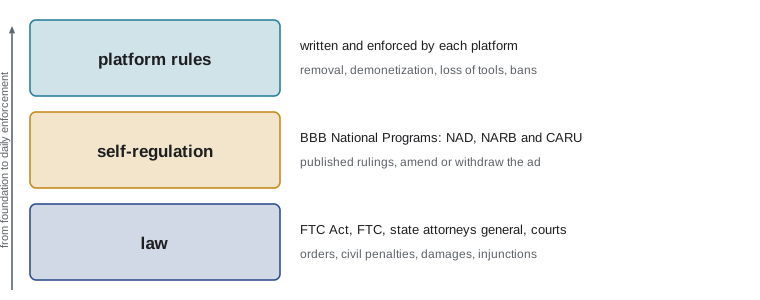
The layers usually point in the same direction. A hidden paid post breaks the law, the self-regulatory code and the platform's branded-content policy all at once. But they are not identical. Platform rules can be stricter than the law, for example by banning promotion of products that are legal to sell. Self-regulatory codes can be more detailed than the law, spelling out which hashtags are acceptable. And the law can reach conduct that platforms ignore, such as misleading health claims made in a video that the platform allows to stay up.
| Layer | Who writes it | Who enforces it | Typical consequences |
|---|---|---|---|
| Law | Legislatures and regulators | Government agencies and courts | Orders, penalties, damages, prosecution |
| Self-regulation | Industry bodies | The same bodies, using complaints | Published rulings, requests to amend or withdraw |
| Platform rules | Each platform | The platform itself | Removal, demonetization, loss of tools, bans |
Who can be held responsible
A common belief among new creators is that advertising law is the brand's problem. It is not. Regulators in both countries have made clear that responsibility is shared along the whole chain that produces a sponsored post.
- The brand, or advertiser, is responsible for the claims made about its products and for ensuring that the people it pays disclose the relationship. Brands are expected to have written policies, train their creators, monitor posts and act when something goes wrong.
- Agencies, public relations firms and influencer marketplaces that arrange campaigns can be responsible for what they design, approve or fail to correct.
- The creator is responsible for their own statements and for disclosing their material connections. A creator who makes a false claim, or who hides that a post is paid, can face enforcement personally.
The FTC's Endorsement Guides state that advertisers are subject to liability for misleading statements made by endorsers and for failing to disclose material connections, and that endorsers themselves may be liable for statements they make in an endorsement. The FTC has sent warning letters directly to individual influencers, not only to brands.
In practice, enforcement has focused most heavily on brands, because they write the briefs, set the incentives and have the money. But individual creators have received warning letters, been named in settlements and lost brand deals because of their own conduct. More importantly, a creator's reputation is personal. A brand can replace a creator after a scandal; a creator cannot easily replace an audience that feels deceived.
The core test: the overall impression
Advertising law in both countries is less interested in whether each sentence is literally true than in what an ordinary member of the audience would take away from the whole message. A post can mislead without a single false word, for example by showing results that were achieved with editing, or by presenting a paid post as a spontaneous discovery.
The FTC's 1983 Policy Statement on Deception describes a deceptive practice as a representation, omission or practice that is likely to mislead consumers acting reasonably in the circumstances, in a way that is material, meaning likely to affect their choices. The FTC looks at the net impression of the whole ad, and when an ad targets a particular group, such as teenagers or people with a medical condition, it asks how a reasonable member of that group would understand it.
Three ideas follow from this test, and they run through the whole course.
- Context matters more than wording. What counts is the message the audience receives, including images, tone, music, captions and what is left unsaid.
- Fine print does not cure a misleading headline. A disclaimer that contradicts the main message, or that people are unlikely to notice, does not fix it.
- The audience sets the standard. A message aimed at children, at people anxious about their health or at first-time investors is judged by how those people would understand it, not by how an experienced marketer would.
Worked problem
Applying the overall impression test
A fitness creator posts a video titled "How I lost 9 kg in 30 days" showing a protein shake in every scene. The caption ends with "#ad results not typical, diet and exercise required" after twenty other hashtags. The creator actually followed a strict diet with a personal trainer. What overall impression does the post give, and is it likely misleading?
Show solution
- Identify the main message: the title and visuals link the shake to dramatic weight loss in 30 days.
- Identify what the audience is not told clearly: that the post is paid, and that the result came mainly from diet and training.
- Check the qualifiers: the disclosure and disclaimer sit at the end after many hashtags, so most viewers will not see them, and a disclaimer cannot contradict the main message anyway.
- Consider the audience: people who want to lose weight are especially likely to take the claim at face value.
Answer: The overall impression is that the shake produced the weight loss. That impression is false and the qualifiers are hidden, so the post is likely misleading; it needs a clear upfront disclosure and must not imply results the product did not cause.
Materiality and the material connection
Two different ideas share the word material, and it helps to keep them apart. A representation is material when it is likely to influence a buyer's decision. A misleading claim about an unimportant detail is less likely to be a problem than a misleading claim about price, performance, safety or health.
A material connection is any relationship between a creator and a brand that the audience might not expect and that could affect how much weight they give the recommendation: payment, free products, discounts, travel, affiliate commissions, employment, family ties or an ambassador agreement. Material connections must be disclosed. Lesson 3 covers the detailed disclosure rules; lesson 4 works through the hard cases.
Ethics beyond the law
The law sets a floor, not a ceiling. Many choices a creator makes are legal but still raise ethical questions. Is it right to promote a high-risk investment to an audience of students, even with a perfect disclosure? To accept a deal with a brand whose values contradict what you have told your audience you stand for? To use a filter that makes your skin look smoother in a skincare ad, if no law in your jurisdiction specifically prohibits it? To build a virtual influencer and let the audience believe it is a person?
Throughout the course we use a simple ethical framework with four questions:
- Honesty: would my audience feel misled if they knew everything I know about this post?
- Fairness: does this exploit a vulnerability, such as youth, illness, financial stress or insecurity about appearance?
- Respect: does it respect my audience's ability to make their own decisions with full information?
- Accountability: would I be comfortable defending this choice publicly, to my audience and to a regulator?
Ethics is not only about avoiding harm. Creators who are consistently honest build the kind of trust that makes their recommendations valuable, and brands increasingly look for creators whose audiences trust them. Lesson 11 returns to ethics in depth, including artificial intelligence, virtual influencers, deepfakes and edited images.
Enforcement in the real world
How likely is it that a regulator will look at one creator's posts? Honestly, for most small creators, a regulator will not review any individual post. Enforcement tends to follow patterns: complaints from the public or competitors, large campaigns, high-risk products such as health products and investments, sweeps of an industry and conduct that harms vulnerable people. But low probability of enforcement is the wrong way to think about compliance, for three reasons.
- Brands increasingly require compliance in their contracts, check posts and drop creators who create risk. Non-compliance costs deals.
- Platforms enforce their own policies automatically and at scale. A missing branded-content label can cost reach or access to tools.
- Audiences notice. Screenshots of hidden sponsorships, fake reviews or misleading claims spread quickly and are hard to undo.
US examples show the pattern. In 2017 the FTC sent more than 90 letters to brands and influencers about disclosure; in 2021 it sent Notices of Penalty Offenses on endorsements to more than 700 companies; in 2023 it sent warning letters to individual registered dietitians and other influencers, and to two trade associations, over undisclosed paid posts about aspartame and sugar. In 2022 the FTC and several states settled with Google and iHeartMedia over radio personalities who endorsed a phone they had never used, with combined penalties of about $9.4 million.
How the rest of the course is organized
The course moves from general principles to specific products, audiences and tools.
- Lesson 2 explains the core advertising law in your country in detail: the prohibitions, the tests, the enforcement process and the penalties.
- Lessons 3 and 4 cover disclosure of material connections: the detailed rules and then the hard cases, such as affiliates, gifts, live streams, podcasts and employees.
- Lesson 5 covers reviews, testimonials and fake engagement.
- Lesson 6 covers claims and substantiation, including environmental and origin claims.
- Lesson 7 covers regulated products: health, food, alcohol, cannabis, gambling and investments.
- Lesson 8 covers children, teens and vulnerable audiences.
- Lesson 9 covers privacy, email and text marketing, and contests and giveaways.
- Lesson 10 covers platform rules and branded-content tools.
- Lesson 11 covers ethics, artificial intelligence, virtual influencers, deepfakes and edits.
- Lesson 12 brings it together in a compliance workflow and a capstone audit.
Worked problem
Sorting rules into layers
A creator receives four instructions about a sponsored video: (a) "Turn on the paid partnership label"; (b) "Do not claim the supplement cures anxiety"; (c) "Use #ad, not #sp"; (d) "No ads for vaping products on this channel." Which layer does each rule most likely come from?
Show solution
- (a) The paid partnership label is a platform tool, and platforms require it for branded content: platform rules.
- (b) A disease cure claim for a supplement is prohibited by health product law and general advertising law: law.
- (c) Specific guidance on acceptable hashtags comes mainly from self-regulatory guidelines and regulator guidance documents: self-regulation, backed by law.
- (d) Many platforms ban promotion of vaping products in branded content even where sales are legal: platform rules.
Answer: (a) platform, (b) law, (c) self-regulation backed by law, (d) platform. Many rules sit in more than one layer, so a creator should follow the strictest that applies.
A note on keeping current
Advertising law changes often. In the past few years both countries have amended or added rules on fake reviews, drip pricing, environmental claims, children's privacy and artificial intelligence, and platforms update their policies even more frequently. This course states facts as they stood at the time of writing in October 2026 and flags points that were changing. Before a significant campaign, check the regulator's current guidance and the platform's current policies, and treat any summary, including this one, as a starting point rather than the final word.
Common mistakes
MistakeAssuming advertising law only applies to brands.
InsteadCreators can be held responsible for their own claims and disclosures.
MistakeJudging a post only by whether each sentence is literally true.
InsteadRegulators judge the overall impression, including images and omissions.
MistakeRelying on a disclaimer to fix a misleading headline.
InsteadMake the main message truthful; disclaimers cannot contradict it.
MistakeTreating platform rules as the same as the law.
InsteadFollow both; platforms can be stricter and the law reaches further.
MistakeIgnoring compliance because enforcement against small creators is rare.
InsteadBrands, platforms and audiences enforce standards every day.
Summary and key terms
- Advertising is regulated to protect consumers, honest competitors and trust in information.
- Creators work under three layers: law, self-regulation and platform rules.
- Responsibility is shared among brands, agencies and creators.
- Regulators judge the overall impression a message gives to its intended audience.
- Material connections must be disclosed; material claims must be truthful.
- Ethics sets a higher bar than the law: honesty, fairness, respect and accountability.
- Rules change often, so check current guidance before significant campaigns.
- Advertising law
- Rules that prohibit false or misleading marketing and set standards for promotions.
- Self-regulation
- Codes written and enforced by industry bodies rather than governments.
- Platform rules
- A social network's terms of service and advertising policies.
- Overall impression
- The message an ordinary member of the audience takes away from the whole ad.
- Material
- Likely to affect a consumer's decision.
- Material connection
- A relationship with a brand that could affect how an endorsement is weighed.
- Endorsement
- A message the audience may see as the creator's own opinion or experience.
- Disclaimer
- A qualifying statement attached to a claim.
- Enforcement
- Action by a regulator, court, industry body or platform to apply rules.
- Shared responsibility
- The principle that brands, agencies and creators are all accountable.
Practice problems
Work each problem on paper first, then reveal the answer to check.
Name the three layers of rules that apply to creators.
Show answer
Law, self-regulation and platform rules.
Why is hidden sponsorship especially harmful in influencer marketing?
Show answer
Audiences give the post the weight of an independent opinion.
Who can be held responsible for a misleading sponsored post?
Show answer
The brand, agencies involved and the creator.
What test do regulators apply to decide whether a message is misleading?
Show answer
The overall or net impression it gives the intended audience.
Can a disclaimer fix a misleading main claim?
Show answer
No, a disclaimer cannot contradict the main message.
What makes a representation material?
Show answer
It is likely to affect a consumer's decision.
Give three examples of material connections.
Show answer
Payment, free products, affiliate commission, employment, family ties.
List the four questions of the ethics check.
Show answer
Honesty, fairness, respect and accountability.
Give two reasons to comply even when regulator enforcement is unlikely.
Show answer
Brands require it, platforms enforce rules and audiences notice.
Which layer usually governs whether a product may appear in branded content?
Show answer
Platform rules, alongside the law.
Lesson quiz · 5 questions
Score 60% or more to complete this lesson.
Create a free account to save your progress, take quizzes and earn a certificate.