
CRE-320 · Lesson 3 of 12 · 27 min
Disclosing material connections: the detailed rules
Lesson 10 of CRE-310 explained disclosure as part of running a brand deal: use #ad, put it up front, add it in the video and do not hide it among hashtags. This lesson goes underneath those habits to the rules they come from. We look closely at what triggers the duty to disclose, what the regulators and self-regulators in your country actually require, the tests used to judge whether a disclosure is adequate and how to apply those tests to real posts. By the end you should be able to look at any sponsored post and explain, with reasons, whether its disclosure would satisfy the rules.
When the duty to disclose arises
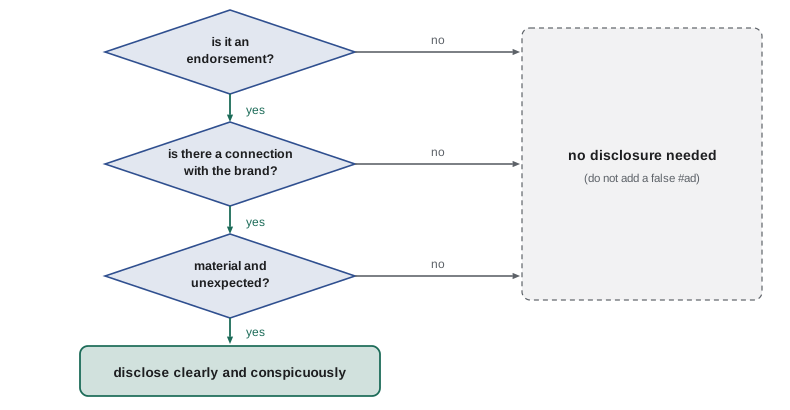
The duty to disclose arises when three conditions are met. Thinking through them in order prevents both under-disclosure, which is the common legal risk, and over-disclosure, which clutters content and can confuse audiences.
- There is an endorsement: a message the audience is likely to see as reflecting the creator's own opinion, belief, finding or experience, rather than the brand's. Reviews, recommendations, "favorites" lists, unboxings, tutorials featuring a product, and even tags, pins and likes can be endorsements.
- There is a connection between the creator and the brand: payment, free or discounted products, loans, travel, affiliate commission, contest entries, employment, a family or business relationship, or a place in an ambassador program.
- The connection is material and unexpected: it could affect how much weight the audience gives the endorsement, and the audience would not already understand it from the context.
If all three are present, disclosure is required. If there is no connection at all, there is nothing to disclose, and adding #ad to a genuinely independent post can mislead in the other direction by implying payment that does not exist.
Why context rarely removes the duty
Creators sometimes argue that their audience "knows" they are paid. That argument rarely works. Regulators ask whether a significant part of the audience would understand the relationship, not whether the most engaged followers do. New viewers arrive from search, recommendations and shares every day and have no background knowledge. A post can also be shared out of context. The only connections that are usually obvious without disclosure are those that are plain from the content itself, such as a brand's own account posting about its own products.
The US framework
In the United States, the disclosure rules come from Section 5 of the FTC Act, interpreted in the Guides Concerning the Use of Endorsements and Testimonials in Advertising, 16 CFR Part 255, revised in June 2023. The FTC's plain-language publication "Disclosures 101 for Social Media Influencers" applies the Guides to everyday posts, and the FTC's ".com Disclosures" guidance explains clear and conspicuous disclosure online. The Guides are not themselves binding rules, but they describe what the FTC considers deceptive under Section 5, and companies that have received Notices of Penalty Offenses face civil penalties for knowingly violating the principles they describe.
Section 255.5 of the Guides requires disclosure when there is a connection between the endorser and the seller that might materially affect the weight or credibility of the endorsement and that the audience would not reasonably expect. The Guides give examples including payment, free products, early access, the possibility of winning a prize, employment, family relationships and affiliate commissions. The 2023 revision added that an unexpected connection must be disclosed even if the endorser would have said the same thing without it, and that a material connection exists when a company pays for, or provides free products for, a review, whether or not the reviewer was required to post.
What clear and conspicuous means
Both countries require that disclosures be clear and conspicuous, even though the phrasing differs slightly. The idea has two halves. A disclosure must be noticeable, so that the audience actually sees or hears it, and it must be understandable, so that the audience grasps what it means.
The 2023 Guides define clear and conspicuous as "difficult to miss (i.e., easily noticeable) and easily understandable by ordinary consumers." A disclosure must use the same means as the endorsement: visual for visual content, audible for audio, and both for video with sound. It must be unavoidable in interactive media, meaning consumers should not have to click, scroll or hover to find it. It must be in the language of the endorsement, in plain words, and for an audience that includes a particular group, such as children or older adults, it must be understandable to that group.
The FTC's guidance says that simple words such as "advertisement," "ad," "sponsored" and "paid partnership" are good choices, and that a statement like "Thanks to [Brand] for the free product" works when accurate. It warns against vague terms such as "sp," "spon," "collab," "thanks" or "ambassador" on their own, against disclosures mixed into a group of hashtags or links, and against relying on a profile bio or an "About me" page, since people may see an individual post without ever visiting the profile.
| Situation | Stronger choices | Weaker or unacceptable |
|---|---|---|
| Paid post | #ad, Ad:, Sponsored by [Brand], Paid partnership with [Brand] | #sp, #spon, #collab, #partner alone |
| Free product | #Gifted, Thanks to [Brand] for the free product | #thanks, tagging the brand only |
| Affiliate link | I earn a commission from links in this post, #affiliate | Disclosure only in the bio or link page |
| Ambassador | #[Brand]Ambassador, I am a paid ambassador for [Brand] | #ambassador without the brand |
| Event invitation | #InvitedGuest, plus what was provided | Silence because no money was paid |
Placement by format
Placement rules follow from one idea: the disclosure must reach the audience before or at the same moment as the endorsement, in a way they will not miss.
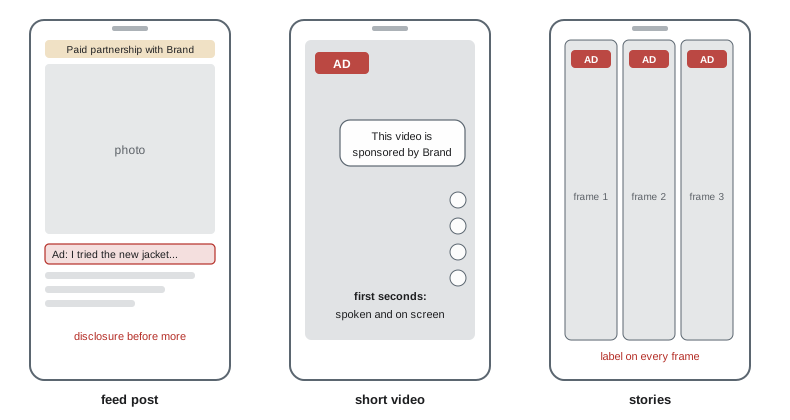
- Static posts and carousels: at the start of the caption, before the platform truncates it with "more". Where possible, on the image too.
- Short and long video: spoken and shown on screen near the start, and in the caption. Repeat it in longer videos, at intervals and near each product mention, because viewers drop in and out.
- Stories and other ephemeral content: on each frame that contains the endorsement, since viewers may see only one.
- Live streams: spoken at the start and repeated periodically, with a persistent on-screen label if possible.
- Podcasts and audio: spoken before the endorsement, not only in show notes.
- Character-limited posts: #ad or "Ad:" at the start; every post in a thread that endorses the product needs its own disclosure.
The FTC's guidance says that for video, the disclosure should be in the video itself, not only in the description, and for live streams it should be repeated periodically so viewers who join late see it. Disclosures placed only in a description that is collapsed, or after a "more" link, are unlikely to be adequate because viewers may never expand them.
Platform tools and their limits
Most platforms provide a branded-content or paid-partnership tool that adds a label to the post. Use it: platforms often require it, and it helps. But regulators in both countries have said the platform label may not be sufficient on its own. Labels can be small, appear in a place viewers do not look, be hidden by other interface elements or use wording that audiences do not understand. The safe approach, recommended in both countries, is to turn on the platform tool and add your own clear disclosure in the content and caption. Lesson 10 examines each platform's tools.
Applying the tests: a scoring approach
To judge a disclosure consistently, it helps to score it against five criteria drawn from the rules. Score each criterion 0 if it clearly fails, 1 if it partly meets the standard and 2 if it fully meets it, for a maximum of 10.
- Presence: is there a disclosure at all, for each endorsement?
- Wording: will ordinary viewers understand it?
- Placement: is it up front and close to the endorsement, before any truncation?
- Medium: does it match the medium, such as spoken and on screen for video?
- Specificity: does it say what the relationship is and with whom, where that matters?
A score of 9 or 10 indicates a disclosure that should satisfy the rules in most situations. A score below 7, or a 0 on any criterion, means the disclosure needs to be fixed. This rubric is a teaching tool, not a legal standard, but it mirrors how regulators reason.
Worked problem
Scoring a sponsored short video
A 45-second sponsored video about a meal-kit service has no spoken disclosure. The phrase "paid partnership" appears in the platform label above the caption. The caption reads "My weeknight secret weapon!! Code SAVE20 #mealprep #easydinners #ad". Score the disclosure.
Show solution
- Presence: there is a disclosure (platform label and #ad), so 2.
- Wording: "paid partnership" and "#ad" are understood terms, so 2.
- Placement: #ad sits at the end of the caption after other hashtags; the label is small, so 1.
- Medium: a video with sound has no spoken or on-screen disclosure in the video itself, so 0.
- Specificity: the label names the brand, so 2.
Answer: Score 7 with a 0 on medium, so the disclosure needs fixing: add a spoken and on-screen disclosure at the start and move "Ad:" to the start of the caption.
Worked problem
Scoring a gifted carousel
A creator posts a carousel of five skincare products. One was bought; four were sent free by different brands, without a requirement to post. The first line of the caption reads "#Gifted: products 2 to 5 were sent free by [Brand A], [Brand B], [Brand C] and [Brand D]. Product 1 I bought myself." Score it.
Show solution
- Presence: each gifted product is covered, so 2.
- Wording: #Gifted plus a plain explanation, so 2.
- Placement: first line of the caption, before truncation, so 2.
- Medium: a carousel is visual and the disclosure is in text; adding a small label on each gifted slide would be ideal, so 1 or 2.
- Specificity: names each brand and distinguishes the bought product, so 2.
Answer: Score 9 or 10. This disclosure is clear, specific and up front, and it avoids implying that the bought product was sponsored.
Disclosure does not cure a false claim
A clear disclosure solves one problem: the audience knows the post is commercial. It does not make a false or unsupported claim acceptable. If a creator says a product cured their eczema, the claim must be true and the product must be lawfully able to make that claim, whether or not the post says #ad. Similarly, an endorser who says they use a product must actually use it, and an endorsement must reflect the creator's honest opinion. Lessons 5 and 6 cover honest endorsements and claim substantiation.
Keeping evidence
Because disclosure is judged on what the audience saw, it helps to keep evidence of what was posted. A simple habit is to screenshot or screen-record each sponsored post on mobile at the time of posting, showing the disclosure in place, and to store it with the contract and brief. If the post is later edited, cropped by the platform or questioned by a brand, regulator or audience member, you have a record.
Common mistakes
MistakeAdding #ad to genuinely unsponsored posts "just in case".
InsteadDisclose real connections; false disclosures can mislead too.
MistakeAssuming loyal followers already know about the deal.
InsteadDisclose for new viewers who arrive without context.
MistakeUsing #collab or #partner alone.
InsteadUse clear words such as #ad, Sponsored or Paid partnership with [Brand].
MistakeDisclosing only in a video's description.
InsteadDisclose in the video itself, spoken and on screen.
MistakeThinking disclosure makes any claim acceptable.
InsteadClaims must still be truthful and supported.
Summary and key terms
- Disclosure is required when an endorsement involves a material, unexpected connection.
- Connections include payment, gifts, travel, affiliate commission, employment and relationships.
- Clear and conspicuous means easy to notice and easy to understand.
- Place disclosures up front, close to the endorsement and in the same medium.
- Vague hashtags, bio-only statements and brand tags alone are not adequate.
- Platform labels help but should be combined with your own disclosure.
- Disclosure does not cure a false or unsupported claim.
- Endorsement
- A message the audience may see as the creator's own opinion or experience.
- Material connection
- A relationship that could affect the weight of an endorsement.
- Clear and conspicuous
- Easily noticeable and easily understandable.
- Unavoidable
- Seen without clicking, scrolling or hovering.
- Gold standard
- Ad Standards' description of #ad as the clearest hashtag.
- Interpretation Guideline #5
- Ad Standards guidance applying the Code to material connections.
- 16 CFR Part 255
- The US Endorsement Guides.
- Paid partnership label
- A platform tool that marks branded content.
- Truncation
- The point where a platform hides the rest of a caption behind more.
- Disclosure rubric
- A scoring method for judging disclosure quality.
Practice problems
Work each problem on paper first, then reveal the answer to check.
What three conditions trigger the duty to disclose?
Show answer
An endorsement, a connection with the brand, and the connection is material and unexpected.
Why might adding #ad to an independent post be a problem?
Show answer
It can falsely imply payment.
What two halves make up clear and conspicuous?
Show answer
Noticeable and understandable.
Where should a disclosure go in a long caption?
Show answer
At the start, before truncation.
How should a video disclose?
Show answer
Spoken and on screen in the video, near the start, plus the caption.
Is a bio statement enough?
Show answer
No, each post needs its own disclosure.
Are platform labels sufficient alone?
Show answer
Not necessarily; add your own disclosure.
A disclosure scores 2, 2, 1, 2, 2. Total?
Show answer
9.
Does #Gifted suit a paid post?
Show answer
No, #ad or Sponsored suits paid content.
Why keep screenshots of sponsored posts?
Show answer
To prove what the audience saw.
Lesson quiz · 5 questions
Score 60% or more to complete this lesson.
Create a free account to save your progress, take quizzes and earn a certificate.