
CRE-302 · Lesson 9 of 12 · 29 min
Courses, coaching and education products
Many creators are teachers, whether or not they think of themselves that way. Audiences come to them to learn how to edit video, cook, invest, play guitar, code, paint, train for a marathon or start a business. Education products turn that teaching into revenue: online courses, cohort-based programs, workshops, coaching and paid communities centered on learning. Courses can command far higher prices than templates or e-books because they promise a transformation, a skill or result the buyer wants, and coaching can be priced higher still. They also carry higher expectations: buyers expect structure, quality and support, and education claims are subject to advertising rules. This lesson covers the main education formats, course design for results, pricing and launch economics, platforms, coaching and its limits, and the honest marketing of education products.
Education formats
Education products fall along a range from fully self-paced to fully personal:
- Self-paced courses: pre-recorded lessons, worksheets and quizzes that buyers complete on their own schedule. They scale without limit but have low completion rates when learners lack support.
- Cohort-based courses: a group of learners progresses together over several weeks with live sessions, deadlines, feedback and community. They command higher prices and achieve much higher completion, but require the creator's time during each cohort.
- Workshops and masterclasses: single live sessions or short series on a specific topic, often recorded for later sale.
- Coaching and mentoring: one-to-one or small-group sessions tailored to each client.
- Learning memberships: ongoing monthly lessons or critique within a membership (Lesson 6).
Many creators combine formats, for example a self-paced course with an optional premium tier that adds group coaching calls.
| Format | Typical price range | Scales? | Completion and results |
|---|---|---|---|
| Self-paced course | About $50–$500 | Yes, unlimited | Often low without support |
| Cohort course | About $300–$2,000+ | Limited by cohort size | High with live support |
| Workshop | About $20–$200 | Moderately | Focused, short |
| Group coaching | About $100–$500 a month | Small groups | High accountability |
| One-to-one coaching | About $100–$500+ an hour | No, time-limited | Tailored |
Designing for results
The value of a course lies in what learners can do after it. Good course design starts from a clear outcome ("edit a three-minute short film in DaVinci Resolve", "build a monthly budget and emergency fund") and works backwards to the steps needed to reach it. Lessons should be short and focused, with practice tasks, examples and feedback opportunities. Free content and paid courses can coexist: free videos explain what and why, while a course provides structure, sequence, depth, exercises, templates and support that turn information into results. Courses that simply repackage free videos tend to disappoint buyers and generate refunds. Gathering feedback from a first small cohort, often sold at a discount as a "beta", improves the course before a larger launch.
Completion matters for reputation and future sales. Self-paced courses commonly report that only a minority of buyers finish; cohort courses with deadlines, community and live sessions report much higher completion. Features that support completion include progress tracking, a clear schedule, accountability groups, short lessons, early wins and occasional live question-and-answer sessions.
Pricing and launch economics
Course pricing reflects the value of the outcome, the depth of support, and the audience's ability to pay. A course that helps people get a job, win clients or save significant money can justify a high price; a hobby course usually needs a lower one. Courses are often sold through launches: a period of free content, such as a webinar or video series, followed by a limited-time enrollment window, often with an early discount or bonuses. Launch revenue can be estimated from the size of the audience that sees the offer and the conversion rate.
Worked problem
Estimating a course launch
A creator has an email list of 12,000 subscribers and expects 1.5 % to buy a $249 course. Refunds average 5 %, and platform and processing fees total 8 % of sales. What net revenue should they expect?
Show solution
- Buyers: 12,000 × 0.015 = 180.
- Gross sales: 180 × $249 = $44,820; after refunds: $44,820 × 0.95 = $42,579.
- After fees: $42,579 × 0.92 ≈ $39,173.
Answer: About $39,000 of net revenue from the launch.
Conversion rates for course launches vary widely, from well under 1 % for a cold audience to several percent for engaged email lists, so creators should plan with a conservative estimate and treat the first launch as a test. After the launch, many creators sell the course on an evergreen basis, with automated email sequences, or reopen enrollment periodically.
Break-even for a course
Courses have substantial fixed costs: planning, recording, editing, worksheets, platform setup and marketing, as well as the creator's time. A course that takes 150 hours to make, valued at $50 an hour, plus $3,000 of editing and design, has fixed costs of $10,500.
Worked problem
Break-even students
A course has fixed costs of $10,500, a price of $199, a 5 % refund rate, 8 % fees and $10 of support cost per student. How many students are needed to break even?
Show solution
- Net per student: $199 × 0.95 × 0.92 ≈ $173.92.
- Contribution: $173.92 − $10 = $163.92.
- Break-even: $10,500 / $163.92 ≈ 64.1, so 65 students.
Answer: About 65 students; a launch to an engaged list of several thousand could reach that, while a small or cold audience might not.
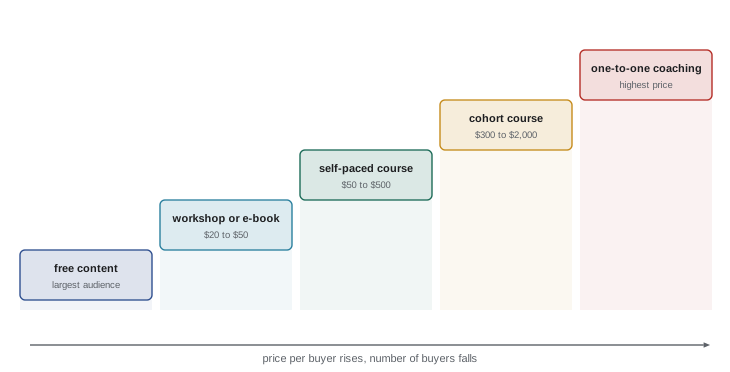
The product ladder
Education products are often arranged as a ladder, sometimes called a value ladder. Free content attracts a broad audience; a low-priced product such as a workshop or guide converts a share of them into customers; a course serves those who want depth; and coaching or cohort programs serve the smaller number who want personal support. Each step requires more trust and offers more value. A ladder is not a scheme to extract money from every viewer; it gives different people the level of help they want, at a price that matches the creator's time.
Platforms
Course platforms include Teachable, Thinkific (a Canadian company), Kajabi, Podia, LearnWorlds and Skool, plus membership tools and community platforms with course features. They differ in pricing (monthly subscription, transaction fees or both), features (quizzes, certificates, cohorts, community, email marketing), and whether they handle sales tax as a merchant of record. Marketplaces such as Udemy and Skillshare bring their own students but set prices or pay by minutes watched, giving the creator less control and lower revenue per student. Creators should consider who owns the student relationship, whether they can export student emails, and how easily the course could be moved later.
Coaching and its limits
Coaching, consulting-style calls and personal mentoring can be the highest-priced education offering, and they are a good way to learn what students struggle with before building a course. But coaching revenue is limited by the creator's time.
A creator who can spare ten hours a week at $150 an hour can earn at most about $6,000 a month from coaching, before preparation time, cancellations and admin. Group coaching raises the effective hourly rate by serving several clients at once. Creators should set boundaries on availability, require payment in advance, and have clear policies on rescheduling and cancellations. Coaching in regulated areas, such as financial, legal, medical, mental health or nutrition advice, may require qualifications or licenses; creators should stay within their qualifications and avoid presenting coaching as professional advice they are not licensed to give.
Honest marketing of education products
Education marketing is prone to exaggerated claims: "earn $10,000 a month", "get fit in 30 days", "guaranteed results". Advertising law in both countries prohibits misleading claims, and earnings claims receive particular scrutiny.
In the United States, the FTC Act prohibits deceptive claims, and the FTC has warned businesses that earnings claims must be truthful and substantiated, with typical results disclosed. The FTC has brought cases against online business-coaching and course operators over unsupported earnings claims, and the 2023 Endorsement Guides and 2024 fake reviews rule apply to testimonials. Some states regulate certain career education programs.
Honest marketing is also good business: students who get the results they expected recommend the course, while those who feel misled ask for refunds and leave public reviews. Clear descriptions of who the course is for, what it covers, the effort required and realistic results, with a fair refund policy, reduce refunds and build long-term reputation.
Structuring a course
A clear structure helps learners progress and helps the creator plan production. A typical course is divided into modules, each covering a stage of the learner's journey, with short lessons of five to fifteen minutes, a practical task at the end of each module and a final project that demonstrates the outcome. Supporting materials, such as checklists, templates, example files and transcripts, add value and make the course easier to follow. Including a short orientation module that explains how to use the course, sets expectations about effort and shows the final result motivates learners from the start.
Recording and production quality
Course production quality matters, but less than many creators fear. Clear audio, legible screens and well-organized explanations matter more than cinematic visuals. Screen recordings with a good microphone serve many software courses well; hands-on skills such as cooking or woodworking need clear camera angles of the work. Planning each lesson in an outline before recording, and recording in batches, keeps production efficient. Courses should be easy to update: separating lessons into small videos means one outdated lesson can be replaced without re-recording a whole module.
Worked problem
Cohort versus self-paced
A creator considers two options. A self-paced course at $199 sells 300 copies a year with 8 % fees and $5 support cost per student. A cohort course at $800 runs three times a year with 25 students each, 8 % fees, and requires 40 hours of live teaching per cohort, valued at $75 an hour. Compare the annual contribution after teaching time.
Show solution
- Self-paced: 300 × ($199 × 0.92 − $5) = 300 × $178.08 = $53,424.
- Cohort revenue after fees: 75 × $800 × 0.92 = $55,200.
- Teaching time: 3 × 40 × $75 = $9,000; cohort contribution: $55,200 − $9,000 = $46,200.
Answer: The self-paced course contributes about $53,400 and the cohort about $46,200 after valuing teaching time, but the cohort serves fewer students more deeply and may produce better results and testimonials.
Certificates and credentials
Many course platforms issue certificates of completion, and learners value them as evidence of effort. Creators should be careful not to imply that a certificate is an accredited qualification, license or professional designation unless it is. Courses that prepare learners for recognized exams or regulated professions must be accurate about what they cover and should not claim affiliation with professional bodies without permission.
Refund policies
Clear refund policies reduce disputes. Common approaches include a 14- or 30-day refund window, sometimes conditional on the learner having attempted the course work. Generous refund policies can increase sales by reducing the risk of buying, and in practice most satisfied learners do not request refunds. Policies must also comply with consumer protection laws, which in some cases give rights regardless of the stated policy.
Community and support in courses
Many learners buy courses partly for the community and support that come with them. A discussion forum, a private group or scheduled question-and-answer sessions give learners a place to ask questions, share progress and stay motivated. Community features increase completion and satisfaction, but they need moderation and the creator's presence, at least at first. Some creators train teaching assistants, often successful former students, to answer questions and give feedback, which allows the course to grow without overwhelming the creator. Clear expectations about how quickly questions will be answered, and in which channels, prevent frustration on both sides.
Common mistakes
MistakeRepackaging free videos as a course.
InsteadAdd structure, practice, resources and support.
MistakePlanning a launch on optimistic conversion rates.
InsteadUse conservative estimates and test with a beta.
MistakeSelling unlimited one-to-one coaching.
InsteadCap hours and move clients to group formats.
MistakeUsing exceptional testimonials as typical results.
InsteadMake claims truthful and representative.
MistakeCoaching beyond your qualifications.
InsteadStay within your expertise and licensing rules.
Summary and key terms
- Education products range from self-paced courses to one-to-one coaching.
- Design courses around a clear outcome with practice and feedback.
- Cohorts and support raise completion and value.
- Launch revenue = list × conversion × price, after refunds and fees.
- Break-even students = fixed costs ÷ contribution per student.
- Coaching revenue is capped by available hours.
- Earnings and results claims must be truthful and substantiated.
- Self-paced course
- Pre-recorded course completed on the learner's schedule.
- Cohort course
- Course taken by a group together with live elements.
- Launch
- A limited period of promotion and enrollment.
- Evergreen
- Available for purchase at any time.
- Beta cohort
- An early discounted group used to improve a course.
- Completion rate
- Share of students who finish a course.
- Value ladder
- Products arranged by price and depth of help.
- Group coaching
- Coaching delivered to several clients together.
- Earnings claim
- A statement about income buyers may achieve.
- Typical results
- What most buyers can realistically expect.
Practice problems
Work each problem on paper first, then reveal the answer to check.
Name four education formats.
Show answer
Self-paced, cohort, workshop, coaching, learning membership.
Why do cohort courses have higher completion?
Show answer
Deadlines, live sessions and community.
Buyers from a 20,000 list at 1 %?
Show answer
200.
Gross from 200 buyers at $150?
Show answer
$30,000.
Break-even for $8,000 fixed and $160 contribution?
Show answer
50 students.
Max coaching revenue for 8 hours a week at $125, per 4-week month?
Show answer
$4,000.
What is a beta cohort for?
Show answer
Testing and improving a course at a discount.
Name a Canadian course platform.
Show answer
Thinkific.
What must earnings claims be?
Show answer
Truthful, substantiated and representative.
What does a value ladder do?
Show answer
Offers different levels of help at matching prices.
Lesson quiz · 5 questions
Score 60% or more to complete this lesson.
Create a free account to save your progress, take quizzes and earn a certificate.