
CRE-302 · Lesson 4 of 12 · 29 min
Affiliate marketing
Affiliate marketing pays creators a commission when someone buys a product through a tracked link or code that the creator shared. It suits creators whose audiences come to them for recommendations: reviewers, educators, hobby and craft creators, travel, fitness, technology and lifestyle channels. Affiliate income requires no inventory, no customer service and no negotiation for each deal, and it can keep earning from old content for years. But it also depends on the honesty of recommendations, the terms set by merchants and networks, and clear disclosure to the audience. This lesson explains how affiliate programs work, the key metrics, conversion rates, earnings per click (EPC) and average order value, how to choose programs and products, how to place links effectively and honestly, and the disclosure rules that apply in Canada and the United States.
How affiliate programs work
An affiliate program is an arrangement in which a merchant pays a commission to partners who refer customers. The creator joins a program, receives unique tracking links or discount codes, and shares them in content, descriptions, posts or newsletters. When a viewer clicks the link, a tracking cookie or similar identifier records the referral; if the viewer buys within the attribution window, often between 24 hours and 90 days depending on the program, the creator earns a commission. Commissions are usually a percentage of the sale, a fixed amount per sale, or a fixed amount per lead or sign-up.
Programs come in several forms:
- Large retailer programs, such as Amazon Associates, which cover millions of products with commission rates that vary by product category and are often in the low single digits, with short attribution windows.
- Affiliate networks, such as Impact, CJ, Rakuten Advertising, ShareASale or Awin, which connect creators to many merchants through one account.
- Direct merchant programs, run by individual brands, especially in software, education and direct-to-consumer products, which may offer higher commissions or recurring commissions on subscriptions.
- Platform shopping programs, such as YouTube Shopping, TikTok Shop and Instagram product tags, which let creators tag products within content and earn commission inside the platform.
Commission rates differ enormously: physical goods from large retailers may pay a few percent, while software and digital courses may pay 20 to 50 %, sometimes recurring monthly for as long as the customer stays subscribed.
Key metrics
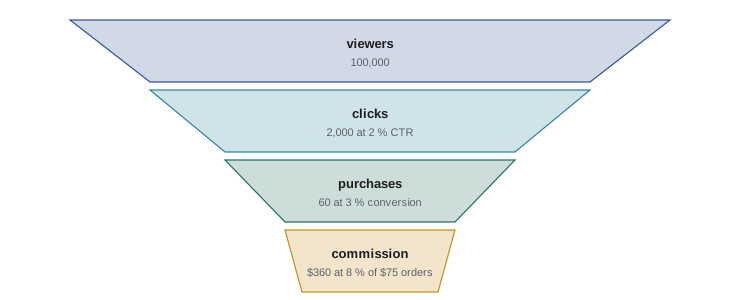
Affiliate performance can be broken into a chain of rates. Click-through rate (CTR) is the share of viewers who click; conversion rate is the share of clicks that result in a purchase; average order value (AOV) is the average value of each purchase; and the commission rate is the share of each sale paid to the creator.
Earnings per click (EPC) combines the last three factors into a single figure that is useful for comparing programs. Networks often report EPC per 100 clicks.
Worked problem
Affiliate revenue from a review video
A camera review gets 100,000 views. 2 % of viewers click the affiliate link, 3 % of those clicks convert, the average order is $75, and the commission rate is 8 %. Find the clicks, purchases, revenue and EPC.
Show solution
- Clicks: 100,000 × 0.02 = 2,000.
- Purchases: 2,000 × 0.03 = 60.
- Sales: 60 × $75 = $4,500; commission: $4,500 × 0.08 = $360.
- EPC: $360 / 2,000 = $0.18 per click, or $18 per 100 clicks.
Answer: About $360 in commission, with an EPC of $0.18.
Worked problem
Comparing two programs
Program A pays 4 % on products with an average order of $200 and converts at 5 %. Program B pays 30 % on a $50 software subscription and converts at 2 %. Which has the higher EPC?
Show solution
- Program A: 0.05 × $200 × 0.04 = $0.40 per click.
- Program B: 0.02 × $50 × 0.30 = $0.30 per click.
- If Program B also pays recurring commission and the average customer stays 6 months, its EPC becomes $0.30 × 6 = $1.80.
Answer: Program A has the higher first-sale EPC, but Program B is far better if recurring commissions continue for several months.
This example shows why headline commission rates alone are misleading: conversion rate, order size, attribution window and recurring terms all matter.
Attribution windows and cookie rules
The attribution window, often called the cookie duration, is how long after a click a purchase still counts. A 24-hour window, common for large retailers, rewards creators whose viewers buy immediately; a 30- to 90-day window rewards considered purchases. Most programs credit the last affiliate link clicked before a purchase, so a viewer who clicks another creator's link later may move the commission. Browser privacy features, ad blockers and app-based shopping can break cookie-based tracking, which is one reason discount codes are popular: a code entered at checkout credits the creator regardless of how the viewer reached the store, and it gives the audience a benefit too.
Choosing programs and products
The best affiliate products are things the creator genuinely uses or has tested, that fit the audience's needs, and that are sold by reputable merchants with good customer service. Recommending a poor product for a high commission may earn money once, but returns, complaints and lost trust cost more. Practical criteria include:
- Relevance: the product solves a real problem for the audience.
- Quality and honesty: the creator would recommend it without the commission.
- Commission rate, conversion rate and EPC, ideally from network data or a test.
- Attribution window and whether commissions are recurring.
- Payment terms: minimum payout, payment schedule and reversal policies for returns.
- Restrictions: some programs forbid links in certain places, paid ads on brand terms or coupon sites.
- Availability in the audience's countries: a US-only program earns nothing from Canadian viewers, and vice versa; regional retailer programs and geo-targeted links help.
| Program type | Typical commission | Typical window | Notes |
|---|---|---|---|
| Large retailer | Low single digits by category | Often 24 hours | Huge range, low rates |
| Network merchant | About 5–15 % | 30 days common | Many brands, one account |
| Software or SaaS | 20–50 %, sometimes recurring | 30–90 days | High EPC if it converts |
| Digital courses | 30–50 % | 30–60 days | Check product quality |
| Platform shopping | Set per product | Platform rules | Tagged inside content |
Placing links effectively
Affiliate links work best where viewers are already deciding what to buy. Effective placements include product reviews and comparisons, tutorials that use specific tools, gear lists and kit pages on a website, newsletter recommendations, pinned comments and descriptions, and platform product tags. Content that answers buying questions, such as "best budget microphone for podcasting" or "how to choose hiking boots", attracts viewers with high purchase intent and can earn for years through search. A website or resource page with the creator's recommended gear, updated regularly, gives one stable destination that can be linked from every video. Creators should check links regularly, because products go out of stock, programs close and links break; broken links in old content silently lose revenue.
Disclosure rules
Affiliate links are a material connection between the creator and the merchant: the creator benefits when the viewer buys. Both Canadian and US law require that such connections be disclosed clearly so audiences can judge recommendations. Disclosure must be clear, close to the recommendation, and understandable, not buried in a long description or hidden behind a "more" link, and it should appear in the content itself when the recommendation is spoken or shown, not only in written text.
In the United States, the FTC's Guides Concerning the Use of Endorsements and Testimonials in Advertising, revised in 2023, require clear and conspicuous disclosure of material connections, including affiliate commissions. The FTC's guidance for influencers recommends simple language such as "I get commissions for purchases made through links in this post", placed where viewers will see it, and spoken in video. The FTC's rule on fake reviews and testimonials, finalized in 2024, adds civil penalties for certain deceptive review and endorsement practices.
Amazon Associates and many networks also require specific disclosure wording in their terms. Disclosure does not reduce affiliate income much in practice; audiences generally accept affiliate links from creators they trust, and many appreciate that clicking supports the creator at no extra cost. CRE-320 and CRE-330 cover advertising law and contracts in more depth.
Taxes and records
Affiliate commissions are business income. Creators should keep records of commissions by program, including reversals for returns, and reconcile payments against network reports. US networks may request tax forms, as with platform programs. Sales taxes are normally the merchant's responsibility, because the merchant makes the sale; the creator's commission is payment for a referral service. Whether that referral service is itself subject to GST/HST or US state sales tax depends on registration status and local rules; CRE-330 covers this.
Building an affiliate strategy
A sustainable affiliate strategy focuses on a manageable set of products the creator trusts, creates evergreen content that answers buying questions, keeps a central recommendation page up to date, tracks EPC by program and placement, tests discount codes against links, and reviews programs annually. It treats affiliate income as a by-product of genuinely helpful recommendations rather than the reason for them. Combined with ad revenue on the same content, affiliate links can substantially increase revenue per view without adding sponsorship negotiations or products to manage.
Testing and measuring affiliate performance
Affiliate performance improves with measurement. Most networks provide reports of clicks, conversions and commissions by link, and creators can use separate tracking IDs or sub-IDs for each video, platform or placement. This reveals which content drives sales, whether description links outperform pinned comments, and whether a discount code beats a link. A simple test changes one variable at a time, such as the wording of a call to action, the position of a link, or whether the product is shown on screen, and compares results over enough clicks to be meaningful.
Worked problem
Affiliate revenue per thousand views
A tutorial gets 40,000 views and earns $220 in affiliate commission; a vlog gets 120,000 views and earns $90. Compare their affiliate revenue per thousand views.
Show solution
- Tutorial: $220 / 40,000 × 1000 = $5.50.
- Vlog: $90 / 120,000 × 1000 = $0.75.
Answer: The tutorial earns $5.50 per thousand views against $0.75, about seven times as much, because its viewers are deciding what to buy.
Reversals, returns and payment terms
Affiliate commissions are usually not final when a sale is recorded. Merchants reverse commissions for returned or canceled orders, fraudulent purchases and orders that break program rules, so reported earnings often fall before payment. Networks commonly pay 30 to 90 days after the end of the month in which a sale occurred, once the return period has passed, and many set minimum payout amounts. Creators should forecast on approved rather than pending commissions, watch for unusually high reversal rates, and read program terms on what counts as a valid referral. Some programs prohibit creators from buying through their own links, using links in paid search ads, or posting links in places such as emails without permission.
Ethics beyond disclosure
Disclosure is the legal minimum, not the whole of ethical affiliate practice. Creators who rely on affiliate income should consider whether their reviews are balanced, whether they mention drawbacks and alternatives, and whether a higher commission influences which product they call the best. Many trusted reviewers publish their review policies, buy products themselves rather than relying on free samples, or recommend the best product even when it has no affiliate program. Audiences notice when every video ends with a link to the most expensive option, and creators who protect their credibility usually earn more over time.
Affiliate links on different platforms
Platforms handle links differently. YouTube allows links in descriptions, pinned comments and product shelves; Instagram restricts clickable links in captions, so creators use bio links, stories and shopping tags; TikTok has its own shop and bio links; podcasts depend on spoken codes and show notes; newsletters allow direct links. Creators should check each platform's rules on external links, as some reduce reach for posts with outbound links or prohibit certain affiliate programs.
Common mistakes
MistakeChoosing programs by headline commission alone.
InsteadCompare EPC, window and recurring terms.
MistakeRecommending products you have not used.
InsteadRecommend only what you trust.
MistakeHiding disclosure in a long description.
InsteadDisclose clearly, close to the recommendation, and aloud.
MistakeIgnoring broken links in old content.
InsteadAudit and update links regularly.
MistakeUsing US-only programs for a Canadian audience.
InsteadUse regional programs or geo-targeted links.
Summary and key terms
- Affiliates earn commission on purchases through tracked links or codes.
- Revenue = viewers × CTR × conversion × AOV × commission rate.
- EPC compares programs on earnings per click.
- Attribution windows and recurring commissions change program value.
- Recommend relevant, trusted products from reputable merchants.
- Place links where viewers are deciding, and keep them updated.
- Disclose affiliate relationships clearly under Canadian and US rules.
- Affiliate program
- A merchant program paying commission on referred sales.
- Affiliate network
- A service connecting affiliates to many merchants.
- Commission rate
- The percentage of a sale paid to the affiliate.
- Conversion rate
- The share of clicks that result in a purchase.
- Average order value
- The average value of purchases.
- EPC
- Earnings per click.
- Attribution window
- Time after a click during which a sale counts.
- Recurring commission
- Commission paid on each subscription renewal.
- Material connection
- A relationship that could affect an endorsement.
- Discount code
- A checkout code that credits the affiliate.
Practice problems
Work each problem on paper first, then reveal the answer to check.
Write the affiliate revenue chain.
Show answer
Viewers × CTR × conversion × AOV × commission rate.
EPC for 4 % conversion, $100 AOV, 5 % commission?
Show answer
$0.20.
Commission on 50 sales of $60 at 10 %?
Show answer
$300.
What is an attribution window?
Show answer
Time after a click during which a purchase counts.
Why are discount codes useful?
Show answer
They credit the creator without cookies and benefit the viewer.
Name three criteria for choosing products.
Show answer
Relevance, quality, EPC, window, terms, availability.
Where should affiliate disclosure appear?
Show answer
Clearly, close to the recommendation, spoken in video.
Name the Canadian and US disclosure authorities.
Show answer
Competition Bureau and Ad Standards; FTC.
Who usually collects sales tax on affiliate sales?
Show answer
The merchant.
Why audit old links?
Show answer
Broken links silently lose revenue.
Lesson quiz · 5 questions
Score 60% or more to complete this lesson.
Create a free account to save your progress, take quizzes and earn a certificate.