
CRE-302 · Lesson 10 of 12 · 30 min
Merchandise and physical products
Merchandise lets fans carry a creator's identity into the world: a T-shirt with an inside joke, a mug with a catchphrase, a poster of the channel's artwork. Beyond merch, some creators build full physical product lines, from cookware and cosmetics to board games, tools and snacks, sometimes growing them into businesses larger than the channels that launched them. Physical products can earn substantial revenue, but they have far thinner margins and more operational complexity than digital products: manufacturing, inventory, shipping, returns, product safety, labeling and sales tax on goods. This lesson covers merchandise models, unit economics and margins, break-even for inventory runs, fulfillment and shipping, legal and safety rules, and how to decide whether a physical product is worth the effort.
Merchandise models
Creators sell physical products through three main models:
- Print-on-demand (POD): a supplier such as Printful, Printify, Spring or Fourthwall prints each item when ordered and ships it directly to the customer. There is no upfront inventory and almost no financial risk, but the cost per item is high and margins are thin.
- Inventory runs: the creator orders a batch of products from a manufacturer, stores them, and ships orders, either personally or through a fulfillment company. Costs per unit are much lower, especially at larger quantities, but the creator must pay upfront and risks unsold stock.
- Limited drops and pre-orders: products are sold for a limited time, and the batch is made to match orders. This reduces inventory risk while keeping lower unit costs, at the cost of longer waits for customers.
Creator merch platforms often integrate with YouTube's merch shelf, Twitch and other platforms, letting fans buy without leaving the platform. Larger creator brands sell through their own online stores and, sometimes, retail partners.
| Model | Upfront cost | Cost per unit | Risk | Best for |
|---|---|---|---|---|
| Print-on-demand | None | High | Very low | Testing designs, small audiences |
| Inventory run | High | Low at volume | Unsold stock | Proven designs, larger audiences |
| Pre-order drop | Low | Moderate to low | Delivery delays | Limited editions |
| Creator brand | Very high | Lowest at scale | Business risk | Established audiences |
Unit economics
The key question for any physical product is how much each sale contributes after all the costs of that unit: the cost of goods (manufacturing or printing), packaging, shipping not charged to the customer, payment processing, platform fees, and an allowance for returns, damage and lost parcels.
Worked problem
Print-on-demand T-shirt
A POD T-shirt sells for $32. The supplier charges $15.50 for the shirt and printing; the customer pays shipping. The store platform and payment processing take 6 % of the price, and returns and reprints average 3 % of the price. What is the contribution and margin?
Show solution
- Fees: $32 × 0.06 = $1.92; returns allowance: $32 × 0.03 = $0.96.
- Total costs: $15.50 + $1.92 + $0.96 = $18.38.
- Contribution: $32 − $18.38 = $13.62; margin: $13.62 / $32 ≈ 43 %.
Answer: About $13.62 per shirt, a 43 % margin.
Worked problem
The same shirt from an inventory run
Ordering 500 shirts from a screen printer costs $7.20 each, plus $1.50 per order for packaging and a fulfillment company's pick-and-pack fee of $3.00. Fees and returns are the same as above. What is the contribution per shirt?
Show solution
- Unit costs: $7.20 + $1.50 + $3.00 + $1.92 + $0.96 = $14.58.
- Contribution: $32 − $14.58 = $17.42; margin ≈ 54 %.
Answer: About $17.42 per shirt, $3.80 more than POD, but only if the shirts sell.
Break-even for an inventory run
An inventory run requires an upfront investment in stock plus fixed costs such as design, samples, photography and setup fees. The break-even quantity is the number of units that must sell to recover the total investment.
Worked problem
How many shirts must sell?
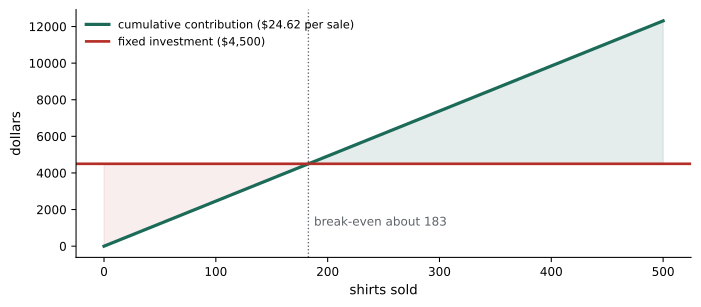
The creator pays $3,600 for 500 shirts (500 × $7.20), plus $900 for design, samples and photography. Selling costs per unit (packaging, fulfillment, fees and returns) are $7.38, and the price is $32. How many shirts must sell to break even, and what is the profit if all 500 sell?
Show solution
- Total investment: $3,600 + $900 = $4,500.
- Contribution per sale before stock cost: $32 − $7.38 = $24.62.
- Break-even: $4,500 / $24.62 ≈ 182.8, so 183 shirts, about 37 % of the run.
- If all 500 sell: 500 × $24.62 − $4,500 = $7,810 profit before overheads and tax.
Answer: About 183 shirts to break even; selling the whole run earns about $7,810.
The risk is that unsold stock ties up cash and may have to be discounted or written off. Sizes and colors make this worse: a shirt design ordered in six sizes and three colors is eighteen separate products, and demand for each is uncertain. Many creators test designs with POD or pre-orders before committing to an inventory run, and order more of the most popular sizes based on past sales.
Minimum order quantities and cash flow
Manufacturers often set minimum order quantities (MOQs), such as 300 units per design or 1,000 units for custom packaging, and unit costs fall as quantities rise. A creator must balance the lower unit cost of a large order against the risk and cash tied up. Cash flow matters as much as profit: a product line can be profitable on paper while the creator runs out of money because stock must be paid for months before it sells. Pre-orders, deposits from crowdfunding (Lesson 7), and starting with small runs reduce this pressure.
Fulfillment, shipping and returns
Getting products to customers is often the hardest part of physical products. Options include packing and shipping orders personally, which is cheap but time-consuming; using a third-party logistics (3PL) company that stores stock and ships orders for per-order fees; or using POD suppliers that handle everything. Shipping costs vary by weight, size and destination, and cross-border shipping adds customs forms, duties and longer delivery times. Customers increasingly expect free or low-cost shipping; many stores set a free-shipping threshold to raise average order value. Clear return and exchange policies, especially for clothing sizes, reduce disputes.
For US creators shipping to Canadian customers, Canadian duties and GST/HST may be charged to the customer on arrival above low-value thresholds, often with a courier brokerage fee, which can surprise buyers; stating this clearly or collecting duties at checkout improves the experience. Since late August 2025 the US has suspended the duty-free de minimis exemption for low-value imports, which affects creators who manufacture abroad and import stock or use overseas POD suppliers. Trade rules have changed frequently, so current tariffs should be checked.
Product safety, labeling and intellectual property
Physical products must meet safety and labeling rules. Clothing and textiles need fiber content and care information; children's products, toys, cosmetics, food, supplements and electrical goods face much stricter requirements, sometimes including testing and certification. Creators selling products to children should be especially careful, because rules on small parts, lead content, flammability and labeling are strict in both countries. Designs must not infringe others' trademarks, copyrights or character rights: fan-art merchandise using a game's logo or a film character without a license can lead to takedowns and legal claims. Creators should also consider registering their own trademarks if their brand becomes valuable, a topic for CRE-330.
In the United States, the Consumer Product Safety Commission enforces product safety rules, including strict testing and certification requirements for children's products under the Consumer Product Safety Improvement Act. The FTC enforces the Textile Fiber Products Identification Act and the Care Labeling Rule for clothing, and its Made in USA rule restricts origin claims.
Sales tax on physical goods
Physical products are generally subject to sales tax in both countries, with exemptions for some categories such as certain clothing or food in some jurisdictions. In Canada, GST/HST applies to most goods, with QST in Quebec and provincial sales taxes in British Columbia, Saskatchewan and Manitoba, and the $30,000 small supplier threshold applies to GST/HST registration. In the United States, state and local sales taxes apply under each state's rules, with economic nexus thresholds after Wayfair and marketplace facilitator laws for sales through marketplaces. Many merch platforms and marketplaces handle collection; creators running their own stores must check their obligations. CRE-330 covers this in detail.
Is a physical product worth it?
Before launching physical products, creators should ask whether the audience wants something physical, whether the product connects to the content, whether margins justify the work, and whether they have the time or partners to handle operations. Merch works best when it expresses the community's identity, such as an inside joke, a slogan or artwork fans love, rather than simply printing a logo. Creator-led product brands that become large businesses usually involve experienced partners, investors or co-founders to handle manufacturing, distribution and retail. For most creators, merch is a modest but valued stream that strengthens community; for a few, a physical product brand becomes the main business.
Designing merchandise fans want
The most successful creator merchandise is something fans would wear or use even without the creator's name on it. Good design, comfortable materials and a connection to the community's shared jokes, symbols or values matter more than a large logo. Many creators work with professional designers or artists from their community, paying them fairly and crediting them. Limited editions, seasonal designs and collaborations with other creators create urgency and novelty. Asking the community to vote on designs, or showing early sketches, builds interest before launch.
Pricing physical products
Pricing must cover all unit costs with room for discounts, free-shipping promotions and wholesale if the product is sold through retailers. A common rule in retail is that the retail price should be several times the cost of goods to leave room for distribution, though creator merchandise sold directly can work with lower multiples. Creators should check prices against comparable products: fans will pay a premium for merchandise connected to a creator they love, but not an unlimited one.
Worked problem
Free-shipping threshold
A store's average order is $38 and shipping costs the creator $9 per order. The creator introduces free shipping on orders over $60, expecting 40 % of orders to rise above the threshold to an average of $66, with the rest unchanged and paying their own shipping. Contribution is 45 % of order value before shipping. Compare contribution per order before and after, assuming customers previously paid shipping.
Show solution
- Before: contribution $38 × 0.45 = $17.10 per order.
- After, orders over $60: $66 × 0.45 − $9 = $20.70.
- After, other orders: $17.10; average: 0.4 × $20.70 + 0.6 × $17.10 = $18.54.
Answer: Contribution rises from $17.10 to about $18.54 per order, if the assumed change in order size happens.
Creator-led product brands
Some creators build product brands that go far beyond merchandise, launching food, beauty, fitness, toy or technology products. These businesses require product development, manufacturing partners, quality control, regulatory compliance, retail distribution and often outside investment. The creator's audience provides a launch advantage, but long-term success depends on the product competing on its own merits once it reaches customers who have never seen the creator's content. Creators considering this path often partner with experienced operators and agree clear terms about ownership, control and the use of their name and likeness.
Sustainability and quality
Fans increasingly care about how products are made. Overproduction, poor-quality items that fall apart, and excessive packaging can damage a creator's reputation. Print-on-demand reduces waste from unsold stock; choosing better blanks, ethical suppliers and recyclable packaging can become part of the brand story, provided claims about environmental benefits are accurate, since misleading environmental claims are prohibited in both countries.
Customer service is part of the product. Prompt answers about orders, sizes and delivery, and fair handling of damaged or lost parcels, turn a problem into a reason for fans to buy again.
Common mistakes
MistakeComparing merch by revenue instead of contribution.
InsteadCalculate contribution after all unit costs.
MistakeOrdering large inventory runs of untested designs.
InsteadTest with POD or pre-orders first.
MistakeIgnoring sizes and colors in stock planning.
InsteadTreat each variant as its own product.
MistakeUsing others' characters or logos without a license.
InsteadUse original designs or licensed art.
MistakeForgetting duties and cross-border shipping.
InsteadCheck current tariffs and carrier fees.
Summary and key terms
- Merch models include print-on-demand, inventory runs and pre-order drops.
- Contribution per unit subtracts all unit costs from the price.
- Inventory runs raise margins but add risk and cash needs.
- Break-even units equal total investment divided by contribution.
- Fulfillment, shipping, returns and duties drive operational cost.
- Products must meet safety, labeling and IP rules.
- Physical goods are generally subject to sales tax.
- Print-on-demand
- Items made and shipped only when ordered.
- Inventory run
- A batch of products ordered in advance.
- COGS
- Cost of goods sold: making each unit.
- Contribution per unit
- Price minus all unit costs.
- MOQ
- Minimum order quantity set by a manufacturer.
- 3PL
- A third-party logistics company that stores and ships stock.
- Pre-order
- Sale taken before a product is made.
- Variant
- A specific size or color of a product.
- De minimis
- A low-value threshold for duty-free imports.
- CUSMA
- The Canada–United States–Mexico trade agreement.
Practice problems
Work each problem on paper first, then reveal the answer to check.
Name three merchandise models.
Show answer
Print-on-demand, inventory run, pre-order drop.
Contribution of a $28 item with $16 total unit costs?
Show answer
$12.
Margin on that item?
Show answer
About 43 %.
Break-even for $3,000 investment and $20 contribution?
Show answer
150 units.
Why test designs with POD first?
Show answer
To avoid unsold inventory.
How many variants: 4 sizes in 3 colors?
Show answer
12.
What is a 3PL?
Show answer
A company that stores and ships stock.
Name a Canadian textile labeling law.
Show answer
The Textile Labeling Act.
Which US agency enforces product safety?
Show answer
The Consumer Product Safety Commission.
Why can merch be profitable but cash-poor?
Show answer
Stock is paid for before it sells.
Lesson quiz · 5 questions
Score 60% or more to complete this lesson.
Create a free account to save your progress, take quizzes and earn a certificate.