
CRE-240 · Lesson 3 of 12 · 27 min
Planning a show and structuring episodes
Listeners rarely notice planning, but they notice its absence: rambling introductions, conversations that circle without a point, episodes that end abruptly, and shows that change format or schedule unpredictably. Good planning operates at three levels: the show as a whole, with recurring elements and a format that listeners learn to expect; seasons or batches of episodes, which give a show rhythm and momentum; and individual episodes, with a clear structure that respects the listener's time. This lesson covers show bibles and format documents, recurring segments, season planning and episode calendars, episode structure, openings and cold opens, signposting, endings and calls to action, run sheets and outlines, and planning workflows that make a show sustainable.
The show bible
A show bible or format document records the decisions that define a show, so that every episode is consistent and anyone joining the team, such as an editor or co-host, understands the show. It typically includes the concept and positioning (Lesson 2), the target audience, the tone and style, the standard episode structure and length, recurring segments, the intro and outro scripts, music and sound guidelines, guest criteria, the release schedule, artwork and branding rules, and production standards such as loudness targets (Lesson 9). The bible is a living document: update it when the show evolves. Even solo creators benefit from writing one, because it forces clarity and prevents drift.
Recurring segments and formats
Recurring segments give a show structure and personality, help listeners know what to expect, and make episodes easier to plan. Examples include a listener question segment, a news roundup, a "tool of the week", a rapid-fire question round at the end of interviews, a recap, or a regular game between co-hosts. Segments should be distinctive, short enough to stay fresh, and easy to produce. Introducing each with a consistent phrase or sound cue helps listeners navigate. Avoid adding so many segments that the core content is squeezed; two or three recurring elements are usually enough.
Season planning and editorial calendars
Planning episodes in batches gives a show momentum and reduces weekly stress. Many shows plan a season of 8 to 20 episodes at a time, with a theme, arc or mix of topics. An editorial calendar, kept in a spreadsheet, a project management tool or a shared document, lists each planned episode with its topic, guest, recording date, editing deadline, release date and promotion plan. Planning ahead allows booking guests weeks in advance, aligning episodes with events and seasons (tax time for a finance show, the start of the school year for an education show), and building a buffer of recorded episodes, ideally three or four, so that illness, holidays or technical problems do not interrupt the release schedule.
| Episode | Topic | Guest | Record | Edit due | Release |
|---|---|---|---|---|---|
| 1 | Why beginners quit running | Physiotherapist | Jan 6 | Jan 13 | Jan 20 |
| 2 | Choosing your first shoes | Store owner | Jan 8 | Jan 20 | Jan 27 |
| 3 | Running through winter | Coach | Jan 15 | Jan 27 | Feb 3 |
| 4 | Listener questions | Solo | Jan 22 | Feb 3 | Feb 10 |
Episode structure
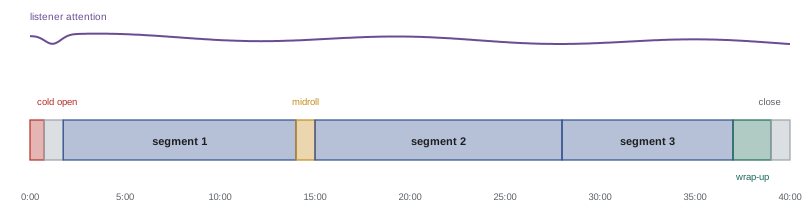
Most episodes, whatever the format, benefit from a clear structure:
- Opening: a hook or cold open that tells listeners why this episode matters, within the first 30 to 60 seconds.
- Introduction: the show's identity, the host, and what this episode covers, kept brief.
- Body: the main content, organized into sections or segments with transitions between them.
- Midroll or break: an advertisement, sponsor message or show announcement, if used.
- Wrap-up: a summary of key points or a reflection.
- Close: a call to action, a preview of the next episode and the outro.
For interviews, the body might follow a narrative arc through the guest's story or a set of themes; for solo educational shows, a numbered list of points; for co-hosted shows, two or three topics with segments. Writing down the intended structure before recording, even as a few bullet points, dramatically improves focus.
Openings and cold opens
The opening is where listeners decide whether to keep listening, especially new listeners sampling a show for the first time. Long introductions with music, housekeeping, sponsor messages and small talk drive people away. Effective openings include a cold open, a compelling excerpt from later in the episode played before the intro; a direct statement of the episode's question or promise ("Today we find out why most diets fail after six months, and what the research says works instead"); a story that drops listeners into a moment; or a surprising fact. Keep the branded intro short, about 10 to 30 seconds; regular listeners hear it every week. Move housekeeping, such as reviews, announcements and thanks, to later in the episode or to the end.
Worked problem
Rewriting a slow opening
An episode opens with 45 seconds of theme music, two minutes of the hosts chatting about their weekend, a sponsor message and then "today we're talking to a sleep scientist". How could it be restructured?
Show solution
- Find the most compelling moment in the interview, such as the guest explaining why sleeping in on weekends does not repay sleep debt.
- Open with a 30-second cold open of that moment.
- Follow with a 10-second theme sting and a two-sentence introduction of the guest and the episode's promise.
- Move the weekend chat to a brief, optional moment later, or cut it, and place the sponsor message at the first natural break.
Answer: Cold open with the best moment, a short intro and clear promise, then the interview; housekeeping and sponsors move later.
Signposting and transitions
Because listeners cannot see a structure, they rely on the host to signal it. Signposting means telling listeners where they are and where the episode is going: "We'll cover three things today", "That's the first reason; the second is…", "Coming up after the break, the question everyone asks". Transitions between segments can use a recurring sound, music, a short recap or a clear verbal bridge. In interviews, the host can summarize what the guest has said before moving to a new theme, helping listeners who joined late or drifted. Signposting is particularly important for listeners who are multitasking, who may miss a minute and need a way back in.
Endings and calls to action
Endings deserve as much care as openings. A strong ending summarizes or reflects, delivers a final memorable moment, thanks the guest, previews the next episode to encourage return listening, and includes one clear call to action. Too many calls to action ("rate, review, subscribe, follow us on four platforms, join the newsletter, visit the sponsor, buy the merch") dilute each other; choose one or two that matter most, such as subscribing or sharing the episode with a friend, and vary them over time. Listener numbers often drop toward the end of episodes, so important calls to action may also belong earlier, after a moment of value. Avoid long outros; once the content is finished, end promptly.
Run sheets and outlines
How much to script depends on the format. Narrative shows are fully scripted. Interview shows use a run sheet or outline: an introduction script, the guest's background, themes in order with key questions under each, and notes on time. Co-hosted shows use a topic list with talking points and segment timings. Solo shows range from bullet-point outlines to full scripts; outlines usually sound more natural, while scripts give precision. Whatever the format, a written plan keeps recordings focused, reduces editing time and helps hosts recover if they lose their place. Lesson 7 covers writing for the ear.
| Format | Planning document | Level of scripting |
|---|---|---|
| Narrative | Full script with tape and sound cues | Fully scripted |
| Interview | Run sheet with themes and questions | Intro scripted, rest outlined |
| Co-hosted | Topic list with talking points | Lightly outlined |
| Solo educational | Outline or full script | Outline or scripted |
| News briefing | Script | Fully scripted, often daily |
Sustainable workflows
Podcasts fail most often from burnout and inconsistency rather than lack of talent. Sustainable workflows include batching, such as recording two or three episodes in one session; templates for show notes, run sheets and editing sessions; checklists for each stage (pre-production, recording, editing, publishing, promotion); clear division of labor among co-hosts and editors; and realistic schedules with buffers. Tracking how long each stage takes for the first few episodes gives a realistic picture of the time commitment, allowing adjustments such as switching to biweekly releases or simplifying editing. CRE-350 covers creator wellbeing.
Worked problem
Estimating weekly workload
An interview show releases a 45-minute episode weekly. Tracking shows: guest research and booking 2 h, recording 1.25 h, editing at about 3 minutes of work per minute of finished audio, show notes 0.75 h, promotion clips and posts 2 h. What is the weekly workload?
Show solution
- Editing: 45 × 3 = 135 minutes = 2.25 h.
- Total: 2 + 1.25 + 2.25 + 0.75 + 2 = 8.25 h.
Answer: About 8.25 hours a week, more than a full working day for a 45-minute episode.
Episode types: full, trailer and bonus
Podcast feeds distinguish episode types: full episodes, trailers and bonus episodes. Bonus episodes, such as short updates, extra interviews or behind-the-scenes conversations, let a show publish extra content without disrupting the main numbering. Seasons can be marked in the feed, and serialized shows can ask apps to present episodes in order from the first, so new listeners start at the beginning, while episodic shows are presented newest first. Using these features correctly helps listeners understand and navigate the show.
Structure for different lengths
Episode structure scales with length. A 10-minute daily episode might have a 20-second hook, a single story or topic, and a short close. A 30-minute weekly episode might have a cold open, intro, two or three segments and a close. A 90-minute conversation needs more signposting and a deliberate arc, with recaps and transitions so that listeners who join or drift can find their place, and perhaps chapters (Lesson 11). Whatever the length, every minute should earn its place: a common editing question is whether a section would be missed if it were removed.
Planning for listener interaction
Many shows include listeners directly: answering questions, reading comments, featuring voice messages or inviting listeners onto the show. Listener segments build community and generate content, but need planning: a simple way for listeners to submit questions or voice memos, permission to use their names and recordings, a process for choosing submissions, and attention to privacy when listeners share personal stories. Read listener messages with care, since tone can be misread in audio, and avoid mocking listeners. Listener questions also reveal what the audience wants, guiding future episodes.
Planning for evergreen and timely content
Episodes can be evergreen, remaining useful for years, or timely, tied to news and events. Timely content can attract attention quickly but loses value fast, while evergreen content builds the back catalog (Lesson 11). Many shows mix the two, for example a weekly news segment followed by an evergreen interview, and avoid dating evergreen episodes with references such as "this week" or current prices unless necessary. Planning which episodes are evergreen helps decide how much effort to invest in each.
Contingency planning
Plans fail: guests cancel, co-hosts fall ill, recordings are corrupted. A sustainable show has contingency plans: a buffer of finished episodes, a list of backup topics that can be recorded on short notice, evergreen bonus episodes ready to publish, and a clear policy for announcing breaks. Telling listeners honestly about a planned break, with a return date, retains far more of them than an unexplained silence.
Writing show notes
Show notes accompany every episode in podcast apps and on the show's website. Useful show notes begin with a short summary of the episode, list guests with their titles and links, provide chapter timestamps, include links to resources and books mentioned, credit music and contributors, and disclose sponsors. They should be accurate and scannable rather than long. A template keeps show notes consistent and quick to write, and many creators draft them from the run sheet before recording, then update them after editing. Show notes also help search engines and listeners understand what each episode covers.
Common mistakes
MistakeLong, chatty openings.
InsteadLead with a cold open or clear promise.
MistakeRecording without a plan.
InsteadUse a run sheet or outline for every episode.
MistakeToo many calls to action.
InsteadChoose one or two that matter most.
MistakeNo recorded buffer.
InsteadKeep three or four episodes ready.
MistakeAdding segments until episodes sprawl.
InsteadKeep two or three recurring elements.
Summary and key terms
- A show bible records concept, structure, segments, style and standards.
- Recurring segments create structure and personality.
- Season planning and calendars build momentum and buffers.
- Episodes need an opening hook, a clear body and a deliberate ending.
- Signposting helps multitasking listeners follow the structure.
- Run sheets and outlines keep recordings focused.
- Batching, templates and realistic schedules prevent burnout.
- Show bible
- Document defining a show's format and standards.
- Segment
- Recurring section of an episode.
- Editorial calendar
- Schedule of planned episodes and deadlines.
- Buffer
- Recorded episodes ready before release.
- Cold open
- Excerpt played before the introduction.
- Midroll
- Advertisement or break in the middle of an episode.
- Signposting
- Telling listeners where they are in the structure.
- Run sheet
- Outline of an episode's order, questions and timings.
- Call to action
- Request for listeners to do something.
- Batching
- Recording or producing several episodes together.
Practice problems
Work each problem on paper first, then reveal the answer to check.
Name four elements of a show bible.
Show answer
Concept, audience, tone, structure, segments, intro script, schedule, standards.
Give two examples of recurring segments.
Show answer
Listener questions, news roundup, rapid-fire round, tool of the week.
Why keep a buffer?
Show answer
To keep publishing through illness or problems.
List the parts of an episode structure.
Show answer
Opening, intro, body, break, wrap-up, close.
What is a cold open?
Show answer
A compelling excerpt before the intro.
Ideal length of a branded intro?
Show answer
About 10–30 seconds.
What is signposting?
Show answer
Signaling the structure to listeners.
How many calls to action at the end?
Show answer
One or two.
Which format needs a full script?
Show answer
Narrative and news briefings.
Editing time for a 30-minute episode at 3 min/min?
Show answer
1.5 hours.
Lesson quiz · 5 questions
Score 60% or more to complete this lesson.
Create a free account to save your progress, take quizzes and earn a certificate.