
CON-499 · Lesson 7 of 12 · 20 min
Cash flow, budget and cost control plan
Ruth looked at Tomas's first cash flow chart for a long time before she said anything. 'So we will be about two and a quarter million dollars out of pocket in month seven,' she said. 'Who is paying for that?' Tomas had not thought of it that way. The estimate said Tamarack would make a fee of about $720,000. The cash flow said that, for most of the job, Tamarack's bank account would be well below zero. Both were true. A contractor that understands only the first number can win profitable jobs and still run out of cash.
This lesson covers the seventh deliverable: the cost-loaded schedule, the project cash flow, and the plan for controlling cost once construction starts. It draws on project cost control and earned value (CON-310) and construction finance and accounting (CON-320), and joins the estimate from lesson 5 to the schedule from lesson 6.
From estimate to control budget
An estimate is organized to win a bid. A control budget is organized to run a job. After award, the project team turns the estimate into a budget by cost code, so that every invoice, timesheet and subcontract payment can be charged to a code and compared with the money allowed for it. Tamarack's cost codes combined the WBS area from lesson 2 with a cost type: labor, material, equipment, subcontract or general conditions. The fee was held separately and not spent.
| Cost code | Description | Budget |
|---|---|---|
| 3.2-S | Apparatus bay structural steel: subcontract | $540,000 |
| 4.2-S | Support wing structural steel: subcontract | $560,000 |
| 5.1-L | Training tower: Tamarack labor | $46,000 |
| 5.1-M | Training tower: materials | $38,000 |
| 1.4-G | Winter heat and hoarding | $68,000 |
| 9.9-C | Pricing contingency | $314,300 |
The first months after award are the buyout period, when the project manager signs subcontracts and purchase orders for the packages priced on bid day. Each award is compared with its budget. A subcontract awarded below budget creates a buyout saving; one awarded above creates a loss. Tamarack's policy was to move buyout savings into the contingency line rather than treat them as extra profit, until the job was safely past its riskiest stages. A capstone plan should describe this policy, because it shows how the contractor protects itself against later surprises.
The cost-loaded schedule
Cost loading assigns each activity in the schedule its share of the contract value. Spread over the activity's duration, those values give the planned value earned each week and each month. Added up over time, they form an S-curve: slow at the start during mobilization and earthwork, steep in the middle when steel, envelope and rough-in run together, and slow again at the end during finishes and commissioning.
| Activity | Weeks | Value ($000) |
|---|---|---|
| A Mobilize and site preparation | 0 to 3 | 420 |
| B Earthwork and underground services | 3 to 8 | 980 |
| C, D Foundations | 8 to 14 | 2,010 |
| E Structural steel | 14 to 20 | 1,350 |
| F, G Roof and envelope | 20 to 29 | 2,510 |
| H Rough-in | 25 to 35 | 1,900 |
| I, L Doors and paving | 29 to 35 | 1,280 |
| J, K Interiors | 35 to 50 | 2,430 |
| M, N, O Equipment, commissioning, closeout | 50 to 60 | 932 |
Tomas used the base 60-week network rather than the 56-week plan. A slower schedule stretches the period during which Tamarack carries costs before it is paid, so it is the more cautious case for cash flow.
Progress billing and money held back
Under the contract, Tamarack would apply for payment once a month for the value of work completed, using a schedule of values that breaks the contract price into lines the Architect can check on site. The owner pays the certified amount less retainage of 5 %, as this contract specifies. Retainage gives the owner security that the work will be completed and defects corrected, and it is released after substantial completion, often in stages. Many states limit how much retainage public owners may hold, and the rules vary. Tamarack assumed that each payment would arrive about a month after the application, as the contract's payment terms allowed.
On the other side, Tamarack pays its own staff weekly, its suppliers within thirty days or so and its subcontractors soon after it is paid, also holding back a share from each subcontractor. Even with that, the general contractor's own costs and the timing of payments mean that cash usually goes out before it comes in. Tomas built a simple model to estimate how far out of pocket Tamarack would be.
# Monthly earned value, billing and contractor cash position (thousands of dollars)
import math
acts = {  # id: (start week, duration weeks, budget in $000)
    'A': (0, 3, 420), 'B': (3, 5, 980), 'C': (8, 6, 1250), 'D': (8, 5, 760),
    'E': (14, 6, 1350), 'F': (20, 5, 1010), 'G': (20, 9, 1500), 'H': (25, 10, 1900),
    'I': (29, 3, 520), 'J': (35, 8, 1400), 'K': (43, 7, 1030), 'L': (29, 6, 760),
    'M': (50, 4, 482), 'N': (54, 4, 260), 'O': (58, 2, 190),
}
weeks = 60
weekly = [0.0] * weeks
for s, d, b in acts.values():
    for w in range(s, s + d):
        weekly[w] += b / d
months = math.ceil(weeks / 4.3)
earned = [sum(weekly[w] for w in range(weeks) if int(w / 4.3) == m) for m in range(months)]
HOLD = 0.05                  # retainage withheld from each payment
cost_ratio = 0.95              # contractor's costs are about 95% of earned value
cum_ev = cash = low = 0
print('Month  Earned  Cum.earned  Paid in  Cash position')
for m in range(months + 1):
    ev = earned[m] if m < months else 0
    paid = earned[m - 1] * (1 - HOLD) if m >= 1 else 0   # paid one month after billing
    cum_ev += ev
    cash += paid - ev * cost_ratio
    low = min(low, cash)
    print(f'{m + 1:5d} {ev:7.0f} {cum_ev:11.0f} {paid:8.0f} {cash:14.0f}')
total = sum(earned)
print(f'Total {total:,.0f}; retainage held at the end {total * HOLD:,.0f}; lowest cash position {low:,.0f}')Month Earned Cum.earned Paid in Cash position
1 812 812 0 -771
2 948 1760 771 -901
3 1441 3202 901 -1369
4 1108 4310 1369 -1053
5 1187 5497 1053 -1128
6 1463 6960 1128 -1390
7 2050 9010 1390 -1948
8 1440 10450 1948 -1368
9 700 11150 1368 -665
10 700 11850 665 -665
11 736 12586 665 -699
12 535 13121 699 -509
13 371 13492 509 -352
14 320 13812 352 -304
15 0 13812 304 0
Total 13,812; retainage held at the end 691; lowest cash position -1,948The model shows the lowest cash position of about −$1.9 million in month 7, when steel, envelope and rough-in are all being billed and paid for at once, and and it reaches zero only at the end of month 15, because the retainage of about $0.69 million is still held. Once the retainage is paid, Tamarack's cash position turns positive by roughly the fee it planned to earn. The model is crude: it treats Tamarack's costs as 95 % of earned value, ignores the retainage Tamarack itself retains from subcontractors and assumes payments arrive on time. Even so, it tells management how much working capital the project will tie up, and it shows why prompt payment and early release of retainage matter so much to contractors.
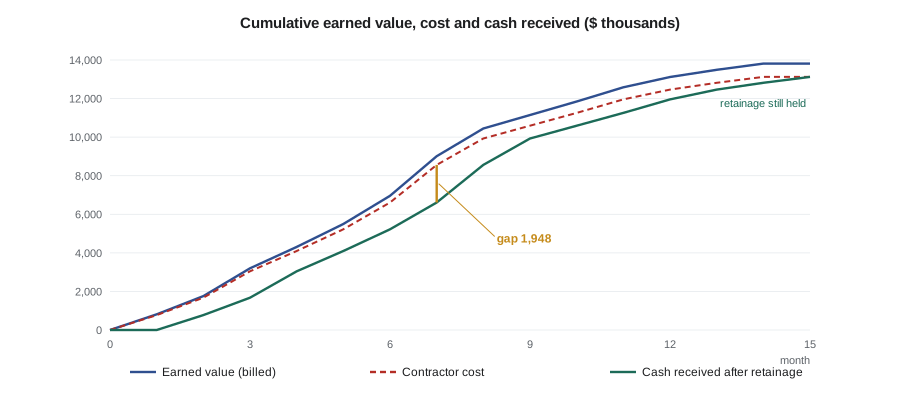
Ruth used the result to make two decisions. She asked the finance team to confirm that Tamarack's bank line could carry the project alongside its other work, and she asked Farah to make front-end loading off-limits. Front-end loading means putting too much value into early schedule of values lines so that the contractor is overpaid at the start. It improves cash flow, but owners and consultants watch for it, and it destroys trust when it is found. A balanced schedule of values, checked against the cost-loaded schedule, was the honest alternative.
Earned value: measuring cost and schedule together
Once construction starts, the cost-loaded schedule becomes the baseline for measuring performance. Earned value management compares three numbers at each reporting date: planned value (the budgeted cost of the work scheduled to date), earned value (the budgeted cost of the work actually done) and actual cost. From them come two simple indices.
An SPI below 1 means the project is behind its planned progress. A CPI below 1 means the work done has cost more than budgeted. The estimate at completion, EAC, projects the final cost if the current cost performance continues. For a contractor, it is most useful to measure these against the cost budget (the bid less the fee) rather than the contract price, because the question that matters is how much of the fee is being consumed.
Worked problem
Earned value at the end of month 6
Tamarack's cost budget at completion is $13.09 million. At the end of month 6, the planned value is $6.60 million, the earned value is $6.20 million and the actual cost is $6.45 million. Calculate SPI, CPI and EAC, and the variance at completion.
Show solution
- SPI = 6.20 ÷ 6.60 = 0.94: the work is about 6 % behind plan.
- CPI = 6.20 ÷ 6.45 = 0.96: every dollar of work done has cost about $1.04.
- EAC = 13.09 ÷ 0.961 = $13.62 million.
- Variance at completion: 13.09 − 13.62 = −$0.53 million.
- If nothing changes, the overrun would consume about $0.53 million of the planned $0.72 million fee.
Answer: SPI 0.94, CPI 0.96, EAC about $13.62 million; most of the fee is at risk.
A forecast like that is not a verdict. It is a warning that triggers action: finding which cost codes are overrunning, whether the cause is a change the owner should pay for, a productivity problem or a pricing error, and what can be done about it. CON-310 covered the detailed methods. The capstone plan should state which indices will be reported, how often, at what thresholds the project team must explain a variance, and who acts.
The cost control plan
A cost control plan describes the routine that keeps the budget honest. It is not long, but it should be specific. Tamarack's plan for Pembrook had six parts.
- Coding: every cost charged to a cost code within two days of the invoice or timesheet.
- Commitments: subcontracts and purchase orders recorded as committed cost when signed, not when invoiced, so the forecast sees them early.
- Monthly cost report: budget, committed cost, cost to date, forecast to complete and forecast at completion for every code, reviewed by the project manager and Ruth.
- Changes: every change tracked from first notice to approved change order, with its cost kept separate from base contract costs.
- Contingency: a running record of contingency used, with a reason for each draw.
- Thresholds: any cost code forecast to overrun by more than $25,000 or 5 % is explained in writing with a recovery plan.
The monthly report also forecast cash. Each month, the project team updated the cash flow model with actual billings and payments, so that Tamarack's finance team could see the project's real demand on working capital rather than the planned one.
Changes and their effect on cash
Changes affect cash as well as cost. When the owner directs extra work, the contractor usually pays for it before it is priced and approved, and sometimes long before it is paid. On Pembrook, Farah planned to price every change within ten working days of a request and to bill approved changes in the next monthly application. For work done under a change directive before the price was agreed, Tamarack would bill the undisputed part and record the rest as a pending claim. CON-420 covered the rules for changes and claims; the capstone plan should show how changes flow into the cost report and the cash forecast.
Your capstone deliverable
- A control budget by cost code, with the fee and contingency shown separately.
- A cost-loaded schedule and S-curve of planned value.
- A cash flow model showing billings, payments, money held back and the contractor's cash position.
- An earned value reporting plan with the indices you will report and the thresholds for action.
- A cost control plan covering coding, commitments, the monthly report, changes and contingency.
Common mistakes
MistakeConfusing profit with cash.
InsteadModel cash flow separately; a profitable job can still need large working capital.
MistakeFront-end loading the schedule of values.
InsteadBalance the schedule of values against the cost-loaded schedule.
MistakeTreating buyout savings as extra profit on day one.
InsteadHold them in contingency until the riskiest work is done.
MistakeRecording subcontract costs only when invoiced.
InsteadRecord commitments when signed so forecasts see them early.
MistakeReporting earned value without thresholds or actions.
InsteadSet variance thresholds and name who must respond.
Summary and key terms
- A control budget reorganizes the estimate by cost code so costs can be compared with the money allowed.
- Buyout compares subcontract awards with their budgets; savings are best held in contingency at first.
- A cost-loaded schedule produces the S-curve of planned value.
- Monthly billing less money held back, paid a month later, means contractors usually carry negative cash for much of a job.
- Earned value compares planned value, earned value and actual cost through SPI, CPI and EAC.
- A cost control plan sets routines for coding, commitments, reporting, changes and contingency.
- Control budget
- The project budget organized by cost code for controlling costs during construction.
- Buyout
- Awarding subcontracts and purchase orders after contract award and comparing them with the budget.
- Schedule of values
- A breakdown of the contract price into lines used for monthly progress billing.
- Retainage
- A percentage of each payment withheld by the owner and released later under lien legislation or the contract.
- Earned value
- The budgeted cost of the work actually performed to date.
- Front-end loading
- Overvaluing early schedule of values lines to be paid ahead of the work.
Practice problems
Work each problem on paper first, then reveal the answer to check.
Planned value is $4.0 million, earned value $3.6 million and actual cost $3.8 million. What are SPI and CPI?
Show answer
SPI = 0.90; CPI = 0.947.
With a budget at completion of $9.0 million and CPI 0.95, what is the EAC?
Show answer
9.0 ÷ 0.95 = $9.47 million.
Why did Tomas use the slower 60-week network for the cash flow?
Show answer
A longer schedule means costs are carried longer before payment, so it is the cautious case.
What is front-end loading and why should it be avoided?
Show answer
Overvaluing early billing lines to be overpaid at the start; owners detect it and it destroys trust.
Why should commitments be recorded when subcontracts are signed?
Show answer
So the forecast at completion reflects known costs before invoices arrive.
Lesson quiz · 5 questions
Score 60% or more to complete this lesson.
Create a free account to save your progress, take quizzes and earn a certificate.