
CON-499 · Lesson 11 of 12 · 23 min
Risk register and contingency
By week nine of the capstone, the team's shared folder held a file called 'worries.txt'. Everyone added to it: Owen's note about rock in the deepest sump, Tomas's doubts about the overhead door lead time, Aaliyah's concern about winter masonry, Farah's question about what happened if the alerting vendor and the exhaust vendor blamed each other. Ruth read it and laughed. 'This is the most honest document you have written,' she said. 'Now turn it into a risk register, decide what you will do about each line, and tell me how much money and time you need to hold back.'
This lesson covers the eleventh deliverable: the risk register and contingency. It draws on risk management, insurance and bonding (CON-350) and on changes, claims and dispute resolution (CON-420). A capstone risk chapter should show that the team has identified the real risks of its project, assessed them sensibly, decided how to respond to each, and set cost and time contingencies with reasons that a reviewer can follow.
Identifying risks
A risk is an uncertain event or condition that, if it happens, affects the project's objectives. Most risks are threats, but some are opportunities. Risks are best identified by several people working together, using several sources: the contract, the scope statement and assumptions log from lesson 2, the procurement schedule from lesson 3, the takeoff's uncertain quantities from lesson 4, the schedule's critical path from lesson 6, the hazard assessment from lesson 9 and the company's lessons learned from past projects.
The Tamarack team held a two-hour risk workshop with Ruth, Marcel and Tamarack's chief estimator. They used a simple prompt list to make sure no category was missed.
| Category | Examples from Pembrook |
|---|---|
| Site and ground | Groundwater in excavations, rock in deep sumps, buried services |
| Design and documents | Gaps between drawings and specifications, coordination of owner-supplied systems |
| Procurement and market | Steel price escalation, overhead door and generator lead times, subcontractor capacity |
| Construction | Winter productivity, crane set-up, quality of the envelope |
| Commercial and contract | Liquidated damages, extended warranties, payment delays |
| Third parties | Town water main, utility connection, alerting and exhaust vendors, permits |
| People and safety | Superintendent availability, serious injury, subcontractor default |
A well-written risk has three parts: a cause, the uncertain event and its effect. 'Steel' is not a risk. 'Because the steel subcontract is priced with a mill escalation clause, steel prices may rise before the mill order is placed, increasing the subcontract price' is a risk that someone can assess and act on. The team rewrote every line of the worries file in that form.
Who carries the risk?
Before assessing a risk, the team asked who would carry it under the contract. This step is often missed in capstone plans, and it changes the answer completely. Rock in excavations, for example, was a concealed condition. Under the contract's concealed conditions clause and the unit price in the bid form, rock would be paid for by the town, provided Tamarack gave prompt notice. Rock therefore left Tamarack's cost risk register and went onto a list of owner risks to be managed, with a note to record quantities carefully. Groundwater and wet excavation, on the other hand, were shown in the geotechnical report and were Tamarack's to deal with. Getting this right stopped the team from double-counting risks the owner already carried, and from overlooking risks it had assumed someone else would carry.
| Risk | Carried by | Reason |
|---|---|---|
| Rock in excavations | Owner, through unit price | Concealed condition with a bid unit price |
| Wet excavation and dewatering | Tamarack | Groundwater shown in the geotechnical report |
| Steel price escalation | Tamarack | Stipulated price; no escalation clause in the contract |
| Water main late | Owner | Work by the town; delay would justify an extension |
| Winter heat beyond the allowance | Tamarack | Weather risk carried by the contractor |
| Alerting system integration | Shared | Owner's vendor, but coordination is Tamarack's |
| Subcontractor default | Tamarack, partly transferred | Subcontract bonds on major packages |
Qualitative assessment
The first assessment is qualitative. Each risk is rated for probability and impact on a simple scale, often one to five, and the product gives a score that ranks the risks. A probability-impact matrix shows the whole register at a glance and draws attention to the top-right corner, where likely and serious risks sit.
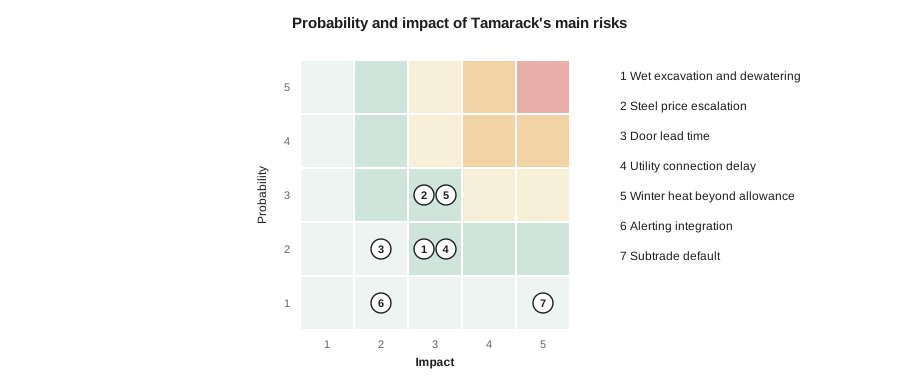
Qualitative scores are quick and useful for ranking, but they cannot be added up to give a contingency. For that, risks with cost or time effects need numbers.
Responding to risks
Every significant risk needs a response and an owner. There are four basic responses to threats. Avoid the risk by changing the plan so it cannot happen. Transfer it to someone better able to carry it, through a subcontract, insurance or a bond. Mitigate it by reducing its probability or impact. Or accept it, with or without a contingency. Opportunities have matching responses: exploit, share, enhance or accept.
| Risk | Response | Action | Owner |
|---|---|---|---|
| Steel price escalation | Mitigate | Release steel by letter of intent; lock mill price at order | Farah |
| Overhead door lead time | Mitigate | Approve door submittals first; weekly check with supplier | Tomas |
| Winter heat beyond allowance | Mitigate and accept | Two masonry crews in autumn; hold contingency | Marcel |
| Wet excavation | Mitigate | Dewatering plan; excavate sumps in driest month | Owen |
| Alerting integration | Mitigate and share | Interface matrix agreed with town; early joint testing | Aaliyah |
| Subcontractor default | Transfer | Bonds on four largest packages; monitor finances | Farah |
| Utility connection delay | Mitigate | Apply for service at award; temporary generator plan | Tomas |
Insurance and bonds are transfer tools, but each has limits. Builder's risk insurance covers physical loss or damage to the work, such as fire or storm, subject to its deductible and exclusions. It does not cover delay costs unless specifically added, and it never covers poor workmanship. Subcontractor performance bonds help when a subcontractor defaults, but claims take time, and the general contractor must still keep the job moving. The plan therefore treated transfer as one layer of protection, not as a reason to stop managing the risk.
Quantitative analysis and Monte Carlo simulation
For the risks Tamarack carried, the team estimated a probability and a range of cost impacts: a low, most likely and high value. Multiplying probability by the average impact gives each risk's expected value, and adding them gives the expected value of the register. But the expected value hides the spread. Some years nothing goes wrong; occasionally several things go wrong at once. Monte Carlo simulation shows the spread by running the risks thousands of times, each time drawing whether each risk happens and, if it does, how much it costs.
Worked problem
Expected value of a single risk
The risk of wet excavation and dewatering has a 30 % probability. If it happens, its cost follows a triangular distribution with a low of $60,000, a most likely value of $150,000 and a high of $400,000. What is its expected value?
Show solution
- Mean of a triangular distribution: (low + most likely + high) ÷ 3 = (60,000 + 150,000 + 400,000) ÷ 3 = $203,333.
- Expected value: 0.30 × $203,333 = $61,000.
- The expected value is not a cost that will actually occur: either the risk happens and costs roughly $60,000 to $400,000, or it does not happen and costs nothing.
Answer: About $61,000.
# Monte Carlo of the Pembrook risk register: cost contingency at P50 and P80
import random
rng = random.Random(499)          # fixed seed so the results repeat
risks = [  # name, probability, (low, most likely, high) cost in $000
    ('Wet excavation and dewatering', 0.30, (60, 150, 400)),
    ('Steel price escalation', 0.40, (40, 110, 260)),
    ('Overhead door lead time slips', 0.35, (20, 60, 150)),
    ('Utility connection delay', 0.25, (30, 80, 220)),
    ('Winter heat beyond the allowance', 0.50, (40, 90, 180)),
    ('Station alerting integration issues', 0.20, (20, 50, 140)),
    ('Subcontractor default', 0.10, (100, 250, 600)),
]
expected = sum(p * (lo + ml + hi) / 3 for _, p, (lo, ml, hi) in risks)
runs = 20000
totals = []
for _ in range(runs):
    t = 0.0
    for _, p, (lo, ml, hi) in risks:
        if rng.random() < p:
            t += rng.triangular(lo, hi, ml)
    totals.append(t)
totals.sort()
p50, p80, p90 = (totals[int(runs * q)] for q in (0.50, 0.80, 0.90))
print(f'Expected value of risks: ${expected:,.0f}k')
print(f'P50 ${p50:,.0f}k   P80 ${p80:,.0f}k   P90 ${p90:,.0f}k')
print(f'Chance that no risk occurs: {sum(1 for t in totals if t == 0) / runs:.1%}')
print(f'P80 contingency as a share of the $13,812k bid: {p80 / 13812:.1%}')Expected value of risks: $267k P50 $236k P80 $409k P90 $515k Chance that no risk occurs: 7.4% P80 contingency as a share of the $13,812k bid: 3.0%
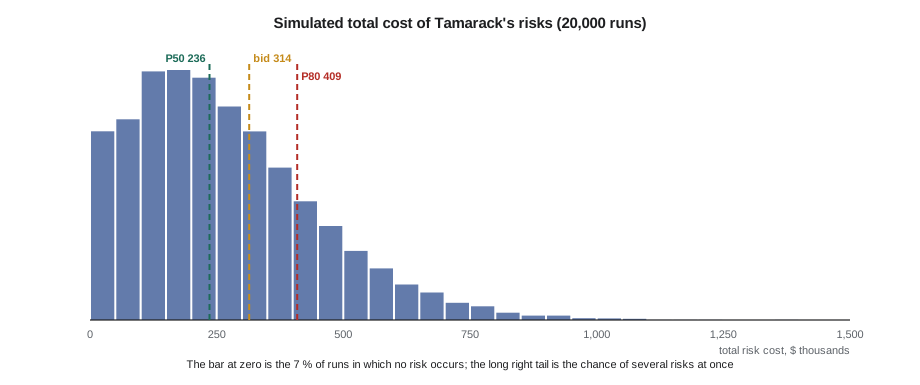
The simulation gave an expected value of about $267,000, a median (P50) of about $236,000 and a P80 of about $409,000: an 80 % chance that the risks would cost no more than that. The pricing contingency in the bid was $314,300, which the simulation suggested would be enough about two times in three. Ruth had to choose: raise the bid's contingency to the P80 and risk losing the job on price, or keep it and accept a one-in-three chance of using part of the fee to cover risk costs.
She kept the bid contingency and made two other decisions. Buyout savings, as lesson 7 described, would go into contingency until the steel and envelope were complete. And the project team would report the remaining risk exposure against remaining contingency every month, so that management would see early if the gap was growing. The capstone plan recorded the decision and the reasons. A reviewer does not need to agree with a decision of this kind, but should be able to see that it was made knowingly.
Time contingency and schedule risk
Cost is only half of the picture. Several of Pembrook's risks affected time: door lead times, utility delays, winter weather. Lesson 6 left four weeks of visible time contingency at the end of the 56-week plan. The team checked whether that was enough by estimating, for each schedule risk, how many weeks it could delay the critical path and how likely it was. The overhead door risk, for example, could delay commissioning by up to four weeks, because the doors had to be tested with the alerting system. But the doors had 22 weeks of float in the base network, so a late delivery would delay the project only if it ran past that float, which was unlikely. The serious time risks were those on the critical path: steel delivery, roofing in a wet autumn and the generator for permanent power.
Worked problem
Is four weeks enough?
The team estimates three critical-path time risks: steel late, 20 % chance of 3 weeks; wet autumn delaying roofing, 40 % chance of 2 weeks; generator late, 25 % chance of 4 weeks. What is the expected delay, and what delay occurs if all three happen?
Show solution
- Expected delay: 0.20 × 3 + 0.40 × 2 + 0.25 × 4 = 0.6 + 0.8 + 1.0 = 2.4 weeks.
- If all three happen: 3 + 2 + 4 = 9 weeks.
- Chance that all three happen, if independent: 0.20 × 0.40 × 0.25 = 0.02, or 2 %.
- Four weeks covers the expected delay with some margin, but not the worst case. The plan adds mitigation: a temporary generator ready to rent if the permanent one is late, so that commissioning can start on schedule.
Answer: Expected delay about 2.4 weeks; four weeks is a reasonable but not generous contingency.
Liquidated damages make time risk easy to price: each week of delay past the contract date costs $17,500 in damages, plus about $11,000 a week in extended general conditions. A week of schedule contingency is therefore worth about $28,500 to Tamarack, a useful number when deciding whether to spend money on acceleration or mitigation.
Keeping the register alive
A risk register written for a proposal and never opened again has no value. The plan set out a monthly risk review, chaired by the project manager, at which each risk owner reported on their risks, closed those that had passed, added new ones and updated the remaining exposure. The register would also be reviewed at key points: buyout, the start of steel, building enclosed and before commissioning. Lessons learned at closeout would feed Tamarack's prompt list for the next project.
Your capstone deliverable
- A risk register with cause-event-effect descriptions, categories and owners.
- A risk allocation review showing who carries each risk under the contract.
- A probability-impact matrix ranking the risks.
- Responses for every significant risk, including the limits of insurance and bonds.
- A quantitative analysis of cost risks, such as a seeded Monte Carlo simulation, and the cost contingency you recommend.
- A time contingency linked to the schedule's critical-path risks, and a plan for monthly risk reviews.
Common mistakes
MistakeListing vague risks such as 'weather' or 'steel'.
InsteadWrite each risk as a cause, an uncertain event and an effect.
MistakeIncluding risks the owner carries in the contractor's contingency.
InsteadCheck the contract's allocation before assessing and pricing a risk.
MistakeAdding up qualitative scores to set contingency.
InsteadUse probabilities and cost ranges, and simulate the spread.
MistakeTreating insurance as the end of risk management.
InsteadKnow the limits of each policy and bond, and keep managing the risk.
MistakeSetting contingency without saying what confidence it gives.
InsteadState the percentile and the decision behind it.
Summary and key terms
- Risks are identified from many sources and written as cause, event and effect.
- The contract's risk allocation decides which risks belong in the contractor's register.
- A probability-impact matrix ranks risks qualitatively, but cannot set a contingency on its own.
- Responses to threats are avoid, transfer, mitigate or accept, each with an owner.
- Monte Carlo simulation shows the spread of total risk cost and supports a contingency at a chosen confidence level.
- Time contingency should be tested against critical-path risks and the cost of delay.
- The register must be reviewed regularly to stay useful.
- Risk register
- A record of identified risks with their assessment, responses, owners and status.
- Expected value
- Probability multiplied by impact; the long-run average cost of a risk.
- Monte Carlo simulation
- Repeated random sampling of risks to show the range of possible outcomes.
- P80
- The value that will not be exceeded in 80 % of simulated outcomes.
- Risk transfer
- Moving a risk to another party through a contract, insurance or a bond.
- Contingency
- An amount of money or time held to cover risks that may occur.
Practice problems
Work each problem on paper first, then reveal the answer to check.
A risk has a 25 % chance and impacts of $40,000, $90,000 and $200,000. What is its expected value?
Show answer
Mean = 330,000 ÷ 3 = $110,000; 0.25 × 110,000 = $27,500.
Why did rock leave Tamarack's cost risk register?
Show answer
Under the concealed conditions clause and the bid unit price, the owner pays for rock if prompt notice is given.
Name the four responses to a threat.
Show answer
Avoid, transfer, mitigate and accept.
What does a P80 of $409,000 mean?
Show answer
In 80 % of simulated outcomes, the total risk cost is $409,000 or less.
Two critical risks have a 30 % chance of 2 weeks and a 10 % chance of 5 weeks. What is the expected delay?
Show answer
0.6 + 0.5 = 1.1 weeks.
Lesson quiz · 5 questions
Score 60% or more to complete this lesson.
Create a free account to save your progress, take quizzes and earn a certificate.