
CON-499 · Lesson 3 of 12 · 20 min
Delivery method, procurement and contract strategy
Farah's first draft of this chapter was one sentence long: 'The owner has chosen design-bid-build with a stipulated price contract.' Ruth sent it back with a note in the margin. 'True, and not enough. Tell me why the town chose it, what it means for us, how we will buy the job from our subcontractors, what we must order early, and what the contract makes us carry.' The rewrite took two weeks and became one of the strongest sections of the plan.
This lesson covers the third deliverable: the delivery method, the contract and the procurement strategy. It draws on project delivery methods (CON-340), contracts and law (CON-220) and procurement and subcontracting (CON-330). Even when the owner has already chosen how the project will be delivered, the contractor's plan must explain what that choice means for risk, price and schedule, and how the contractor will organize its own buying.
The delivery method and why the owner chose it
A delivery method sets who designs, who builds, when the contractor joins the team and how the price is set. The Town of Pembrook chose design-bid-build: Larkin Hale Architects completed the design, the town tendered it publicly and the lowest compliant bidder will build it for a fixed price. The town had good reasons. It is a public body that must show fair, open competition. The design was complete, so bidders could price it accurately. The building type was familiar. And the town's council wanted a firm price before it committed the money.
Design-bid-build also has weaknesses that the contractor's plan must deal with. The contractor has no input to the design, so constructability problems are found during construction. Every gap or error in the documents becomes a potential change. The schedule is longer, because design must finish before tendering begins. And the relationship between owner and contractor starts with a price competition, which can make it adversarial. Tamarack's plan could not change the method, but it could reduce these weaknesses: by reading the documents carefully, asking questions during the tender, building a realistic schedule and treating the Architect as a partner from the first meeting.
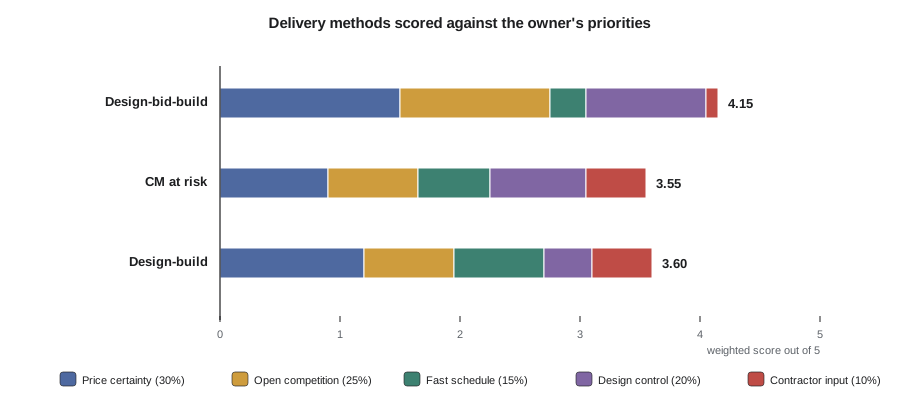
The team also compared the alternatives the town could have used, because Ruth wanted the capstone to show they understood the choice. They scored three methods against the town's stated priorities.
| Owner priority | Weight | Design-bid-build | CM at risk | Design-build |
|---|---|---|---|---|
| Price certainty before commitment | 30 % | 5 | 3 | 4 |
| Open, simple public competition | 25 % | 5 | 3 | 3 |
| Fast overall schedule | 15 % | 2 | 4 | 5 |
| Owner control of design details | 20 % | 5 | 4 | 2 |
| Contractor input to design | 10 % | 1 | 5 | 5 |
The weighted scores were 4.15 for design-bid-build, 3.55 for construction management at risk and 3.60 for design-build. Design-bid-build came first because the town's top priorities were price certainty and open competition. If the town had valued speed or contractor input more, construction management at risk or design-build would have been strong choices. The team noted that a progressive design-build or construction management approach might suit the town's next station, which had a tighter site and an older building to replace in place.
The contract and what it makes the contractor carry
The contract is AIA A101-2017, the standard owner-contractor agreement with a stipulated sum, used with the A201-2017 general conditions, with supplementary conditions written by the town's lawyers. The supplementary conditions are where owners change the standard form, and they deserve the most careful reading. Farah listed every change and rated its effect on Tamarack's risk.
| Clause topic | What the Pembrook documents say | Effect on Tamarack |
|---|---|---|
| Liquidated damages | $2,500 per calendar day after the substantial completion date | Schedule risk priced; float protected |
| Bid security | Bid bond for 5 % of the bid price | Surety must issue before bid day |
| Contract security | Performance bond and payment bond, each 100 % of the contract price | Bond cost in markups; subcontractor bonds for large trades |
| Insurance | General liability, builder's risk and automobile, with town named as additional insured | Insurance cost in markups |
| Concealed conditions | Standard clause kept | Rock and poor soil remain owner risk if notice is given promptly |
| Owner-supplied items | Contractor responsible for receiving, storage and installation | Storage, handling and damage risk |
| Warranty | Two years on roofing and overhead doors; one year elsewhere | Longer warranty cost from those subcontractors |
Two terms mattered most. Liquidated damages of $2,500 per day are modest for a $14 million project, but 30 days late would cost $75,000, more than a tenth of the expected fee. And the extended warranties on roofing and overhead doors had to be passed down to those subcontractors in their subcontracts, or Tamarack would carry the second year itself. Each item went into the plan in three places: the estimate, the subcontract terms and the risk register.
How the contractor buys the job
On a typical building project, the general contractor performs a small part of the work with its own forces and subcontracts the rest. Tamarack planned to self-perform site supervision, general labor, rough carpentry, the installation of owner-supplied items and the concrete formwork for the training tower. Everything else would be subcontracted. This makes the subcontract packages, and the way Tamarack buys them, central to both price and risk.
A subcontract package groups work that one trade contractor will do under one subcontract. Packages should match how trades actually price and work, avoid gaps and overlaps between trades, and be large enough to attract competition but not so large that only one firm can do them. Owen and Farah defined twenty-two packages for Pembrook. The tricky ones were the boundaries: who supplies the embedded plates the steel erector welds to, who seals the overhead door frames into the masonry, who connects the exhaust extraction fans to power, and who patches the roof after the mechanical contractor's curbs are installed.
| Package | Includes | Key boundary |
|---|---|---|
| Concrete | Foundations, slabs, apron, trench drain forming, tower footings | Embedded plates supplied by steel, set by concrete |
| Structural steel and joists | Columns, beams, joists, deck, embedded plates | Deck by steel; roofing starts on accepted deck |
| Masonry | Block backup, brick veneer, tower walls, flashing in walls | Door frames grouted by masonry, supplied by doors |
| Overhead doors | Doors, operators, safety devices, frames | Power to operators by electrical |
| Mechanical | Plumbing, heating, ventilation, controls, exhaust extraction connections | Owner-supplied extraction system installed by mechanical |
| Electrical | Power, lighting, generator, fire alarm, alerting rough-in | Alerting devices by owner's vendor |
Procurement rules differ between regions. Subcontractor prices arrive directly by email and phone in the last hours before bids close. A few states require general contractors on public work to list their major subcontractors in the bid and restrict substitutions afterwards, and some public owners set goals or requirements for small or disadvantaged business participation. Tamarack checked the Colorado and town requirements that applied to Pembrook before planning its bid day.
Prequalification protects the general contractor from the low-price subcontractor that cannot finish. Tamarack asked every subcontractor it planned to use on a major package for safety statistics, bonding capacity, references, current workload and financial information. Aaliyah reviewed safety records, and a subcontractor without an acceptable record was not used, however low its price. For the largest packages, concrete, steel, mechanical and electrical, Tamarack required subcontract performance and payment bonds or a credit-checked alternative.
Bonding capacity shaped the procurement plan too. A surety sets a limit on the total value of bonded work a contractor may carry at one time, and on the size of any single project. Before bid day, Farah confirmed with Tamarack's surety broker that Pembrook fit within the program, obtained the bid bond and the surety's consent to provide the contract bonds if Tamarack won, and asked the broker to review the subcontract bond requirements so that the four largest subcontractors would know what was expected of them when they quoted.
Long-lead items and the procurement schedule
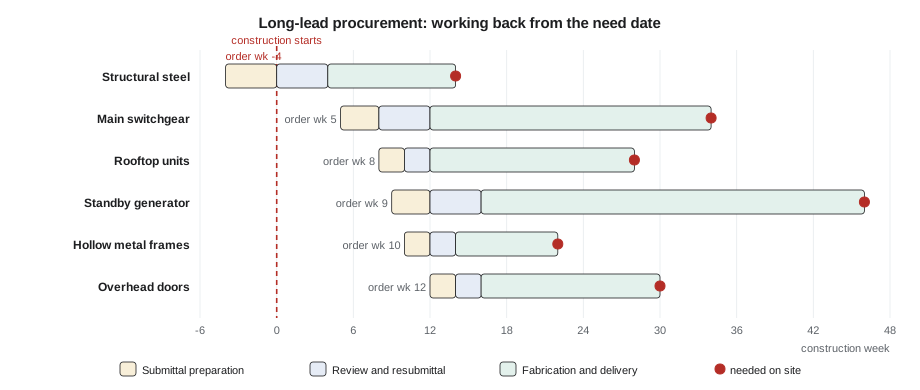
Some items take much longer to arrive than the work that installs them. Structural steel needs shop drawings, approval, fabrication and delivery. Overhead doors and their operators are built to order. The standby generator and the main electrical switchgear have had long and unpredictable lead times in recent years. Rooftop units and the exhaust extraction system are made to order. If any of these arrive late, the critical path slips no matter how hard the crews work. A procurement schedule works backward from the date each item is needed on site.
Worked problem
Working back from the need date
The standby generator is needed on site in week 46 of the construction schedule so that permanent power can be energized for testing. The supplier quotes 30 weeks from approved submittals to delivery. Submittal preparation takes 3 weeks and the Architect's review takes 2 weeks, with one allowed resubmission of 2 more weeks. In which week must Tamarack place the order?
Show solution
- Work back from the need date: week 46.
- Less manufacturing and delivery: 46 − 30 = week 16 for approved submittals.
- Less one resubmission cycle: 16 − 2 = week 14.
- Less the first review: 14 − 2 = week 12.
- Less submittal preparation: 12 − 3 = week 9, the latest date to order and start the submittal.
- Week 9 is only nine weeks after the start of construction, so the generator purchase order must be one of the first subcontract awards.
Answer: The order must be placed no later than week 9, with no float left.
Tomas wrote a short program that did the same calculation for every long-lead item and flagged anything whose order date fell before the expected award of its subcontract.
# Latest order dates for long-lead items, working back from the week each is needed on site
items = {  # name: (need week, submittal prep, review, resubmittal, fabrication and delivery)
    'Structural steel':    (14, 4, 2, 2, 10),
    'Overhead doors':      (30, 2, 2, 0, 14),
    'Standby generator':   (46, 3, 2, 2, 30),
    'Main switchgear':     (34, 3, 2, 2, 22),
    'Rooftop units':       (28, 2, 2, 0, 16),
    'Hollow metal frames': (22, 2, 2, 0, 8),
}
for name, (need, prep, rev, resub, fab) in sorted(items.items(), key=lambda kv: kv[1][0] - sum(kv[1][1:])):
    order = need - fab - resub - rev - prep
    flag = '  <-- order before construction starts' if order < 0 else ''
print(f'{name:20s} needed week {need:2d}, order by week {order:3d}{flag}')Structural steel needed week 14, order by week -4 <-- order before construction starts Main switchgear needed week 34, order by week 5 Rooftop units needed week 28, order by week 8 Standby generator needed week 46, order by week 9 Hollow metal frames needed week 22, order by week 10 Overhead doors needed week 30, order by week 12
The result was a shock. Structural steel had to be ordered four weeks before construction even started, because shop drawings, review and fabrication took sixteen weeks and the steel was needed in week 14. Switchgear, rooftop units and the generator all had to be ordered within the first nine weeks. The plan therefore asked the town for a letter of intent immediately after bid evaluation, so that Tamarack could release the steel subcontract before the formal contract was signed. Without it, the 14-month schedule was not achievable. This kind of finding is exactly what an owner wants to see in a contractor's plan.
Your capstone deliverable
- A description of the delivery method and why the owner chose it, with a scored comparison against alternatives.
- A review of the contract's key commercial terms and their effect on your price, schedule and risk.
- A self-perform and subcontract plan with defined packages and their boundaries.
- Your subcontractor procurement approach: prequalification, bid day handling, bonding and any regional rules.
- A procurement schedule for long-lead items, worked back from the need dates, with actions for anything that cannot wait for award.
Common mistakes
MistakeStating the delivery method without explaining what it means for the contractor.
InsteadExplain the method's risks and how your plan reduces them.
MistakeSkimming the supplementary conditions.
InsteadRead every change to the standard form and record its effect on price and risk.
MistakeDrawing package boundaries loosely.
InsteadDefine who supplies, installs and connects at every interface between trades.
MistakeChoosing subcontractors on price alone.
InsteadPrequalify for safety, capacity, bonding and financial strength.
MistakeOrdering long-lead items after award without checking dates.
InsteadWork back from need dates and act early when the dates fall before award.
Summary and key terms
- The delivery method sets who designs, who builds, when the contractor joins and how the price is set.
- Design-bid-build suits owners who need price certainty and open competition, but brings design gaps and a longer schedule.
- Supplementary conditions change the standard contract and need careful review for damages, bonds, insurance and warranties.
- Subcontract packages must match how trades price and work, with clear boundaries at every interface.
- Prequalification protects the contractor from subcontractors that cannot perform or work safely.
- A procurement schedule works back from need dates through delivery, fabrication, review and submittal preparation.
- Long-lead items sometimes must be released before the contract is signed, using a letter of intent.
- Design-bid-build
- A delivery method in which the design is completed and then tendered for a fixed price.
- Supplementary conditions
- Owner-written changes to a standard form of contract.
- Bid bond
- A surety bond guaranteeing that a bidder will sign the contract and provide the required bonds if awarded.
- Subcontract package
- A group of work assigned to one trade contractor under one subcontract.
- Prequalification
- Assessing a contractor's safety, capacity, finances and experience before it may bid or be used.
- Letter of intent
- An owner's written notice of intent to award, sometimes authorizing early work or purchases.
Practice problems
Work each problem on paper first, then reveal the answer to check.
Give two reasons a public owner might choose design-bid-build.
Show answer
Any two of: price certainty before commitment, open and simple competition, complete design, familiar building type.
Liquidated damages are $2,500 per day. What is the cost of finishing 18 days late?
Show answer
18 × $2,500 = $45,000.
An item is needed in week 30, with 14 weeks of fabrication, 2 weeks of review and 2 weeks of preparation. When must it be ordered?
Show answer
30 − 14 − 2 − 2 = week 12.
Why are package boundaries important?
Show answer
Gaps and overlaps between trades lead to unpriced work, disputes and delays.
What should a contractor check when prequalifying a subcontractor?
Show answer
Safety record, bonding capacity, references, current workload and financial strength.
Lesson quiz · 5 questions
Score 60% or more to complete this lesson.
Create a free account to save your progress, take quizzes and earn a certificate.