
CON-375 · Lesson 8 of 12 · 20 min
Photos, video, inspection and test records
In the second winter of the Westgate project, a section of the level 2 slab edge flashing failed, and water stained the exposed timber ceiling below. The roofing subcontractor said the flashing had been installed correctly and damaged later by another trade. The cladding subcontractor said the flashing had been missing laps before cladding started. The argument was settled in an afternoon by Hannah Lowe's photographs. Before the cladding crew started each bay, Brightwater's procedure required a dated photo set of the completed flashing from fixed points. The photos for bays 7 and 8 showed the laps missing on the day the flashing was signed off. The roofing subcontractor fixed it at its own cost, and nobody needed a lawyer.
Photographs and video are among the most persuasive records on a project. They show conditions that words struggle to describe, and they capture things that are about to be covered up forever. Inspection and test records do the same for quality: they prove that work was checked against the specification at the right moment, by the right person, with the right result. This lesson covers planning and managing site photography, video and reality capture, and then the inspection and test records that make up the quality file.
A photo plan, not just a camera
Most site staff take plenty of photos. The problem is rarely too few pictures; it is pictures that cannot be found, cannot be located on the building, or do not show what someone later needs to see. Brightwater solves this with a photo plan that says what must be photographed, when, from where and by whom.
| Category | When | What to capture |
|---|---|---|
| Pre-construction condition survey | Before mobilization | Existing site, neighboring buildings, roads, sidewalks, trees, utilities; any existing damage |
| Progress | Daily or weekly from fixed points; monthly overall | Each area and elevation, to show progress over time |
| Before cover-up | Before any work is concealed | Embedded services, reinforcement, waterproofing, insulation, fire stopping, anchors, flashings |
| Deliveries | On arrival | Labels, quantities, condition, damage |
| Problems and changes | When found | Differing conditions, damage, defects, work by others, extra work |
| Incidents | Immediately, once safe | Scene, equipment, conditions, signage |
| Inspections and tests | During the inspection | What was inspected and any defects found |
| Closeout | At substantial completion and handover | Finished spaces, equipment nameplates, access panels, concealed valve locations |
The pre-construction survey is the cheapest insurance on any job. Westgate sits beside a 1920s brick church and a row of older houses. Before excavation, Brightwater photographed and video-recorded every elevation of the neighboring buildings, noting existing cracks with a scale in the frame, and gave a copy to each neighbor. When one homeowner later blamed the excavation for a crack in her basement wall, the survey showed the crack had been there before work started.
Before-cover-up photos are the ones most often missed, because the moment passes quickly. A wall that is open in the morning may be boarded by afternoon. On Westgate, the pre-cover checklist used by the drywall and ceiling subcontractors has a photo step: the area must be photographed and the photos uploaded before boarding starts, and the field engineer checks the upload before signing the release.
Making photos usable
A photo is evidence only if it can be tied to a date, a time and a location, and if it can be found again. Digital cameras and phones record date, time and often GPS position in the file's metadata, known as EXIF data. Construction platforms add more: the area, the drawing location, a description and links to related records.
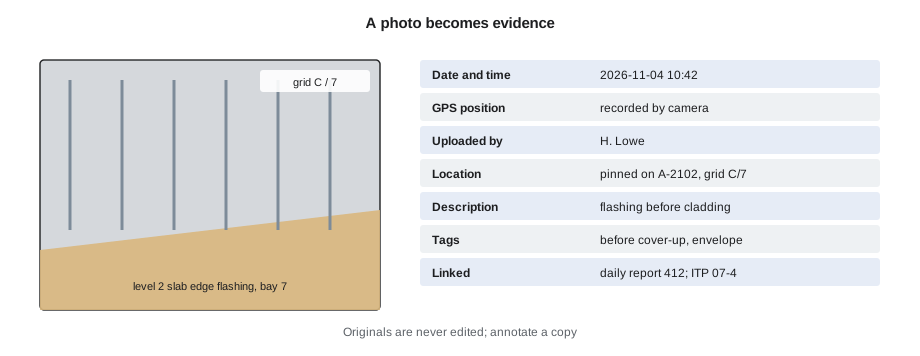
- Check that phone and camera clocks are set correctly; a camera an hour out after a time change can make a photo appear to contradict a daily report.
- Pin each photo to its location on the drawing, or include a grid line, room number or reference marker in the frame.
- Add a short factual description: what, where, why it was taken.
- Include a scale, such as a tape measure, when size matters: a crack, a gap, a corrosion spot.
- Never edit originals. Cropping or annotating should be done on a copy, with the original kept untouched.
- Upload the same day, so the photos sit with the day's daily report.
Brightwater's platform keeps the original file and its metadata when photos are uploaded. Some messaging apps strip metadata when photos are shared, so photos sent by text message from a subcontractor may lose their date and location. Brightwater asks subcontractors to upload directly to the platform instead.
Video, 360° capture and drones
Video is useful for showing processes and sequences: a crane lift, water running across a roof, equipment operating at commissioning. Short clips with a spoken introduction ('Westgate, level 4 roof, east drain, 14:20 on 3 November, water test') are far more useful than long unedited recordings.
Reality capture has changed site documentation. A 360-degree camera mounted on a hard hat or monopod records an entire floor in a single walk, and software pins the images to the floor plan automatically. Repeated weekly, these walks create a complete visual history of every space, including what was inside walls before they were closed. On Westgate, Marcus walks each active floor weekly with a 360° camera, which takes about twenty minutes per floor. Laser scanning goes further, producing a measurable point cloud that can be compared with the model to check tolerances or produce accurate as-built information.
Drones give overall progress views and can inspect roofs and facades without scaffolding. In the US, commercial drone flights generally fall under the FAA's Part 107 rules, which require a remote pilot certificate, registration and compliance with airspace and operational limits, with authorization needed in controlled airspace. Westgate's drone flights are planned and approved in advance by a certified remote pilot.
Photos and video raise privacy issues. Images may capture workers' faces, members of the public, neighbors' windows or vehicle plates. Brightwater's photo policy tells staff to avoid photographing people unnecessarily, to use images only for project purposes, and to protect them from public posting.
Inspection and test records
The quality file proves that the work meets the contract. It is made up of inspection and test records created throughout construction, by Brightwater, its subcontractors, independent testing agencies, the design team and authorities having jurisdiction. Many of these records cannot be recreated: a concrete cylinder is tested once, and a wall cavity is inspected only before it is closed.
| Record | Who creates it | Example on Westgate |
|---|---|---|
| Inspection and test plan (ITP) | Contractor and subcontractors, reviewed by the consultant | List of inspections and tests for each system with hold and witness points |
| Checklists and sign-offs | Contractor and subcontractors | Pre-pour checklist; pre-drywall checklist; timber connection inspection |
| Third-party test reports | Independent testing agency | Concrete cylinder strength tests to ASTM C39; soil compaction tests |
| Design team field reports | Architect and engineers | Structural field review reports; envelope review reports |
| Authority inspections | Building department and other regulators | City of Pittsburgh building inspections under the adopted building code |
| Non-conformance reports (NCRs) | Contractor or consultant | Record of work that does not conform, the agreed fix and verification |
| Commissioning test records | Commissioning agent and trades | Functional performance tests for mechanical and electrical systems |
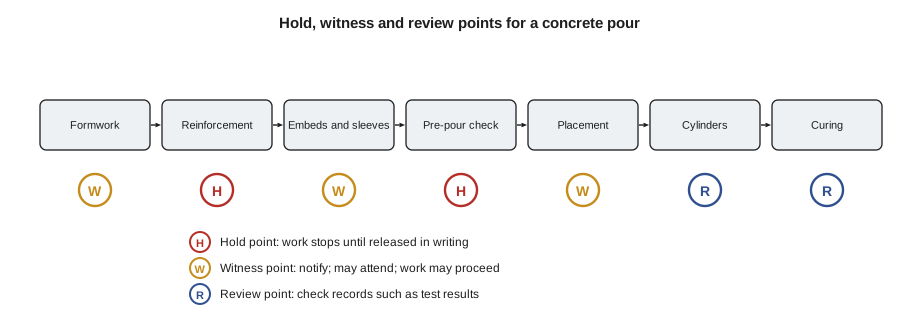
The inspection and test plan is the backbone. For each system it lists the inspections and tests, who performs them, the acceptance criteria, the record produced, and the type of point. At a hold point, work must stop until the inspection is done and the work released in writing. At a witness point, the consultant or owner is notified and may attend, but work can proceed if they do not. A review point is a check of records, such as mill certificates, rather than of the work itself.
A missing hold-point release can be very expensive. If concrete is placed over reinforcement that was never inspected, the owner may require the concrete to be cored or removed. On Westgate, no pour is released until the pre-pour checklist is complete, the structural engineer's field review is recorded, and Marcus has signed the pour release in the platform.
Non-conformance reports
When work does not meet the contract documents, a non-conformance report records what is wrong, where, who found it, the agreed resolution (repair, replace, accept as is with the designer's approval), and the verification that the fix was made. NCRs must be closed formally; an NCR that is open at handover is a defect the owner has not accepted.
Worked problem
How complete is the concrete test record?
Westgate's structural specification requires one set of concrete cylinders for every 50 cubic meters of each mix placed in a day, with at least one set per day per mix. On one podium pour day, 230 cubic meters of the 35 MPa mix and 40 cubic meters of the 25 MPa mix were placed. The testing agency's records show 4 sets for the 35 MPa mix and 1 set for the 25 MPa mix. Is the testing frequency met?
Show solution
- 35 MPa mix: 230 ÷ 50 = 4.6, so 5 sets are needed (round up).
- 25 MPa mix: 40 ÷ 50 = 0.8, rounded up to 1 set, which also satisfies the minimum of one per day.
- Records show 4 sets for the 35 MPa mix: one set short.
- Brightwater raises an NCR, and the structural engineer decides whether the existing results, maturity data or later cores are enough to accept the concrete.
Answer: The 35 MPa mix is one set short (4 of 5 required); the 25 MPa mix meets the requirement.
Checking test frequencies by hand across hundreds of pours is tedious. Jun's check runs on the pour log exported from the platform each week.
# Check concrete test sets against the required frequency
import math
pours = [  # date, mix, volume in m3, sets taken
    ('2026-03-18', '35 MPa', 230, 4),
    ('2026-03-18', '25 MPa', 40, 1),
    ('2026-04-02', '35 MPa', 145, 3),
    ('2026-04-15', '35 MPa', 96, 2),
]
per_set = 50
for day, mix, vol, sets in pours:
    need = max(1, math.ceil(vol / per_set))
    flag = 'OK' if sets >= need else f'SHORT by {need - sets}'
print(day, mix, f'{vol} m3', 'need', need, 'took', sets, flag)2026-03-18 35 MPa 230 m3 need 5 took 4 SHORT by 1 2026-03-18 25 MPa 40 m3 need 1 took 1 OK 2026-04-02 35 MPa 145 m3 need 3 took 3 OK 2026-04-15 35 MPa 96 m3 need 2 took 2 OK
Safety records
Safety documentation is a world of its own, but it belongs in the project record. Daily hazard assessments, toolbox talk attendance, inspection reports, training records, incident reports and orders from regulators all show whether the project met its legal duties. They are also often requested in disputes and insurance claims. Brightwater files them by date and area in the platform, with the same rules as other records: made at the time, never altered, kept for the required period.
Common mistakes
MistakeTaking lots of photos with no plan.
InsteadUse a photo plan that sets what, when, where and who, especially before cover-up.
MistakeSharing photos by text message.
InsteadUpload originals to the platform so date, time and location metadata are kept.
MistakeEditing original photos.
InsteadCrop or annotate copies only; keep originals unaltered.
MistakePouring or closing up past a hold point without written release.
InsteadTreat hold points as absolute stops until the release is recorded.
MistakeLeaving non-conformance reports open.
InsteadClose every NCR with a recorded resolution and verification before handover.
Summary and key terms
- A photo plan specifies condition surveys, progress, before-cover-up, deliveries, problems, incidents, inspections and closeout photos.
- Photos are evidence when they carry correct date, time and location metadata, a description and links, and when originals are kept unaltered.
- Video, 360-degree capture, laser scanning and drones extend the visual record; drones and images raise legal and privacy obligations.
- Inspection and test records form the quality file and often cannot be recreated.
- An inspection and test plan sets hold, witness and review points with acceptance criteria and records.
- Non-conformance reports record defects, the agreed fix and verification, and must be closed before handover.
- Safety records belong in the project record and follow the same rules.
- EXIF data
- Metadata stored in a digital photo, such as date, time, camera settings and GPS position.
- Pre-construction condition survey
- A record of existing conditions on and around the site before work begins.
- Reality capture
- Recording existing or built conditions with 360-degree photos, laser scanning or photogrammetry.
- Inspection and test plan (ITP)
- A document listing inspections and tests, responsibilities, criteria, records and hold or witness points.
- Hold point
- A stage beyond which work may not proceed until an inspection is completed and released.
- Witness point
- A stage at which a party is notified and may attend an inspection, but work may proceed if it does not.
- Non-conformance report (NCR)
- A record of work that does not meet the requirements, the agreed resolution and its verification.
Practice problems
Work each problem on paper first, then reveal the answer to check.
Name three moments when photos are essential.
Show answer
Any three of: before mobilization, before cover-up, on delivery, when problems or changes are found, after incidents, during inspections, at closeout.
Why upload photos rather than sending them by text message?
Show answer
Messaging apps may strip date, time and location metadata.
What is the difference between a hold point and a witness point?
Show answer
Work must stop at a hold point until released; at a witness point the party may attend but work can proceed if it does not.
A pour of 180 m³ needs one set per 50 m³. How many sets are required?
Show answer
180 ÷ 50 = 3.6, so 4 sets.
What must an NCR record before it is closed?
Show answer
The defect, its location, who found it, the agreed resolution and verification that the fix was made.
Lesson quiz · 5 questions
Score 60% or more to complete this lesson.
Create a free account to save your progress, take quizzes and earn a certificate.