
CON-375 · Lesson 10 of 12 · 20 min
Payment applications, prompt payment and lien records
Cash is the lifeblood of a construction company, and documents are how cash moves. On the 25th of every month, Elena Vasquez submits Brightwater's payment application for Westgate. It is built from a schedule of values, supported by progress photos, the updated schedule, the change order log, lien and payment paperwork from subcontractors, and a cover invoice in the form the contract and the law require. If any piece is missing or wrong, the application can be rejected or delayed, and Brightwater, its subcontractors and their suppliers all wait for their money. If it is right, the money arrives on time, and the law gives Brightwater strong remedies if it does not.
This lesson covers the documents that drive payment: the schedule of values, the progress application and its support, retainage, the paperwork that shows subcontractors are being paid, and the records that the prompt payment and lien laws require. It also shows how payment documentation feeds the fast dispute processes that now exist for unpaid amounts.
The schedule of values
The schedule of values breaks the contract price into parts against which progress is measured and paid. It is prepared by the contractor at the start of the project and accepted by the architect. Every payment application afterwards reports the percentage complete of each line.
| Line | Description | Value | Complete to date | Earned |
|---|---|---|---|---|
| 03 | Concrete: foundations and podium | $6,480,000 | 100% | $6,480,000 |
| 06A | Mass timber: supply | $7,950,000 | 85% | $6,757,500 |
| 06B | Mass timber: installation | $2,640,000 | 60% | $1,584,000 |
| 08 | Curtain wall and windows | $4,120,000 | 25% | $1,030,000 |
| 21–23 | Fire protection and mechanical | $9,860,000 | 35% | $3,451,000 |
| 26 | Electrical | $5,310,000 | 30% | $1,593,000 |
A good schedule of values is detailed enough that progress can be checked, but not so detailed that it becomes a burden. Lines should match how the work is actually built and how subcontracts are let. Brightwater separates supply and installation for major prefabricated items, so that materials delivered to site or stored off site can be valued separately where the contract allows payment for them. Front-loading, putting too much value into early lines to improve cash flow, is tempting but damages trust, and experienced reviewers spot it quickly.
The payment application
Under the A201-2017, the contractor submits an application for payment, typically on AIA forms G702 and G703, based on the schedule of values, at least ten days before the payment date set in the agreement. The architect then has seven days to certify the amount it considers due, or to notify the owner and contractor in writing of the reasons for withholding a certificate in whole or in part. The owner pays the certified amount within the period set in the agreement.
Brightwater's application package for Westgate always contains the same items.
- The invoice or application form, with the period, amounts by schedule of values line and the totals.
- Approved change orders, listed separately with their own percentage complete.
- Stored materials, if claimed, with invoices, insurance and proof of title, and for off-site storage, the location and identification.
- Progress photos and the updated schedule, so the reviewer can check percentages against reality.
- Evidence that subcontractors and suppliers have been paid from the previous payment, in the form the contract requires.
- A reconciliation of retainage withheld and released.
Before submission, Elena walks the site with the subcontractors' project managers and agrees percentages line by line, then walks it again with Simone Achebe of Arden Moss before the formal application goes in. Agreeing the numbers before the paperwork is submitted means the formal review is quick and disputes are rare.
Retainage and lien waivers
Retainage is a percentage of each payment, set by the agreement, that the owner withholds as security until the work is complete. The A101 states the retainage rate, often 5 or 10 percent, and may reduce it once the work is half complete. Pennsylvania's Contractor and Subcontractor Payment Act, which applies to private projects like Westgate, whose owner is a non-profit library corporation, regulates retainage and allows a contractor at substantial completion to post a maintenance bond for 120 percent of the retainage instead. Public agencies in Pennsylvania are covered instead by prompt payment rules in the state's procurement law.
Owners also want proof that the contractor is paying those below it, and protection against liens. The usual tool is the lien waiver: a document in which a contractor, subcontractor or supplier gives up its lien rights to the extent of a payment. A conditional waiver takes effect only when the payment is actually received; an unconditional waiver takes effect immediately and should be given only after funds have cleared. Pennsylvania does not prescribe statutory waiver forms the way some states do, so the wording of each waiver matters, and Brightwater's controller checks every waiver before it is passed up.
Prompt payment
Pennsylvania's Contractor and Subcontractor Payment Act requires owners to pay contractors, and contractors to pay subcontractors, in accordance with their contracts, and sets default payment periods where the contract is silent. An owner or contractor that intends to withhold payment for deficient work must give written notice of the deficiency, with its good-faith reasons, within 14 days of receiving the invoice. If it does not, it waives the right to withhold and must pay the invoice in full. Unpaid amounts carry interest, wrongfully withheld amounts can attract a penalty of 1 percent per month, and the losing party can be ordered to pay attorneys' fees. The 2018 amendments also allow a contractor or subcontractor to suspend work after a set notice process if undisputed amounts remain unpaid.
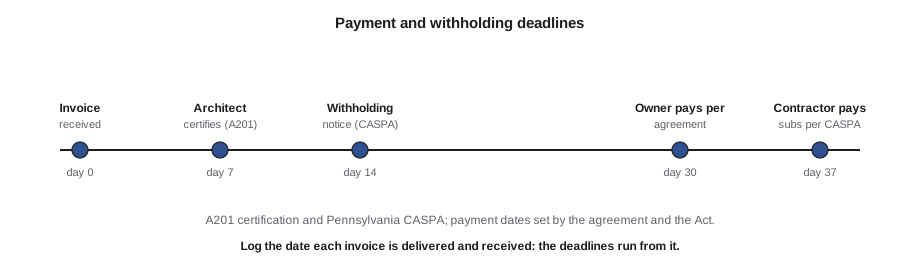
The documentation lesson is the same in both countries. Payment rights now turn on dates: when an invoice was received, when a notice was given, what it said. Brightwater sends every invoice with proof of delivery, logs the date received, and diarizes each deadline. When a notice of non-payment or withholding arrives, the date and contents are checked against the law immediately, because a late or vague notice may mean the amount must be paid in full.
Worked problem
Building the month's application
In month 14, Brightwater's earned value to date on the base contract is $27,540,000, approved change orders are $1,180,000 complete to date, and $410,000 of curtain wall units are stored on site with proper documentation, which the contract allows to be paid. Previous certificates total $24,320,000 before deduction of retainage. The retainage rate is 10 percent, and no release has yet occurred. Ignoring sales tax, what is the amount due this month?
Show solution
- Total earned to date: $27,540,000 + $1,180,000 + $410,000 = $29,130,000.
- Retainage at 10 percent: $2,913,000.
- Earned less retainage: $29,130,000 − $2,913,000 = $26,217,000.
- Previously certified less retainage: $24,320,000 × 0.90 = $21,888,000.
- Amount due this month: $26,217,000 − $21,888,000 = $4,329,000.
Answer: About $4,329,000 is due this month, before tax.
# Monthly payment application from the schedule of values
sov = {  # line: (value, percent complete to date)
    '03 Concrete': (6480000, 1.00),
    '06A Timber supply': (7950000, 0.85),
    '06B Timber install': (2640000, 0.60),
    '08 Curtain wall': (4120000, 0.25),
    '21-23 Mechanical': (9860000, 0.35),
    '26 Electrical': (5310000, 0.30),
}
rate = 0.10
earned = sum(v * p for v, p in sov.values())
held = earned * rate
previous_net = 15000000
for line, (v, p) in sov.items():
    print(f'{line:20} {p:>5.0%}  ${v * p:>12,.0f}')
print(f'Earned to date   ${earned:,.0f}')
print(f'Less 10% held    ${held:,.0f}')
print(f'Due this month ${earned - held - previous_net:,.0f}')03 Concrete 100% $ 6,480,000 06A Timber supply 85% $ 6,757,500 06B Timber install 60% $ 1,584,000 08 Curtain wall 25% $ 1,030,000 21-23 Mechanical 35% $ 3,451,000 26 Electrical 30% $ 1,593,000 Earned to date $20,895,500 Less 10% held $2,089,550 Due this month $3,805,950
Mechanics' liens and dispute records
If payment is not made, lien rights depend on records. Pennsylvania's Mechanics' Lien Law sets strict notice and filing periods; for example, a subcontractor must generally give the owner formal written notice of its intent to file a lien before filing, and liens must be filed within a set period after the claimant last performed work or supplied materials. The date of last work is therefore a critical record, and work done only to extend that date may not count. Payment disputes that go to the initial decision maker, mediation, arbitration or court are decided on the same records: the contract, the applications, proof of delivery, any withholding notices, the change records and the evidence of work done.
The common thread is the date of last supply or last work, which daily reports, delivery tickets and timesheets must capture accurately. Brightwater's subcontracts require subcontractors to report it, and Jun records it for each subcontractor as their work finishes.
Stored materials
Mass timber and curtain wall units are expensive and are often made months before they are installed. Suppliers want to be paid when the product is finished, not when it is lifted into place, so contractors ask owners to pay for materials stored on site or in a warehouse. Owners will do this only if the documents prove that the materials exist, are identified for the project, are insured and will belong to the owner once paid for.
| Record | Purpose |
|---|---|
| Supplier invoice and bill of lading | Shows quantity, value and delivery |
| Photos with tags or labels visible | Shows the items exist and are marked for the project |
| Storage location and access arrangement | Lets the owner or its representative inspect the items |
| Insurance certificate naming the owner | Covers loss or damage while stored |
| Bill of sale or title document | Transfers ownership once payment is made |
| Inventory reconciliation each month | Shows items installed and items still in storage |
On Westgate, the CLT panels for levels 3 and 4 sat in the supplier's yard for six weeks. Before each payment application, the supplier sent photos of the stacks with project tags, and Simone Achebe visited once to confirm them. Each month Jun reconciled the panels claimed as stored against the panels installed, so that nothing was paid for twice.
The payment log
Behind every application sits Brightwater's payment log, a single register of every invoice going up the pyramid and every payment coming down. For each application to the owner it records the date sent, proof of delivery, the date received, any deficiency or withholding notice, the amount certified, the amount paid and the date paid. For each subcontractor it records the same in reverse, together with retainage, waivers or declarations, and the date of last supply. The log makes the statutory deadlines visible. A glance shows which payments are late, which subcontractors must be paid within the week, and which notices are due. It is also the first document an adjudicator, arbitrator or court will want to see if payment becomes a dispute, because it tells the story of the money in one place.
Subcontractors keep their own logs, and the two should agree. Elena's team sends each subcontractor a monthly statement showing what Brightwater has received for their work, what it has paid and what it is holding. Discrepancies raised early are almost always clerical; discrepancies discovered at the end of the job often become claims.
Common mistakes
MistakeFront-loading the schedule of values.
InsteadValue lines fairly so that progress and payment match the work actually done.
MistakeSubmitting an invoice that lacks required contents.
InsteadCheck every application against the contract requirements before sending.
MistakeNot logging when invoices are received.
InsteadSend with proof of delivery and record the received date, which starts the statutory clock.
MistakeMissing the deadline to dispute or withhold.
InsteadDiarize the notice deadline the day an invoice arrives and give a specific, reasoned notice on time.
MistakeGiving unconditional lien waivers before funds clear.
InsteadUse conditional waivers until payment is received and cleared.
Summary and key terms
- The schedule of values divides the price into measurable lines and is the basis of every payment application.
- A payment application is supported by change orders, stored materials records, photos, the schedule and evidence that those below have been paid.
- Retainage is set by the agreement and regulated by Pennsylvania's payment act for private projects.
- Conditional and unconditional lien waivers protect against liens and must match actual payment.
- Pennsylvania requires written notice of withholding within 14 days or the right to withhold is lost.
- Payment rights turn on dates, so invoice delivery, receipt and notices must be logged precisely.
- Lien and dispute rights depend on accurate records of the date of last supply or work.
- Schedule of values
- A breakdown of the contract price into lines used to measure progress and payment.
- Application for payment
- The contractor's request for payment, typically on AIA G702 and G703 forms.
- Retainage
- A percentage of each payment withheld until completion as security for performance.
- Notice of withholding
- Written notice, with reasons, that a payer will withhold part of an invoice for deficient work.
- Lien waiver
- A document in which a party gives up lien rights to the extent of a payment, conditionally or unconditionally.
- Mechanics' lien
- A claim against the property for unpaid work or materials supplied to it.
Practice problems
Work each problem on paper first, then reveal the answer to check.
Why separate supply and installation for prefabricated items in the schedule of values?
Show answer
So delivered or stored materials can be valued and paid separately where the contract allows, and progress matches how the work is built.
Earned to date is $10,000,000, the rate is 10 percent, and $7,200,000 was previously certified before deduction. What is due?
Show answer
Earned less 10%: $9,000,000. Previous less 10%: $6,480,000. Due: $2,520,000.
Under CASPA, what happens if an owner does not give written notice of withholding within 14 days?
Show answer
The owner waives the right to withhold and must pay the invoice in full.
Why must the date of last supply be recorded carefully?
Show answer
Lien preservation and filing periods run from it, so an error can cost lien rights.
What should accompany each application after the first?
Show answer
Lien waivers matching payments made, plus the usual support.
Lesson quiz · 5 questions
Score 60% or more to complete this lesson.
Create a free account to save your progress, take quizzes and earn a certificate.