
CON-375 · Lesson 11 of 12 · 20 min
Closeout and handover documents
Westgate's doors opened to the public on a Saturday in early autumn, with a ribbon-cutting, a children's choir and a queue of families waiting for library cards. Behind the celebration, Brightwater's closeout team had spent four months assembling more than 9,000 documents: as-built drawings, operation and maintenance manuals for 186 pieces of equipment, warranties from 41 suppliers and subcontractors, commissioning reports, training records, test certificates, spare parts lists and keys. The library board's facilities manager, Priya Nair, would use those documents to run the building for decades. To her, the building was not finished until they were complete.
Closeout is the stage where the contractor finishes the work, proves it is finished, and hands the owner both the building and the information needed to operate and maintain it. It is also the stage where many projects lose money and goodwill: punch lists drag on, documents arrive late or incomplete, the final payment is held back, and the warranty period starts with arguments. This lesson covers the milestones of completion, the documents needed at each, and how to plan closeout so that it does not become a crisis at the end.
The milestones of completion
Under the A201-2017, two milestones matter most. Substantial completion is the stage when the work, or a designated portion, is sufficiently complete under the contract documents that the owner can occupy or use it for its intended purpose. The contractor submits a list of items to be completed or corrected, the architect inspects, and when satisfied issues a certificate of substantial completion, which sets the responsibilities for security, maintenance, utilities and insurance, and starts the warranty and correction periods. Final completion follows when all work is complete, and the final payment then becomes due.
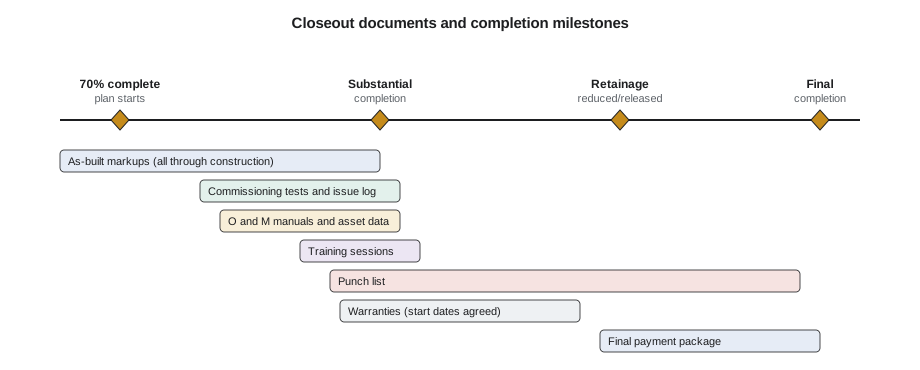
The figure shows why closeout starts long before the end. Operation and maintenance manuals need reviewed submittals; training needs installed and commissioned equipment; as-built drawings need a record kept throughout construction. Brightwater starts its closeout plan at about 70 percent complete, with a closeout coordinator, a register of every required document and a schedule that works back from the substantial completion date.
Punch lists
Before substantial completion, the contractor and then the design team inspect the work and list everything that is incomplete or does not conform. In the US this is usually called a punch list. The items on it must be completed or corrected before final completion, and the contract may allow part of the payment to be held until they are.
| Practice | Why it works |
|---|---|
| Contractor walks first and fixes what it finds before inviting the consultant | The consultant's list is shorter and the process faster |
| One list per area, item numbered, located on a plan, with a photo | Every item can be found, assigned and verified |
| Each item assigned to a responsible trade with a target date | Accountability is clear |
| Items closed only after verification by the person who raised them, or as the contract allows | Prevents disputes about whether an item is really done |
| Daily status report during the final weeks | Keeps everyone focused on closing the list |
On Westgate, Brightwater ran its own quality walk-throughs floor by floor from about 85 percent complete, using a tablet app that pinned each deficiency to the floor plan with a photo. By the time Arden Moss carried out its formal review, the list was about a third of the length it would otherwise have been, and almost every item was cosmetic.
As-built and record drawings
As-built information shows what was actually built, including every change from the design: relocated services, changed dimensions, substitutions, added equipment. It is essential for operating, maintaining and later renovating the building. The terms are used loosely, but on Westgate they have specific meanings.
| Term | Prepared by | What it is |
|---|---|---|
| Field markups | Trades and field engineers during construction | Red-line changes marked on a site set of drawings as work is built |
| As-built drawings | Contractor and trades | Drawings updated from the field markups to show the work as built |
| Record drawings | Often the design team, from the contractor's as-builts | A final set incorporating as-built information for the owner's records |
| As-built model | Contractor or design team | The building model updated to reflect what was built, with asset information where required |
As-built information must be recorded as the work is built, not reconstructed at the end. The most valuable details, such as the exact location of buried services or valves above ceilings, are invisible once the work is covered. Brightwater's subcontracts require each trade to keep a current markup set on site, and Hannah checks the markups monthly as part of the payment review. A subcontractor whose markups are not current does not get its monthly payment approved until they are. For underground services, survey coordinates are recorded before backfilling, and the 360° photo record supplements the drawings for services above ceilings and in walls.
Operation and maintenance information
Operation and maintenance manuals, usually called O&M manuals, tell the owner how to run and look after each system. They are assembled from product data, reviewed submittals, manufacturers' instructions and the commissioning results.
- A system description and the design intent, so operators understand how each system is meant to work.
- Equipment data: manufacturer, model, serial number, location, nameplate data and supplier contacts.
- Operating instructions: start-up, shutdown, seasonal changes, emergencies.
- Maintenance instructions and schedules, with recommended spare parts and consumables.
- Reviewed shop drawings and product data, test and balance reports, and commissioning reports.
- Warranty information with start dates and contacts.
Many owners now want this information as structured data for their maintenance management systems, not just as PDF binders. A common format is COBie, a spreadsheet-based standard for exchanging asset information, which can be produced from a building model. Westgate's contract requires asset data for all mechanical, electrical and plumbing equipment in a spreadsheet matching the library board's maintenance system, so Brightwater collected nameplate data and photos as each piece of equipment was installed rather than hunting for them at the end.
Commissioning and training
Commissioning verifies that building systems are installed, tested and working together as the owner requires. It produces some of the most important closeout records: pre-functional checklists, functional performance test results, issue logs and the final commissioning report.
On Westgate, commissioning follows ASHRAE Guideline 0 and the owner's project requirements, and is led by an independent commissioning authority hired by the library board. Brightwater and its trades complete installation checklists, start-up reports and functional tests under the commissioning authority's direction, and every issue found is logged and tracked to closure.
Training is part of handover. The specifications list training sessions for each system, with duration and audience. Brightwater records each session: date, trainer, attendees, topics covered and any video recording. Priya Nair's operations staff signed attendance sheets, and the videos were added to the O&M information so new staff could watch them later.
Warranties
The A201-2017 includes a warranty that the work will conform to the contract documents and be free from defects, and a correction period, generally one year from substantial completion, during which the contractor must correct work found not to conform. Specifications often require longer extended warranties for particular products such as roofing, curtain wall and equipment. Each warranty document should state the product, the period, the start date, what is covered, what voids it, and whom to contact.
Warranty start dates cause many arguments. Equipment started up months before substantial completion to provide temporary heat may have a manufacturer's warranty that began at start-up, not at handover. Brightwater negotiates with suppliers in advance so that warranties start at substantial completion, and records any exceptions in the warranty register.
Worked problem
How close is closeout?
Six weeks before the target substantial completion date, Jun's closeout register for Westgate shows the following required items and the number complete: O&M manuals 186 required, 124 complete; warranties 41 required, 22 complete; as-built drawing sets 14 disciplines, 6 complete; training sessions 23 required, 4 complete; commissioning functional tests 312 required, 168 complete. What percentage of each category is complete, and which category is most at risk?
Show solution
- O&M manuals: 124 ÷ 186 = 66.7 percent.
- Warranties: 22 ÷ 41 = 53.7 percent.
- As-built sets: 6 ÷ 14 = 42.9 percent.
- Training: 4 ÷ 23 = 17.4 percent.
- Functional tests: 168 ÷ 312 = 53.8 percent.
- Training looks most at risk by percentage, but most sessions cannot happen until commissioning is complete; functional tests are the real constraint and need daily tracking.
Answer: Completion ranges from about 17 percent (training) to about 67 percent (manuals); commissioning tests drive the critical path to handover.
# Closeout register status
register = {  # category: (required, complete)
    'O&M manuals': (186, 124),
    'Warranties': (41, 22),
    'As-built sets': (14, 6),
    'Training sessions': (23, 4),
    'Functional tests': (312, 168),
}
for cat, (req, done) in sorted(register.items(), key=lambda kv: kv[1][1] / kv[1][0]):
    print(f'{cat:18} {done:>4}/{req:<4} {done / req:6.1%}  remaining {req - done}')
total_req = sum(r for r, _ in register.values())
total_done = sum(d for _, d in register.values())
print(f'Overall items complete: {total_done / total_req:.1%}')Training sessions 4/23 17.4% remaining 19 As-built sets 6/14 42.9% remaining 8 Warranties 22/41 53.7% remaining 19 Functional tests 168/312 53.8% remaining 144 O&M manuals 124/186 66.7% remaining 62 Overall items complete: 56.2%
Keys, spare parts and the handover meeting
The physical handover has its own records. Keys and access cards are counted, tagged and handed over against a signed schedule that lists every key by number, door and quantity, because a missing master key can mean re-keying a whole building. Spare parts, extra stock of finishes such as carpet tiles and ceiling panels, and special tools required by the specifications are delivered to the owner's storage room against a signed inventory. Meter readings for electricity, gas and water are recorded at the moment responsibility for utilities passes to the owner, so that the bills can be split fairly.
Brightwater holds a formal handover meeting with the owner's facilities team a week before substantial completion. The agenda walks through every closeout category: what has been delivered, what is outstanding, who will finish it and when. The meeting is minuted like any other, and the minutes become the agreed list of what remains. For Priya Nair, the most useful hour of the meeting was a walk around the building with Marcus and the mechanical foreman, who showed her where every shut-off valve, access panel and control panel was, while her assistant photographed each one and added it to the O&M information.
After handover, the warranty period brings its own records. Every warranty call from the owner is logged with the date, the problem, the trade responsible, the response time and the fix. Brightwater carries out a review with the owner about ten months after substantial completion, before the general warranty period ends, so that any remaining defects are reported in time.
Final documents and final payment
Final payment usually depends on a package of documents in addition to the completed work. The contract lists them; typical items include the completed punch list, all closeout submittals, evidence that subcontractors and suppliers have been paid, releases or waivers, consent of the surety where a bond was provided, and any certificates required by authorities, such as occupancy permits.
On Westgate, the final package also included final lien waivers from Brightwater and all major subcontractors and suppliers, the surety's consent to final payment, and an affidavit that all payrolls, bills for materials and other debts connected with the work had been paid or otherwise satisfied, as the A201 requires.
Brightwater treats the final package as a project in itself, with a checklist, owners and dates. Every week that final payment is delayed by a missing warranty or an unsigned waiver is a week of Brightwater's money, and its subcontractors' retainage, sitting in the owner's account.
Common mistakes
MistakeStarting closeout in the last month.
InsteadBegin the closeout plan and register at about 70 percent complete.
MistakeReconstructing as-builts at the end from memory.
InsteadKeep markups current throughout and check them monthly with payment.
MistakeInviting the consultant to inspect before the contractor's own walk-through.
InsteadWalk and fix first so the formal list is short.
MistakeLetting warranties start at equipment start-up without noticing.
InsteadAgree warranty start dates in advance and record exceptions.
MistakeTreating O&M manuals as binders of brochures.
InsteadProvide system descriptions, equipment data, instructions, schedules and structured asset data.
Summary and key terms
- Substantial completion, certified by the architect, starts warranty and correction periods; final completion triggers final payment.
- Closeout planning should start at about 70 percent complete with a register and schedule.
- Punch lists work best when the contractor walks first and each item is located, assigned, photographed and verified.
- As-built information must be recorded as work is built; record drawings and models hand it to the owner.
- O&M manuals and structured asset data, such as COBie, let the owner run and maintain the building.
- Commissioning and training produce essential records; warranties need clear start dates and terms.
- Final payment depends on a defined package of documents, which should be managed like a project.
- Substantial completion
- The stage when the work is sufficiently complete for the owner to occupy or use it for its intended purpose.
- Punch list
- A list of incomplete or non-conforming work to be finished before final completion.
- As-built drawings
- Drawings updated to show the work as actually built.
- O&M manual
- Operation and maintenance information for building systems and equipment.
- COBie
- A spreadsheet-based standard for exchanging building asset information.
- Commissioning
- The process of verifying that systems are installed, tested and working as the owner requires.
Practice problems
Work each problem on paper first, then reveal the answer to check.
Why must as-built information be recorded during construction?
Show answer
Key details, such as buried services and hidden valves, cannot be seen once covered.
Give three contents of a good O&M manual.
Show answer
Any three of: system descriptions, equipment data, operating instructions, maintenance schedules, reviewed submittals, test and commissioning reports, warranty details.
A register shows 45 of 60 warranties received. What percentage is outstanding?
Show answer
15 ÷ 60 = 25 percent outstanding.
Why might an equipment warranty expire earlier than the owner expects?
Show answer
It may have started at start-up, for example for temporary heat, rather than at substantial completion.
Name three documents often needed for final payment.
Show answer
Any three of: completed punch list, closeout submittals, final lien waivers, surety consent, payment affidavit, occupancy permit.
Lesson quiz · 5 questions
Score 60% or more to complete this lesson.
Create a free account to save your progress, take quizzes and earn a certificate.