
CON-335 · Lesson 7 of 12 · 22 min
Workface planning and advanced work packaging
Look-aheads and constraint logs plan the work at the level of zones and trades. Workface planning goes one level further: it prepares, for each crew, a package containing everything the crew needs to do a defined piece of work in about a week, and it releases that package only when every item in it is ready. The idea came largely from heavy industrial construction, where crews on large plants were spending a large share of each day looking for drawings, materials, tools and permissions. It has since spread to buildings, infrastructure and institutional projects, often under the broader name advanced work packaging.
This lesson explains where workface planning came from, how its packages fit together, how a building contractor like Thornbury Builders can apply a lighter version on a project like Larkspur Commons, and what the evidence says about its benefits.
Origins: Alberta and CII
Workface planning grew out of work by owners and contractors building oil sands facilities in Alberta, Canada, in the mid-2000s, through the Construction Owners Association of Alberta (COAA). The model defined packages of work for each crew and the role of a dedicated workface planner who prepares them. The Construction Industry Institute (CII), based at the University of Texas at Austin, then studied the approach with COAA's involvement. CII research teams RT-272 and RT-319 broadened it into advanced work packaging, which links construction planning back into engineering and procurement, and in a 2015 report CII concluded that advanced work packaging should be treated as a standard best practice for industrial projects. (Dates and report numbers checked October 2026; specific benefit percentages are discussed below with caution.)
The core insight is simple. If a crew arrives at its work area and finds that something is missing, the crew either waits, works on something else inefficiently, or improvises. Studies of industrial sites found that crews often spent less than half of the day on direct installation work, with the rest lost to waiting, traveling, searching and rework. Workface planning tries to raise the share of direct work by making sure everything is ready before the crew starts.
The package hierarchy
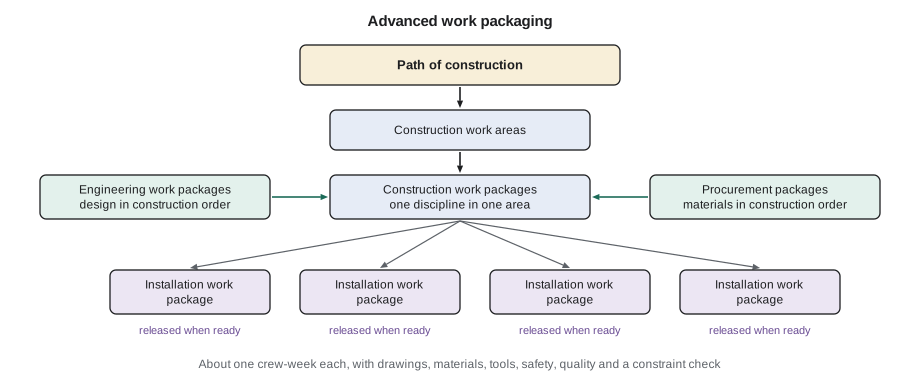
Advanced work packaging divides the project into a hierarchy of packages that connects the overall construction plan to the work of individual crews.
| Package | What it is | Who prepares it | Typical size |
|---|---|---|---|
| Construction work area (CWA) | A geographic part of the project, such as a building, a podium or a set of floors | Construction management during planning | Large: weeks to months of work |
| Construction work package (CWP) | All the work of one discipline in one area, such as "interior framing and drywall, residential floors" | Construction team, early in design | Many crew-weeks |
| Engineering work package (EWP) | The design deliverables needed for a CWP, issued in the order construction needs them | Design team, aligned with CWPs | Matched to CWPs |
| Procurement work package | The materials and fabricated items needed for a CWP, ordered and delivered in the order construction needs them | Procurement, aligned with CWPs | Matched to CWPs |
| Installation work package (IWP) | The work of one crew for about a week, with drawings, quantities, materials, tools, permits and safety plans | Workface planner, a few weeks before the work | Often about one crew-week |
The key idea is the path of construction: the planned order in which the construction work areas and packages will be built. Once the path of construction is set, engineering and procurement are asked to deliver their packages in that order, rather than in the order most convenient for them. On an industrial plant, that might mean the design team completes the pipe racks for one unit before starting the next unit, instead of designing all the pipe racks for the whole plant first. The result is that each construction work package can start with complete information and materials.
The installation work package
The installation work package is where workface planning meets the crew. A good IWP contains everything a foreman needs to plan and carry out a week of work without hunting for information.
- Scope: a clear description of the work and its boundaries, with the location marked on a plan.
- Drawings and details: only the current, approved sheets and details the crew needs, not the whole drawing set.
- Quantities and materials: a list of materials with quantities, where they are staged and confirmation that they are on site.
- Tools and equipment: lifts, specialty tools and any equipment bookings such as hoist time.
- Safety: the hazard assessment for the work, required permits, and any special precautions such as working near open shafts.
- Quality: the inspection and test requirements, hold points and acceptance criteria.
- Constraint check: a signed confirmation that all constraints were cleared before release.
- Labor estimate: the expected work-hours, so progress and productivity can be tracked.
The IWP is released to the foreman only when all its constraints are clear. Until then it stays in the workface planner's hands. A healthy project keeps a backlog of released IWPs, often around two to three weeks of work for each crew, so that crews never run out of ready work but packages are not prepared so far ahead that they go stale.
Sizing installation work packages
On Larkspur Commons, Dana decided to try a light version of workface planning for the drywall and the plumbing work, the two largest interior scopes. Mei acted as the workface planner, with help from the trades' own estimators. Her first job was to divide each scope into IWPs sized to about one crew-week, and to see how many weeks of released backlog the project could keep.
# Split the drywall board scope into crew-week IWPs and track released backlog (illustrative)
import math
zone_hours = {"L3W": 610, "L3E": 590, "L4W": 600, "L4E": 600,
              "L5W": 605, "L5E": 595, "L6W": 640, "L6E": 620}   # board work-hours per zone
crew, hours_per_day, days = 8, 8, 5
crew_week = crew * hours_per_day * days                        # 320 work-hours
iwps = []
for z, h in zone_hours.items():
    n = math.ceil(h / crew_week)
    for i in range(n):
        iwps.append((z, i + 1, round(h / n)))
print(f"Crew-week {crew_week} work-hours; {len(iwps)} IWPs; first five:",
      ", ".join(f"{z}-{i} ({h} h)" for z, i, h in iwps[:5]))
released = 6                                                   # IWPs released and ready today
crews = 2                                                      # board crews working in parallel
print(f"Released backlog: {released} IWPs = {released / crews:.1f} weeks for {crews} crews")
target_weeks = 2
print(f"Target {target_weeks} weeks -> keep at least {target_weeks * crews} IWPs released;"
f" {'OK' if released >= target_weeks * crews else 'release more'}")Crew-week 320 work-hours; 16 IWPs; first five: L3W-1 (305 h), L3W-2 (305 h), L3E-1 (295 h), L3E-2 (295 h), L4W-1 (300 h) Released backlog: 6 IWPs = 3.0 weeks for 2 crews Target 2 weeks -> keep at least 4 IWPs released; OK
Each zone splits into two IWPs of about 300 work-hours, close to one crew-week for an eight-person crew. With two board crews working in parallel, six released IWPs give three weeks of backlog, comfortably above Mei's two-week target. The plumbing scope, with smaller crews, splits into more and smaller IWPs.
The workface planner
On industrial projects the workface planner is a dedicated role, often filled by an experienced tradesperson or foreman who knows how the work is done. The planner prepares the IWPs, checks constraints, releases packages and tracks their completion, freeing the foreman to supervise the crew instead of chasing information. On large projects there may be one workface planner for every few foremen.
On a building of Larkspur Commons's size, a full-time workface planner for each trade is not affordable. Instead, Dana divided the role: Mei prepares the drawing and information side of each IWP and checks the design constraints; Omar confirms materials, hoist time and equipment; and the trade foreman adds the crew plan and the hazard assessment. The IWP is released at the weekly work plan meeting once all three have signed off. This shared approach captures much of the benefit at modest cost.
Applying advanced work packaging to buildings
Building projects differ from industrial ones in several ways that affect how workface planning is applied. Buildings have more trades with smaller scopes, more repetitive work and more design changes driven by tenants and owners. Their general contractors often subcontract almost all the work, so the crews being planned belong to other companies. And their schedules are shorter, which leaves less time to align engineering and procurement with the path of construction.
| Element | Industrial practice | Lighter building practice on Larkspur Commons |
|---|---|---|
| Path of construction | Defined early and drives design and procurement order | Set by the takt plan: bottom to top, west to east; used to set submittal priorities |
| Construction work packages | Formal packages by discipline and area | Subcontract scopes by zone group, such as "drywall, levels 3 and 4" |
| Engineering work packages | Design issued package by package | Design is mostly complete before construction; questions and changes are prioritized by zone |
| Installation work packages | Prepared by dedicated workface planners | Prepared jointly by field engineer, assistant superintendent and foreman for the largest scopes |
| Released backlog | Tracked formally with software | Tracked on a simple log at the plan board |
The building version is less formal, but the principle is the same: decide the order of construction first, align information and materials with that order, and release work to crews only when it is ready. Many building contractors find that the takt plan, the look-ahead and the constraint log already do much of this, and that adding installation work packages for the largest scopes is the step that brings the benefits to the crew level.
What the evidence says
Proponents of advanced work packaging cite large benefits: higher field productivity, lower total installed cost, better schedule predictability, fewer safety incidents and less rework. CII's research reports describe the improvements as substantial, and case studies published by owners and consultants often quote productivity gains in the range of roughly 10 to 25 percent. These figures should be treated with care. They come largely from industrial megaprojects, many from organizations that promote the method, and from projects that adopted several improvements at once, so it is hard to separate the effect of workface planning from that of better management in general.
A reasonable conclusion for a building superintendent is that the mechanism is sound, because crews that have everything they need do waste less time, and that the size of the benefit on any given project depends on how bad the starting point was and how well the method is applied. Measuring direct work time before and after, as Lesson 10 describes, is the best way to know whether it is working on your own site.
Common pitfalls
Workface planning can fail in several ways. Packages can become paperwork: thick binders that foremen never open because they repeat information the foremen already have. Packages can be released before they are truly ready, because of pressure to keep crews busy, which defeats the purpose. The path of construction can be ignored by engineering or procurement, so packages are always waiting for something. And the workface planner can become a bottleneck if the role is underresourced. Dana kept the Larkspur Commons IWPs to two or three pages plus the relevant drawings, and checked every few weeks with the foremen whether they found them useful.
Common mistakes
MistakeReleasing installation work packages before all constraints are cleared.
InsteadRelease an IWP only when every constraint is cleared and signed off.
MistakeMaking packages so thick that foremen ignore them.
InsteadKeep IWPs short and specific: scope, current drawings, quantities, materials, tools, safety, quality and the constraint check.
MistakeLetting design and procurement work in their own order.
InsteadSet a path of construction and ask design and procurement to deliver in that order.
MistakeCopying industrial practice unchanged onto a building.
InsteadUse a lighter version built on the takt plan, look-ahead and constraint log, with IWPs for the largest scopes.
MistakeQuoting benefit percentages as guarantees.
InsteadTreat published figures as indications from mainly industrial projects and measure results on your own site.
Summary and key terms
- Workface planning prepares a package of everything a crew needs for about a week of work and releases it only when ready.
- It was developed by owners and contractors through COAA in Alberta and broadened by CII research into advanced work packaging, which CII recommends as a best practice.
- The hierarchy runs from construction work areas and construction work packages, aligned with engineering and procurement packages, to installation work packages.
- The path of construction sets the order in which design, procurement and construction deliver their packages.
- An installation work package holds scope, drawings, quantities, materials, tools, safety, quality and a constraint check.
- Packages are sized to about a crew-week, and a released backlog of a few weeks keeps crews supplied without stale packages.
- Building projects can use a lighter version built on the takt plan, look-ahead and constraint log, with shared workface planning duties.
- Published benefits are mostly from industrial projects and should be treated with caution; measure results on site.
- Workface planning
- Preparing and releasing to each crew a package containing everything needed for a defined piece of work.
- Advanced work packaging
- A planning approach that aligns engineering, procurement and construction packages with the path of construction.
- Path of construction
- The planned order in which areas and packages will be built.
- Construction work package
- All the work of one discipline in one area.
- Engineering work package
- The design deliverables needed for a construction work package.
- Installation work package
- About a week of work for one crew, with everything needed to carry it out.
- Workface planner
- The person who prepares, checks and releases installation work packages.
- Released backlog
- Installation work packages that have been released to crews but not yet completed.
Practice problems
Work each problem on paper first, then reveal the answer to check.
Which Canadian organization's members developed the workface planning model?
Show answer
The Construction Owners Association of Alberta (COAA).
What did CII conclude about advanced work packaging in its 2015 report?
Show answer
That it should be treated as a standard best practice for industrial projects.
List six items an installation work package should contain.
Show answer
Any six of: scope and location, drawings and details, quantities and materials, tools and equipment, safety plan and permits, quality requirements, constraint check, labor estimate.
In Mei's sizing, how big was a crew-week and how many IWPs did each zone need?
Show answer
320 work-hours for an eight-person crew; each zone needed two IWPs of about 300 hours.
How many weeks of released backlog did six IWPs give for two crews?
Show answer
Three weeks.
How did Dana share the workface planner role?
Show answer
Mei prepared drawings and checked design constraints, Omar confirmed materials, hoist time and equipment, and the foreman added the crew plan and hazard assessment.
What sets the path of construction on Larkspur Commons?
Show answer
The takt plan: bottom to top and west to east.
Why should published productivity gains be treated with caution?
Show answer
They come mostly from industrial projects, often from promoters of the method, and from projects that changed several things at once.
Lesson quiz · 5 questions
Score 60% or more to complete this lesson.
Create a free account to save your progress, take quizzes and earn a certificate.