
CON-335 · Lesson 3 of 12 · 25 min
Handoffs, inspections and area turnover
Every time one trade finishes in an area and another starts, the work changes hands. On a floor of Larkspur Commons there are dozens of these handoffs: from the framers to the plumbers, from the plumbers to the duct installers, from the electricians to the inspector, from the inspector to the insulators and so on through to the cleaners. Each handoff is a point where work can be lost, damaged or misunderstood. A sloppy handoff means the next trade arrives to find the area not ready, the previous trade's work incomplete or damaged, or someone else's materials in the way. The next trade then either works around the problem, which is slow and causes defects, or leaves, which wastes a mobilization and delays everyone behind it.
Good superintendents treat handoffs as planned events with clear conditions, not as something that happens when one crew drifts out and another drifts in. This lesson covers how to define what 'ready' means for each handoff, how to check it, how to manage the inspections that sit at the most important handoffs, and how to hand areas over in a condition that lets the next trade work at full speed.
What makes a handoff fail
When Dana's team reviewed the handoffs on the podium, which had been completed before this course begins, they found the same problems repeating.
| Problem at handoff | Typical cause | Effect on the next trade |
|---|---|---|
| Previous work incomplete | Crew moved on to meet a target elsewhere; small items left for later | Works around gaps, then returns later; extra mobilizations |
| Previous work defective | No check before leaving the area | Rework before starting, or defects buried and found later |
| Area not clean or clear | Debris, leftover materials, equipment left behind | Time lost cleaning and moving things |
| Inspection not done | Inspection not booked in time, or failed | Cannot start; crew stands by or leaves |
| Information missing | Changes not communicated, revised drawings not issued | Wrong work installed and later removed |
| Damage after completion | Next trade or traffic damages finished work | Disputes over who pays for repair |
Most of these problems are cheap to prevent and expensive to fix. A five-minute walk through a zone by the outgoing foreman, the incoming foreman and the assistant superintendent catches most of them before the incoming crew mobilizes. The rest of this lesson builds on that simple idea.
Defining 'ready': handoff conditions
For each handoff in the interior sequence, Dana's team wrote down the conditions that must be true before the next trade starts. These conditions became a checklist for each zone. Writing them down forced the trades to agree on details that had previously caused arguments, such as who removes the bottom plate offcuts or who seals the holes the plumbers leave in the top plates.
| Handoff | Conditions the incoming trade can expect |
|---|---|
| Framing to rough-in | Framing complete to drawings; blocking for fixtures, grab bars, cabinets and TV mounts installed; stud layout checked at bathrooms and kitchens; area swept; framing deficiencies closed |
| Rough-in to inspection | All rough-in complete in the zone; pressure tests done and recorded; holes in fire separations sleeved or ready for firestop; labels on circuits and valves; request for inspection submitted |
| Inspection to insulation | Building official's rough-in approval recorded; fire separations firestopped and photographed; moisture readings acceptable; nail plates installed where pipes and cables pass close to stud faces |
| Insulation to drywall | Insulation and vapor barrier complete and inspected where required; acoustic sealant applied at party walls; all in-wall items confirmed in place; board stocked on the floor |
| Drywall to finishes | Board, tape, mud and sanding complete; prime coat applied; dust cleaned; a walk of each suite done with the painter and finish carpenter |
| Finishes to finish trades | Cabinets and counters set; flooring and tile complete and protected; rooms clean; finish trades' fixtures and devices delivered to the zone |
The conditions are written from the point of view of the incoming trade, because that is the trade that pays the price when the area is not ready. They should be short enough to check in a walk and specific enough that two people would agree whether each item is done. 'Area clean' is vague; 'floor swept, offcuts and packaging removed to the bins on the east landing' is checkable.
The handoff walk
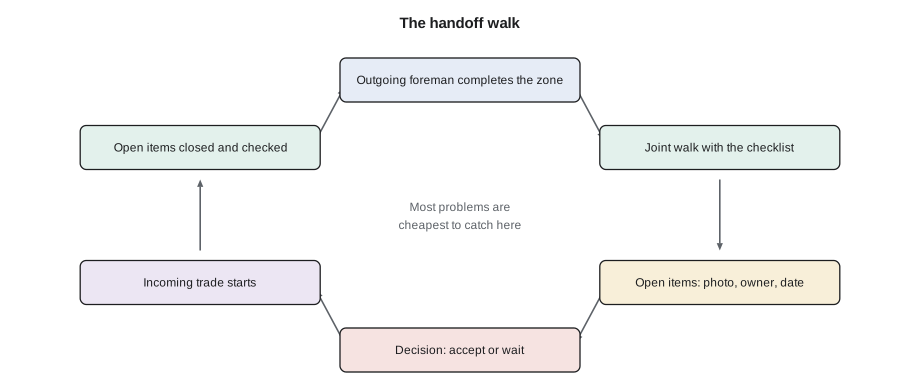
On Larkspur Commons, each major handoff in a zone is marked by a short walk. The outgoing foreman, the incoming foreman and Omar or Dana walk the zone with the checklist. Items that are not ready are recorded with a photograph, an owner and a date. The incoming foreman then decides, with the superintendent, whether the zone can be accepted with a short list of open items or must wait.
The walk has three effects beyond catching problems. It gives the outgoing trade a clear finish line, so crews stop leaving small items behind to come back to later. It records the condition of the area at handoff, which settles later disputes about damage. And it puts the two foremen in the same room, where they often solve small coordination problems on the spot, such as where the electrician's boxes should go relative to the cabinet layout.
A readiness check
Omar keeps the checklists in a simple spreadsheet linked to the look-ahead. Before confirming a trade's start in a zone, he checks how many conditions are met and whether any open item is a blocker that prevents the work outright. The script below shows the logic for the rough-in-to-insulation handoff on level 3 west.
# Readiness check before the insulation crew starts on level 3 west (illustrative)
checklist = [  # (condition, done, blocks the start if not done)
    ("Rough-in approval from the building official recorded", True, True),
    ("Fire separations firestopped and photographed",         False, True),
    ("Moisture readings at or below the specified limit",      True, True),
    ("Nail plates installed where services are near stud faces", True, False),
    ("Electrical boxes at kitchens match the cabinet layout",  False, False),
    ("Zone swept and offcuts removed",                         True, False),
    ("Insulation and vapour barrier stocked on the floor",     True, True),
]
done = sum(1 for _, ok, _ in checklist if ok)
blockers = [c for c, ok, b in checklist if not ok and b]
open_items = [c for c, ok, b in checklist if not ok and not b]
print(f"Conditions met: {done} of {len(checklist)} ({done / len(checklist):.0%})")
for c in blockers:
    print("  BLOCKER:", c)
for c in open_items:
    print("  open item:", c)
if blockers:
    print("Decision: do not start; clear the blockers and re-walk")
else:
print("Decision: start, with open items assigned an owner and a date")Conditions met: 5 of 7 (71%) BLOCKER: Fire separations firestopped and photographed open item: Electrical boxes at kitchens match the cabinet layout Decision: do not start; clear the blockers and re-walk
Five of seven conditions sounds like a reasonable score, and the cabinet box locations can be fixed while insulation proceeds, but the missing firestopping is a blocker: insulation would cover fire separations that have not been sealed, and the inspector or fire consultant may then require it to be removed. A percentage on its own can mislead. The decision depends on which items are missing, not how many.
Inspections as hold points
Some handoffs cannot happen until an outside party approves the work. These are hold points. On a building like Larkspur Commons, the main ones in the interior phase are the building official's inspections of rough-in before cover and of insulation and vapor barrier where required, the fire sprinkler and fire alarm inspections, the plumbing tests, and inspections by the owner's consultants, such as the building envelope consultant or the architect's field reviews.
In Boise, as in most US cities, the building permit lists the inspections the city requires, and the contractor books each one with the city's building division before covering the work. Typical stages for this type of building include framing, rough plumbing, rough mechanical, rough electrical, insulation and, in some jurisdictions, drywall fastening, followed by final inspections. Fire sprinklers are installed to NFPA 13 and inspected by the fire marshal or building official, and the special inspections required by the building code are carried out by the owner's special inspection agency. Exact inspection stages and booking rules vary by jurisdiction and are set out in the permit and local ordinances.
Inspections are a common source of lost days because they combine three uncertainties: when the work will be ready, when the inspector can come and whether the inspection will pass. Dana manages them in four ways.
- Book ahead from the look-ahead. Inspection requests are placed as soon as the look-ahead shows the zone will be ready, then confirmed or moved the day before.
- Pre-inspect. Mei or Omar walks the zone the day before with the inspector's checklist and the trades fix anything that would fail.
- Stage the work. Instead of asking for one inspection of a whole floor, the team asks for zone-by-zone inspections that match the trade train, so the insulation crew does not wait for the last suite on the floor.
- Keep a relationship. Inspectors are busy public servants. A site that is ready when they arrive, with the documents laid out and a person to walk with them, gets better cooperation than one that wastes their time.
A failed inspection does more than delay one trade. It also delays every trade behind it in that zone, and it may delay the trade in front if it has to come back to fix its work. The pre-inspection walk is cheap insurance against that ripple.
Inspection timing and the cost of waiting
Mei estimated how much schedule a single day of inspection waiting costs on the interior trade train. Because the insulation and drywall crews follow the inspection directly, a day of waiting in one zone delays those crews by a day, and unless there is slack downstream, every following zone and the last zone's finish move by the same day. The calculation is simple but persuasive at the weekly meeting.
# How inspection waiting moves the interior finish (working days, illustrative)
zones = ["L3W", "L3E", "L4W", "L4E", "L5W", "L5E", "L6W", "L6E"]
planned_wait = 1                 # one day from ready to inspection is built into the plan
actual_wait = {"L3W": 1, "L3E": 3, "L4W": 1, "L4E": 2, "L5W": 1, "L5E": 1, "L6W": 4, "L6E": 1}
buffer = 2                       # days of buffer the plan holds after the inspection step
delay = 0
for z in zones:
    extra = actual_wait[z] - planned_wait
    delay = max(0, delay + extra)        # extra waiting pushes the train
    print(f"{z}: waited {actual_wait[z]} day(s), train delay so far {delay} day(s)")
net = max(0, delay - buffer)
print(f"Total extra waiting {sum(actual_wait.values()) - planned_wait * len(zones)} days;"
f" after the {buffer}-day buffer the last zone finishes {net} day(s) late")L3W: waited 1 day(s), train delay so far 0 day(s) L3E: waited 3 day(s), train delay so far 2 day(s) L4W: waited 1 day(s), train delay so far 2 day(s) L4E: waited 2 day(s), train delay so far 3 day(s) L5W: waited 1 day(s), train delay so far 3 day(s) L5E: waited 1 day(s), train delay so far 3 day(s) L6W: waited 4 day(s), train delay so far 6 day(s) L6E: waited 1 day(s), train delay so far 6 day(s) Total extra waiting 6 days; after the 2-day buffer the last zone finishes 4 day(s) late
Six extra days of waiting, spread across the eight zones, push the last zone four days late even after the two-day buffer is used. That is almost a week of general conditions, supervision and possibly liquidated damages. It makes the case for pre-inspections and zone-by-zone booking much better than a general appeal to 'stay on top of inspections'.
Protection of finished work
Handoffs do not end when the next trade starts. Finished work must be protected from the trades that follow, or it will be damaged and the dispute over who pays will cost more than the repair. Interior protection on Larkspur Commons includes floor protection boards over finished flooring and tile, corner guards on finished drywall corners in corridors, covers over tubs and counters, door protection, and sealed doors to finished suites. Each protection item has an owner: the trade that installs the finished work usually installs the protection, and the general contractor maintains and removes it.
Damage still happens. When it does, the handoff record and the photographs from the walk show whether the damage was there at handoff. Many contractors keep a damage log, and the site rules make clear that the trade causing damage pays for repair. The best protection, however, is good sequencing: if flooring goes in after cabinets and before finish trades, and the finish trades have been told the floors are finished and protected, damage drops.
Area turnover to the owner
The last handoff in each zone is from the contractor to the owner. On Larkspur Commons, the owner wants the residential floors handed over floor by floor so that leasing can begin, with the podium and retail units last. Turnover of each floor needs its own conditions: all work complete, deficiencies listed and mostly closed, systems tested, the floor cleaned, the fire separations and life-safety systems in service, and the building official's permission to occupy that part of the building.
Partial occupancy brings its own coordination issues. Occupied floors must be separated from construction, with safe exits, working fire alarm and sprinkler systems, and controlled access. Trades must not carry materials through occupied corridors. These conditions must be planned months ahead with the owner, the building official and the fire department, and they constrain how the remaining construction can be sequenced. Lesson 12 returns to them in the capstone.
Deficiencies and the punch list
Deficiencies, often called the punch list, are the items of incomplete or defective work found near the end. A punch list that grows to hundreds of items per floor is a symptom of poor handoffs: each trade left small items behind, and nobody checked. Contractors that manage handoffs well find that their final deficiency lists are short, because most items were caught and closed at each handoff walk.
Dana's rule on Larkspur Commons is 'zero-defect handoffs where possible, short lists where not'. Each trade closes its own items before the next handoff, and the superintendent's final walk with the owner should find mostly cosmetic items. CON-345 covers quality control and inspection in more depth, and CON-385 covers commissioning and closeout.
Common mistakes
MistakeLetting trades drift in and out of a zone without a defined handoff.
InsteadDefine handoff conditions, walk each handoff with both foremen and record open items with owners and dates.
MistakeJudging readiness by the percentage of checklist items done.
InsteadIdentify blockers separately; one missing blocker means the next trade should not start.
MistakeBooking inspections only when the work is finished.
InsteadBook from the look-ahead, confirm the day before and pre-inspect to avoid failures.
MistakeAsking for floor-wide inspections when trades work by zone.
InsteadStage inspections zone by zone to match the trade train.
MistakeLeaving protection of finished work to chance.
InsteadAssign an owner to each protection item and record the condition of work at each handoff.
Summary and key terms
- Handoffs between trades are where work is lost, damaged or misunderstood; they should be planned events.
- Common failures include incomplete or defective work, uncleared areas, missing inspections, missing information and later damage.
- Handoff conditions, written from the incoming trade's point of view, define what ready means and form a checklist for each zone.
- A joint handoff walk catches problems, sets a finish line, records the condition of the area and helps foremen coordinate.
- Readiness depends on blockers, not on the percentage of conditions met.
- Inspections are hold points; book them from the look-ahead, pre-inspect and stage them by zone.
- A few days of inspection waiting spread across zones can push the last zone's finish by a week.
- Finished work needs protection with clear owners; turnover to the owner and partial occupancy need their own conditions.
- Handoff
- The point at which one trade finishes in an area and another starts.
- Handoff conditions
- The written conditions an area must meet before the next trade starts.
- Hold point
- A step in the work that cannot be passed until an inspection or approval is given.
- Pre-inspection
- A check by the contractor, using the inspector's checklist, before the official inspection.
- Blocker
- An open item that prevents the next trade from starting.
- Punch list
- The list of incomplete or defective items found near the end of the work.
- Partial occupancy
- Occupation of part of a building while construction continues elsewhere.
- Damage log
- A record of damage to finished work, used to assign responsibility for repair.
Practice problems
Work each problem on paper first, then reveal the answer to check.
Who walks the zone at a handoff on Larkspur Commons?
Show answer
The outgoing foreman, the incoming foreman and the assistant superintendent or superintendent.
Rewrite 'area clean' as a checkable condition.
Show answer
For example: floor swept, offcuts and packaging removed to the bins on the east landing.
In the readiness check, why did 5 of 7 conditions not allow the insulation crew to start?
Show answer
The missing item, firestopping of fire separations, was a blocker.
List the four ways Dana manages inspections.
Show answer
Book ahead from the look-ahead, pre-inspect, stage inspections by zone, and keep a good relationship with inspectors.
In the inspection-waiting example, how late did the last zone finish and why?
Show answer
Four days late: six extra days of waiting pushed the train, and the two-day buffer absorbed only two.
Who usually installs and who maintains protection of finished work?
Show answer
The trade installing the finished work installs the protection; the general contractor maintains and removes it.
What does a long final punch list usually indicate?
Show answer
Poor handoffs: trades left items behind and nobody checked at each handoff.
Name three conditions for handing a floor over to the owner.
Show answer
Any three of: work complete, deficiencies listed and mostly closed, systems tested, floor clean, life-safety systems in service, permission to occupy.
Lesson quiz · 5 questions
Score 60% or more to complete this lesson.
Create a free account to save your progress, take quizzes and earn a certificate.