
CON-310 · Lesson 4 of 12 · 27 min
Measuring progress and percent complete
Actual cost tells you what has been spent; it says nothing about what has been achieved. A crew that has used 60 % of its budget hours on a wall is either ahead, on target or in trouble depending on how much of the wall is finished. Measuring physical progress is therefore the step that turns a cost ledger into a control system. It is also the step most often done badly, by asking the foreman for a percentage and writing it down. This lesson sets out the standard methods for measuring percent complete, how to choose among them, how to roll progress up from detailed items to a control account and the whole job, and how measured progress converts into earned hours and earned value.
Why opinions are not enough
A foreman's estimate of percent complete is quick and often reasonable, but it is biased in predictable ways. Early in an activity, people tend to overestimate progress because the visible work goes quickly; the last 10 % of an activity, with its details, corrections and cleanup, often takes far longer than 10 % of the time. Under pressure to show good results, estimates also drift upward. The result is the familiar pattern of an activity that is '90 % complete' for weeks. Objective methods, agreed before work starts, reduce these biases because they tie credit to something that can be counted or inspected.
The standard methods
Earned value practice recognizes a small set of methods for measuring progress on a work item. Each gives credit by a different rule.
| Method | Rule for credit | Best suited to |
|---|---|---|
| Units complete | Quantity installed ÷ total quantity | Repetitive work with one unit of measure: lf of pipe, ft² of drywall, piles |
| Incremental milestones (weighted steps) | Fixed percentages earned as defined steps are completed | Work with distinct stages: formwork, equipment installation, a pour |
| Start and finish (0/100, 50/50, 20/80) | A share on start, the rest on finish | Short activities completed within one or two periods |
| Cost ratio | Cost to date ÷ forecast cost at completion | Services and items that progress with spending, such as some general conditions |
| Level of effort | Earned automatically as time passes | Supervision and support with no measurable output |
| Apportioned effort | Earned in proportion to a related discrete item | Inspection or quality control tied to installation |
| Supervisor opinion | Judgment of the responsible person | Small items only, where no objective method is practical |
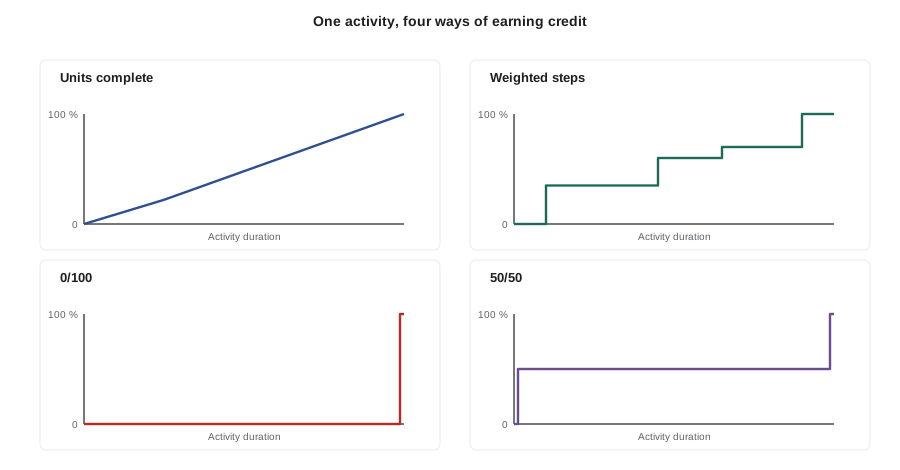
Units complete
Units complete is the most objective method when the work has one dominant unit of measure that can be counted. Progress equals quantity installed divided by the budget quantity. Its weakness is that not every unit takes the same effort: the first hundred meters of pipe in an open corridor go much faster than the last fifty in a congested plant room, so straight units complete can overstate progress early. Separating codes by area or difficulty, or weighting units, reduces the problem.
Worked problem
Units complete on drywall boarding
The budget for boarding partitions on level 3 is 49,500 ft² of board. At month-end the crew has hung 32,200 ft² as confirmed by the superintendent's walk-through. What is percent complete?
Show solution
- 32,200 ÷ 49,500 = 0.65.
Answer: 65 % complete. The quantity should come from a count or measurement, not from the delivery tickets for board, which would count material on site but not installed.
Incremental milestones and weighted steps
For work that passes through distinct stages, the activity is divided into steps, each given a weight that reflects its share of the effort. Credit for a step is earned only when the step is complete, or in some systems partly as the step progresses. The weights are set before work starts, usually from the estimate or from historical data, and should not be changed to improve the numbers.
| Step | Weight |
|---|---|
| Layout and set out | 5 % |
| Form one side and install embeds | 30 % |
| Reinforcing inspected (by others, no credit to forming) | 0 % |
| Close forms, brace and align | 25 % |
| Pour support and check during placement | 10 % |
| Strip, clean and move forms | 30 % |
# Weighted-step progress for six wall pours on level 1
steps = {"layout": 0.05, "form one side": 0.30, "close and brace": 0.25,
         "pour support": 0.10, "strip and clean": 0.30}
walls = {   # steps completed on each wall at month-end
    "W1": ["layout", "form one side", "close and brace", "pour support", "strip and clean"],
    "W2": ["layout", "form one side", "close and brace", "pour support", "strip and clean"],
    "W3": ["layout", "form one side", "close and brace", "pour support"],
    "W4": ["layout", "form one side", "close and brace"],
    "W5": ["layout", "form one side"],
    "W6": [],
}
budget_hours = {"W1": 96, "W2": 96, "W3": 120, "W4": 120, "W5": 84, "W6": 84}   # bigger walls carry more hours
earned = 0
for w, done in walls.items():
    pct = sum(steps[s] for s in done)
    earned += pct * budget_hours[w]
    print(f"{w}: {pct:4.0%} of {budget_hours[w]} h")
total = sum(budget_hours.values())
print(f"Earned hours {earned:.0f} of {total}; activity {earned / total:.1%} complete")W1: 100% of 96 h W2: 100% of 96 h W3: 70% of 120 h W4: 60% of 120 h W5: 35% of 84 h W6: 0% of 84 h Earned hours 377 of 600; activity 62.9% complete
Because each wall carries its own budget hours, the activity's percent complete is a weighted average, not a simple average of the six wall percentages. A simple average would give equal weight to the small walls and the large ones.
Start and finish methods
For activities short enough to start and finish within one or two reporting periods, measuring intermediate progress is not worth the effort. The 0/100 method gives no credit until the activity is complete; 50/50 gives half on start and half on finish; 20/80 and similar splits are also used. These methods are conservative (0/100) or slightly generous (50/50) within a period, but errors cancel out quickly because the activities are short. They should not be used on long activities, where they give badly distorted pictures for months.
Level of effort and cost ratio
Some costs produce no measurable output. A site superintendent's salary, a site office rental or a safety coordinator's time support the whole job. Level of effort (LOE) earns value automatically as time passes, so earned value always equals planned value and the schedule variance is always zero. That is correct for support work, but LOE should be kept to genuinely supportive items, because it masks problems: if LOE makes up a large share of a control account, the account will look on schedule even when the discrete work is behind.
The cost ratio method earns value in proportion to cost spent against forecast cost. It is acceptable for some services, but it simply assumes performance is on target, so it can never show a cost variance. Neither LOE nor cost ratio should be used for self-performed construction work that can be counted.
Rules of credit
Whatever methods are chosen, they should be written down before work starts as rules of credit: for each type of work, the method, the steps and weights, and who certifies the quantities. Typical rules also cover materials: whether value is earned when materials are delivered to site or only when installed. For cost control the usual practice is to earn value for installed work only, while the owner payment may include materials stored on site under the contract's conditions (Lesson 11).
| Element of the rules | Example decision |
|---|---|
| Method for each work type | Pipe by units complete; equipment by weighted steps; short tasks 0/100 |
| Steps and weights | Fixed from the estimate before work starts |
| Quantity source | Superintendent walk-through, survey, model quantities or inspection records |
| Materials on site | No earned value until installed |
| Rework | No new credit for redoing work already credited; rework hours charged to a rework code |
| Certification | Superintendent signs quantities; cost engineer spot-checks a sample |
Rolling up progress
Percent complete at the level of a control account, a trade or the whole project is the budget-weighted average of the items below it. The weight can be dollars or hours. For self-performed labor, budget hours are the usual weight; for the whole project, budget dollars. The calculation is simple, but it is often done wrong by averaging percentages without weights or by mixing items measured in different units.
# Roll up Riverbend structure progress by budget dollars (amounts $)
items = [  # item, budget, percent complete
    ("Footings and foundation walls", 612_000, 1.00),
    ("Slab on grade", 312_400, 1.00),
    ("Columns L1-L4", 284_000, 0.55),
    ("Elevated slab L2", 498_000, 1.00),
    ("Elevated slab L3", 498_000, 0.40),
    ("Elevated slab L4", 498_000, 0.00),
    ("Roof slab and parapets", 458_000, 0.00),
]
budget = sum(b for _, b, _ in items)
earned = sum(b * p for _, b, p in items)
simple = sum(p for *_, p in items) / len(items)
print(f"Budget {budget:,}  earned {earned:,.0f}")
print(f"Weighted percent complete {earned / budget:.1%}; unweighted average {simple:.1%}")Budget 3,160,400 earned 1,777,800 Weighted percent complete 56.3%; unweighted average 56.4%
The weighted figure is the right one. Here the unweighted average is close, but on jobs where items differ greatly in size the two can diverge by many points.
Earned hours
For self-performed work, progress is often expressed as earned hours: the budget hours for the work actually done. Earned hours equal percent complete multiplied by budget hours. Comparing earned hours with actual hours gives the productivity factor that Lesson 5 develops. Earned hours are also easy for foremen to understand: 'you have earned 520 hours and spent 610' is clearer than a dollar variance that mixes wages and productivity.
Worked problem
Earned hours on slab edge forms
The slab edge form budget is 1,345 lf at 0.183 h/lf, or 246 h. The crew has installed and stripped 886 lf and spent 189 h. What are earned hours and how does the crew stand?
Show solution
- Percent complete: 886 ÷ 1,345 = 65.9 %.
- Earned hours: 0.659 × 246 = 162 h.
- Actual hours 189 exceed earned hours 162 by 27 h.
Answer: The crew has earned 162 hours but used 189, so it is running about 17 % over its budget rate on this item.
Auditing progress
Because so much depends on percent complete, it should be checked. A cost engineer or project manager should walk the site with the superintendent at month-end for the main items, compare claimed quantities with drawings or models, and look for warning signs: items stuck at a high percentage for several periods, percentages that jump without matching hours, or earned value on work that has not been inspected. BIM quantities and reality capture (CON-260 Lessons 6 and 8) can make the check faster, by comparing installed elements in a scan or a progress-tracked model with the budget quantities.
Common mistakes
MistakeAsking the foreman for a percentage and recording it.
InsteadUse objective methods such as units complete and weighted steps agreed before work starts.
MistakeUsing 0/100 on an activity that lasts four months.
InsteadUse start and finish methods only for activities completed within one or two periods.
MistakeClassifying measurable work as level of effort.
InsteadKeep level of effort for genuine support work; it hides schedule variances.
MistakeAveraging item percentages without weights.
InsteadRoll up by budget dollars or hours.
MistakeEarning value for materials delivered but not installed.
InsteadFor cost control, earn value on installed work; treat stored materials under the billing rules.
MistakeChanging step weights during the job to improve results.
InsteadFix weights before work starts and change them only for documented scope changes.
Summary and key terms
- Physical progress must be measured objectively to turn cost data into a control system.
- Units complete, weighted steps, start and finish, cost ratio, level of effort and apportioned effort are the standard methods.
- Choose the method to suit the work: units for repetitive items, steps for staged work, start and finish for short tasks.
- Level of effort and cost ratio cannot show problems and should be limited to support work.
- Rules of credit, agreed in advance, set methods, weights, quantity sources and treatment of materials and rework.
- Roll up progress by budget dollars or hours, never by unweighted averages.
- Earned hours compare directly with actual hours and should be audited at month-end.
- Percent complete
- The share of an item's work that has been accomplished.
- Units complete
- Progress measured as quantity installed divided by budget quantity.
- Weighted steps
- Progress earned as defined stages of an activity are completed, each with a fixed weight.
- 0/100 method
- No credit until an activity is finished.
- 50/50 method
- Half credit at start and half at finish.
- Level of effort
- Support work earned automatically with time.
- Cost ratio method
- Progress measured as cost to date over forecast cost at completion.
- Rules of credit
- The agreed methods and weights for measuring progress on each type of work.
- Earned hours
- Budget hours for the work actually completed.
- Roll-up
- Combining item progress into higher levels using budget weights.
Practice problems
Work each problem on paper first, then reveal the answer to check.
Why does the last 10 % of an activity often take much more than 10 % of the time?
Show answer
Details, corrections, inspection and cleanup concentrate at the end.
Which method suits 900 piles of similar size?
Show answer
Units complete.
Steps weighted 10, 40, 30 and 20 % are complete for the first two steps. What is percent complete?
Show answer
50 %.
When is 0/100 acceptable?
Show answer
For activities that start and finish within one or two reporting periods.
Why should level of effort be limited?
Show answer
It always earns planned value, so it hides schedule problems in discrete work.
Item A ($300,000) is 80 % complete; item B ($100,000) is 20 % complete. What is the weighted percent complete?
Show answer
(240,000 + 20,000) ÷ 400,000 = 65 %.
Budget hours are 500 and percent complete is 46 %. What are earned hours?
Show answer
230 hours.
Should value be earned for drywall delivered to the floor but not hung?
Show answer
Not for cost control; it may be billable as stored material under the contract.
Name two warning signs when auditing progress.
Show answer
Items stuck near completion, jumps without matching hours, value on uninspected work.
Who usually certifies installed quantities?
Show answer
The superintendent, with spot-checks by the cost engineer or project manager.
Lesson quiz · 5 questions
Score 60% or more to complete this lesson.
Create a free account to save your progress, take quizzes and earn a certificate.