
CON-230 · Lesson 9 of 12 · 34 min
Lighting and lighting controls
Lighting is the most visible part of the electrical system and one of the most closely regulated for energy. In two decades the industry has moved almost entirely from fluorescent and incandescent sources to light-emitting diodes (LEDs), and from simple wall switches to networked controls that dim lights by daylight and occupancy and report energy use. Lighting also has life safety roles: emergency lighting and exit signs guide people out when the power fails.
For the constructor, lighting brings large quantities of fixtures with long submittal lists, tight ceiling coordination with ducts, sprinklers and diffusers, controls programming and commissioning, and inspections of emergency lighting. Substitutions are common and need care, because a cheaper fixture can change light levels, glare, energy compliance and controls compatibility.
Light, lumens and illuminance
Lighting has its own vocabulary. Luminous flux, measured in lumens (lm), is the total light a source emits. Efficacy, in lumens per watt, measures how efficiently it does so; modern LED fixtures commonly exceed 100 lm/W, roughly double the efficacy of the fluorescent fixtures they replaced. Illuminance is the light falling on a surface.
US practice measures illuminance in footcandles (lumens per square foot), with lux used in some specifications (1 footcandle = 10.76 lux).
Recommended light levels come from the Illuminating Engineering Society (IES) and depend on the task: around 300 to 500 lux (30 to 50 footcandles) for general office work, less for corridors, more for detailed tasks. Quality matters as much as quantity: glare, uniformity, color rendering (CRI or TM-30 metrics), color temperature (warm 2,700 to 3,000 K, neutral 3,500 to 4,000 K) and flicker all affect comfort and productivity.
Estimating fixture quantities: the lumen method
Designers use lighting software for layouts, but the lumen method gives a quick estimate of how many fixtures a room needs. It accounts for how much of each fixture's light reaches the work plane (the coefficient of utilization, CU) and how light output falls with age and dirt (the light loss factor, LLF).
Worked problem
Fixtures for an open office
An office measures 33 ft by 39 ft (about 1,290 ft²). The target illuminance is 37 footcandles. Each LED fixture produces 4,000 lumens, the CU is 0.7 and the LLF is 0.8. How many fixtures are needed?
Show solution
- Area: about 1,290 ft².
- Lumens needed at the work plane: 37 × 1,290 = 47,730 lm.
- Useful lumens per fixture: 4,000 × 0.7 × 0.8 = 2,240 lm.
- Fixtures: 47,730 ÷ 2,240 = 21.3, so about 22 fixtures, arranged to give even coverage.
Answer: About 22 fixtures.
Lighting power density and energy codes
Energy codes limit the electrical power that lighting may use, expressed as lighting power density (LPD): installed lighting watts divided by floor area. Codes allow either a whole-building allowance or a space-by-space allowance. LED technology has driven allowances down sharply over the past decade.
ASHRAE 90.1-2022 and the IECC 2024 set interior lighting power allowances by building area or space type and require automatic shutoff, occupancy-based controls and daylight responsive controls in many spaces.
Worked problem
Checking lighting power density
The open office in the previous example uses 22 fixtures at 32 W each. If the applicable allowance for this space type is 0.60 W/ft² (illustrative; check the adopted code), does it comply?
Show solution
- Installed power: 22 × 32 = 704 W.
- LPD: 704 ÷ 1,290 = 0.55 W/ft².
- 0.55 is below 0.60, so the space complies with margin to spare.
Answer: Yes, at about 0.55 W/ft².
Substituting a fixture with lower efficacy, for example a decorative fixture at 60 lm/W instead of 120 lm/W, can double the installed watts for the same light and break compliance. Energy code compliance forms are part of the permit and are often checked again at substantial completion.
Lighting controls
Controls cut lighting energy by turning lights off or down when they are not needed. Common strategies are:
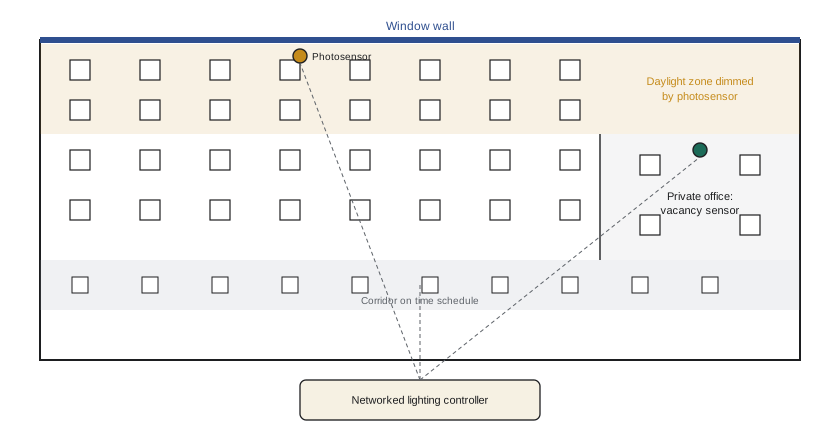
- Occupancy sensors, which turn lights on when people enter and off when the space is empty, and vacancy sensors, which require manual on but turn lights off automatically.
- Daylight harvesting, which dims fixtures near windows and skylights when daylight is sufficient, using photosensors.
- Time scheduling, which turns lights off after hours with override switches.
- Task tuning or high-end trim, which sets maximum output below 100 percent where full output is not needed.
- Networked lighting controls, in which each fixture or zone communicates over wired or wireless networks, allowing reprogramming, energy reporting and integration with the BAS.
Worked problem
Savings from occupancy control
The office lighting uses 704 W and would run about 3,000 hours a year under a simple schedule. Occupancy sensors are expected to cut operating hours by 30 percent. How much energy is saved, at an illustrative rate of $0.12 per kWh?
Show solution
- Baseline energy: 704 W × 3,000 h = 2,112,000 Wh = 2,112 kWh.
- Savings: 0.30 × 2,112 = 634 kWh per year.
- Cost: 634 × 0.12 = $76 per year for this room, which across a large building adds up to significant savings.
Answer: About 634 kWh and $76 a year for the room.
Daylight zones are defined by the geometry of windows and skylights. A common rule in energy codes is that the primary sidelit zone extends from the window wall a distance equal to the window head height, so a window head at 2.7 meters (9 ft) creates a daylight zone about 2.7 meters deep along the façade.
Controls are a frequent commissioning problem: sensors placed where they cannot see occupants, photosensors calibrated wrongly so lights stay dim on cloudy days, or time-outs set so short that lights switch off on people at desks. Functional testing of a sample of each control type, with documented settings, is part of good practice and is required by many energy codes.
Fixtures, drivers and dimming
LED fixtures contain the LED modules and a driver, an electronic power supply that converts line voltage to the low-voltage direct current the LEDs need and provides dimming. Common dimming methods are 0–10 V analog control, digital protocols such as DALI, and phase dimming for some small fixtures. Driver and control compatibility must be checked at submittal, because mismatches cause flicker, poor dimming range or failure. LED fixtures also create harmonic currents and high inrush current at switch-on, which affects breaker selection and the number of fixtures on a circuit.
Worked problem
Fixtures on a 347 V or 277 V lighting circuit
A 277 V lighting circuit is protected by a 20 A breaker and carries a continuous load. Each LED fixture draws 0.15 A at 277 V. How many fixtures can the circuit carry, before considering inrush limits?
Show solution
- Continuous load limit: 80 percent of 20 A = 16 A.
- Fixtures: 16 ÷ 0.15 = 106.7, so 106 fixtures.
- In practice designers limit the number further for inrush current, switching zones and maintenance.
Answer: Up to 106 fixtures.
Emergency lighting and exit signs
Emergency lighting illuminates exit routes when normal power fails, from batteries in unit equipment or fixtures, from a central battery system or from the emergency generator. Exit signs mark the way out.
In the United States, the IBC (Section 1008) and NFPA 101 require emergency lighting along the means of egress with an initial average of at least 1 footcandle (about 11 lux) and a minimum of 0.1 footcandle at floor level, for at least 90 minutes. Exit signs may be red or green depending on local rules and must be listed to UL 924.
Worked problem
Battery energy for unit equipment
A unit equipment battery pack powers two 9 W remote heads for the required 90 minutes. How much battery energy is needed, and what capacity at 6 V?
Show solution
- Load: 2 × 9 = 18 W.
- Energy: 18 W × 1.5 h = 27 Wh.
- Capacity at 6 V: 27 ÷ 6 = 4.5 Ah, before allowances for aging and end-of-discharge voltage.
Answer: 27 Wh, about 4.5 Ah at 6 V.
Emergency lighting is tested at completion by simulating a power failure for the full duration and checking light levels along exit routes, often at night with a light meter. Monthly and annual tests follow in service. Construction managers should plan these tests early, because failures found late can require additional fixtures or heads.
Exterior and site lighting
Parking lots, walkways and building façades need lighting for safety and security, but codes and municipalities increasingly limit light trespass and sky glow. Dark-sky principles, such as full cut-off fixtures, warm color temperatures and curfew dimming, are written into many municipal by-laws and green building programs. Site lighting also involves poles, bases, underground conduit and coordination with civil work and landscaping.
Lighting quality: color, glare and flicker
Quantity of light is only part of the story. Color rendering index (CRI) measures how faithfully a light source shows colors compared with a reference source; 80 is common for offices and 90 or higher for retail, healthcare and galleries. Correlated color temperature (CCT), in kelvins, describes whether light looks warm (2,700 to 3,000 K) or cool (4,000 to 5,000 K), and projects usually standardize one or two values so that fixtures from different makers match. Mixing color temperatures in a single space is a common and visible installation error.
Glare comes from bright sources in the field of view and is controlled with fixture optics, shielding and placement; the unified glare rating (UGR) is often specified for offices. Flicker, rapid fluctuation of light output that can cause headaches even when it is not noticed, depends on the LED driver and dimming method. Specifications increasingly limit flicker, and substitutions that change drivers should be reviewed for it.
Submittals, substitutions and mock-ups
Lighting is one of the most substituted trades, because fixtures from different makers can look similar on paper. A substitution must match light output, distribution, efficacy, CRI, CCT, dimming compatibility, emergency options, finish and warranty, and it must still meet the lighting power density the energy compliance was based on. For important spaces, a mock-up of a few fixtures on site, viewed with the owner and designer, settles questions about appearance and glare before hundreds of fixtures are ordered.
Worked problem
Checking a substituted fixture against the energy allowance
A 12,900 ft² office floor was designed with 180 fixtures at 34 W, against an energy code allowance of 0.56 W/ft². The contractor proposes a substitute fixture drawing 40 W with the same light output. Does the substitute still comply?
Show solution
- Design load: 180 × 34 = 6,120 W, or 6,120 ÷ 12,900 = 0.47 W/ft².
- Substitute load: 180 × 40 = 7,200 W, or 7,200 ÷ 12,900 = 0.56 W/ft².
- 0.56 W/ft² equals the allowance, leaving no margin for other fixtures on the floor.
- The substitute is unlikely to be acceptable; it lowers efficacy and puts compliance at risk.
Answer: It only just meets the allowance with no margin, so it should be rejected or the design rechecked.
Common mistakes
MistakeSubstituting fixtures on price alone.
InsteadCheck lumens, efficacy, distribution, color, dimming compatibility and energy code compliance before approving substitutions.
MistakePlacing occupancy sensors without checking coverage.
InsteadLocate sensors where they can see occupants and verify coverage at commissioning.
MistakeIgnoring driver and dimmer compatibility.
InsteadConfirm control protocol compatibility at submittal and test dimming before handover.
MistakeTesting emergency lighting at the last minute.
InsteadPlan full-duration tests with light measurements early enough to correct deficiencies.
MistakeForgetting light trespass rules on site lighting.
InsteadCheck municipal and green building limits on exterior lighting levels and shielding.
Summary and key terms
- Lumens measure light output; efficacy is lumens per watt; illuminance is light on a surface.
- Illuminance is measured in footcandles (1 footcandle = 10.76 lux).
- The lumen method estimates fixture counts from target illuminance, CU and LLF.
- Energy codes cap lighting power density and require automatic controls.
- Occupancy, daylight, schedule and networked controls save energy but need commissioning.
- LED drivers and dimming controls must be compatible; inrush affects circuit loading.
- Emergency lighting averages at least 1 footcandle for 90 minutes; exit signs are listed to UL 924.
- Lumen
- The unit of total light output from a source.
- Efficacy
- Light output per unit of electrical power, in lumens per watt.
- Illuminance
- Light falling on a surface, in lux or footcandles.
- Coefficient of utilization
- The fraction of a fixture's lumens that reaches the work plane.
- Light loss factor
- A factor for the reduction in light output over time from aging and dirt.
- Lighting power density
- Installed lighting watts per unit floor area.
- Daylight harvesting
- Dimming electric light automatically when daylight is available.
- Vacancy sensor
- A sensor that turns lights off automatically but requires manual switching on.
- Driver
- The electronic power supply that runs and dims LED modules.
- Unit equipment
- A self-contained battery emergency lighting unit.
Practice problems
Work each problem on paper first, then reveal the answer to check.
Convert 500 lux to footcandles.
Show answer
About 46 footcandles.
A 650 ft² room needs 28 fc with 3,000 lm fixtures, CU 0.6, LLF 0.85. How many fixtures?
Show answer
18,200 ÷ 1,530 = 11.9, so 12.
Twelve 28 W fixtures light a 650 ft² room. What is the LPD?
Show answer
336 ÷ 650 ≈ 0.52 W/ft².
What is the difference between an occupancy sensor and a vacancy sensor?
Show answer
A vacancy sensor requires manual switching on; both turn lights off automatically.
What does a photosensor do in daylight harvesting?
Show answer
It measures light and signals fixtures to dim when daylight is sufficient.
Why must LED drivers and dimmers be compatible?
Show answer
Mismatches cause flicker, poor dimming or failure.
How many 0.1 A fixtures fit on a 20 A, 277 V continuous circuit?
Show answer
160.
What minimum average emergency illuminance does the IBC require on egress floors?
Show answer
1 footcandle.
Unit equipment powers 24 W for 90 minutes. What energy is needed?
Show answer
36 Wh.
Name two dark-sky measures for site lighting.
Show answer
Full cut-off fixtures, warm color temperatures or curfew dimming.
Lesson quiz · 5 questions
Score 60% or more to complete this lesson.
Create a free account to save your progress, take quizzes and earn a certificate.