
CON-220 · Lesson 6 of 12 · 30 min
Prompt payment laws and pay-when-paid clauses
Late payment is the most common complaint in construction. Owners take weeks to certify, general contractors wait to be paid before paying their subcontractors, and the subcontractors at the bottom of the chain end up financing the project. Payment delays ripple outward into insolvencies, liens and disputes that cost everyone more than the money at stake. Legislatures in both countries have responded with prompt payment laws that set firm deadlines for paying invoices and, in some places, fast processes for resolving payment disputes. This lesson explains how those laws work and how they interact with contract clauses that make payment depend on being paid.
The problem prompt payment laws solve
Without statutory rules, payment timing is set by contract, and the contracts are written by the party with more bargaining power. A general contractor may promise to pay a subcontractor only after the owner pays it, and the owner may take sixty or ninety days. A dispute over one change order can be used to hold back an entire monthly payment. Prompt payment laws respond in three ways: they set maximum payment periods; they require the payer to give written reasons, within a short time, for withholding any amount; and they impose interest on late payments. Some add a fast-track dispute process.
How federal prompt payment works
The federal Prompt Payment Act (31 U.S.C. §§ 3901–3907), implemented by FAR Subpart 32.9 and clause 52.232-27 for construction, sets payment deadlines on federal construction contracts.
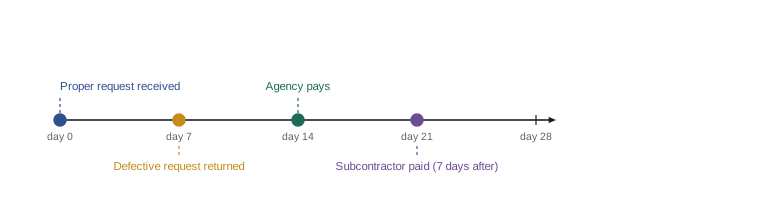
- The agency must pay a proper progress payment request within 14 days after the designated billing office receives it, or later if the contract specifies, and a final payment within 30 days.
- The agency must return a defective request within 7 days, stating the reasons, and the clock restarts on a corrected request.
- The prime contractor must pay each subcontractor within 7 days after receiving payment from the government, for the subcontractor's share, and subcontracts must flow the same obligation down to each tier.
- Late payments carry an interest penalty at the rate set by the Treasury every six months, paid automatically by the agency; a prime that withholds from a subcontractor without notice pays interest to the subcontractor.
The Act gives subcontractors a right to interest, but not a right to sue the government: subcontractors have no privity with the United States. Their protection against non-payment is the Miller Act payment bond (Lesson 7). Contractors' disputes with the government on the contract go through the Contract Disputes Act process: a certified claim to the contracting officer, then an appeal to a board of contract appeals or the Court of Federal Claims.
Worked problem
Building a payment calendar
A contractor's proper progress payment request is received by the federal billing office on March 3. When is payment due, and when must the contractor pay a subcontractor if it is paid on the last day?
Show solution
- Defective request notice: within 7 days, by March 10.
- Payment due: 14 days after receipt, by March 17.
- Subcontractor payment: within 7 days after receipt, by March 24.
- If payment is late, interest accrues from the day after the due date.
Answer: Payment by March 17; subcontractor by March 24.
State prompt payment acts
Every state has a prompt payment statute for its own public construction contracts, and many have statutes covering private construction as well. They vary widely in their deadlines and interest rates. A few examples, summarized and subject to change:
| State | Private work rule (summary) | Late payment consequence (summary) |
|---|---|---|
| California | Owner pays within 30 days of a demand; contractor pays subcontractors within 7 days of receipt | 2 % per month penalty on late amounts, plus fees |
| Texas | Owner pays within 35 days of a request; contractor pays subcontractors within 7 days of receipt | Interest at 1.5 % per month |
| New York | Prompt payment act for private contracts above a threshold | Interest and fast dispute resolution by arbitration |
| Florida | Payment deadlines for private and public projects | Interest and attorney fees |
| Federal public work | Prompt Payment Act | Treasury interest rate |
State acts also differ in when the clock starts (receipt of an invoice, certification or payment from above), whether retainage is covered, what counts as a good-faith dispute justifying withholding, and whether the contract can change the deadlines. Many allow withholding only for amounts genuinely in dispute and require the rest to be paid.
Pay-when-paid and pay-if-paid clauses
Subcontracts often link payment to the general contractor being paid. There are two kinds of clause.
- A pay-when-paid clause is about timing: the general contractor will pay within a reasonable time after it is paid, or within so many days after it is paid. If the owner never pays, the general contractor must still pay within a reasonable time.
- A pay-if-paid clause shifts the risk of the owner's non-payment: payment by the owner is a condition precedent to the general contractor's obligation to pay. If the owner never pays, the subcontractor may never be paid.
States are divided. New York's highest court held pay-if-paid clauses void as against public policy in West-Fair Electric Contractors v. Aetna Casualty (1995), and California's Supreme Court did the same in Wm. R. Clarke Corp. v. Safeco (1997), because they undermine the right to a mechanics' lien. Several states have banned pay-if-paid clauses by statute, including Virginia from 2023. Many other states enforce a pay-if-paid clause only if it states the condition precedent clearly and unambiguously; otherwise courts treat it as pay-when-paid. Even where enforceable, pay-if-paid may not defeat a subcontractor's claim on a payment bond or a lien.
Worked problem
Calculating late payment interest
A Texas owner pays a $240,000 request 25 days late under a private contract subject to the Texas Prompt Payment Act, which sets interest at 1.5 % per month. What interest is owed, using a 30-day month?
Show solution
- Daily rate: 1.5 % ÷ 30 = 0.05 % per day.
- Interest: $240,000 × 0.0005 × 25 = $3,000.
- Check the statute for how interest is calculated and when attorney fees are recoverable.
Answer: $3,000.
Using the statutes in practice
For a construction manager, the practical tools are the notice and interest provisions. A contractor should submit complete, proper requests on time and track when each payment is due. A payer that intends to withhold must give written reasons within the statutory time, and may withhold only the disputed amount. A subcontractor should ask for the prime contract's payment terms, track when the general contractor is paid, and use the statutory interest and, where available, bond and lien rights as leverage. Some states, including New York, give contractors a right to suspend work after notice if they are not paid.
Worked problem
Valuing a partial withholding
A $310,000 invoice includes a disputed change order of $42,000. The payer gives a timely written notice withholding $42,000 for stated reasons. What must be paid by the deadline, and what happens to the disputed amount?
Show solution
- Undisputed amount: $310,000 − $42,000 = $268,000, payable by the deadline.
- The $42,000 can be withheld only if the dispute is in good faith; the payee may pursue its claim, with interest if it succeeds.
- Withholding the whole invoice because of one disputed item would breach the statute and attract interest.
Answer: $268,000 by the deadline; $42,000 resolved separately.
Running a compliant payment system
Prompt payment laws reward companies that run disciplined payment systems and punish those that do not. A general contractor sits in the middle of the chain: it is a payee to the owner and a payer to its subcontractors, so it must meet deadlines in both directions. A practical system has several parts.
- An invoice calendar: for every contract and subcontract, the invoice date, the notice deadlines and the payment deadlines, generated automatically when an invoice is received or sent.
- An intake checklist that confirms each invoice received contains what the statute and contract require, and triggers any deficiency notice within the short period allowed.
- A dispute log that records each withheld amount, the reason, the notice sent and its date, so that undisputed money is paid on time.
- Matching rules that link owner payments to subcontractor payments, so that money received for a subcontractor's work is passed on within the statutory period.
- Interest and penalty tracking, so that late payments are identified and costed rather than discovered later in a claim.
Owners need similar systems: a single point of receipt for invoices, a clear chain of approval, and authority for the person who signs non-payment notices. Many disputes under prompt payment statutes arise not from genuine disagreement about money but from invoices lost in an inbox, approvals waiting on someone on vacation, and notices sent a day late.
Worked problem
Costing a late payment habit
A general contractor routinely pays its subcontractors 20 days late on about $1,200,000 a month of subcontract billings. If the statutory or contractual interest rate is 8 % a year, roughly what annual interest exposure does this create, before any penalties or fees?
Show solution
- Average amount outstanding late at any time: $1,200,000 × 20 ÷ 30 = $800,000.
- Annual interest: $800,000 × 8 % = $64,000.
- Some statutes impose much higher penalties, such as 2 % per month, which would raise the exposure to about $192,000.
- Fixing the payment process is cheaper than paying the interest and defending the claims.
Answer: About $64,000 a year at 8 %, and far more under penalty rates.
Preparing for a payment dispute
Whatever forum is available, a payment dispute is won on the paper trail: the contract and any amendments, each invoice and the date it was delivered, any notices given and received, the certified amounts, the change orders and their status, and correspondence about the disputed items. Organize these chronologically, with a short summary of the amounts claimed, paid and disputed. A clear, short submission backed by documents persuades adjudicators, mediators and judges far more than a long narrative.
Prompt payment rules also change the commercial conversation. A subcontractor that knows its rights, and calmly cites the statute and its interest provisions, usually gets paid faster than one that simply complains. A general contractor that pays on time builds a reputation that attracts the best subcontractors and the sharpest prices on the next bid.
Common mistakes
MistakeWithholding a whole payment because one item is disputed.
InsteadWithhold only the disputed amount, with written reasons in the statutory time, and pay the rest.
MistakeMissing the notice of non-payment deadline.
InsteadDiarize the deadline for every invoice; a late notice may mean the full amount is payable.
MistakeRelying on a pay-if-paid clause without checking the law.
InsteadCheck whether the statute or courts override it, and whether lien or bond rights remain.
MistakePursuing payment without tracking upstream payment dates.
InsteadTrack when the general contractor is paid; deadlines run from that date.
MistakeSubmitting incomplete invoices.
InsteadInclude everything the statute and contract require, so the invoice is proper and the clock starts.
Summary and key terms
- Prompt payment laws set payment deadlines, require written reasons for withholding and impose interest.
- Federal: agencies pay progress requests within 14 days, final within 30; primes pay subcontractors within 7 days after.
- Federal subcontractors rely on Miller Act bonds; contractors use the Contract Disputes Act.
- Every state has public prompt pay rules and many cover private work, with varied deadlines and interest.
- Pay-when-paid clauses deal with timing; pay-if-paid clauses shift non-payment risk.
- Some states void pay-if-paid clauses; others enforce only clear ones.
- Withhold only disputed amounts, give timely written reasons and keep good records.
- Prompt payment
- Statutory rules setting maximum payment periods for construction invoices.
- Proper invoice
- An invoice containing the information the statute requires, which starts the payment clock.
- Non-payment notice
- A written statement of an amount being withheld and the reasons.
- Adjudication
- A fast statutory process giving an interim binding decision on payment disputes.
- Interim binding
- Binding and payable now, but open to final determination later.
- Pay-when-paid
- A clause about the timing of payment after the payer is paid.
- Pay-if-paid
- A clause making upstream payment a condition of the duty to pay.
- Condition precedent
- An event that must occur before a duty arises.
- Privity of contract
- The direct contractual relationship between parties.
- Interest penalty
- Interest payable by law on late construction payments.
Practice problems
Work each problem on paper first, then reveal the answer to check.
Within how many days must a federal agency pay a proper progress request?
Show answer
14 days.
Within how many days after being paid must a contractor pay its subcontractor?
Show answer
7 days.
An invoice of $500,000 includes a disputed $60,000. What must be paid?
Show answer
$440,000, with timely written reasons for the $60,000.
What is the difference between pay-when-paid and pay-if-paid?
Show answer
Pay-when-paid deals with timing; pay-if-paid shifts the risk of non-payment.
Which cases voided pay-if-paid clauses in New York and California?
Show answer
West-Fair Electric v. Aetna (1995) and Wm. R. Clarke v. Safeco (1997).
Invoice received May 2; owner deadline 28 days. What is the date?
Show answer
May 30.
$100,000 paid 30 days late at 6 % a year. Interest?
Show answer
About $493.
Can a federal subcontractor sue the government for non-payment?
Show answer
No; it relies on the Miller Act payment bond.
Why does an incomplete invoice matter?
Show answer
It may not be proper, so the payment clock may not start.
What records help in a payment dispute?
Show answer
Signed change orders, daily reports, correspondence and the payment history.
Lesson quiz · 5 questions
Score 60% or more to complete this lesson.
Create a free account to save your progress, take quizzes and earn a certificate.