
CON-220 · Lesson 12 of 12 · 35 min
Dispute resolution and capstone: a subcontract and payment dispute
Disputes are a normal part of construction. With dozens of parties, thousands of decisions and constant change, disagreements about scope, payment, time and quality are inevitable. What matters is how they are resolved: quickly and cheaply at the level of the project, or slowly and expensively through years of litigation that damages relationships and consumes management time. This lesson surveys the methods of dispute resolution available in construction, from negotiation to litigation, and then brings the course together in a capstone exercise analyzing a subcontract payment dispute from first principles. CON-420 covers claims, delay analysis and dispute strategy in depth.
The dispute resolution spectrum
Dispute resolution methods range from informal and party-controlled to formal and decided by a third party.
- Negotiation: the parties discuss and settle. Cheapest and fastest; most disputes end here.
- Stepped negotiation: many contracts require escalation, first between site representatives, then project managers, then senior executives, within set times.
- Mediation: a neutral mediator helps the parties reach their own settlement. Non-binding unless a settlement is signed.
- Dispute boards: a standing panel of experts follows the project and makes recommendations or decisions on disputes as they arise, common on large infrastructure projects.
- Initial decision makers: under A201-2017, the architect or another named person makes an initial decision on claims, which becomes binding if not challenged in time.
- Arbitration: a private tribunal makes a final, binding award, enforceable like a court judgment, with limited rights of appeal.
- Litigation: a court decides, with full procedure, public hearings and appeals.
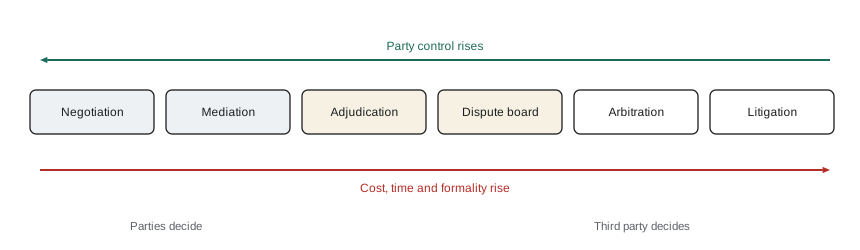
Mediation and negotiation
Mediation works because it lets parties test their positions privately with a neutral who can see both sides, and because settlement allows creative solutions a court cannot order: credits on future work, revised schedules, payment plans. A mediator does not decide; success depends on preparation, on having decision makers in the room, and on realistic assessment of the case. Many construction mediations settle in a day.
Good negotiation in construction starts with the record. A party that can show the contract clause, the notice it sent on time, the daily reports and the cost records negotiates from strength. A useful discipline is to estimate the expected value of a claim: the probability of success multiplied by the likely award, less the costs of getting there, and to compare it with the offer on the table.
Worked problem
Expected value of a claim
A subcontractor has a $400,000 claim. Its lawyer estimates a 60 % chance of recovering the full amount at trial and a 40 % chance of recovering nothing, with legal and expert costs of $120,000, of which perhaps half would be recovered from the other side if it wins. Trial is two years away. The contractor offers $200,000 now. Should the subcontractor consider accepting?
Show solution
- Expected recovery: 60 % × $400,000 = $240,000.
- Expected cost recovery: 60 % × $60,000 = $36,000.
- Net expected value before time value: $240,000 + $36,000 − $120,000 = $156,000.
- The $200,000 offer exceeds the expected value of continuing, before even counting management time and two years of delay.
- Accepting, or countering modestly, is worth serious consideration.
Answer: Expected value of continuing about $156,000; the $200,000 offer is attractive.
Arbitration
Arbitration in the United States is governed by the Federal Arbitration Act for contracts involving interstate commerce and by state arbitration statutes. A201-2017 § 15.4 provides for arbitration under the American Arbitration Association's Construction Industry Arbitration Rules if the parties select it in the agreement; otherwise disputes go to court after mediation. ConsensusDocs forms provide a dispute mitigation process before binding resolution. Arbitration awards are final and can be vacated only on narrow grounds such as fraud or an arbitrator exceeding its powers. Courts enforce arbitration agreements vigorously.
Arbitration is not always cheaper than litigation. Arbitrators and hearing rooms are paid for by the parties, and large construction arbitrations can cost as much as a trial. Its advantages are privacy, expertise, scheduling control and finality.
Litigation
Construction litigation in the United States usually takes place in state courts, with lien foreclosures, contract and negligence claims often joined. Federal courts hear Miller Act claims. Claims against the federal government go to a board of contract appeals or the Court of Federal Claims under the Contract Disputes Act, after a contracting officer's final decision. Each side normally pays its own legal fees under the American rule, unless a contract clause or statute, such as some prompt payment and lien statutes, shifts fees to the loser.
| Method | Who decides | Binding? | Typical time | Privacy |
|---|---|---|---|---|
| Negotiation | The parties | If agreed | Days to weeks | Private |
| Mediation | The parties, helped by a mediator | If settlement signed | One or two days of sessions | Private |
| Initial decision maker | The architect or named person | Binding unless challenged | Weeks | Private |
| Dispute board | Expert panel | Recommendation or interim decision | Weeks | Private |
| Arbitration | Arbitrator or tribunal | Final | Months to years | Private |
| Litigation | Judge | Final, subject to appeal | Years | Public |
Capstone: the scenario
Northline Interiors is a drywall and ceilings subcontractor on a private six-story office building in California. Its subcontract with the general contractor, Apex Builders, is an AIA A401-2017 form amended to include a clause that Apex will pay Northline 'within 7 days after Apex is paid by the Owner for Northline's work, and only if Apex is so paid', a requirement to give written notice of any claim for extra cost or time within 5 working days, and 10 % retainage. The prime contract is AIA A201-2017.
The facts are as follows.
- Northline's progress invoice for March, delivered on April 1, is $186,000 before holdback or retainage, including $36,000 for a disputed change: additional bulkheads ordered verbally on site by Apex's superintendent on March 6. Northline confirmed the direction by email that day and gave written notice of the cost on March 10.
- Apex has paid nothing on the March invoice. It says the owner has not paid Apex because of a dispute about Apex's own mechanical work, and that the bulkheads were always in Northline's scope.
- Apex has also issued a back-charge of $14,000 for cleanup, without prior notice.
- Northline's crews were delayed 15 working days in February because the mechanical trade was late; Northline told Apex about the delay at a site meeting, recorded in the minutes, but sent no separate written notice.
- Northline's last work on the project was on May 2; it finished its scope and left the site.
Capstone: the analysis
Work through the issues in order: what is owed, what the contract and statutes say about payment, what security Northline has, what claims are weak, and what Northline should do and by when.
Worked problem
Step 1: what is owed on the invoice
Calculate the amounts in dispute and not in dispute on the March invoice.
Show solution
- Gross invoice: $186,000.
- Retainage at 10 %: $18,600, retained under the subcontract.
- Net payable: $186,000 − $18,600 = $167,400.
- Disputed change, net of 10 %: $36,000 × 0.90 = $32,400.
- Undisputed net amount: $167,400 − $32,400 = $135,000.
- The $14,000 back-charge is a separate set-off claim by Apex.
Answer: Undisputed $135,000; disputed change $32,400 net; back-charge $14,000 claimed by Apex.
Worked problem
Step 2: the payment obligations
Does the pay-if-paid clause protect Apex under California law?
Show solution
- California courts hold pay-if-paid clauses unenforceable as against public policy (Wm. R. Clarke v. Safeco, 1997), so Apex must pay within a reasonable time regardless of the owner.
- California's prompt payment statute requires a contractor to pay a subcontractor within 7 days after receiving payment, with a 2 % per month penalty for late amounts not in good-faith dispute.
- Apex cannot rely on the clause to withhold the undisputed $135,000.
- Northline should demand payment in writing, citing the statute.
Answer: Apex must pay the undisputed $135,000; the clause is unenforceable.
Worked problem
Step 3: Northline's security and deadlines
What lien, bond or other rights does Northline have, and what are the deadlines?
Show solution
- Preliminary notice: Northline should have served it within 20 days of first furnishing; if late, its lien covers only work in the 20 days before service and after.
- Lien: if the owner records a notice of completion, Northline has 30 days after recording; otherwise 90 days after completion of the work of improvement.
- Payment bond: if Apex furnished a payment bond, Northline can claim on it, subject to its notice requirements.
- Stop payment notice: California also lets subcontractors serve a stop payment notice on the owner or construction lender, which requires them to withhold funds.
- Diarize the recording deadline as soon as completion or a notice of completion is known.
Answer: Confirm the preliminary notice; diarize the recording deadline; consider bond and stop payment notice rights.
Worked problem
Step 4: weak points and strong points
Assess the bulkheads, the back-charge and the February delay.
Show solution
- Bulkheads: the verbal direction came from the superintendent, but Northline confirmed it by email the same day and gave written notice of cost on March 10, inside the 5-working-day period. Whether the work was extra depends on the drawings and scope; Northline should assemble the scope documents.
- Back-charge: a back-charge without prior notice and an opportunity to do the cleanup itself is often contestable under the subcontract; Northline should ask for particulars and supporting records.
- February delay: only minute-book discussion, no written notice within 5 working days. Under a strict notice clause, the delay claim is weak; Northline should still document it and raise it in negotiation, but cannot rely on it.
- Overall: strong on the undisputed $135,000; arguable on the $32,400 change; contestable defense to the $14,000 back-charge; weak on delay.
Answer: Strong, arguable, contestable and weak positions identified.
Worked problem
Step 5: the action plan
What should Northline do, and in what order?
Show solution
- Send a written demand to Apex for the undisputed $135,000, citing the prompt payment statute and penalty.
- Confirm the preliminary notice status and diarize the lien recording deadline.
- Consider a stop payment notice and any payment bond claim.
- Assemble the record: subcontract, drawings, emails, daily reports, cost records for the bulkheads.
- Propose mediation of the disputed change, back-charge and delay claim, using expected value analysis.
- Calendar foreclosure, bond suit and limitation deadlines.
Answer: Demand payment, protect security on time, start the fast process where available, build the record and negotiate the rest.
Lessons from the capstone
The capstone shows how the course fits together. Contract terms such as pay-if-paid and notice clauses must be read against statutes that may override them. Security rights such as liens, trusts and bonds run on their own deadlines, which are usually shorter than the time it takes to negotiate. Strong records, such as a same-day email confirming a verbal direction, turn arguable claims into strong ones; missing notices turn good claims into weak ones. And the best outcome often comes from combining firm protection of rights with a realistic negotiation.
Finally, remember that dispute resolution clauses are themselves contract terms. Read them at the start of the project, because they may require steps, such as escalation meetings or notices of dispute, within fixed times that apply long before anyone thinks of arbitration or court.
Common mistakes
MistakeLetting negotiations run past lien or bond deadlines.
InsteadProtect security rights on time; negotiate in parallel.
MistakeGoing to mediation without decision makers or a prepared case.
InsteadBring people with authority to settle and organized evidence.
MistakeAssuming arbitration is always cheaper than litigation.
InsteadCompare costs, timing and procedure for the dispute at hand.
MistakeRelying on a contract clause that a statute overrides.
InsteadCheck prompt payment, lien and other statutes before acting on the clause.
MistakePursuing weak claims as hard as strong ones.
InsteadRank claims by strength and expected value, and concentrate effort accordingly.
Summary and key terms
- Methods range from negotiation and mediation to adjudication, dispute boards, arbitration and litigation.
- Expected value analysis compares the likely net result of continuing with an offer.
- Mediation is non-binding but settles most cases with good preparation.
- Arbitration follows the FAA and AAA rules when chosen; litigation is in state or federal court, or under the CDA for federal claims.
- Statutes can override contract terms such as pay-if-paid clauses.
- Security rights have short deadlines that must be protected while negotiating.
- Records and timely notices decide which claims are strong and which are weak.
- Mediation
- Assisted negotiation with a neutral who does not decide.
- Arbitration
- Private, binding determination by an arbitrator.
- Dispute board
- A standing panel of experts that resolves disputes during a project.
- Step clause
- A clause requiring escalating levels of negotiation before formal proceedings.
- Award
- The decision of an arbitrator.
- Expected value
- Probability-weighted outcome of a claim less the costs of pursuing it.
- Back-charge
- A deduction for costs a party claims it incurred because of another party's failure.
- Set-off
- Reducing a payment by an amount the payer claims is owed to it.
- Stay of proceedings
- A court order pausing litigation, for example in favor of arbitration.
- Settlement
- An agreement resolving a dispute.
Practice problems
Work each problem on paper first, then reveal the answer to check.
Which method gives a final, private, binding decision?
Show answer
Arbitration.
What is the main difference between mediation and arbitration?
Show answer
A mediator helps the parties settle; an arbitrator decides.
A $200,000 claim has a 50 % chance of success and costs $40,000. Expected value?
Show answer
$100,000 − $40,000 = $60,000.
Why combine protecting liens with negotiation?
Show answer
Lien deadlines run regardless of negotiations.
Invoice $100,000 with 10 % withheld; $20,000 disputed gross. Undisputed net?
Show answer
$90,000 − $18,000 = $72,000.
What makes a verbal direction stronger as a claim?
Show answer
A same-day written confirmation and timely notice.
What usually happens to a claim with no timely written notice under a strict clause?
Show answer
It is weak and may fail.
Which rules apply to arbitration under A201 if selected?
Show answer
The AAA Construction Industry Arbitration Rules.
Name two advantages of arbitration.
Show answer
Privacy, expertise, scheduling control, finality.
What is a back-charge?
Show answer
A deduction for costs one party claims it incurred because of the other's failure.
Lesson quiz · 5 questions
Score 60% or more to complete this lesson.
Create a free account to save your progress, take quizzes and earn a certificate.