
CON-220 · Lesson 4 of 12 · 28 min
AIA, ConsensusDocs and EJCDC standard form contracts
Most construction contracts are not drafted from scratch. They start from standard forms prepared by industry bodies, then are modified by supplementary conditions written for the project. Standard forms save time, reflect decades of experience, allocate risk in ways the industry understands, and allow courts to develop consistent interpretations. They also have a weakness: because everyone has seen them, people stop reading them, and the supplementary conditions that change them are where many disputes begin. This lesson introduces the main families of forms, the structure of a typical general conditions document, and how to review amendments.
Why standard forms exist
Standard forms solve several problems at once. They reduce the cost of drafting and reviewing contracts on every project. They allocate risks in a balanced way that has been negotiated between owners, designers, contractors and sometimes sureties and insurers. They coordinate the documents: the general conditions, the subcontract and the insurance requirements are written to fit together. And they are known to banks, sureties and courts, which reduces uncertainty.
In the United States, three main families compete. The American Institute of Architects (AIA) publishes the most widely used forms, organized in series around the A201 General Conditions. ConsensusDocs, developed by a coalition of contractor, owner, subcontractor and surety groups led by the Associated General Contractors, publishes forms intended to be more balanced between owner and contractor. The Engineers Joint Contract Documents Committee (EJCDC) publishes forms used mainly for engineered infrastructure such as water and wastewater projects. The Design-Build Institute of America (DBIA) publishes design-build forms. Federal agencies do not use these forms; they use FAR clauses incorporated into each contract.
| Form | Purpose | Notes |
|---|---|---|
| AIA A101-2017 | Owner-contractor agreement, stipulated sum | Used with A201 |
| AIA A102 and A103 | Cost of the work plus a fee, with or without a guaranteed maximum price | Cost-plus variants |
| AIA A201-2017 | General conditions of the contract for construction | The core document, revised every ten years |
| AIA A401-2017 | Contractor-subcontractor agreement | Fits A201 |
| AIA A133 and A134 | Owner and construction manager as constructor, with or without a GMP | CM at risk |
| ConsensusDocs 200 | Owner-contractor agreement and general conditions, lump sum | Combined agreement and conditions |
| ConsensusDocs 750 | Standard subcontract | Widely used by subcontractors |
| EJCDC C-700 | Standard general conditions for engineered projects | Used mainly for public infrastructure |
| DBIA 500 series | Design-build forms | Design-build projects |
Structure of a contract
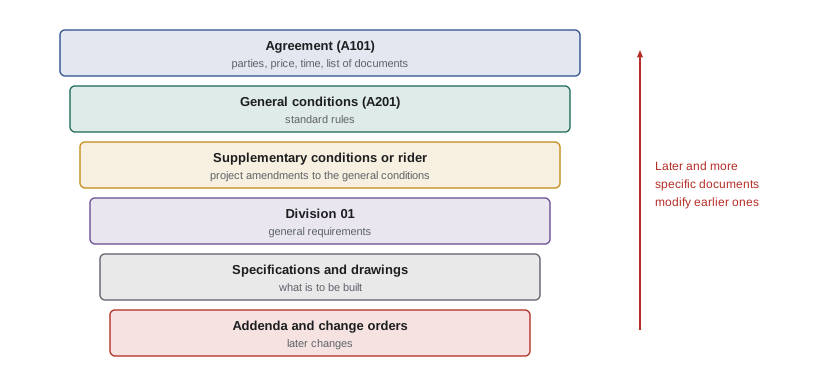
A typical contract package has several layers, read together.
- The agreement: names the parties, the work, the contract price, the contract time and the list of contract documents.
- The general conditions: the standard rules on administration, payment, changes, delays, insurance, termination and disputes.
- Supplementary conditions: project-specific amendments to the general conditions, sometimes many pages long.
- Division 01 of the specifications: general requirements such as submittals, scheduling, site facilities and closeout.
- Technical specifications and drawings: what is to be built.
- Addenda issued during bidding, and change orders after award.
Inside AIA A201-2017
A201-2017 is organized in fifteen articles. The ones most used on site are these.
- Article 4, the architect: administers the contract, interprets the documents, reviews submittals and certifies payment.
- Article 3, the contractor: supervises the work, provides the schedule under § 3.10, and warrants the work under § 3.5.
- Article 9, payments and completion: applications for payment, certificates, retainage, substantial completion and final payment.
- Article 7, changes in the work: change orders, construction change directives and minor changes; Article 8, time, including delays and extensions under § 8.3.
- Article 14, termination or suspension: for cause by either party, and for the owner's convenience under § 14.4.
- Article 15, claims and disputes: the 21-day claim notice under § 15.1.2, the initial decision maker, mediation and, if selected, arbitration.
- Articles 10 to 13: protection of persons and property, insurance and bonds, uncovering and correction of work including the one-year correction period under § 12.2.2, and miscellaneous provisions such as the mutual waiver of consequential damages in § 15.1.7.
AIA revises its forms on a ten-year cycle, and the 2017 editions changed insurance provisions, moved insurance and bond terms into exhibits, and adjusted the claims process from the 2007 editions. A new edition is expected around 2027, so check which edition a project uses. ConsensusDocs revises its forms more often.
Supplementary conditions and amendments
Owners rarely use standard forms unchanged. Supplementary conditions add project requirements, adjust risk and sometimes transfer risks that the standard form deliberately leaves with the owner. Common amendments include:
- Shifting the risk of unknown site conditions to the contractor.
- Shortening notice periods for claims, or making notice a condition precedent to any entitlement.
- Adding broad indemnities, waivers of claims and limits on delay damages.
- Extending warranty periods or adding performance guarantees.
- Changing payment terms, holdback release or retainage.
- Adding owner rights to terminate for convenience.
AIA forms are licensed and include a notice that changes must be shown, and AIA's software tracks deletions and additions. Owners often add a separate rider of amendments. Courts interpret amendments according to their words, and the more a form is amended, the less earlier case law on the unamended form helps.
Worked problem
Reviewing an amended notice clause
A201-2017 § 15.1.2 requires claims to be initiated within 21 days after the claimant first recognizes the condition. An owner's rider states: 'Notwithstanding Section 15.1.2, any claim shall be submitted in writing with full particulars within 7 days of the event, failing which the claim is waived.' What does the contractor's manager do?
Show solution
- Flag the clause at contract review as high risk, and ask whether it can be negotiated to a longer period or to an initial notice followed by particulars.
- If it stays, build it into the project procedures: daily review of events, a template notice letter, and authority for site staff to send it.
- Give a short initial notice within 7 days of any potential claim, stating the event and that particulars will follow, then send particulars as soon as practicable.
- Keep a log of events and notices so that compliance can be proved.
Answer: Treat the 7-day period as a condition precedent: send a short notice within 7 days and follow with particulars.
Subcontracts and flow-down
A subcontract must fit the prime contract. Most subcontract forms include a flow-down clause binding the subcontractor to the general contractor as the general contractor is bound to the owner, for the subcontractor's part of the work. Flow-down protects the general contractor from being caught between an owner's demands and a subcontractor's narrower obligations, but it can also impose on subcontractors terms they never saw. A subcontractor should always ask for the prime contract, or at least the parts that flow down.
AIA A401-2017 and ConsensusDocs 750 are both drafted to coordinate with the prime contract forms. Subcontractors should pay special attention to pay-if-paid and pay-when-paid clauses, which states treat differently (Lesson 6), set-off rights, notice periods that are shorter than those in the prime contract, and indemnities, which many states limit by anti-indemnity statutes.
Choosing a form
The right form depends on the delivery method and on how price risk is shared.
- Stipulated price or lump sum: the contractor takes the risk of cost overruns on a defined scope.
- Cost plus a fee, with or without a guaranteed maximum price: the owner pays actual costs, and takes more of the risk, in exchange for flexibility and transparency.
- Unit price: payment by measured quantities, suited to civil work where quantities are uncertain.
- Construction management and design-build: different relationships with the designers and different allocation of design risk, covered in CON-340.
Worked problem
Comparing price outcomes
An owner compares a stipulated price of $8,400,000 with a cost-plus contract at cost plus a 6 % fee and a guaranteed maximum price of $8,600,000. The work actually costs the contractor $7,900,000. What does the owner pay under each?
Show solution
- Stipulated price: $8,400,000; the contractor keeps the $500,000 difference less its overhead and profit allowance.
- Cost plus fee: $7,900,000 × 1.06 = $8,374,000, below the GMP of $8,600,000.
- The owner pays $26,000 less under cost plus in this case, but would have carried more risk if costs had risen.
Answer: Stipulated price $8,400,000; cost plus fee $8,374,000.
The contract summary at project start-up
The single most effective legal habit for a construction manager is to prepare a contract summary at the start of every project. A good summary fits on two or three pages and is shared with the site team, the project accountant and the estimator who will price changes. It turns a contract package of several hundred pages into the handful of terms that people need to act on every week.
- Parties, addresses for notices and the people authorized to give instructions and sign changes.
- Contract price, pricing method, allowances, unit prices and the markups allowed on changes.
- Contract time, milestones, liquidated damages, and the procedure and notice periods for time extensions.
- Payment terms: application dates, holdback or retainage, stored materials and the documents needed with each application.
- Requirements for notices of claims, differing site conditions, delays and defects, with each period stated in days.
- Insurance and bonding requirements, warranties and correction periods, and closeout documents.
- Dispute resolution steps and any unusual or onerous amendments flagged for attention.
The summary is a working tool, not a legal opinion. It should cite the clause numbers so that anyone can go back to the source, and it should be updated whenever a change order or amendment alters a term. Many disputes that end in court would never have arisen if the people on site had known, from the first week, that the contract required written notice within seven days or that only the owner's director of capital projects could sign a change.
Worked problem
Converting notice periods into working rules
A contract requires: written notice of a delay within 10 working days; notice of a claim for extra cost within 15 calendar days; notice of a differing site condition before it is disturbed; and particulars of any claim within 30 days after notice. How should these appear in the site team's working rules?
Show solution
- Delay: send written notice within 5 working days (internal target), legal limit 10 working days.
- Extra cost: send notice within 7 calendar days (target), legal limit 15 calendar days.
- Differing condition: stop work in the affected area and notify the same day, before disturbance.
- Particulars: diarize 30 days after each notice, with a draft at 20 days.
Answer: Internal targets set at about half the legal periods, with same-day notice for differing conditions.
Common mistakes
MistakeAssuming a familiar standard form is unchanged.
InsteadRead the supplementary conditions or rider line by line; they decide most risk allocation.
MistakeSigning a subcontract without seeing the prime contract.
InsteadAsk for the prime contract or the clauses that flow down to your work.
MistakeTreating notice periods as formalities.
InsteadMany amended forms make notice a condition precedent; build the deadlines into site procedures.
MistakeMixing documents from different editions.
InsteadCheck that the agreement, general conditions and subcontract editions match.
MistakeChoosing a contract form by habit.
InsteadChoose the form that fits the delivery method and the way price risk should be shared.
Summary and key terms
- Standard forms save drafting effort, balance risk and are known to courts, sureties and insurers.
- AIA, ConsensusDocs, EJCDC and DBIA forms dominate private and local public work; federal work uses FAR clauses.
- A contract package includes the agreement, general conditions, supplementary conditions, specifications, drawings, addenda and change orders.
- Key A201 articles cover the architect, contractor, changes, time, payment, termination, and claims and disputes.
- Supplementary conditions often shift significant risks and must be read carefully.
- Flow-down clauses bind subcontractors to prime contract terms for their work.
- Choose the form to fit the delivery method and price risk.
- Standard form
- A contract document prepared by an industry body for repeated use.
- General conditions
- The standard rules governing administration, payment, changes, time and disputes.
- Supplementary conditions
- Project-specific amendments to the general conditions.
- Agreement
- The document naming the parties, price, time and contract documents.
- Flow-down clause
- A subcontract clause binding the subcontractor to the prime contract terms for its work.
- Stipulated price
- A fixed price for a defined scope of work.
- Cost plus
- A pricing method paying the contractor's costs plus a fee.
- Guaranteed maximum price
- A ceiling on the owner's cost under a cost-plus contract.
- Condition precedent
- A requirement that must be met before a right arises.
- Change directive
- An owner instruction to proceed with a change before price and time are agreed.
Practice problems
Work each problem on paper first, then reveal the answer to check.
Which AIA document contains the general conditions?
Show answer
A201-2017.
Which AIA form is the matching subcontract?
Show answer
A401-2017.
Where are project-specific changes to the general conditions found?
Show answer
In the supplementary conditions or an amendment rider.
Under which A201 article are claims dealt with?
Show answer
Article 15.
What is a flow-down clause?
Show answer
A clause binding the subcontractor to the prime contract terms for its part of the work.
Why is a 7-day claim notice clause risky?
Show answer
It may be a condition precedent, and missing it can waive the claim.
Cost is $5,000,000 plus a 5 % fee under a GMP of $5,400,000. What is paid?
Show answer
$5,250,000.
When does a unit price contract make sense?
Show answer
When quantities are uncertain, as in civil work.
Name two common owner amendments.
Show answer
Shifting unknown site condition risk, shortening notice periods, broad indemnities, longer warranties.
What should a subcontractor ask for before signing?
Show answer
The prime contract or the clauses that flow down.
Lesson quiz · 5 questions
Score 60% or more to complete this lesson.
Create a free account to save your progress, take quizzes and earn a certificate.