
CON-210 · Lesson 2 of 12 · 30 min
Work breakdown structures and activity definition
Before a project can be scheduled, it has to be broken into pieces small enough to estimate, assign, sequence and track. The work breakdown structure, usually shortened to WBS, is the tool for that breakdown. From the lowest levels of the WBS come the activities that make up the schedule network. Get the breakdown right and the rest of the schedule, the cost control system and the progress reports all line up. Get it wrong and the project spends months arguing about what an activity includes, why the cost codes do not match the schedule, and how much of a vague activity called "building envelope" is really complete.
What a work breakdown structure is
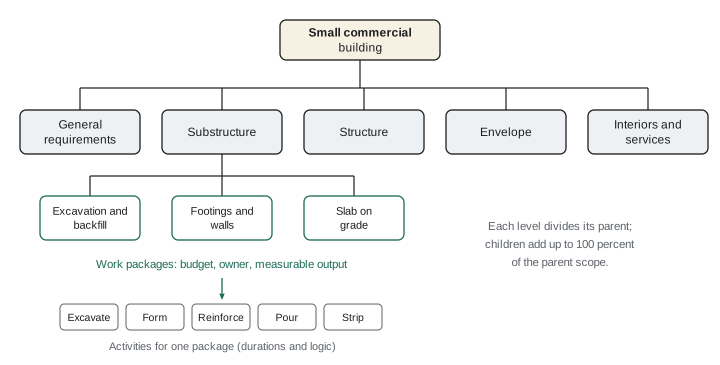
A work breakdown structure is a hierarchical breakdown of the total scope of a project into deliverables and work packages. The top level is the whole project. Each lower level divides its parent into smaller parts, until the lowest level, the work package, is small enough to be estimated, scheduled, assigned to one responsible party and measured. The Project Management Institute's standard practice for work breakdown structures describes it as deliverable-oriented: each element is a product, result or service, not just a list of tasks.
Two rules make a WBS useful.
- The 100 % rule: the WBS includes all of the project scope and nothing outside it, and the children of each element add up to exactly the whole of their parent. Nothing is left out and nothing is counted twice.
- Mutually exclusive elements: work appears in only one place. If curtain wall anchors appear under both structure and envelope, someone will either price them twice or not at all.
A WBS is a picture of the scope, not of the sequence. It does not show which element comes first. Sequence comes later, when activities drawn from the work packages are linked with logic.
Ways to organize the breakdown
There is no single correct WBS. The right structure depends on how the project will be managed and reported. Common bases for the first one or two levels are:
- Physical location or area: building, floor, zone, wing, or for civil work, station range or structure.
- System or element: substructure, structure, envelope, interiors, mechanical, electrical, site work, often following UniFormat.
- Trade or contract package: the work of each trade contractor, often following MasterFormat divisions.
- Phase: design, procurement, construction, commissioning, with construction subdivided further.
Most construction schedules combine these. A typical breakdown for a building puts phase at level 2, area or system at level 3 and trade at level 4. A highway project might use corridor segment, then structure or roadway element, then trade. What matters is that the structure matches how the project team thinks about and controls the work, and that the same structure can be used by both the schedule and the cost control system.
| Basis | Strengths | Weaknesses | Typical use |
|---|---|---|---|
| Location or area | Matches how crews move through the building; good for look-aheads | Trade costs scattered across areas | Multi-story buildings, repetitive work |
| System or element (UniFormat) | Stable through design; good for early estimates | May not match trade contracts | Design phase and elemental cost plans |
| Trade (MasterFormat) | Matches subcontracts and specifications | Weak link to physical progress by area | Cost control and procurement |
| Phase | Shows design, procurement and construction clearly | Too coarse on its own | Upper levels of almost every WBS |
Work packages and the WBS dictionary
A work package is the lowest level of the WBS. It is the point at which cost and schedule are planned and controlled. A good work package has a clear scope, a single responsible party, a measurable output, a budget and a time frame that is neither too short nor too long. Many organizations aim for work packages that last somewhere between a few days and a couple of months and carry a budget large enough to be worth tracking separately.
The WBS dictionary is the companion document that describes each element. For every work package it records the identifier, the name, a description of the scope and what is excluded, the responsible party, the deliverables and acceptance criteria, the related specification sections and drawings, the estimated cost and the schedule activities. The dictionary is what settles arguments about whether the elevator pit sump belongs to the concrete package or the plumbing package.
Worked problem
Checking a WBS against the 100 % rule
A contractor's WBS for the substructure of a small building has a parent element budgeted at $412,000. Its children are: excavation and backfill $96,000; footings and foundation walls $188,000; underslab services $34,000; slab on grade $82,000. Does the breakdown meet the 100 % rule? If not, what should the team look for?
Show solution
- Sum of the children: $96,000 + $188,000 + $34,000 + $82,000 = $400,000.
- Difference from the parent: $412,000 − $400,000 = $12,000.
- The children do not add up to the parent, so some scope is either missing from the children or included in the parent's budget twice.
- Typical candidates are items that sit between packages: dewatering, perimeter drainage, vapor barrier, under-slab insulation, waterproofing or testing. The team checks the WBS dictionary and the estimate to find the $12,000 and assign it to one child.
Answer: No. The children total $400,000 against $412,000, so $12,000 of scope must be found and placed in exactly one work package.
From work packages to activities
A work package is a deliverable; an activity is a piece of work with a duration that produces part of that deliverable. Footings in area A is a work package. The activities that produce it might be excavate footings, form footings, place reinforcing, inspect, place concrete and strip forms. Activities are what the schedule network links together.
Choosing the level of detail for activities is a judgment. Too little detail hides the logic and makes progress hard to measure; one activity called interiors, level 2, lasting four months tells nobody anything. Too much detail makes the schedule enormous, slow to update and so cluttered that nobody reads it. Practical guidelines used by many schedulers and in owners' specifications include:
- An activity should have one responsible party, normally one trade or crew.
- It should take place in one location or area, so that crews can move through the building in sequence.
- Its progress should be measurable, either by quantity or by clear steps.
- Its duration should be short enough to track: many owners' specifications limit construction activities to about 20 working days, and the Defense Contract Management Agency's 14-point assessment flags activities longer than 44 working days.
- It should be detailed enough to show the logic that matters, such as a hold point for inspection.
Not every activity is physical work. Construction schedules also include procurement activities (prepare shop drawings, review and approve, fabricate, deliver), administrative activities (permit approval, notice to proceed), inspections and tests, owner activities (owner-furnished equipment, owner's move-in), and milestones of zero duration such as substantial completion.
Naming activities
Activity names are read by many people who never open the schedule file: superintendents, trade foremen, owners, lawyers years later. A good name starts with a verb, says what is being done and where, and stands on its own without the WBS around it. Form and pour footings, gridlines A to D is clear. Footings is not, because it does not say which footings or which part of the work. Concrete — phase 2 is worse, because it could mean anything from footings to toppings.
| Poor name | Better name | Why |
|---|---|---|
| Footings | Form, reinforce and pour footings, grid A–D | States the work and the area |
| Steel | Erect structural steel, level 2 | Separates erection from fabrication and gives the level |
| Drywall | Hang drywall, level 3 east | Separates hanging from taping and gives the zone |
| Electrical | Rough-in electrical, level 3 east | Distinguishes rough-in from trim-out |
| Inspection | Municipal framing inspection, level 3 | Names the inspector and what is inspected |
Activity coding
Every activity in a professional schedule carries codes in addition to its identifier and name. Codes allow the schedule to be filtered, grouped and summarized in different ways without rebuilding it. Typical activity codes include the WBS element, the area or floor, the responsible trade or contractor, the phase, the cost code that links to the estimate, the type of activity (construction, procurement, submittal, inspection, milestone) and sometimes a responsibility code that shows whether the owner or the contractor controls the work.
A consistent identifier scheme also helps. Many schedulers build activity identifiers from codes, so that an identifier such as SUB-A-1030 tells the reader that the activity is in substructure, area A, and falls in a numbered sequence with gaps of ten so new activities can be inserted later.
Worked problem
Building a simple coding scheme
A two-story building has 3 phases (procurement, construction, closeout), 2 floors plus a roof (3 areas) and 8 trades. The project team wants every activity to carry a phase, area and trade code. How many distinct phase–area–trade combinations are possible, and why will the schedule use far fewer?
Show solution
- Combinations: 3 phases × 3 areas × 8 trades = 72.
- Many combinations do not occur: procurement activities are not tied to a floor, roofing does not happen on level 1, and closeout uses only some trades.
- A realistic schedule might use 30 to 40 of the combinations, each with several activities.
- Coding still pays off: the scheduler can print, for example, all level 2 construction activities, or all electrical activities in every phase, without rebuilding the schedule.
Answer: 72 combinations are possible; perhaps half are used. Codes let one schedule produce many views.
Linking the WBS to cost
The WBS is also the backbone of cost control. When schedule activities and cost accounts share the same WBS and cost codes, the project can load the budget onto the schedule, produce a planned cost curve, measure earned value and compare it with actual cost. The detail of earned value management belongs to the cost control course (CON-310), but the foundation is laid here: if the schedule and the estimate use different breakdowns, linking them later is painful and error-prone.
US estimators commonly organize estimates by MasterFormat for trade pricing and by UniFormat (ASTM E1557, UNIFORMAT II) for early cost planning. A WBS that maps cleanly to both lets the same project be reported by element to the owner and by trade to subcontractors.
Worked problem
Estimating the number of activities
A three-story office building is scheduled with 12 construction work packages per floor, each broken into an average of 4 activities, plus 60 procurement and submittal activities, 25 inspection and testing activities and 15 milestones and administrative activities. About how many activities will the schedule contain?
Show solution
- Construction activities: 3 floors × 12 packages × 4 activities = 144.
- Other activities: 60 + 25 + 15 = 100.
- Total: 144 + 100 = 244 activities.
- That is typical of a level 3 schedule for a building of this size: large enough to show the logic, small enough to update monthly.
Answer: About 240 activities, a manageable level 3 schedule.
Common pitfalls
Breakdowns go wrong in predictable ways. Elements overlap, so that two work packages claim the same scope. Hammock or summary activities are mistaken for real work and linked with logic. Activities are created for every line of the estimate, giving thousands of tiny tasks. Procurement is left out entirely, so the schedule shows steel being erected the week after the contract is signed. And the structure is designed by the scheduler alone, so the superintendent's way of running the job and the schedule's way of describing it never meet. The cure in every case is the same: build the WBS with the people who will run the work, write a dictionary, and test the structure against the 100 % rule.
Common mistakes
MistakeListing tasks instead of deliverables at the upper levels of the WBS.
InsteadMake WBS elements deliverables; derive tasks as activities from the work packages.
MistakeLetting WBS children add up to more or less than their parent.
InsteadApply the 100 % rule and check the totals.
MistakeUsing vague activity names such as 'Concrete' or 'Phase 2'.
InsteadName activities with a verb, the work and the location.
MistakeCreating very long activities that cannot be tracked.
InsteadBreak activities so most last no more than about 20 working days.
MistakeBuilding separate breakdowns for the schedule and the estimate.
InsteadShare WBS and cost codes so cost can be loaded and earned value measured.
Summary and key terms
- A WBS breaks the total scope into a hierarchy of deliverables ending in work packages.
- The 100 % rule requires the WBS to include all scope, with children adding up to their parent.
- Breakdowns can be based on location, system, trade or phase; most projects combine them.
- The WBS dictionary describes the scope, exclusions, responsibility and links of each element.
- Activities come from work packages and carry durations and logic.
- Good activities have one responsible party, one location, measurable progress and a trackable duration.
- Consistent names and codes let one schedule produce many views and link to cost control.
- Work breakdown structure
- A hierarchical breakdown of the total project scope into deliverables and work packages.
- Work package
- The lowest level of the WBS, at which cost and schedule are planned and controlled.
- 100 % rule
- The principle that a WBS includes all of the scope and that children sum to their parent.
- WBS dictionary
- A document describing the scope, responsibility and details of each WBS element.
- Activity
- A unit of work with a duration, used in the schedule network.
- Activity code
- An attribute such as area, trade or phase used to filter and group activities.
- Milestone
- A zero-duration event marking a significant point in the project.
- Responsibility matrix
- A table showing which party is responsible for each WBS element.
- Level of detail
- How finely the work is broken into activities.
- Cost code
- A code linking schedule activities or estimate lines to cost accounts.
Practice problems
Work each problem on paper first, then reveal the answer to check.
State the 100 % rule.
Show answer
The WBS includes all project scope, and the children of each element add up to exactly their parent.
Is 'excavate footings' a WBS element or an activity?
Show answer
An activity; it is a task with a duration within a work package.
Give two bases for organizing a WBS.
Show answer
Any two of: location or area, system or element, trade, phase.
What does a WBS dictionary record?
Show answer
Scope, exclusions, responsible party, deliverables, related documents, cost and schedule activities.
Rewrite the activity name 'Roofing' to be more useful.
Show answer
For example: 'Install membrane roofing, roof area 1'.
Why limit construction activities to about 20 working days?
Show answer
Longer activities are hard to measure and hide the logic within them.
A parent is budgeted at $250,000 and its children total $243,000. What does this suggest?
Show answer
$7,000 of scope is missing from the children or double-counted in the parent.
Name three kinds of activity other than field installation.
Show answer
Any three of: procurement, submittals, approvals, permits, inspections, tests, owner activities, milestones.
Why should the schedule and estimate share codes?
Show answer
So that cost can be loaded onto the schedule and earned value can be measured.
Who should help build the WBS?
Show answer
The superintendent, project manager, estimator, scheduler and key trades who will run the work.
Lesson quiz · 5 questions
Score 60% or more to complete this lesson.
Create a free account to save your progress, take quizzes and earn a certificate.