
CON-210 · Lesson 1 of 12 · 29 min
Why planning matters and the planning process
Every construction project is a race against two clocks. One is the contract time, the date the owner needs the building and the date after which the contractor may owe damages. The other is the money clock: every extra week on site costs supervision, equipment, temporary facilities, insurance and financing. Planning and scheduling are how a project team decides, before the work starts, how it will beat both clocks, and how it will know early when it is falling behind. This course teaches the methods behind that work, from breaking a project into activities to building and analyzing a critical path schedule, and the contract rules that turn a schedule into a legal document.
This first lesson sets out what planning and scheduling are, why they matter so much in construction, who does them, and the levels of schedule a project uses from the first proposal to the last week of work.
Planning and scheduling are different jobs
People often use the two words as if they meant the same thing, but experienced construction managers separate them deliberately.
- Planning decides what will be done and how: the scope broken into pieces of work, the construction methods, the sequence, the crews and equipment, the site layout, the procurement strategy and the risks. Planning answers the questions what, how, by whom and in what order.
- Scheduling puts the plan on a calendar: it assigns durations to the pieces of work, links them with logic, calculates start and finish dates, finds the critical path and shows how much flexibility each activity has. Scheduling answers the questions when and how long.
A schedule is only as good as the plan behind it. Software can calculate dates for any network of activities, however unrealistic, and print a handsome bar chart. If the plan behind it assumes a crane that cannot reach the far corner of the site, a concrete supplier that cannot deliver on Saturdays, or steel that has not been ordered, the dates are fiction. The best schedulers spend more time talking to superintendents, trade contractors and suppliers than they spend at the keyboard.
The two jobs also continue for the whole project. Planning is revisited whenever conditions change, and the schedule is updated, usually every month and often every week, to show actual progress and forecast the remaining work. A schedule that is produced for the bid and then filed away is a common sign of a project in trouble.
Why construction needs formal scheduling
A small renovation can be run from a superintendent's memory and a whiteboard. Anything larger quickly exceeds what one person can hold in their head. A mid-sized commercial building can involve several hundred activities, thirty or more trade contractors, dozens of long-lead items and thousands of interfaces. Formal scheduling helps in several ways.
- It coordinates many parties. The schedule is the shared timetable that tells each trade when its area will be ready and when the next trade needs it back.
- It reveals the critical path, the chain of work that controls the finish date, so management attention goes where delay matters.
- It drives procurement. Working back from installation dates gives the latest dates for submittals, approvals, fabrication and delivery of long-lead items such as switchgear, elevators, structural steel and curtain wall.
- It plans resources. Crews, cranes, hoists and laydown space can be loaded against time to avoid peaks that cannot be supplied.
- It supports cash flow. Costs spread over the schedule produce the cash flow curve that owners use to arrange financing and contractors use to plan working capital.
- It measures progress. Comparing actual progress with the baseline shows early whether the project is ahead or behind, and by how much.
- It documents the project. When delays happen and responsibility is disputed, a well-kept schedule with regular updates is the most important evidence of what happened and why.
Research on project performance has repeatedly found that time overruns are common on construction projects of every size, and that the root causes are usually poor early planning, unrealistic durations, late design information, late procurement and weak progress control rather than bad luck. Formal scheduling does not remove these risks, but it makes them visible while there is still time to act.
The cost of time
Time is money in a very literal sense on a construction site. A contractor's time-related costs, often called general conditions or general requirements, include site supervision, the site office, temporary power and heat, hoisting, security, insurance and site cleanup. These costs accumulate every day the project is open, whether or not productive work is happening.
Worked problem
What one week of delay costs
A contractor's general conditions on a mid-sized building average $18,500 per week. The owner's contract includes liquidated damages of $4,000 per calendar day after the contract completion date. The project finishes two weeks late, and the contractor is responsible for the delay. Estimate the direct cost of the delay to the contractor.
Show solution
- Extra general conditions: 2 weeks × $18,500 = $37,000.
- Liquidated damages: 14 calendar days × $4,000 = $56,000.
- Total direct cost to the contractor: $37,000 + $56,000 = $93,000.
- This excludes lost productivity, the cost of keeping key staff from the next project, damage to the contractor's reputation, and the owner's own costs, such as lost rent and extended financing.
Answer: About $93,000 for two weeks, before indirect losses. Avoiding even a few days of delay can justify a serious scheduling effort.
Liquidated damages are an agreed estimate, set in the contract, of the owner's loss for each day of late completion. They are usually enforceable when they are a genuine pre-estimate of loss rather than a penalty. They make the cost of delay explicit, and they are one reason why contractors invest in experienced schedulers on larger work.
Who plans and schedules
Planning and scheduling are shared work, even when one person owns the schedule file.
- The owner sets the required dates and milestones, often through a project manager or owner's representative, and may require a particular scheduling method in the contract.
- The design team's schedule controls when drawings and specifications are issued; late design information is a frequent source of construction delay.
- The general contractor or construction manager usually prepares and maintains the construction schedule, with a project scheduler on larger work and the project manager and superintendent on smaller work.
- Trade contractors provide durations, crew sizes and sequencing for their work, and they commit to the dates in coordination meetings.
- Suppliers and fabricators provide lead times for submittals, fabrication and delivery.
On larger US projects the owner may also retain a scheduling consultant to review the contractor's baseline and updates, and public owners such as federal agencies and state departments of transportation write detailed scheduling specifications, for example in section 01 32 16 Construction Progress Schedule or the US Army Corps of Engineers guide specification for project schedules.
Levels of schedule
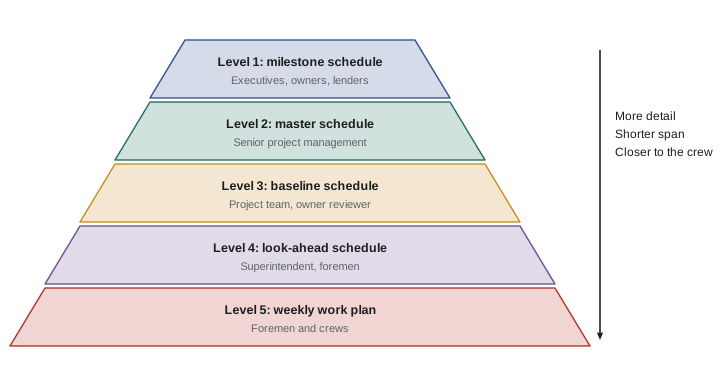
A project uses several schedules at different levels of detail, each for a different audience. Many organizations describe them as levels 1 to 5, a convention used by owners, contractors and AACE International guidance, although the exact definitions vary.
| Level | Typical name | Detail | Main audience |
|---|---|---|---|
| 1 | Milestone or summary schedule | A handful of key dates on one page | Owners, executives, lenders |
| 2 | Master or management schedule | Major phases and areas, tens of bars | Senior project management |
| 3 | Baseline or project control schedule | Hundreds of activities with logic and float | Project team, owner's reviewer |
| 4 | Look-ahead schedule | Next three to six weeks in detail | Superintendent, trade foremen |
| 5 | Weekly or daily work plan | Tasks for each crew this week | Foremen and crews |
The levels must agree with each other. The look-ahead schedule is drawn from the baseline schedule, refined with the latest information, and the weekly work plan is drawn from the look-ahead. When a foreman's weekly plan no longer matches the project schedule, the project schedule must be updated, or the two will drift apart until nobody trusts either.
The planning process step by step
Most construction scheduling follows the same broad sequence, whether the tool is a sheet of paper or enterprise software.
- Understand the scope: read the contract, drawings and specifications, visit the site, and note the milestones, access limits, phasing and special requirements.
- Break the work down: develop a work breakdown structure that divides the project into manageable deliverables (Lesson 2).
- Define activities: list the tasks needed to produce each deliverable, at a level of detail that suits control (Lesson 2).
- Estimate durations: use quantities, productivity and crew sizes to estimate how long each activity will take (Lesson 3).
- Sequence the activities: link them with logic that reflects physical, resource, safety and contractual constraints (Lesson 4).
- Calculate the schedule: perform the critical path calculations to find dates, float and the critical path (Lesson 5).
- Check risk and resources: test the schedule for uncertainty, load resources and smooth peaks (Lessons 6 and 7).
- Optimize: compress the schedule where time is worth money, or re-sequence to meet milestones (Lessons 8 and 9).
- Approve the baseline: review the schedule with the team and the owner and freeze it as the baseline (Lesson 10).
- Monitor and update: record progress, update the forecast, and act on slippage (Lesson 11).
Bar charts and networks
Two ways of showing a schedule have dominated construction for more than a century.
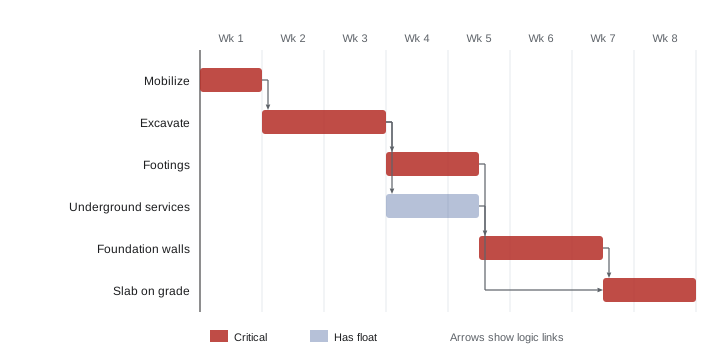
The bar chart, often called a Gantt chart after Henry Gantt, who popularized it in the early twentieth century, shows each activity as a horizontal bar against a time scale. Bar charts are easy to read, and almost every schedule is printed as one. On their own, though, they do not show why an activity is where it is: which activities must finish before it can start, and what happens downstream if it slips.
The network diagram shows activities and the logical links between them. The critical path method, developed in the late 1950s by engineers at DuPont and Remington Rand for plant maintenance and construction, and the closely related program evaluation and review technique, developed for the US Navy's Polaris missile program, both use networks to calculate dates and float. Modern scheduling software stores the network and draws it as a bar chart with logic lines, giving the readability of the bar chart and the analysis of the network.
Worked problem
Converting working days to a calendar date
A contractor plans a 45 working-day phase on a 5-day work week, starting on a Monday, with one statutory holiday falling inside the period. On which working day number, and roughly after how many calendar days, will the phase finish?
Show solution
- Working days needed: 45, plus 1 holiday that is not a working day, so the phase spans 46 weekdays.
- 46 weekdays = 9 full weeks (45 weekdays) plus 1 more weekday.
- Calendar days: 9 weeks × 7 = 63 days, plus 1 day into the tenth week, so the phase finishes on day 64, a Monday.
- In other words, 45 working days takes about 64 calendar days, a ratio of roughly 7 ÷ 5 plus holidays.
Answer: The phase finishes on the Monday of the tenth week, 64 calendar days after it starts. Always state whether durations are working days or calendar days.
Qualities of a good schedule
A good construction schedule is not the most detailed one or the one with the most colors. Experienced reviewers look for a short list of qualities.
- Complete: it covers all the scope, including design, submittals, procurement, permits, inspections, commissioning and closeout, not just field work.
- Logical: every activity has a predecessor and a successor, except the start and finish, and the logic reflects how the work will really be built.
- Realistic: durations come from quantities and productivity, not wishful thinking, and resources exist to support them.
- Readable: activity names describe the work and location, coding allows filtering by area, trade and phase, and the critical path is easy to find.
- Current: it is updated regularly with actual dates and remaining durations, so the forecast reflects reality.
- Owned: the people who must perform the work have contributed to it and believe in it.
The rest of this course builds the skills to produce schedules with these qualities, ending in a capstone in which you build and analyze a critical path schedule for a small commercial building.
Common mistakes
MistakeTreating planning and scheduling as one task done by the scheduler alone.
InsteadDevelop the plan with the superintendent, trades and suppliers, then schedule it.
MistakeProducing a schedule for the bid and never updating it.
InsteadUpdate the schedule regularly with actual progress and revised forecasts.
MistakeScheduling only field work.
InsteadInclude design, submittals, procurement, permits, inspections, commissioning and closeout.
MistakeMixing working days and calendar days without saying so.
InsteadState the calendar for each activity and convert carefully between working and calendar days.
MistakeRelying on a bar chart with no logic.
InsteadLink activities with logic so that the effect of a delay can be calculated.
Summary and key terms
- Planning decides what, how, by whom and in what order; scheduling puts the plan on a calendar.
- Formal scheduling coordinates parties, reveals the critical path, drives procurement and resources, supports cash flow and documents the project.
- Time costs money through general conditions, liquidated damages and indirect losses.
- Owners, designers, contractors, trades and suppliers all contribute to the schedule.
- Schedules exist at levels from a one-page milestone summary to a weekly crew plan, and the levels must agree.
- The planning cycle runs from scope through breakdown, durations, logic, calculation, optimization and baseline to monitoring and updates.
- Bar charts are readable; networks show logic; modern software combines them.
- Planning
- Deciding what work will be done, how, by whom and in what sequence.
- Scheduling
- Assigning durations, logic and dates to planned work to produce a timetable.
- Baseline schedule
- The approved schedule against which progress is measured.
- Look-ahead schedule
- A detailed short-term schedule, usually covering the next three to six weeks.
- Critical path
- The longest chain of logically linked activities, which controls the project finish date.
- Liquidated damages
- An amount per day, agreed in the contract, payable for late completion.
- General conditions
- Time-related site costs such as supervision, temporary facilities and insurance.
- Gantt chart
- A bar chart showing activities against a time scale.
- Network diagram
- A diagram showing activities and the logical relationships between them.
- Milestone
- A significant event of zero duration, such as substantial completion.
Practice problems
Work each problem on paper first, then reveal the answer to check.
In one sentence, what is the difference between planning and scheduling?
Show answer
Planning decides what will be done and how; scheduling decides when and for how long.
Name three things a construction schedule helps a project do.
Show answer
Any three of: coordinate trades, find the critical path, drive procurement, plan resources, forecast cash flow, measure progress, document delays.
General conditions are $15,000 per week. What do three weeks of delay cost in general conditions?
Show answer
$45,000.
Liquidated damages are $2,500 per calendar day. What are ten days of damages?
Show answer
$25,000.
Which schedule level would a foreman use to plan next week?
Show answer
Level 5, the weekly work plan, drawn from the look-ahead.
Why must the look-ahead agree with the baseline schedule?
Show answer
So that short-term plans support the project dates and the master schedule stays credible.
What did the critical path method add to the bar chart?
Show answer
Logic between activities and calculation of dates, float and the critical path.
A 20 working-day activity on a 5-day week starts on a Monday with no holidays. How many calendar days does it span?
Show answer
4 weeks, so 26 calendar days from the first Monday to the final Friday (28 days to the next Monday).
List three kinds of non-field work a complete schedule includes.
Show answer
Any three of: design, submittals, procurement, permits, inspections, commissioning, closeout.
Why are liquidated damages useful to both parties?
Show answer
They set the cost of delay in advance and avoid having to prove actual losses.
Lesson quiz · 5 questions
Score 60% or more to complete this lesson.
Create a free account to save your progress, take quizzes and earn a certificate.