
CON-110 · Lesson 7 of 12 · 28 min
Concrete materials and mix design basics
Concrete is the most widely used construction material in the world. It is made by mixing cement, water, aggregates and usually admixtures and supplementary cementing materials; the cement and water react in a process called hydration to form a paste that binds the aggregates into a hard, durable mass. Concrete is cheap, easily shaped and strong in compression, but weak in tension, which is why it is usually reinforced with steel (Lesson 9). Constructors rarely design concrete mixes themselves, since ready-mix suppliers and engineers do that, but they order concrete, check delivery tickets, accept or reject loads, adjust placement methods and are responsible for the result. This lesson explains the ingredients of concrete, how they affect fresh and hardened properties, the water-cementing materials ratio, exposure classes, a basic mix proportioning calculation and how concrete is specified and ordered.
Portland cement and blended cements
Portland cement is manufactured by heating limestone and clay or shale in a kiln to about 1,450 °C, producing clinker, which is ground with a small amount of gypsum into a fine powder. When mixed with water, the main compounds (calcium silicates and aluminates) hydrate, producing calcium silicate hydrate, the glue that gives concrete its strength, and calcium hydroxide. Hydration releases heat and continues for months as long as moisture and suitable temperatures are present. Different cement types are produced by adjusting the chemistry and fineness.
In the United States, portland cements are specified under ASTM C150 as Type I (normal), Type II (moderate sulfate resistance), Type III (high early strength), Type IV (low heat) and Type V (high sulfate resistance); many cements are dual-certified, such as Type I/II. Blended cements are specified under ASTM C595, and portland-limestone cement, Type IL, containing up to 15 % limestone, has rapidly become the most common cement in many states because it reduces carbon emissions. Performance-based cements are specified under ASTM C1157.
Cement production is responsible for a large share of the carbon emissions of concrete, so owners and designers increasingly ask for lower-carbon mixes using limestone cements, supplementary cementing materials and performance-based specifications. Environmental product declarations (EPDs) document the embodied carbon of mixes.
Supplementary cementing materials
Supplementary cementing materials (SCMs) replace part of the portland cement and react with the calcium hydroxide produced by hydration to form additional binding compounds. The main SCMs are:
- Fly ash: fine ash from coal-burning power plants; improves workability and long-term strength, reduces heat and permeability, but slows early strength gain, especially in cold weather. Supply is declining as coal plants close.
- Slag cement (ground granulated blast-furnace slag): a by-product of iron production; improves durability and long-term strength and gives a lighter color, with slower early strength.
- Silica fume: an extremely fine by-product of silicon production; produces very strong, low-permeability concrete for parking structures, bridge decks and high-rise columns, but makes concrete sticky and needs careful curing.
- Natural pozzolans and calcined clays: increasingly used as alternatives to fly ash.
The total of portland cement plus SCMs is the cementing materials (or cementitious materials) content, and the water-to-cementing-materials ratio (w/cm) uses that total.
Aggregates
Aggregates make up about 60 % to 75 % of the volume of concrete, so their properties strongly influence workability, strength, durability, shrinkage and cost. Fine aggregate is natural or manufactured sand passing a 5 mm (No. 4) sieve; coarse aggregate is gravel or crushed stone retained on that sieve, with common nominal maximum sizes of 20 mm (3/4 in) for buildings and 40 mm (1.5 in) for mass concrete. Important properties include:
- Grading: the distribution of particle sizes, which should be well graded to reduce voids and paste demand.
- Maximum size: larger aggregates reduce the paste needed but must fit between reinforcing bars and within thin sections; a common rule limits the maximum size to three-quarters of the clear spacing between bars and one-fifth of the narrowest form dimension.
- Shape and texture: crushed angular aggregates bond well but need more paste for workability than rounded gravels.
- Cleanliness: clay, silt and organic matter weaken bond and increase water demand.
- Soundness and durability: resistance to freezing and thawing and to abrasion.
- Alkali-aggregate reactivity: some aggregates react with alkalis in cement, forming expansive gels that crack concrete years later; standards require testing and preventive measures such as SCMs.
- Moisture condition: aggregates may be oven dry, air dry, saturated surface dry (SSD) or wet. Mix designs are based on SSD aggregates, and batch plants adjust batch water for the actual moisture of the stockpiles; free moisture in sand can add a lot of water to a batch.
In the United States, concrete aggregates are specified under ASTM C33, with test methods in other ASTM standards.
Water and admixtures
Mixing water should be clean; potable water is generally acceptable, and other water must be tested. Admixtures are added in small quantities to modify properties:
- Air-entraining admixtures create billions of microscopic air bubbles that relieve pressure from freezing water, essential for concrete exposed to freezing and thawing and de-icing salts. Typical total air contents are about 5 % to 8 %.
- Water reducers and high-range water reducers (superplasticizers) increase workability without adding water or allow less water for the same workability, raising strength. High-range water reducers make flowing and self-consolidating concrete possible.
- Retarders slow setting for hot weather, long hauls or large placements.
- Accelerators speed setting and early strength for cold weather; calcium chloride is a strong accelerator but promotes corrosion of reinforcement and is restricted or prohibited in reinforced concrete.
- Specialty admixtures: corrosion inhibitors, shrinkage reducers, viscosity modifiers, hydration stabilizers and crystalline waterproofing admixtures.
Admixture doses are usually given in milliliters per 100 kg of cementing materials (or fluid ounces per hundredweight), and additions on site must be controlled and recorded on the delivery ticket.
The water-cementing materials ratio
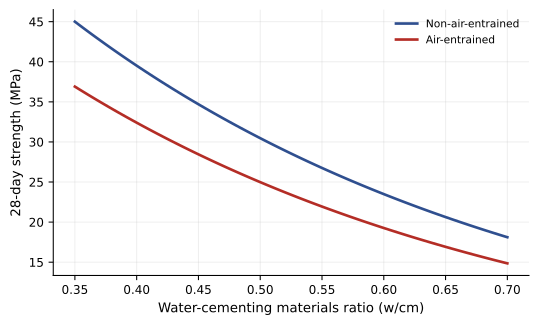
The most important single factor controlling the strength and durability of concrete is the ratio of the mass of water to the mass of cementing materials:
Only about 0.25 of water per unit of cement is needed to hydrate cement, but more is added for workability. Extra water that does not combine chemically leaves capillary pores as it evaporates, reducing strength and increasing permeability. As the w/cm rises, strength falls and permeability rises; a w/cm around 0.40 produces strong, durable concrete, while 0.60 or above produces weaker, more permeable concrete. This is why adding water on site to make concrete easier to place is one of the most damaging practices in construction: every liter of water added to a cubic meter lowers strength. Workability should come from admixtures or the mix design, not the hose.
Worked problem
The effect of adding water on site
A truck delivers 8 m³ of concrete batched with 340 kg/m³ of cementing materials and 150 kg/m³ of water. The finisher asks the driver to add 80 L of water to the load to make it flow better. What happens to the w/cm?
Show solution
- Original w/cm: 150 ÷ 340 = 0.44.
- Added water per cubic meter: 80 L ÷ 8 m³ = 10 L/m³, or 10 kg/m³.
- New water content: 150 + 10 = 160 kg/m³.
- New w/cm: 160 ÷ 340 = 0.47.
- If the specification allows a maximum w/cm of 0.45, the addition takes the load out of specification; strength may drop several megapascals (several hundred psi) and durability falls.
Answer: The w/cm rises from about 0.44 to 0.47, which may violate the specification; use admixtures, not water, and record any permitted additions on the ticket.
Fresh and hardened properties
Fresh concrete must be workable enough to be placed and consolidated without segregation (separation of coarse aggregate from paste) or excessive bleeding (water rising to the surface). Workability is commonly measured by the slump test (Lesson 12). Setting time determines how long crews have to place and finish. Hardened concrete must reach the specified compressive strength, usually at 28 days, measured on cylinders. Other hardened properties include durability against freezing and thawing, de-icing salts, sulfates and abrasion; low permeability to protect reinforcement from corrosion; and dimensional stability, since concrete shrinks as it dries, causing cracking that joints and reinforcement must control.
In the United States, specified compressive strength \(f'_c\) is usually given in pounds per square inch (psi); common values are 3,000 psi for footings, 4,000 psi for slabs and exterior flatwork and 5,000 psi or more for parking structures and high-performance work. One MPa is about 145 psi.
Exposure classes and durability requirements
Standards classify the environment that concrete will face and set minimum requirements for each class, typically a maximum w/cm, minimum strength, air content and sometimes cement type or SCM content.
ACI 318 defines exposure categories F (freezing and thawing, F0 to F3), S (sulfate, S0 to S3), W (in contact with water, W0 to W2) and C (corrosion protection of reinforcement, C0 to C2). For example, class F3 (frequent freezing with de-icing chemicals) requires a maximum w/cm of 0.40 and minimum strength of 5,000 psi, with air entrainment; class C2 (reinforced concrete exposed to chlorides) requires a maximum w/cm of 0.40 and 5,000 psi. ACI 318-25 is the current edition at the time of writing, and ACI 301 covers specifications for structural concrete.
| Ingredient or factor | Main effect | Constructor's concern |
|---|---|---|
| Cement type | Strength gain, heat, sulfate resistance | Correct type for exposure and season |
| SCMs | Durability, lower heat and carbon | Slower early strength in cold weather |
| Aggregate size and grading | Workability, paste demand | Fits between bars and in forms |
| Aggregate moisture | Actual water in the batch | Batch adjustments by the plant |
| Air entrainment | Freeze-thaw resistance | Check air on site; slight strength loss |
| Water reducers | Workability without water | Add per ticket, not by guesswork |
| w/cm | Strength and permeability | Never add unrecorded water |
Proportioning a mix by absolute volume
Mix designs are usually developed by the supplier using standard methods, such as the absolute volume method described by the Portland Cement Association and ACI 211. The principle is simple: the volumes of all ingredients (cement, SCMs, water, air, coarse aggregate and fine aggregate) must add up to one cubic meter (or one cubic yard, 27 ft³). The volume of each solid ingredient equals its mass divided by its density (relative density times the density of water).
Worked problem
Proportioning one cubic meter
A mix needs a maximum w/cm of 0.45 and 6 % air. Trial batches indicate 170 kg/m³ of water for the desired slump and 1,050 kg/m³ of SSD coarse aggregate. Use portland-limestone cement with a relative density of 3.15, coarse aggregate 2.68 and fine aggregate 2.65. Find the cement and sand contents.
Show solution
- Cement: 170 ÷ 0.45 ≈ 378 kg/m³.
- Volume of cement: 378 ÷ (3.15 × 1,000) = 0.120 m³.
- Volume of water: 170 ÷ 1,000 = 0.170 m³.
- Volume of air: 6 % of 1 m³ = 0.060 m³.
- Volume of coarse aggregate: 1,050 ÷ 2,680 = 0.392 m³.
- Sum so far: 0.120 + 0.170 + 0.060 + 0.392 = 0.742 m³.
- Fine aggregate volume: 1.000 − 0.742 = 0.258 m³; mass 0.258 × 2,650 ≈ 684 kg/m³ SSD.
- Check density: 378 + 170 + 1,050 + 684 = 2,282 kg/m³, a reasonable value for air-entrained concrete.
Answer: About 378 kg of cement, 170 kg of water, 1,050 kg of coarse aggregate and 684 kg of SSD sand per cubic meter, with 6 % air.
In imperial units the same method fills 27 ft³ per cubic yard, with water at 62.4 lb/ft³; a comparable mix would use roughly 290 lb of water and 640 lb of cement per cubic yard. Real mixes are refined with trial batches and field experience, and suppliers document them in mix design submittals that the engineer reviews.
Specifying and ordering ready-mixed concrete
Most concrete is supplied by ready-mix producers, batched at a central plant and delivered in truck mixers. Specifications may be prescriptive, stating proportions and ingredients, or performance-based, stating required properties and leaving the supplier to design the mix.
ASTM C94 covers ready-mixed concrete, including ordering information, tolerances, delivery tickets and a general discharge limit of 90 minutes or 300 drum revolutions after batching unless waived by the purchaser. ACI 301 sets general requirements for structural concrete construction, and many producers are certified by the NRMCA.
When ordering, the constructor gives the mix designation or specified properties, slump or slump flow, air content, maximum aggregate size, any admixtures, volume, placement method (chute, pump or bucket), delivery rate, start time and site access. Volumes ordered should include allowances for waste, uneven subgrade and spillage, often a few percent. Each truck arrives with a delivery ticket showing the mix, volume, batch time and any water that may be added. The site representative checks the ticket before discharge, records any additions and arranges testing.
Common mistakes
MistakeAdding water at the truck to improve flow.
InsteadUse admixtures or order a more workable mix.
MistakeIgnoring the batch time on delivery tickets.
InsteadCheck discharge time limits on every truck.
MistakeUsing calcium chloride in reinforced concrete.
InsteadUse non-chloride accelerators where permitted.
MistakeChoosing aggregate too large for congested reinforcement.
InsteadCheck bar spacing and form dimensions.
MistakeAssuming SCM mixes gain strength as fast in cold weather.
InsteadPlan for slower early strength and protection.
Summary and key terms
- Concrete is cement, water, aggregates, SCMs and admixtures bound by hydration.
- Cement types are GU, GUL, HE and others in Canada, and Types I to V and IL in the US.
- SCMs such as fly ash, slag and silica fume improve durability and lower carbon.
- Aggregates form most of the volume; grading, size, cleanliness and moisture matter.
- The w/cm ratio controls strength and permeability; never add unrecorded water.
- Exposure classes set maximum w/cm, minimum strength and air requirements.
- Absolute volume proportioning adds ingredient volumes to one cubic meter or yard.
- Hydration
- Chemical reaction of cement and water.
- Portland-limestone cement
- Cement with up to 15 % ground limestone.
- SCM
- Supplementary cementing material such as fly ash or slag.
- w/cm
- Mass ratio of water to cementing materials.
- Air entrainment
- Deliberate microscopic air bubbles for freeze-thaw resistance.
- Superplasticizer
- High-range water-reducing admixture.
- SSD
- Saturated surface dry condition of aggregate.
- Exposure class
- Category of environment setting durability requirements.
- Segregation
- Separation of coarse aggregate from paste.
- Delivery ticket
- Document describing each load of ready-mixed concrete.
Practice problems
Work each problem on paper first, then reveal the answer to check.
What reaction makes concrete harden?
Show answer
Hydration of cement.
Name two SCMs.
Show answer
Fly ash, slag cement, silica fume, calcined clay.
What w/cm results from 160 kg water and 400 kg cementing materials?
Show answer
0.40.
Why entrain air?
Show answer
To resist freezing and thawing damage.
What is the main drawback of calcium chloride?
Show answer
It promotes corrosion of reinforcement.
Volume of 300 kg of cement with RD 3.15?
Show answer
About 0.095 m³.
Why do plants adjust batch water?
Show answer
To account for aggregate moisture.
What does SSD mean?
Show answer
Saturated surface dry.
What volume do all ingredients add up to in a metric mix design?
Show answer
One cubic meter.
What should you check on each delivery ticket?
Show answer
Mix, volume, batch time and any additions.
Lesson quiz · 5 questions
Score 60% or more to complete this lesson.
Create a free account to save your progress, take quizzes and earn a certificate.