
COMP-119 · Lesson 11 of 12 · 24 min
Practice review and closing gaps
▶ Video coming soon A video version of this lesson is on the way.
Earlier this month Noor took her first full practice test, and lesson 9 described the reading errors it revealed. Her plan has two more full tests before March 2027, one in December and one in mid-February. Lorna wants her to know exactly what to do with each result, because a practice test is only as useful as the review that follows it. Many candidates take test after test, glance at the score and start another. They are measuring, not improving. This lesson describes a review method that turns each practice test into a short list of specific gaps, a plan to close them, and a better estimate of readiness. The numbers in the examples are invented for teaching, but they are typical of what Lorna has seen in cert club members.
What a practice test can and cannot tell you
A good practice test shows which topics and question types cause trouble and whether pacing holds up for a full hour. It cannot predict the exact scaled score on the real exam. Practice providers write their own questions, which differ in style and difficulty from CompTIA's, and they report results in their own way, often as a number correct out of the total. The real exam converts results onto a scale where 650 of 900 passes, using a method CompTIA does not publish. So treat practice results as signals: improvement from test to test, consistency across domains and the kinds of mistakes being made matter more than any single number.
Choose practice material carefully. Questions should be written for the FC0-U71 objectives, not the older FC0-U61 exam, and should come from reputable sources: CompTIA's own CertMaster products, established training publishers, or questions written by an instructor from the objectives. Avoid sites that claim to offer the real exam questions. Using leaked exam content breaks CompTIA's candidate agreement and can lead to a ban and loss of certifications, and those collections are often wrong anyway.
The error log
The core of the method is an error log. For every question answered wrongly, and for every question answered correctly by a guess, record four things: the domain and objective, what the correct answer was, why you chose wrongly, and what you will do about it. The "why" column uses a small set of categories. A knowledge gap means you did not know the fact or concept. A misread means you knew the material but misread the question, missing a keyword such as NOT or FIRST. A careless error means you knew the answer and read correctly but clicked the wrong option or rushed. A time error means you guessed because time was short. Each category has a different fix, which is why separating them matters.
| Category | Typical sign | Fix |
|---|---|---|
| Knowledge gap | You could not explain the right answer before seeing it | Restudy the objective, then practice similar questions |
| Misread | The right answer is obvious when you reread the question | Use the ask, read, predict, check routine; slow down on keywords |
| Careless | You knew it and read it but chose wrongly | Pause one second before confirming each answer |
| Time | You guessed because the clock was short | Practice pacing checkpoints and earlier flagging |
Worked problem
Reading an error log
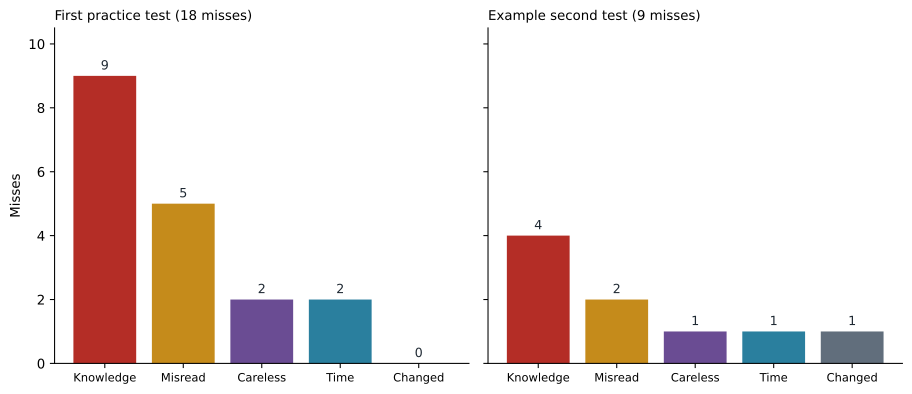
Noor's first full practice test had 70 questions. She answered 52 correctly and logged 18 misses: 9 knowledge gaps (4 in data, 3 in software development, 2 in security), 5 misreads, 2 careless errors and 2 time errors. What should her next two weeks focus on?
Show solution
- Knowledge gaps are half the misses (9 of 18), and 7 of them are in data and software development, the two domains she rated lowest at the start. Those objectives come first.
- Misreads are the next largest group (5 of 18). They need a habit change, not more content: the reading routine from lesson 9 on every practice question.
- Careless and time errors (4 together) suggest a pacing check: she should look at her checkpoint log to see whether the time errors came at the end, and add a one-second pause before confirming answers.
- Plan: about two thirds of study time on the data and software development objectives behind the 7 gaps, a short daily drill of mixed questions with the reading routine, and one timed drill a week.
Answer: Restudy the data and software development objectives first, practice the reading routine daily, and check pacing once a week.
Closing a knowledge gap properly
Closing a gap means more than rereading the right answer. Go back to the objective in the official document, reread the relevant lesson, and write a short explanation in your own words, as if teaching a colleague. Then test yourself on new questions about the same objective, ideally a day or two later. Explaining and then retrieving from memory are two of the most reliable learning techniques known: actively recalling information strengthens memory far more than reading it again, and spacing the practice over days works better than cramming it into one session.
Noor applies this to her weakest objective, database keys. She rereads COMP-111's lesson on databases, writes three sentences explaining primary and foreign keys with a library example, draws the patrons, items and loans tables from memory, and two days later answers ten new questions on keys. She gets nine right, and the one she missed was a misread. The gap is closed; the objective moves from "shaky" to "known" on her checklist.
Flash cards and spaced repetition
Many Tech+ facts are short and specific: port numbers she may meet in context, file system limits, Wi-Fi security modes, license types, malware names. These suit flash cards, either on paper or in a spaced-repetition app that shows each card again just before you are likely to forget it. Cards you answer easily appear less often; cards you miss appear again soon. Ten or fifteen minutes a day with cards is more effective than an hour once a week. Write cards in your own words, one fact per card, and include a short example where possible.
Confidence calibration
A useful extra column in the error log is confidence: before checking the answer, rate each response as sure, fairly sure or guess. After a few practice tests, compare confidence with results. Ideally, "sure" answers are almost always right and "guess" answers are right only sometimes. If many "sure" answers are wrong, overconfidence is a problem, and those topics need checking even though they feel comfortable. If many "guess" answers are right, you know more than you think, and the fix is trust and pace rather than more study. Calibration also helps on exam day, when knowing which answers deserve a second look makes the review time more productive.
| Confidence | Answers | Right | What it suggests |
|---|---|---|---|
| Sure | 40 | 38 | Well calibrated |
| Fairly sure | 18 | 11 | Review these topics |
| Guess | 12 | 3 | Genuine gaps; restudy |
Judging readiness
No practice score guarantees a pass, but a few signals together suggest readiness. Scores on reputable practice tests have improved and are consistently comfortable rather than borderline. No domain is far weaker than the others. Most misses are misreads or occasional careless errors rather than knowledge gaps. Pacing checkpoints are met with time to spare. The objectives checklist is marked known for nearly every line. If several of these are missing a week or two before the exam, it may be wiser to reschedule than to sit an exam that the evidence says is not ready. Pearson VUE allows rescheduling under its own policy and deadlines, which should be checked well in advance; a lost attempt costs the full price.
Worked problem
Comparing two practice tests
Lorna shows Noor how she will compare results once her December test is done, using made-up numbers. Suppose the second test, from a different reputable source, gives 61 of 70 correct, with 9 misses: 4 knowledge gaps, 2 misreads, 1 careless error and 1 time error, plus 1 she got wrong after changing a correct answer. Would that show improvement, and what would remain?
Show solution
- Correct answers would have risen from 52 to 61 of 70, a clear improvement on a different question set.
- Knowledge gaps would have fallen from 9 to 4 and misreads from 5 to 2, showing that both the study and the reading routine were working.
- The changed answer would be a new pattern, a sign that she should change answers only for a specific reason, as lesson 10 recommends.
- Remaining work: the 4 knowledge gaps, checked against her objectives list, and one more timed test to confirm pacing.
Answer: Yes, that would show steady improvement. She would close the last four gaps, stop changing answers without a reason, and confirm pacing with one more timed test.
One more caution applies to practice material: memorizing the answers to a particular practice set is not the same as learning the objectives. If a practice test is retaken and the score jumps because the questions are familiar, the result says nothing new about readiness. Fresh questions on the same objectives are the real measure, which is why Noor's plan uses a different source for each full test.
A week of gap closing
Turning an error log into action works best as a short weekly plan. Lorna helps Noor draft the week after her first test, built around the categories in her log. Each weekday has a focused block of about forty minutes on one weak objective, a short card review and a small set of mixed questions using the reading routine. The weekend has one longer session. The plan is deliberately modest, because a plan that fits around real shifts is one that actually happens.
| Day | Focus block (about 40 minutes) | Daily habits (about 15 minutes) |
|---|---|---|
| Monday | Database keys and constraints: reread, explain in writing, draw the tables | Flash cards; 5 mixed questions |
| Tuesday | Relational and non-relational databases; structured and unstructured data | Flash cards; 5 mixed questions |
| Wednesday | Language categories and data types | Flash cards; 5 mixed questions |
| Thursday | Cert club: pseudocode tracing with a partner | Flash cards |
| Friday | Security weak spots: MFA categories and backup rules | Flash cards; 5 mixed questions |
| Saturday | 15-question timed drill, then error log review | None |
| Sunday | Rest, or a light read of the objectives checklist | None |
Reviewing correct answers too
It is tempting to look only at wrong answers, but correct answers hold information as well. A correct answer reached by luck is a gap waiting to appear on the exam, which is why guesses go in the log. A correct answer that took three minutes is a pacing problem in disguise. And a correct answer reached by eliminating three options, without being able to say why the key is right, shows partial understanding that may fail on a differently worded question. Lorna suggests a quick pass through every question after a practice test, right or wrong, asking one thing: could I explain to someone else why the right answer is right and why each wrong option is wrong? Where the answer is no, the objective goes back on the study list.
If the real exam does not go to plan
The same method applies to a real score report. If a first attempt does not pass, the report lists the domains where performance was weakest. Those domains become the top of a new priority list, using the weight-and-gap method from lesson 2 with the report as evidence. Candidates often find that the report confirms what their practice logs already suggested; the difference is that now the evidence is official. CompTIA's retake policy allows a second attempt without a waiting period, but a few weeks of focused work on the weak domains, followed by at least one fresh practice test, is the sensible path before rebooking.
Common mistakes
MistakeTaking practice test after practice test without reviewing errors.
InsteadLog every miss and guess, categorize it and fix the cause.
MistakeTreating a practice score as a prediction of the scaled score.
InsteadUse practice results as signals of improvement and consistency.
MistakeUsing sites that offer real exam questions.
InsteadThose break CompTIA's candidate agreement and risk a ban; use reputable practice material.
MistakeRereading notes instead of testing yourself.
InsteadExplain in your own words, then retrieve from memory on new questions days later.
MistakeIgnoring answers that were right by guessing.
InsteadLog guessed correct answers too; they are hidden gaps.
Summary and key terms
- Practice tests are signals of improvement, not predictions of the scaled score.
- Use practice material written for FC0-U71 from reputable sources, never leaked exam content.
- Log every miss and every guess by domain, objective and error category.
- Knowledge gaps, misreads, careless errors and time errors each have different fixes.
- Explaining, retrieval practice and spaced repetition close gaps more reliably than rereading.
- Judge readiness from several signals together, and reschedule if the evidence says you are not ready.
- Error log
- A record of every wrong or guessed answer with its cause and fix.
- Knowledge gap
- A miss caused by not knowing the fact or concept.
- Misread
- A miss caused by reading the question incorrectly.
- Retrieval practice
- Strengthening memory by recalling information without looking at it.
- Spaced repetition
- Reviewing material at increasing intervals over days and weeks.
- Calibration
- How well your confidence in answers matches how often they are right.
Practice problems
Work each problem on paper first, then reveal the answer to check.
Why can't a practice score predict the scaled score?
Show answer
Practice questions and scoring differ from CompTIA's, and the scaling method is not published.
Name the four error categories.
Show answer
Knowledge gap, misread, careless error and time error.
What should you log besides wrong answers?
Show answer
Correct answers that were guesses.
What is the best fix for misreads?
Show answer
A consistent reading routine, slowing down on keywords.
Why is using leaked exam questions a bad idea?
Show answer
It breaks the candidate agreement, can lead to a ban, and the content is often wrong.
What does it mean if many 'sure' answers are wrong?
Show answer
Overconfidence; those topics need checking.
What should you do if the evidence says you are not ready a week before the exam?
Show answer
Consider rescheduling within Pearson VUE's policy rather than risking a full-price attempt.
Lesson quiz · 5 questions
Score 60% or more to complete this lesson.
Create a free account to save your progress, take quizzes and earn a certificate.