
COMP-119 · Lesson 1 of 12 · 24 min
The Tech+ exam at a glance
▶ Video coming soon A video version of this lesson is on the way.
The Thursday cert club at Library Technology Services at Fairhaven Regional Library in Spokane has a new routine. Since the first session on November 5, Noor Abbasi has finished the two Tech+ content courses with Lorna Fitzgerald, and today she arrives with a printed copy of the exam objectives covered in sticky notes. Her plan, written in her roadmap, is to sit the Tech+ exam in March 2027 through online proctoring. Lorna tells her that knowing the material and passing the exam are related but not identical skills. The first is about understanding computers; the second is about showing that understanding under a time limit, in a particular question format, after a check-in process that has its own rules. This course is about the second skill. It starts where every good exam plan starts: with a clear, accurate picture of what the exam actually is.
What Tech+ is and who it is for
CompTIA Tech+ is CompTIA's entry-level certification for people who are new to information technology or who work alongside it. It replaced the older IT Fundamentals+ certification, whose exam was FC0-U61, and its current exam is FC0-U71. CompTIA describes Tech+ as needing no prior experience, and its objectives cover a broad sweep of basic knowledge: how computers represent and process data, the parts of a computer and a network, operating systems and applications, the ideas behind writing software, how data and databases work, and everyday security. It is not a job certification in the way A+ is for help desk work, but it is a recognized first credential, and many schools, colleges and employers use it as a starting point. Jun, one of the teen volunteers in the makerspace, is working toward it through a high-school program, and Noor is using it as a stepping stone toward A+.
A useful way to think about Tech+ is as a map of the whole territory rather than a deep study of any one region. A+ goes much deeper into hardware and troubleshooting; Network+ goes deeper into networks; Security+ goes deeper into security. Tech+ touches all of those and adds software development and databases, which the other core certifications barely mention. That breadth is exactly why the exam can feel harder than its entry-level label suggests. Nobody is asked to configure a router or write a working program, but candidates must recognize a wide range of terms and choose the best answer in short scenarios from many different areas.
The exam in numbers
CompTIA's public Tech+ page lists the essential facts. The exam has a maximum of 70 questions, all of them multiple choice. Candidates have 60 minutes. The passing score is 650 on a scale that runs to 900. The exam is offered in English and Japanese. CompTIA lists the launch date of FC0-U71 as July 16, 2024. There are no performance-based questions on Tech+, which is one of the clearest differences from A+, Network+ and Security+, where interactive simulations appear near the start of the exam. Every Tech+ question is a written question with answer choices.
| Item | Tech+ (FC0-U71) | Where to check |
|---|---|---|
| Number of questions | Maximum of 70 | The CompTIA Tech+ certification page |
| Question type | Multiple choice (no performance-based questions) | The CompTIA Tech+ certification page |
| Time allowed | 60 minutes | The CompTIA Tech+ certification page |
| Passing score | 650 on a scale of 900 | The CompTIA Tech+ certification page |
| Languages | English and Japanese | The CompTIA Tech+ certification page |
| Experience needed | None | The CompTIA Tech+ certification page |
| Price | Varies by country and currency | The CompTIA store for your country |
| Delivery | Pearson VUE test center or OnVUE online proctoring | The Pearson VUE CompTIA page |
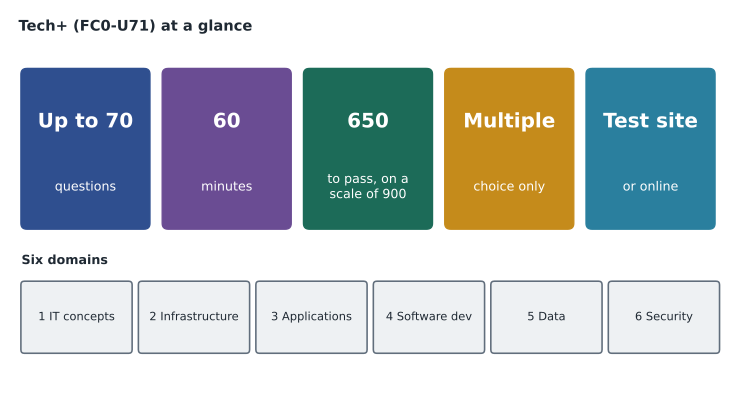
Lorna points out a small but important detail. CompTIA's partner site, which is aimed at schools and training companies, gives slightly different figures: 75 questions, English only, a launch date of August 28, 2024, and slightly different domain weights. Different pages written at different times for different audiences sometimes disagree. The right response is not to worry about which page is correct today but to build the habit every certification candidate needs: treat the official exam objectives document for the exact exam code you will sit as the final word, check the main certification page in the weeks before booking, and never rely on a number from a forum, a video or a study guide printed two years ago. Lesson 2 looks at the domain weights in detail, including how to plan when sources disagree.
Two exam codes: FC0-U71 and FC0-U71-CE
Tech+ is unusual among CompTIA certifications in having two versions of the same exam. A pass on FC0-U71 gives a certification with no expiration date: once earned, it stays valid. A pass on FC0-U71-CE gives a certification that is valid for five years and can be kept current. CompTIA's page explains that renewing Tech+ means passing the latest version of the exam, and that there is no continuing education fee for Tech+. The two versions cover the same objectives; the difference is what happens afterward. Some employers and government programs require certifications that are kept current, which is why the CE version exists. For a learner like Jun, whose school program pays for the exam, the program coordinator usually decides which code to buy.
Noor asks which one she should choose. Lorna suggests reading what the voucher or the employer asks for, then choosing. If nobody requires the CE version, the lifetime version is simpler, and her plan is to move on to A+ within a year anyway, which renews under its own continuing education rules. The important thing is to know which code is on the booking before exam day, because the confirmation email names the exact exam, and the voucher must match it.
How the exam is delivered
CompTIA exams are delivered by Pearson VUE in two ways. Candidates can book a seat at a Pearson VUE test center, where the center provides the computer, a quiet room and a proctor who checks identification in person. Or they can choose OnVUE, Pearson VUE's online proctored delivery, and sit the exam on their own computer at home or in another private room while a remote proctor watches through the webcam and microphone. The exam content and scoring are the same either way. What differs is the check-in process, the rules about the room, and who is responsible for the equipment working.
Both routes require identification that matches the registration exactly. COMP-101 covered the rules in detail; the short version is two original, valid, unexpired IDs, one government-issued with a photo and name, and a second with name and either signature or photo, with the first and last names matching the registration exactly. A candidate whose CompTIA account says "Noor Abbasi" but whose passport says "Nour Abbasi" has a problem that must be fixed weeks before the exam, not on the morning. For OnVUE, the computer must pass Pearson VUE's system test on the same device and network that will be used on exam day, and the room must be private, quiet and clear of notes, phones and second screens.
Lorna is a fan of test centers for first exams. The center removes the worry about webcams, home networks and a family member walking in, and the drive there forces a calm start to the day. Noor prefers online proctoring because the nearest test center is a long bus ride from her apartment and she has a quiet spare room. Both choices are sensible. What matters is making the choice early, practicing under the chosen conditions, and reading the current rules for that delivery method a week before the exam.
How scoring works
Tech+ is scored on a scale up to 900, and 650 is the passing score. That number is not a mark out of 100 and should not be converted into one. CompTIA uses scaled scores so that different forms of the same exam, which contain different questions of slightly different difficulty, can be compared fairly. The raw number of questions a candidate answers correctly is converted onto the scale, and the passing point on that scale stays at 650 even when individual question forms change. CompTIA sets passing scores statistically and does not publish the raw number of correct answers needed, so a candidate cannot work backward from 650 to an exact count of questions.
Two practical lessons follow from this. First, every question is worth attempting: there is no published penalty for a wrong answer, so leaving a question blank can only lose points. Second, a practice test that reports "72 out of 100" is measuring something different from the real exam's scale, so practice scores should be read as rough signals of readiness, not predictions. Lesson 11 shows how to use practice results well. A candidate sees the score report at the end of the exam, and the report lists the domains where answers were weakest, which is useful for anyone who needs to retake.
| Question | Short answer |
|---|---|
| Is 650 a mark out of 100? | No. It is a point on a scale that runs to 900. |
| Is there a penalty for wrong answers? | CompTIA does not publish one; answer every question. |
| Can I work out how many questions I need? | No. CompTIA sets passing scores statistically and does not publish the raw count. |
| When do I see my result? | The score report appears at the end of the exam. |
| Does the report help if I fail? | Yes. It points to the domains where answers were weakest. |
Retakes, retirement and price
CompTIA's retake policy allows a second attempt without a waiting period. After a second failed attempt, at least 14 calendar days must pass before each later attempt, and every attempt costs the full exam price, with no free retests. A candidate who passes cannot retake the same exam code to raise the score without CompTIA's consent. Those rules make it sensible to sit the exam when ready rather than to book it as a practice run.
CompTIA exams usually stay in use for about three years after launch before a new version replaces them, and CompTIA announces a retirement date in advance. FC0-U71 launched in 2024, so a candidate studying in late 2026 for an exam in 2027 should check the Tech+ page for any announced retirement before booking. If a new version is announced, the safest course is to sit the version whose objectives you studied, before it retires, or to switch study materials to the new objectives.
Prices vary by country and change from time to time, so this course does not quote one. The CompTIA store shows the current price for each country in local currency, and many learners never pay the list price at all: schools, workforce programs, employers and libraries often provide vouchers. Lorna has already confirmed that the library's professional development budget will pay for Noor's voucher, which is one reason she is keen for the first attempt to succeed.
Worked problem
Building a booking timeline
Noor wants to sit Tech+ online in the second week of March 2027. Working backward, what should she do and when, using the facts in this lesson?
Show solution
- Six to eight weeks before (mid-January 2027): confirm which exam code the voucher covers, check the CompTIA Tech+ page for current facts and any announced retirement date, and check that her name matches exactly on her CompTIA account and both IDs.
- Four to six weeks before (early February 2027): book the OnVUE appointment, choosing a morning time when she is usually alert, and run the Pearson VUE system test on the computer and network she will use.
- One week before: reread the current OnVUE rules, rerun the system test, and set up the room exactly as it will be on the day.
- On the day: check in up to 30 minutes early, with both IDs ready, phone and notes out of arm's reach.
Answer: Confirm the code, facts and ID in mid-January; book and system-test in early February; rehearse the room in the final week; check in early on the day.
What this course covers
The rest of the course follows the exam's own structure. Lesson 2 explains the six domains and how to divide study time among them. Lessons 3 to 8 review each domain in turn, concentrating on the distinctions that exam questions like to test: the difference between similar terms, the correct order of a process, the best choice in a short scenario. Lesson 9 teaches careful question reading. Lesson 10 is about time on exam day. Lesson 11 is about using practice tests to find and close gaps. Lesson 12 is a plan for the final week. The review lessons are not a replacement for COMP-110 and COMP-111, where each topic is taught from the beginning; they assume you have met the ideas and want to make them exam-ready.
Lorna closes the session with the most important point of the day. Tech+ rewards breadth and calm. Candidates who fail it rarely do so because one topic was too hard; they fail because they skipped a domain they found dull, ran out of time after dwelling on a few questions, or misread questions that they actually knew how to answer. All three of those are fixable with a plan, and the plan is what this course builds.
Common mistakes
MistakeConverting 650 out of 900 into a mark out of 100 to estimate how many questions you need.
InsteadTreat the scale as a scale; CompTIA does not publish the raw count needed to pass.
MistakeExpecting performance-based simulations like those on A+.
InsteadTech+ questions are all multiple choice.
MistakeTrusting a number from an old study guide or forum post.
InsteadCheck the official objectives for your exact exam code and the CompTIA page before booking.
MistakeBooking the exam before checking that names match on the account and both IDs.
InsteadFix name mismatches weeks ahead; they cannot be fixed at check-in.
MistakeTreating the first attempt as a free practice run.
InsteadEvery attempt costs the full price; sit the exam when practice shows you are ready.
Summary and key terms
- Tech+ (FC0-U71) is CompTIA's entry-level certification, needing no prior experience.
- CompTIA's main page lists up to 70 multiple-choice questions, 60 minutes and a passing score of 650 on a scale of 900.
- Official pages sometimes disagree; the objectives document for your exact exam code is the final word.
- FC0-U71 never expires; FC0-U71-CE is valid for five years and is renewed by passing the latest exam.
- Exams are delivered by Pearson VUE at a test center or online through OnVUE, with strict ID and room rules.
- Scaled scores are not marks out of 100, and every question is worth answering.
- FC0-U71
- The exam code for the current Tech+ exam.
- FC0-U71-CE
- The version of the Tech+ exam whose certification is valid for five years and can be renewed.
- Scaled score
- A result converted onto a fixed scale so that different exam forms can be compared fairly.
- Exam objectives
- CompTIA's official document listing the domains and topics an exam covers.
- OnVUE
- Pearson VUE's online proctored delivery, taken on your own computer with a remote proctor.
- Voucher
- A prepaid code used to pay for an exam booking.
- Retirement date
- The date after which an exam version can no longer be taken.
Practice problems
Work each problem on paper first, then reveal the answer to check.
How many questions and minutes does CompTIA's main Tech+ page list?
Show answer
A maximum of 70 questions in 60 minutes.
What is the passing score for Tech+?
Show answer
650 on a scale of 900.
Does Tech+ include performance-based questions?
Show answer
No; all questions are multiple choice.
What is the difference between FC0-U71 and FC0-U71-CE?
Show answer
FC0-U71 gives a certification with no expiration; FC0-U71-CE gives one valid for five years that is renewed by passing the latest exam.
Why can't you convert 650 into a number of correct answers?
Show answer
It is a scaled score; CompTIA sets passing scores statistically and does not publish the raw count.
Where should you check the price?
Show answer
The CompTIA store for your country.
Two official pages give different numbers. What do you trust?
Show answer
The objectives document for your exact exam code, then the current main certification page.
Lesson quiz · 5 questions
Score 60% or more to complete this lesson.
Create a free account to save your progress, take quizzes and earn a certificate.