
CMPUT-450 · Lesson 4 of 12 · 36 min
Global state, snapshots and coordination
Many tasks in a distributed system need a picture of the whole system at once. A backup should capture the state of every partition. A debugger wants to know whether the system is deadlocked. A garbage collector wants to know whether any process still refers to an object. On one machine you could pause everything and look. In a distributed system there is no global pause button and no global clock, and messages are always in flight between processes. This lesson asks what a meaningful global state is, shows the Chandy–Lamport algorithm for recording one without stopping the system, and then turns to two coordination problems that recur constantly: ensuring that only one process at a time does something (mutual exclusion) and choosing one process to lead (leader election).
Cuts and consistent global states
A global state consists of the local state of every process together with the state of every channel, the messages sent but not yet received. Imagine recording each process's state at some moment of its own choosing. The set of recording points is called a cut: it divides each process's history into a past and a future. A cut is consistent if, for every message whose receipt is in the past, its sending is also in the past. In terms of lesson 3, a consistent cut is closed under happened-before: if it contains an event, it contains every event that happened before it.
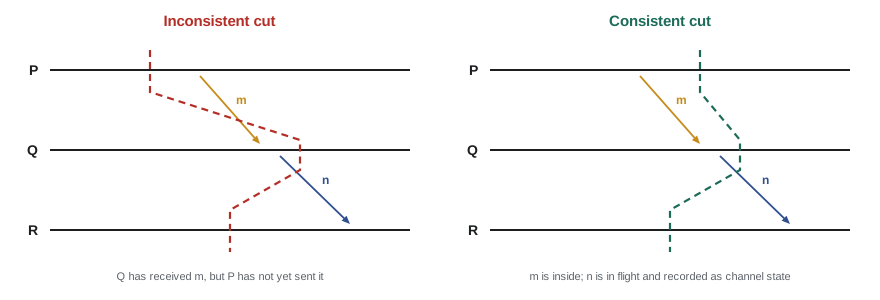
An inconsistent cut records an effect without its cause, such as money arriving at one bank branch that has not yet left another. Such a state never existed and could never have existed, so conclusions drawn from it are wrong. A consistent cut may not correspond to a moment in real time either, but it is a state the system could have passed through, which is enough for most purposes. In particular, if a property is stable, meaning that once it becomes true it stays true, such as "the computation has terminated", "these processes are deadlocked" or "this object is garbage", then evaluating it on a consistent cut gives a correct answer: if it holds in the recorded state, it holds now.
The Chandy–Lamport snapshot algorithm
K. Mani Chandy and Leslie Lamport published an algorithm in 1985 that records a consistent global state of a running system without stopping it. It assumes reliable, first-in-first-out channels between every pair of processes. Any process can start a snapshot. The algorithm uses a special message, a marker, which separates messages sent before a process recorded its state from those sent after.
The rules are short. To start, a process records its own state and sends a marker on every outgoing channel before sending anything else. When a process receives a marker on some channel for the first time, it records its own state, records that channel as empty, sends markers on all its outgoing channels, and begins recording every other incoming channel. When a process receives a marker on a channel it was recording, it stops recording that channel; the messages it saw on that channel between recording its own state and receiving the marker are the channel's recorded state. The snapshot is complete when every process has recorded its state and received a marker on every incoming channel.
Why is the result consistent? Because channels are FIFO, any message a process sent after recording its state arrives after the marker it sent on the same channel. So when the receiver records its state, which happens no later than receiving that marker, it has not yet received any message sent after the sender's recording point. Every receipt inside the cut therefore has its send inside the cut. Messages sent before the sender's recording but received after the receiver's are exactly those the receiver records as channel state.
# Chandy-Lamport snapshot of three bank branches that keep transferring money.
# Channels are FIFO. Total money is 300; a correct snapshot must also total 300.
import random
from collections import deque
random.seed(450)
P = ["A", "B", "C"]
bal = {"A": 100, "B": 100, "C": 100}
chan = {(i, j): deque() for i in P for j in P if i != j}   # messages in flight i -> j
recorded, chan_state, recording = {}, {}, {}

def start_snapshot(p):
    recorded[p] = bal[p]                                  # record own state
    for q in P:
        if q != p:
            chan[(p, q)].append(("MARKER", 0))             # marker on every outgoing channel
            recording[(q, p)] = True                       # record incoming channels
            chan_state[(q, p)] = []

def deliver(i, j):
    kind, amt = chan[(i, j)].popleft()
    if kind == "MARKER":
        if j not in recorded:                              # first marker: snapshot now
            start_snapshot(j)
            chan_state[(i, j)] = []                        # this channel recorded as empty
        recording[(i, j)] = False                          # stop recording this channel
    else:
        bal[j] += amt
        if recording.get((i, j)):
            chan_state[(i, j)].append(amt)                 # in flight when the cut was taken

steps, started = 0, False
while steps < 400:
    steps += 1
    if steps == 40 and not started:
        start_snapshot("A"); started = True                # A initiates the snapshot
    if random.random() < 0.5:                              # a branch sends a transfer
        i = random.choice(P); j = random.choice([q for q in P if q != i])
        amt = random.randint(1, 20)
        if bal[i] >= amt:
            bal[i] -= amt; chan[(i, j)].append(("MONEY", amt))
    else:                                                  # some channel delivers a message
        busy = [k for k in chan if chan[k]]
        if busy: deliver(*random.choice(busy))
    if started and len(recorded) == 3 and not any(recording.values()):
        break

in_flight = sum(sum(v) for v in chan_state.values())
print("recorded branch balances:", recorded)
print("recorded in-flight money:", {f"{i}->{j}": v for (i, j), v in chan_state.items() if v})
print("snapshot total:", sum(recorded.values()) + in_flight)
naive = dict(bal)                          # what you would get by just reading balances now
print("live balances now:", naive, "sum", sum(naive.values()),
"+ in channels", sum(a for q in chan.values() for k, a in q if k == "MONEY"))recorded branch balances: {'A': 126, 'C': 20, 'B': 127}
recorded in-flight money: {'B->A': [14], 'C->B': [13]}
snapshot total: 300
live balances now: {'A': 68, 'B': 131, 'C': 3} sum 202 + in channels 98The recorded balances alone may not sum to 300, because some money was in flight when the cut was taken; adding the recorded channel contents restores the total exactly. That conservation check is the classic test of a correct snapshot. Snapshot algorithms of this family are used in practice. Apache Flink, a stream-processing system, takes periodic distributed snapshots of operator state by injecting barriers, which play the role of markers, into its data streams; after a failure, every operator restores the last completed snapshot and replays input from the corresponding positions in the source logs. Lesson 12 returns to this as the basis of exactly-once stream processing.
| Requirement | Why it is needed | What breaks without it |
|---|---|---|
| FIFO channels | A message sent after the marker must arrive after it | Post-snapshot messages could be recorded as received, giving an inconsistent cut |
| Reliable delivery | Every marker must eventually arrive | The snapshot never completes |
| Strongly connected processes | Markers must reach everyone from the initiator | Some processes never record a state |
| Recording channel contents | Captures money or work in flight | Conserved quantities appear to change |
Mutual exclusion
CMPUT-379 (lessons 5 and 6) solved mutual exclusion among threads with locks built on atomic hardware instructions. Between machines there is no shared memory, so mutual exclusion must be built from messages. Three classic designs illustrate the trade-offs.
The simplest is a central coordinator. A process wanting the lock sends a request to the coordinator, which grants it if the lock is free and otherwise queues the request; the holder sends a release when done. It takes three messages per entry and is easy to understand, but the coordinator is a single point of failure and a potential bottleneck. In the Ricart–Agrawala algorithm (1981), a process wanting entry sends a request timestamped with a Lamport clock to every other process and enters only after all have replied; a process defers its reply if it is in the critical section or has an earlier request of its own. It needs \(2(n - 1)\) messages per entry and has no central point of failure, but any single crashed process blocks everyone, so it is less fault tolerant than the central design. In a token ring, a single token circulates around a logical ring and only its holder may enter; it is fair and simple, but the token can be lost when its holder crashes, and detecting that is hard.
| Algorithm | Messages per entry | Delay before entry (messages) | Failure behavior |
|---|---|---|---|
| Central coordinator | 3 | 2 | Coordinator crash blocks everyone until a new one is elected |
| Ricart–Agrawala | 2(n − 1) | 2 | Any process crash blocks everyone |
| Token ring | 1 to unbounded | 0 to n − 1 | Token lost if its holder crashes |
| Lease from a consensus service | A few, to the service | 2 | Tolerates minority failures of the service; needs fencing |
None of the classic algorithms tolerates failures well, which is why real systems take a different route: they obtain locks from a small, replicated coordination service such as ZooKeeper or etcd, which uses consensus internally (lesson 9) and therefore keeps working while a minority of its servers are down.
Leases and fencing tokens
A lock held by a process that crashes would block everyone forever, so distributed locks are granted as leases: a lock that expires after a fixed time unless renewed. Leases were introduced by Gray and Cheriton in 1989 for cache consistency and are now everywhere. A lease solves the crashed-holder problem but creates a subtler one. Suppose a client holding a lease is paused, perhaps by a long garbage-collection pause, a virtual machine migration or a page fault on a busy disk. The lease expires, the service grants it to another client, and then the first client wakes up, still believing it holds the lease, and writes to shared storage. Two clients now act as lock holders at once.
The fix, described clearly by Martin Kleppmann, is a fencing token: a number that the lock service increases every time it grants the lock. The client must present its token with every write, and the storage system rejects any write carrying a token smaller than one it has already seen. The paused client's token is stale, so its late write is refused. Note where the check happens: in the resource being protected, not in the client, because the client is precisely the party that cannot be trusted to know its lease has expired. ZooKeeper's znode version numbers and etcd's revision numbers serve as fencing tokens.
# Leases and fencing tokens: a paused client must not overwrite newer work.
class Storage:
    def __init__(self, fencing):
        self.data, self.max_token, self.fencing = {}, 0, fencing
    def write(self, key, value, token):
        if self.fencing and token < self.max_token:
            return f"REJECTED (token {token} < {self.max_token})"
        self.max_token = max(self.max_token, token)
        self.data[key] = value
        return "ok"

for fencing in (False, True):
    s = Storage(fencing)
    # t=0: client 1 acquires the lease with token 33, then pauses (garbage collection)
    # t=12: the lease (10 s) has expired; client 2 acquires it with token 34 and writes
    r2 = s.write("invoice-812", "paid by client 2", 34)
    # t=15: client 1 wakes up, still believing it holds the lease, and writes
    r1 = s.write("invoice-812", "stale write by client 1", 33)
print(f"fencing {'on ' if fencing else 'off'}: client2 {r2}; client1 {r1}; final = {s.data['invoice-812']!r}")fencing off: client2 ok; client1 ok; final = 'stale write by client 1' fencing on : client2 ok; client1 REJECTED (token 33 < 34); final = 'paid by client 2'
Leader election
Many protocols work best with a single coordinator, or leader, that orders requests or makes decisions, while the other processes follow. When the leader crashes, the others must choose a new one. A leader-election algorithm must ensure that, eventually, every live process agrees on the same leader. The two classic algorithms assume processes have unique, comparable identifiers and choose the largest live one.
In Garcia-Molina's bully algorithm (1982), a process that suspects the leader has failed sends an ELECTION message to every process with a higher identifier. If none replies, it declares itself leader and sends COORDINATOR to everyone. If a higher process replies, that process takes over the election, and so on, until the highest live process wins; hence the name, since the biggest process always takes over. In the ring algorithm (Chang and Roberts, 1979), processes are arranged in a logical ring and an election message circulates collecting identifiers, or carrying only the largest seen so far; when it returns to its initiator, the largest identifier is announced as leader.
# The bully algorithm: the highest-numbered live process becomes coordinator.
def bully(initiator, alive, log):
    higher = [p for p in alive if p > initiator]
    log.append(f"{initiator} sends ELECTION to {higher or 'nobody'}")
    if not higher:
        log.append(f"{initiator} wins and sends COORDINATOR to all")
        return initiator
    log.append(f"{', '.join(map(str, higher))} {'replies' if len(higher) == 1 else 'reply'} OK to {initiator}; {initiator} waits")
    # every live higher process starts its own election; the highest finishes it
    return bully(min(higher), alive, log)

alive = {1, 2, 3, 4, 6}          # process 5 has crashed; 7 crashed earlier
log = []
winner = bully(2, alive, log)   # process 2 noticed the old coordinator (7) is gone
print("\n".join(log))
print("coordinator:", winner)
msgs = sum(1 for p in alive for q in alive if q > p)
print("ELECTION messages if every process starts an election (worst case):", msgs)2 sends ELECTION to [3, 4, 6] 3, 4, 6 reply OK to 2; 2 waits 3 sends ELECTION to [4, 6] 4, 6 reply OK to 3; 3 waits 4 sends ELECTION to [6] 6 replies OK to 4; 4 waits 6 sends ELECTION to nobody 6 wins and sends COORDINATOR to all coordinator: 6 ELECTION messages if every process starts an election (worst case): 10
Both classic algorithms assume reliable failure detection: a process that does not reply is assumed dead. Lesson 1 explained why that assumption fails in practice. If the old leader is merely slow or partitioned away, it may still believe it is leader while the others elect a new one, and both act as leader at once. Avoiding this split brain requires two ideas developed in lessons 8 and 9. First, a leader must be chosen by a majority (a quorum), and any two majorities overlap, so two leaders cannot both be chosen in the same round. Second, each leadership period carries a term or epoch number, increasing with every election, and every message carries it, so that a deposed leader's messages are recognized as stale, which is exactly the fencing idea applied to leaders. Raft's elections in lesson 9 combine both ideas with randomized timeouts.
Coordination services
Because mutual exclusion, leader election, configuration management and group membership are needed by almost every distributed system, and are hard to implement correctly, they have been factored into dedicated coordination services. Google's Chubby (2006) provided a lock service with small files, used for electing masters in systems such as Bigtable. Apache ZooKeeper (2010), developed at Yahoo, offers a hierarchical namespace of small data nodes with ordered updates, watches that notify clients of changes, and ephemeral nodes that vanish when their creator's session ends, which makes leader election a few lines of client code. etcd, created at CoreOS in 2013 and now part of the Cloud Native Computing Foundation, offers a key-value store with leases and watches and is the configuration store at the heart of every Kubernetes cluster. All three replicate their state with consensus protocols, which lesson 9 examines.
Worked examples
Worked problem
Is this cut consistent?
Process P sends m at its 3rd event; Q receives m at its 5th event. A cut includes P's first 2 events and Q's first 6 events. Is it consistent? What about P's first 4 events and Q's first 4?
Show solution
- First cut: Q's receipt (event 5) is inside, but P's send (event 3) is outside. A receipt without its send: inconsistent.
- Second cut: P's send is inside, Q's receipt is outside. That is allowed; m is in flight.
- The second cut must record m as part of the channel state from P to Q.
Answer: The first cut is inconsistent; the second is consistent, with m recorded as in flight.
Worked problem
Recording a channel
B records its state on receiving a marker from A. Later, before C's marker arrives at B, B receives transfers of 15 and 7 from C. What does B record for the channel C→B?
Show solution
- B started recording the channel C→B when it recorded its own state.
- The transfers of 15 and 7 arrived after B recorded and before C's marker, so C sent them before C recorded its state.
- They were in flight at the cut.
Answer: The channel C→B is recorded as containing 15 and 7, a total of 22.
Worked problem
Choosing a lease length
A Ledgerline batch job holds a lease to reconcile one account at a time. Its longest observed garbage-collection pause is 4 seconds and renewals take up to 1 second. The team proposes a 3-second lease. What goes wrong, and what should they do?
Show solution
- A 4-second pause exceeds the lease, so another job may acquire the lease while the first is paused.
- Lengthening the lease reduces the risk but makes recovery after a real crash slower, and no length removes the risk entirely.
- The safe fix is fencing: the ledger rejects writes with a token older than the newest it has seen.
Answer: Use a longer lease (say 15 seconds, renewed every 5) for efficiency, and fencing tokens for correctness.
Common mistakes
MistakeRead every process's state "at the same time" by wall clock and call it a snapshot.
InsteadClocks are skewed and messages are in flight; use a consistent cut such as Chandy–Lamport, and record channel contents.
MistakeAssume a lease guarantees the holder is the only one acting.
InsteadA paused holder can outlive its lease; protect the resource with fencing tokens checked by the resource itself.
MistakeElect a leader by "whoever has not heard from the old one".
InsteadRequire a majority vote and number each leadership term so stale leaders can be recognized.
MistakeTreat Ricart–Agrawala as more fault tolerant than a central lock.
InsteadIt removes the central server but any crashed participant blocks everyone.
MistakeBuild your own lock service from scratch.
InsteadUse a coordination service such as etcd or ZooKeeper, which replicates its state with consensus.
Summary and key terms
- A global state is every process state plus every channel's in-flight messages; a cut is consistent if every receipt it includes has its send included.
- Consistent cuts may not match any real-time instant but are states the system could have been in; stable properties can be evaluated on them.
- The Chandy–Lamport algorithm records a consistent snapshot with markers over FIFO channels, without pausing the system.
- Classic mutual exclusion algorithms (central, Ricart–Agrawala, token ring) trade messages against fault tolerance; none tolerates failures well.
- Leases prevent crashed holders from blocking others; fencing tokens checked by the resource stop paused holders from causing damage.
- Leader election chooses one coordinator; safe election needs majority votes and increasing term numbers to avoid split brain.
- Coordination services such as ZooKeeper and etcd package locks, leases, watches and election on top of consensus.
- Global state
- The local states of all processes together with the messages in transit on all channels.
- Cut
- A choice of a point in each process's history dividing past from future.
- Consistent cut
- A cut in which every received message was also sent within the cut.
- Stable property
- A property that, once true, remains true, such as termination or deadlock.
- Marker
- The control message used by the Chandy–Lamport algorithm to delimit the snapshot.
- Lease
- A lock or right that expires after a fixed time unless renewed.
- Fencing token
- A monotonically increasing number issued with a lease and checked by the protected resource.
- Leader election
- Choosing a single process to coordinate the others.
- Bully algorithm
- A leader-election algorithm in which the highest-numbered live process takes over.
- Term (epoch)
- A number identifying a leadership period, increased with every election.
- Coordination service
- A replicated service, such as ZooKeeper or etcd, providing locks, leases, watches and configuration.
Practice problems
Work each problem on paper first, then reveal the answer to check.
What makes a cut inconsistent?
Show answer
It includes the receipt of a message but not its sending.
Why can a deadlock be detected reliably from a consistent snapshot?
Show answer
Deadlock is stable: if it holds in a state the system passed through, it still holds.
Why does Chandy–Lamport need FIFO channels?
Show answer
So that a message sent after the marker cannot overtake it and be recorded as received inside the cut.
In Chandy–Lamport, what does a process record for the channel on which it first receives a marker?
Show answer
The channel is recorded as empty.
How many messages does Ricart–Agrawala need per entry with 8 processes?
Show answer
2(8 − 1) = 14.
Why is checking a lease in the client not enough?
Show answer
A paused client cannot know its lease expired; the protected resource must check fencing tokens.
In the bully algorithm, who becomes coordinator?
Show answer
The live process with the highest identifier.
How do term numbers prevent split brain?
Show answer
Messages carry the term; a node that sees a higher term knows its own leadership is stale and steps down.
What is an ephemeral node in ZooKeeper?
Show answer
A node deleted automatically when the session that created it ends, used for locks and leader election.
Name a production system that uses distributed snapshots for recovery.
Show answer
Apache Flink, which injects checkpoint barriers into its streams.
Lesson quiz · 5 questions
Score 60% or more to complete this lesson.
Create a free account to save your progress, take quizzes and earn a certificate.