
CMP-340 · Lesson 7 of 12 · 33 min
Detailed design and code quality
Architecture decides the big structure; detailed design decides how each module, class and function is organized inside. Most of a developer's working life is spent at this level, reading and changing code that someone else wrote, often months or years ago. Code that is easy to read and change keeps a product moving; code that is tangled slows every change and hides defects. This lesson covers the core principles of good detailed design, coupling, cohesion and information hiding; how to recognize code smells and remove them by refactoring safely under tests; how to measure complexity; how linters, formatters and type checkers help; and how to think about technical debt. CMPUT-274 lessons 5 and 6 covered SOLID principles and design patterns; this lesson builds on them with a focus on maintaining and improving existing code.
Coupling and cohesion
Two concepts from structured design in the 1970s, by Larry Constantine and Edward Yourdon, remain the most useful ways to judge a design. Coupling is the degree to which one module depends on others. Cohesion is the degree to which the elements inside one module belong together. The goal is low coupling and high cohesion: modules that each do one well-defined job and depend on each other through small, stable interfaces. Low coupling means a change in one module rarely forces changes in others; high cohesion means that when a change is needed, it is in one place.
| Coupling, from worst to best | Description | Example |
|---|---|---|
| Content | One module reaches into another's internals | Code that modifies another class's private fields |
| Common (global) | Modules share global data | Several modules read and write a global settings dictionary |
| Control | One module passes a flag that controls another's logic | report(rows, kind) with a big if on kind |
| Stamp | Modules share a data structure but use only parts of it | Passing a whole volunteer record to a function that needs only the email |
| Data | Modules share only the elementary data they need | send_reminder(email, shift_time) |
| Message | Modules communicate only through calls or events with no shared state | Publishing a ShiftSignedUp event |
Cohesion has a similar ladder, from coincidental (unrelated functions in a utils module), through logical (functions grouped because they are the same kind of thing, such as all input handling), temporal (things done at the same time, such as everything at start-up), to functional cohesion, where everything in the module contributes to one well-defined task. A useful smell test: if describing what a module does requires the word 'and', it probably has low cohesion.
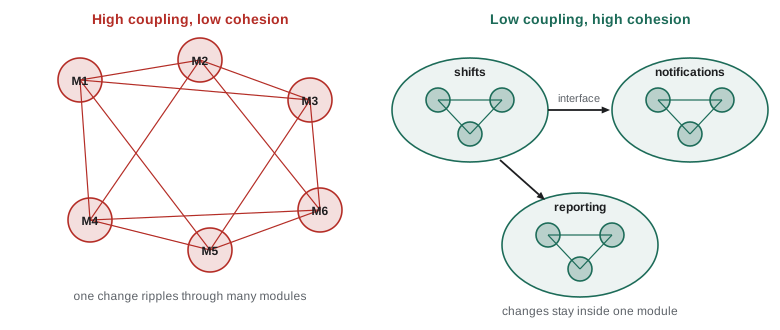
David Parnas's 1972 paper on information hiding gave the reason these principles work. He argued that a system should be decomposed so that each module hides a design decision likely to change, such as a data format, an algorithm or the choice of an external service, behind an interface. When that decision changes, only the module that hides it changes. A notifier interface hides whether reminders go by email, text message or app notification; a repository hides whether shifts are stored in PostgreSQL or SQLite. Python has no enforced private fields, but its conventions (a leading underscore, properties, modules with a small public API listed in __all__) serve the same purpose.
Code smells
Kent Beck and Martin Fowler coined the term code smell for a surface sign that usually indicates a deeper design problem. A smell is not a bug, and not every smell must be removed, but each is worth a second look. Fowler's book Refactoring, first published in 1999 and revised in 2018, catalogs smells and the refactorings that remove them.
| Smell | Symptom | Typical refactoring |
|---|---|---|
| Long function | A function that needs scrolling or comments to separate its sections | Extract function |
| Duplicated code | The same logic in several places | Extract function, pull up method |
| Long parameter list | Functions taking six or more parameters | Introduce parameter object |
| Primitive obsession | Lists and strings standing in for domain concepts | Replace primitive with object (a dataclass) |
| Flag argument (control coupling) | A parameter that switches between behaviors | Split into separate functions |
| Feature envy | A function that uses another object's data more than its own | Move function |
| Shotgun surgery | One change requires edits in many modules | Move related code together |
| Divergent change | One module changes for many unrelated reasons | Split the module |
| Magic numbers | Unexplained literals such as 24 or 0.15 | Replace with a named constant |
| Comments explaining unclear code | A comment says what confusing code does | Rename and extract so the code explains itself |
Refactoring safely
Refactoring is changing the internal structure of code without changing its observable behavior, in small steps, each of which keeps the program working. The safety net is a suite of tests: run them before the change, make one small refactoring, run them again, and commit. If a test fails, the last step was small enough to undo and redo carefully. Refactoring without tests is just editing and hoping. When legacy code has no tests, the first step is to write characterization tests, which record what the code currently does, right or wrong, so that changes in behavior are noticed; Michael Feathers's Working Effectively with Legacy Code is the standard guide.
Here is a function with several smells: a flag argument, primitive lists indexed by number, nested conditions, a hard-coded month, string concatenation, and an error that prints instead of failing. First a characterization test captures its current behavior.
cat test_report.py
pytest -q test_report.py$ cat test_report.py
from report import report
ROWS = [["Ana", "Pantry", "2026-10-03", "3", "attended"],
["Ben", "Pantry", "2026-10-03", "3", "no_show"],
["Chloe", "Delivery", "2026-10-04", "4.5", "attended"],
["Ana", "Delivery", "2026-11-01", "2", "attended"]]
def test_month_report():
assert report(ROWS, "month") == ["Ana Pantry 3", "Chloe Delivery 4.5", "TOTAL 7.5"]
def test_program_report():
assert report(ROWS, "program") == ["Pantry 3.0", "Delivery 6.5"]
$ pytest -q test_report.py
.. [100%]
2 passed in 0.01sdef report(rows, kind):
# rows: list of [name, program, date, hours, status]
out = []
total = 0
if kind == "month":
for r in rows:
if r[4] == "attended":
if r[2][:7] == "2026-10":
total = total + float(r[3])
out.append(r[0] + " " + r[1] + " " + str(r[3]))
out.append("TOTAL " + str(total))
elif kind == "program":
progs = {}
for r in rows:
if r[4] == "attended":
if r[1] in progs:
progs[r[1]] = progs[r[1]] + float(r[3])
else:
progs[r[1]] = float(r[3])
for p in progs:
out.append(p + " " + str(progs[p]))
else:
print("bad kind")
return outThe refactoring proceeds in small steps: introduce a dataclass for a row (replace primitive with object), extract the repeated attended filter, split the flag argument into two functions, make the month a parameter, and use f-strings and a defaultdict. After each step the tests run; at the end the tests are updated to call the new functions, which is the one deliberate change to the interface. The result is shorter and each function has one job.
from collections import defaultdict
from dataclasses import dataclass


@dataclass(frozen=True)
class Attendance:
    name: str
    program: str
    date: str          # ISO date, for example "2026-10-03"
    hours: float
    status: str


def attended(rows: list[Attendance]) -> list[Attendance]:
    return [r for r in rows if r.status == "attended"]


def monthly_lines(rows: list[Attendance], month: str) -> list[str]:
    selected = [r for r in attended(rows) if r.date.startswith(month)]
    lines = [f"{r.name} {r.program} {r.hours:g}" for r in selected]
    lines.append(f"TOTAL {sum(r.hours for r in selected):g}")
    return lines


def hours_by_program(rows: list[Attendance]) -> dict[str, float]:
    totals: dict[str, float] = defaultdict(float)
    for r in attended(rows):
        totals[r.program] += r.hours
return dict(totals)pytest -q test_report.py$ pytest -q test_report.py ... [100%] 3 passed in 0.01s
Look at the third test. Because the month is now a parameter, testing November costs one line; with the hard-coded month, it would have required editing the function. Refactoring that improves testability is often the best evidence that a design improved.
Measuring complexity
Thomas McCabe's cyclomatic complexity, from 1976, counts the number of independent paths through a function: one plus the number of decision points (each if, elif, for, while, and, or, except and similar). A function with complexity 1 has one path; a function with complexity 10 needs at least 10 test cases to exercise every branch, and is harder to understand. A common guideline is to keep functions under 10. Tools compute it automatically. Here flake8 with its McCabe plugin and the Ruff linter report the two versions of the report function.
flake8 --select=C901 --max-complexity=3 report_before.py report_after.py
ruff check --select C901 --config "lint.mccabe.max-complexity=3" --output-format concise report_before.py report_after.py$ flake8 --select=C901 --max-complexity=3 report_before.py report_after.py report_before.py:1:1: C901 'report' is too complex (10) $ ruff check --select C901 --config "lint.mccabe.max-complexity=3" --output-format concise report_before.py report_after.py report_before.py:1:5: C901 `report` is too complex (10 > 3) Found 1 error.
The original function has complexity 10 and is flagged; none of the refactored functions exceeds 3, so neither tool reports them. Complexity is not the whole story: a long sequence of simple statements can still be hard to read, and a dictionary dispatch can hide complexity from the metric. Cognitive complexity, a measure introduced by SonarSource in 2017, weights nested structures more heavily, matching how hard code feels to read. Metrics are useful for finding hotspots, especially when combined with change frequency: a complex file that changes every week is a far better refactoring target than a complex file nobody has touched in years.
Linters, formatters and type checkers
Automated tools catch whole categories of problems before review. A formatter such as Black or Ruff's formatter rewrites code into one consistent style, so reviews never argue about spacing. A linter such as Ruff, flake8 or Pylint flags likely bugs and style violations: unused imports and variables, undefined names, mutable default arguments, comparisons with None using ==, and hundreds more. A static type checker such as mypy or Pyright checks type hints, catching errors such as passing a string where a number is expected, as CMPUT-274 lesson 7 showed. Running all three automatically in the editor and in continuous integration (lesson 11) moves a large share of review comments to the machine.
cat notify.py
ruff check --select F,E711,B006 --output-format concise notify.py
mypy --strict --no-error-summary --no-color-output notify.py$ cat notify.py
import os
import json
def reminders(shifts, sent=[]):
for s in shifts:
if s["volunteer"] == None:
continue
sent.append(s["volunteer"])
return sent
def hours(shift: dict) -> int:
return shift["end"] - shift["start"] + "h"
$ ruff check --select F,E711,B006 --output-format concise notify.py
notify.py:1:8: F401 [*] `os` imported but unused
notify.py:2:8: F401 [*] `json` imported but unused
notify.py:5:28: B006 Do not use mutable data structures for argument defaults
notify.py:7:30: E711 Comparison to `None` should be `cond is None`
Found 4 errors.
[*] 2 fixable with the `--fix` option (2 hidden fixes can be enabled with the `--unsafe-fixes` option).
$ mypy --strict --no-error-summary --no-color-output notify.py
notify.py:5: error: Function is missing a type annotation [no-untyped-def]
notify.py:13: error: Missing type arguments for generic type "dict" [type-arg]
notify.py:14: error: Returning Any from function declared to return "int" [no-any-return]Ruff reports the unused imports, the mutable default argument (a classic Python bug: the same list is shared across calls, so reminders accumulate), and the comparison to None, which should use is. Mypy in strict mode reports the missing type annotations, the unparameterized dict, and that the function returns a value of unknown type (Any) where it promised an int. Neither tool catches that adding a string to a number will fail at run time here, because the dict is untyped; adding precise types, such as a dataclass for the shift, would let mypy catch that too. Tools are complementary to tests and reviews, not replacements.
Naming, comments and readability
Good names are the cheapest documentation. Names should say what something means in the domain (hours_by_program, not proc2 or data), be pronounceable and searchable, and follow the language's conventions, in Python those of PEP 8: snake_case for functions and variables, CapWords for classes, UPPER_CASE for constants. Functions should be named for what they do (send_reminder) and booleans for what they assert (is_full, has_parent_consent).
Comments should explain why, not what. 'Increment i' adds nothing; 'shifts are stored in UTC, so convert before comparing with the volunteer's local reminder time' saves the next reader an hour. When a comment explains what confusing code does, the better fix is usually to rename and extract until the code says it. Docstrings describe a function's contract: what it expects, what it returns and what it raises. Public interfaces deserve them; private helpers with clear names often do not.
Technical debt
Ward Cunningham introduced the technical debt metaphor in 1992: shipping code that is not quite right is like borrowing money. It can be a sensible way to deliver sooner, but the debt accrues interest, paid as extra effort on every later change, until it is repaid by refactoring. Martin Fowler's technical debt quadrant distinguishes debt that is deliberate or inadvertent and prudent or reckless. Deliberate and prudent: 'we must ship for the grant deadline and will clean up the report module next sprint.' Deliberate and reckless: 'we have no time for design.' Inadvertent and prudent: 'now we know how we should have done it.' Inadvertent and reckless: 'what is layering?'
| Reckless | Prudent | |
|---|---|---|
| Deliberate | "We don't have time for design." | "We must ship now and will deal with the consequences." |
| Inadvertent | "What's layering?" | "Now we know how we should have done it." |
Healthy teams make debt visible, as backlog items with an estimate of the interest it charges, and pay it down continuously rather than in rare 'rewrite' projects, which carry high risk. A practical rule from the Boy Scouts, popularized by Robert Martin, is to leave the code a little better than you found it: rename a confusing variable or extract a function as part of every change you make to that area.
Worked problem
Spotting coupling and fixing it
A function send_reminder(volunteer) takes a Volunteer object with 25 fields, reads volunteer.email and volunteer.preferences["sms"], formats a message using a global TIMEZONE setting, and calls smtplib directly. Identify the coupling problems and suggest improvements.
Show solution
- Stamp coupling: it receives a whole volunteer record but uses two fields. Pass what it needs (email, prefers_sms) or a small value object.
- Common coupling: the global TIMEZONE makes behavior depend on hidden state. Pass the time zone, or store times with zones attached.
- Hidden dependency on smtplib couples it to one delivery mechanism and makes testing require a mail server. Depend on a Notifier interface and inject an implementation (email, text or a test fake).
- After the change, the function can be unit-tested with a fake notifier and fixed values, and switching to a new email provider touches only one adapter.
Answer: Narrow the parameters to data coupling, remove the global, and hide the delivery mechanism behind an interface. Each change reduces what send_reminder knows about the rest of the system.
Worked problem
Paying down a hotspot
Version-control history shows that scheduling.py has been changed in 41 of the last 60 commits and has three functions with complexity above 15. Nearly every bug fix in the last two months touched it. How should the team approach it?
Show solution
- Confirm it is a hotspot: high change frequency combined with high complexity, plus defects, makes it the best place to invest.
- Write characterization tests for the most-changed functions, aiming at the behaviors that recent bugs involved.
- Refactor in small, tested steps: extract functions, introduce domain types, split flag arguments, and move unrelated responsibilities into their own modules.
- Track the effect: complexity of the hot functions, defects found in the file, and time to make changes there.
Answer: Combine change frequency with complexity to choose targets, protect behavior with tests, refactor incrementally and measure the result. A big rewrite would be riskier and slower.
Common mistakes
MistakeRefactoring without tests.
InsteadWrite characterization tests first, then change structure in small steps, running the tests after each.
MistakeMixing refactoring with behavior changes in one commit.
InsteadKeep refactoring commits separate from feature or bug-fix commits so reviews and rollbacks stay simple.
MistakeTreating metrics such as complexity as targets.
InsteadUse them to find hotspots, combined with change frequency and defects, not as goals to game.
MistakeWriting comments that restate the code.
InsteadExplain why; rename and extract until the code explains what.
MistakeLetting technical debt stay invisible.
InsteadRecord debt as backlog items with its cost, and pay it down continuously.
Summary and key terms
- Good detailed design has low coupling between modules and high cohesion within them.
- Information hiding (Parnas) puts each design decision likely to change behind an interface.
- Code smells such as long functions, duplication, flag arguments and primitive obsession point to design problems.
- Refactoring changes structure without changing behavior, in small steps protected by tests; characterization tests protect legacy code.
- Cyclomatic complexity counts independent paths; combined with change frequency it identifies refactoring hotspots.
- Formatters, linters and type checkers automate style and catch whole classes of defects.
- Technical debt accrues interest on every change; make it visible and repay it continuously.
- Coupling
- The degree to which one module depends on others.
- Cohesion
- The degree to which the elements of a module belong together.
- Information hiding
- Hiding a design decision likely to change behind a stable interface.
- Code smell
- A surface sign in code that usually indicates a deeper design problem.
- Refactoring
- Changing code structure without changing its observable behavior.
- Characterization test
- A test that records what existing code currently does, to protect it during change.
- Cyclomatic complexity
- The number of linearly independent paths through a function.
- Linter
- A tool that flags likely bugs and style violations in source code.
- Static type checker
- A tool that checks type annotations without running the program.
- Technical debt
- The future cost of rework incurred by choosing an expedient solution now.
Practice problems
Work each problem on paper first, then reveal the answer to check.
Classify the coupling: a function takes a boolean is_admin that switches between two completely different behaviors.
Show answer
Control coupling; split into two functions.
What is the cyclomatic complexity of a function with one if, one elif and one for loop?
Show answer
1 + 3 = 4.
Give a refactoring for each smell: magic number 24; six-parameter function; feature envy.
Show answer
Replace with named constant (CANCEL_CUTOFF_HOURS); introduce parameter object; move function to the class whose data it uses.
Why is def f(items=[]) a bug in Python?
Show answer
The default list is created once and shared across calls, so mutations accumulate between calls.
What is the first step before refactoring untested legacy code?
Show answer
Write characterization tests that capture its current behavior.
Name the four quadrants of Fowler's technical debt model.
Show answer
Deliberate–reckless, deliberate–prudent, inadvertent–reckless, inadvertent–prudent.
Why does a formatter reduce review effort?
Show answer
It makes style automatic and consistent, so reviewers focus on design and correctness.
Which decision might a notifier module hide, in Parnas's sense?
Show answer
Which delivery channel and provider are used (email, text, push), and their protocols.
A utils.py module contains date formatting, password hashing and CSV export. What kind of cohesion is this, and what would you do?
Show answer
Coincidental cohesion; move each function into the module for its own concern.
Why combine complexity with change frequency when choosing what to refactor?
Show answer
Complex code that rarely changes costs little; complex code that changes often charges interest on every change.
Lesson quiz · 5 questions
Score 60% or more to complete this lesson.
Create a free account to save your progress, take quizzes and earn a certificate.