
CMP-340 · Lesson 11 of 12 · 33 min
Continuous integration, delivery and DevOps
Writing and testing code is only part of delivering software. The change must be combined with everyone else's work, built, checked, packaged, deployed to servers or app stores, watched in production, and rolled back if something goes wrong. When these steps are manual and infrequent, each release is large, risky and stressful; teams that release quarterly often spend weeks integrating and stabilizing. Continuous integration, continuous delivery and DevOps practices automate the path from commit to production so that releases become small, frequent and routine. This lesson covers continuous integration and build pipelines, continuous delivery and deployment strategies, feature flags, infrastructure as code, monitoring and incident response, the DORA metrics, and software supply-chain security. Lesson 2 introduced DevOps as a process; here are its practices.
Continuous integration
Continuous integration (CI), named by Grady Booch and made a core practice by Extreme Programming, means that every developer integrates their work into the shared main branch frequently, at least daily, and each integration is verified by an automated build that runs the tests. The point is to find integration problems within minutes, when the change is small and fresh in its author's mind, rather than weeks later. Martin Fowler's description lists the essential practices: keep a single source repository, automate the build, make the build self-testing, everyone commits to main every day, every commit triggers a build on an integration machine, fix broken builds immediately, keep the build fast, and make it easy for anyone to get the latest executable.
A CI server such as GitHub Actions, GitLab CI, Jenkins or Buildkite watches the repository and runs a pipeline on every push and pull request. A pipeline is a sequence of stages, each of which must pass before the next runs: typically checking out the code, installing dependencies, linting and formatting checks, type checking, unit tests, building artifacts, integration tests and security scans. Branch protection rules then prevent merging a pull request unless the pipeline passes. The most important cultural rule is that a broken main branch is everyone's top priority: if it stays red, people stop trusting it, merge on top of failures, and the benefit disappears.
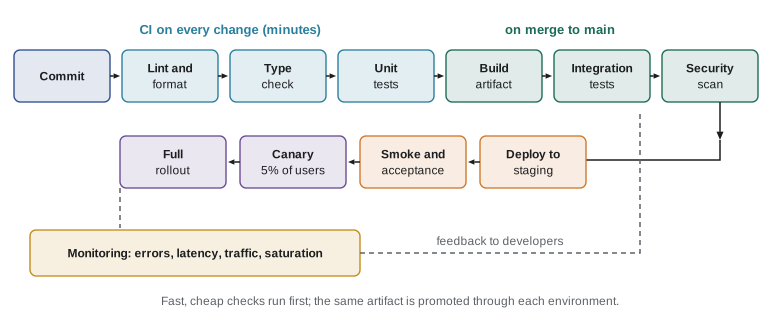
Pipelines order stages from fast and cheap to slow and expensive, so that most problems are caught in the first minute. A common target is that the commit stage, which developers wait for, finishes within about ten minutes. The configuration lives in the repository as code, so it is versioned and reviewed like everything else. The first listing below is a GitHub Actions workflow; it cannot be run here, because it runs on GitHub's servers. The second is the same checks as a local script, which really was run against a small project, so developers can reproduce a CI failure on their own machines.
# .github/workflows/ci.yml  (GitHub Actions; runs on GitHub's servers, shown as a listing)
name: ci
on:
  push:
    branches: [main]
  pull_request:
jobs:
  check:
    runs-on: ubuntu-latest
    strategy:
      matrix:
        python-version: ["3.12", "3.13"]
    steps:
      - uses: actions/checkout@v4
      - uses: actions/setup-python@v5
        with:
          python-version: ${{ matrix.python-version }}
          cache: pip
      - run: pip install -r requirements-dev.txt
      - run: ruff check --select F,E,B .
      - run: ruff format --check .
      - run: mypy --strict .
      - run: pytest -q --junitxml=results.xml
      - uses: actions/upload-artifact@v4
        if: always()
        with:
          name: test-results-${{ matrix.python-version }}
path: results.xmlcat ci.sh
bash ci.sh$ cat ci.sh #!/usr/bin/env bash # ci.sh: the same checks the CI server runs, so developers can run them locally set -euo pipefail echo "== lint"; ruff check --select F,E,B . echo "== format"; ruff format --check . echo "== types"; mypy --strict --no-error-summary . echo "== tests"; pytest -q echo "all checks passed" $ bash ci.sh == lint All checks passed! == format 2 files already formatted == types == tests . [100%] 1 passed in 0.01s all checks passed
bash ci.sh$ bash ci.sh == lint F841 Local variable `unused` is assigned to but never used --> shifts.py:13:9 | 11 | self.confirmed += 1 12 | return "confirmed" 13 | unused = 1 | ^^^^^^ 14 | return "waitlisted" | help: Remove assignment to unused variable `unused` Found 1 error. No fixes available (1 hidden fix can be enabled with the `--unsafe-fixes` option).
The second run shows a principle worth copying: the script stops at the first failing stage (set -e), reports exactly what failed, and never runs the slower stages on code that is already known to be wrong. In a real pipeline, the developer sees the same message in the pull request within a minute or two.
Builds and artifacts
A build turns source code into something deployable: a Python wheel, a container image, a compiled binary, a mobile app bundle. Good builds are automated (one command), repeatable (the same inputs give the same outputs, which requires pinning dependency versions in a lock file), and fast (caching dependencies and test results). The output of the build is an artifact, which should be built once and promoted unchanged through test, staging and production environments, configured for each by environment variables rather than rebuilt. Rebuilding for production risks deploying something different from what was tested. Container images, usually built from a Dockerfile and stored in a registry, have become the standard artifact for server software because they package the application with its operating-system dependencies.
Continuous delivery and continuous deployment
Continuous delivery, described by Jez Humble and David Farley in their 2010 book of that name, extends CI so that every change that passes the pipeline is releasable: it has been built, tested in a production-like environment and could be deployed at the push of a button. Continuous deployment goes one step further and deploys every passing change to production automatically, with no manual approval. Continuous delivery suits organizations that need a business decision or regulatory approval for each release, such as app store submissions or medical software; continuous deployment suits web services where small, frequent releases are low risk. Both depend on a reliable automated test suite, because the pipeline, not a release manager, decides what is safe.
| Strategy | How it works | Benefit | Cost |
|---|---|---|---|
| Recreate (big bang) | Stop the old version, start the new one | Simple | Downtime; rollback is a full redeploy |
| Rolling | Replace instances a few at a time | No downtime | Two versions run at once during the rollout |
| Blue–green | Run the new version alongside the old, then switch traffic | Instant switch and instant rollback | Double the infrastructure during the switch |
| Canary | Send a small percentage of traffic to the new version, watch metrics, then widen | Limits the impact of a bad release | Needs good monitoring and automated analysis |
| Feature flags | Deploy code turned off; enable it separately for chosen users | Separates deploying from releasing | Flag debt; more code paths to test |
Canary releases, named after the canaries miners once carried to detect gas, deserve emphasis after lesson 1's CrowdStrike example: sending a new version to a few percent of users first, and comparing its error rate and latency with the old version, limits how many people a bad release can hurt. The comparison should be statistical rather than by eye, because small samples are noisy.
import math

def canary_check(base_req, base_err, can_req, can_err, z_limit=3.0):
    """Two-proportion z-test: is the canary's error rate significantly higher?"""
    p1, p2 = base_err / base_req, can_err / can_req
    pooled = (base_err + can_err) / (base_req + can_req)
    se = math.sqrt(pooled * (1 - pooled) * (1 / base_req + 1 / can_req))
    z = (p2 - p1) / se if se else 0.0
    verdict = "ROLL BACK" if z > z_limit else "continue"
    return f"baseline {p1:.3%}, canary {p2:.3%}, z = {z:5.2f} -> {verdict}"

# 95% of traffic on the old version, 5% on the canary, over the same 10 minutes
print(canary_check(base_req=95_000, base_err=190, can_req=5_000, can_err=12))
print(canary_check(base_req=95_000, base_err=190, can_req=5_000, can_err=31))baseline 0.200%, canary 0.240%, z = 0.61 -> continue baseline 0.200%, canary 0.620%, z = 6.16 -> ROLL BACK
Feature flags
A feature flag (or toggle) is a condition in the code that turns a feature on or off at run time, controlled by configuration rather than by a new deployment. Flags separate deploying code from releasing a feature: unfinished work can be merged to main and deployed while switched off, which makes trunk-based development (lesson 8) possible; a feature can be released gradually to a percentage of users, to a pilot group such as one food bank location, or to staff first; and a misbehaving feature can be switched off in seconds. Percentage rollouts should be sticky, so each user sees the same choice every time, which is usually achieved by hashing the user's identifier.
import hashlib

FLAGS = {"shift_swaps": {"enabled": True, "percent": 20, "allow": {"coordinator@example.org"}}}

def is_enabled(flag, user_id):
    cfg = FLAGS.get(flag)
    if not cfg or not cfg["enabled"]:
        return False
    if user_id in cfg["allow"]:
        return True
    digest = hashlib.sha256(f"{flag}:{user_id}".encode()).hexdigest()
    bucket = int(digest[:8], 16) % 100          # a stable bucket from 0 to 99 for each user
    return bucket < cfg["percent"]

users = [f"volunteer{i}@example.org" for i in range(1000)]
on = sum(is_enabled("shift_swaps", u) for u in users)
print(f"{on} of {len(users)} users see shift swaps (target 20%)")
print("same answer every time:", all(is_enabled("shift_swaps", u) == is_enabled("shift_swaps", u)
                                     for u in users))
print("coordinator always sees it:", is_enabled("shift_swaps", "coordinator@example.org"))184 of 1000 users see shift swaps (target 20%) same answer every time: True coordinator always sees it: True
Flags carry a cost: every flag doubles the paths through the affected code, and old flags left in place become technical debt and occasionally cause incidents. The Knight Capital loss in lesson 1 involved an old flag reused for a new purpose. Teams therefore give each flag an owner and an expiry date, and remove release flags once a feature is fully rolled out.
Infrastructure as code
Infrastructure as code (IaC) describes servers, networks, databases, load balancers and their configuration in version-controlled files, applied by tools such as Terraform or OpenTofu, AWS CloudFormation, Pulumi, Ansible and, for containers, Kubernetes manifests. Instead of an administrator clicking through a console, the desired state is written down, reviewed in pull requests, tested and applied automatically, so environments can be recreated exactly and differences between staging and production disappear. The same discipline applies to configuration: the twelve-factor app methodology recommends keeping configuration in environment variables, separate from code, and keeping development, staging and production as similar as possible.
Monitoring, observability and incidents
Once software is in production, the team needs to know whether it is working. Monitoring watches known indicators and alerts when they cross thresholds. Observability is the broader ability to understand a system's internal state from its outputs, especially to answer questions nobody anticipated. It rests on three kinds of telemetry: metrics (numbers over time, such as request rate, error rate and latency percentiles), logs (timestamped records of events, best written as structured key–value data) and traces (the path of one request through many services). OpenTelemetry has become the standard for collecting all three. Google's site reliability engineering (SRE) practice recommends watching four golden signals for every service: latency, traffic, errors and saturation.
SRE also introduced service level objectives and error budgets. A service level indicator (SLI) is a measured quantity, such as the proportion of requests that succeed within 300 milliseconds. A service level objective (SLO) is a target for it, such as 99.9 percent over 30 days. The error budget is what the SLO allows to fail: 0.1 percent of requests, or about 43 minutes of full downtime in 30 days. While budget remains, the team ships features freely; when it is spent, the team slows releases and works on reliability. The budget turns the old argument between speed and stability into an agreed, measurable rule.
# Error budget for a 30-day SLO, and how much of it has been spent
slo = 0.999
days = 30
total_requests = 4_200_000
failed_requests = 2_730
budget = (1 - slo) * total_requests
minutes = (1 - slo) * days * 24 * 60
print(f"SLO {slo:.1%}: budget of {budget:,.0f} failed requests "
      f"(about {minutes:.0f} minutes of total downtime) per {days} days")
spent = failed_requests / budget
print(f"failed so far: {failed_requests:,} = {spent:.0%} of the budget")
print("policy:", "freeze risky releases, prioritize reliability" if spent >= 1
      else "slow down and review recent changes" if spent >= 0.5
else "ship normally")SLO 99.9%: budget of 4,200 failed requests (about 43 minutes of total downtime) per 30 days failed so far: 2,730 = 65% of the budget policy: slow down and review recent changes
When something does go wrong, a clear incident process helps: someone takes the incident commander role and coordinates, others investigate, a communications lead keeps users informed, and the first priority is to restore service, often by rolling back or switching off a feature flag, before diagnosing the root cause. Afterwards, a blameless post-incident review asks how the system and process allowed the failure and what will prevent it, rather than who made the mistake. Blame teaches people to hide problems; blameless reviews, standard practice at Google, Etsy and many others, surface the latent conditions that cause the next incident.
Measuring delivery: the DORA metrics
The DevOps Research and Assessment (DORA) program, founded by Nicole Forsgren, Jez Humble and Gene Kim and described in the 2018 book Accelerate, identified four key metrics of software delivery performance: deployment frequency (how often the team deploys to production), lead time for changes (from commit to running in production), change failure rate (the percentage of deployments that cause a failure needing remediation), and time to restore service after a failure. In 2024 DORA added a fifth, rework rate (the share of deployments that are unplanned fixes), and grouped the metrics into throughput and instability measures. The 2025 report, renamed The State of AI-assisted Software Development, replaced its familiar low, medium, high and elite clusters with team archetypes based on a wider set of measures, including product performance, friction and burnout. The enduring finding is that throughput and stability go together: the teams that deploy most often also fail least and recover fastest, because small, automated, well-tested changes are both quicker and safer.
from datetime import datetime as dt, timedelta
from statistics import median

# One month of production deployments: (deployed_at, oldest commit included, caused_failure, restored_at)
deploys = [
    (dt(2026, 10, 1, 10), dt(2026, 9, 30, 15), False, None),
    (dt(2026, 10, 2, 14), dt(2026, 10, 2, 9), False, None),
    (dt(2026, 10, 5, 11), dt(2026, 10, 2, 16), True, dt(2026, 10, 5, 11, 40)),
    (dt(2026, 10, 7, 9), dt(2026, 10, 6, 13), False, None),
    (dt(2026, 10, 9, 16), dt(2026, 10, 8, 10), False, None),
    (dt(2026, 10, 14, 10), dt(2026, 10, 9, 17), False, None),
    (dt(2026, 10, 15, 15), dt(2026, 10, 15, 11), False, None),
    (dt(2026, 10, 20, 13), dt(2026, 10, 16, 9), True, dt(2026, 10, 20, 15, 5)),
    (dt(2026, 10, 22, 10), dt(2026, 10, 21, 14), False, None),
    (dt(2026, 10, 27, 11), dt(2026, 10, 23, 15), False, None),
]
weeks = 4
lead = [(d - c) / timedelta(hours=1) for d, c, _, _ in deploys]
fails = [(r - d) / timedelta(minutes=1) for d, _, f, r in deploys if f]
print(f"deployment frequency : {len(deploys) / weeks:.1f} per week")
print(f"lead time for changes: median {median(lead):.0f} hours")
print(f"change failure rate  : {len(fails) / len(deploys):.0%}")
print(f"time to restore : median {median(fails):.0f} minutes")deployment frequency : 2.5 per week lead time for changes: median 25 hours change failure rate : 20% time to restore : median 82 minutes
Like velocity in lesson 4, these metrics are for a team to understand and improve its own system, not for ranking teams or individuals. Used as targets, they invite gaming: splitting deployments to raise frequency, or classifying failures to lower the failure rate.
Software supply-chain security
Modern applications are mostly other people's code: a typical web application depends directly and indirectly on hundreds of open-source packages, and its build runs on third-party servers using third-party actions and images. Attackers have noticed. The 2020 SolarWinds attack inserted malicious code into a vendor's build system and reached thousands of customers through a signed update; the 2021 Log4Shell vulnerability in the ubiquitous Log4j library forced emergency patching worldwide; and the 2024 XZ Utils backdoor, planted over two years by an attacker who gained a maintainer's trust, was caught by chance days before it would have shipped in major Linux distributions. Defenses include pinning dependency versions in lock files and verifying their hashes, scanning dependencies for known vulnerabilities (Dependabot, pip-audit, OSV-Scanner) and keeping them updated, generating a software bill of materials (SBOM) in a standard format such as SPDX or CycloneDX that lists every component, signing artifacts (for example with Sigstore), and hardening the build itself, as described by the SLSA (Supply-chain Levels for Software Artifacts) framework.
Regulation is following. The European Union's Cyber Resilience Act applies to software sold in the EU, including by American companies: manufacturers must report actively exploited vulnerabilities and severe incidents from 11 September 2026, and most other obligations, including secure-by-design requirements, vulnerability handling and documentation of components, apply from 11 December 2027. In the United States, Executive Order 14028 of 2021 led federal agencies to require software suppliers to attest that they follow the NIST Secure Software Development Framework (SSDF) and to encourage SBOMs, and CISA's Secure by Design initiative asks vendors to take ownership of customers' security outcomes. CISSP-113 and CMPUT-331 cover these requirements in more depth; check current federal guidance, which has been revised several times.
Worked problem
Designing a pipeline
The volunteer scheduling team (three developers, a modular monolith on one server, PostgreSQL) currently deploys by copying files over SSH every few weeks, and the last two deployments broke sign-ups for an afternoon. Design a pipeline and release process.
Show solution
- Commit stage on every pull request: ruff, format check, mypy and unit tests in under five minutes; branch protection requires it to pass plus one review.
- On merge to main: build a container image once, tag it with the commit hash, run integration tests against a real PostgreSQL in a container, run dependency scanning and generate an SBOM.
- Deploy the same image automatically to a staging environment with production-like data (anonymized) and run a handful of end-to-end smoke tests, including the sign-up journey.
- Release to production with a button (continuous delivery), using a blue–green switch so rollback is instant; database migrations are written to be backward compatible so the old version still works during the switch.
- Put new features such as shift swaps behind flags; monitor error rate and latency of sign-ups with an alert, and hold a short blameless review after any incident.
Answer: A fast commit stage, one immutable artifact promoted through environments, automated integration and smoke tests, blue–green releases with backward-compatible migrations, feature flags and monitoring. Releases become small and safe enough to do weekly or daily.
Common mistakes
MistakeRebuilding the application separately for each environment.
InsteadBuild one artifact once and promote it unchanged, configuring each environment with environment variables.
MistakeLeaving the main branch broken.
InsteadFixing a red build is the team's top priority; otherwise CI loses its value.
MistakeShipping every release to all users at once.
InsteadUse canaries, staged rollouts or feature flags so a bad release reaches few users and can be stopped quickly.
MistakeKeeping feature flags forever.
InsteadGive each flag an owner and expiry date and remove it after rollout.
MistakeBlaming individuals after incidents.
InsteadHold blameless reviews focused on the conditions that allowed the failure, so problems are reported rather than hidden.
Summary and key terms
- Continuous integration merges small changes to main at least daily, each verified by an automated, self-testing build; a broken build is fixed immediately.
- Pipelines order checks from fast to slow, live in the repository as code, and produce one immutable artifact promoted through environments.
- Continuous delivery keeps every passing change releasable; continuous deployment releases it automatically.
- Rolling, blue–green and canary deployments and feature flags reduce release risk; canary analysis should be statistical.
- Infrastructure as code makes environments reproducible and reviewable.
- Observability rests on metrics, logs and traces; SLOs and error budgets make reliability a measurable policy, and incidents are followed by blameless reviews.
- DORA metrics (deployment frequency, lead time, change failure rate, time to restore, and since 2024 rework rate) show that speed and stability go together; supply-chain security protects the dependencies and build.
- Continuous integration
- Frequently merging changes into a shared main branch, each verified by an automated build and tests.
- Pipeline
- An automated sequence of stages that builds, tests and deploys software.
- Artifact
- The deployable output of a build, such as a container image or package.
- Continuous delivery
- Keeping every change that passes the pipeline ready to release at any time.
- Continuous deployment
- Automatically releasing every change that passes the pipeline to production.
- Canary release
- Releasing a new version to a small share of traffic first and comparing its health with the old version.
- Feature flag
- A run-time switch that enables or disables a feature without redeploying.
- Infrastructure as code
- Defining infrastructure in version-controlled files applied by automated tools.
- Service level objective
- A target value for a measured service level indicator over a period.
- Software bill of materials
- A machine-readable inventory of the components in a piece of software.
Practice problems
Work each problem on paper first, then reveal the answer to check.
List five stages of a typical CI pipeline in order.
Show answer
Checkout and install; lint and format; type check; unit tests; build artifact; integration tests; security scan.
What is the difference between continuous delivery and continuous deployment?
Show answer
Delivery keeps every passing change releasable with a manual decision to release; deployment releases automatically.
Why build an artifact once and promote it?
Show answer
So production runs exactly what was tested; rebuilding can introduce differences.
A 99.95 percent monthly SLO allows how many minutes of downtime in 30 days?
Show answer
0.0005 x 43,200 minutes, about 21.6 minutes.
Give two ways feature flags help trunk-based development.
Show answer
Unfinished work can be merged and deployed while switched off; features can be released gradually and turned off quickly.
Why should percentage rollouts be sticky?
Show answer
So each user consistently sees the same behavior, avoiding confusing switches between versions.
What are the four golden signals?
Show answer
Latency, traffic, errors and saturation.
Name the original four DORA metrics.
Show answer
Deployment frequency, lead time for changes, change failure rate and time to restore service.
Name three defenses against software supply-chain attacks.
Show answer
Lock files with hashes, dependency vulnerability scanning, SBOMs, signed artifacts, hardened builds (SLSA).
What makes a post-incident review blameless?
Show answer
It focuses on how the system and process allowed the failure and how to prevent recurrence, not on punishing individuals.
Lesson quiz · 5 questions
Score 60% or more to complete this lesson.
Create a free account to save your progress, take quizzes and earn a certificate.