
CMP-200 · Lesson 9 of 12 · 21 min
Heaps and priority queues
A queue serves items in the order they arrived. Many problems instead need the most urgent item first, whatever order the items arrived in: an operating system runs the highest-priority ready task, a network router sends voice packets before bulk downloads, a simulation processes the earliest scheduled event next, and a hospital emergency room sees the most serious case first. The abstract data type for this is the priority queue, which supports inserting an item with a priority and removing the item with the highest priority, or equivalently the smallest key. The standard implementation is the binary heap, a complete binary tree stored in an array, which makes both operations O(log n) and finding the minimum O(1). Heaps are also the basis of heapsort, of the top-k selection that analysts use every day, and of the shortest-path algorithms in later courses.
Jonah meets two priority queues at once. On the NS-4, the modem can send only one message at a time, and several kinds of message compete for it: alarms, such as an open cabinet door, must go first; scheduled count reports next; and bulk uploads of raw records whenever the link is otherwise idle. Within each class, older messages go before newer ones. On the server, the morning report lists the 100 highest speeds recorded across all nodes the previous day, out of roughly 30 million records, and the first version sorted all 30 million records to find them.
The heap property
A binary min-heap is a complete binary tree in which every node's key is less than or equal to the keys of its children. Applied at every node, this heap-order property means the smallest key in the heap is always at the root. A max-heap reverses the comparison, keeping the largest key at the root. Note what the heap property does not say: there is no ordering between siblings or between the left and right subtrees, so a heap is far less ordered than a binary search tree. That looseness is exactly what makes it cheap to maintain. A heap answers only one question quickly, which item is smallest, but answers it in constant time and updates in logarithmic time.
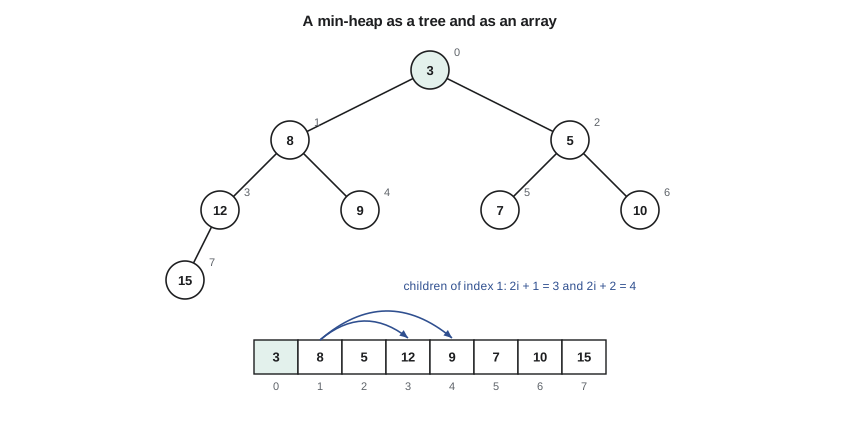
Because a heap is a complete binary tree, it is stored in an array exactly as lesson 7 described: the root at index 0, then each level from left to right, with the children of index i at 2i + 1 and 2i + 2 and its parent at ⌊(i − 1)/2⌋. There are no pointers, no wasted slots and no balancing to worry about: a complete tree of n nodes always has height ⌊log₂ n⌋. A heap of a million items has height 19. This compact array layout is also cache-friendly near the top of the tree, which is where most operations spend their time.
Insert: sift up
To insert a key, place it in the next free position, at the end of the array, which keeps the tree complete. The new key may be smaller than its parent, breaking the heap property, so compare it with its parent and swap if it is smaller; repeat from its new position until it is no smaller than its parent or it reaches the root. This is called sift-up, or bubble-up. Each swap moves the key one level up, so at most height swaps are needed: O(log n). On average, for random keys, insertion is even cheaper, about a constant number of swaps, because most new keys belong near the bottom.
Remove the minimum: sift down
The minimum is at the root, so reading it is O(1). Removing it leaves a hole at the top. Move the last element of the array into the root, which keeps the tree complete, then restore the heap property by sift-down: compare the key with its two children; if it is larger than the smaller child, swap with that child; repeat from the child's position until the key is no larger than either child or it reaches a leaf. Swapping with the smaller child is essential, because that child becomes the parent of the other and must not be larger than it. Each step moves down one level, so removing the minimum costs O(log n).
Worked problem
Removing the minimum
The heap in the figure is stored as [3, 8, 5, 12, 9, 7, 10, 15]. Remove the minimum and show the array after each step of sift-down.
Show solution
- Remove 3 from the root and move the last element, 15, into index 0: [15, 8, 5, 12, 9, 7, 10].
- Index 0 has children 8 (index 1) and 5 (index 2). The smaller is 5, and 15 > 5, so swap: [5, 8, 15, 12, 9, 7, 10].
- Index 2 now holds 15, with children at indexes 5 and 6: 7 and 10. The smaller is 7, and 15 > 7, so swap: [5, 8, 7, 12, 9, 15, 10].
- Index 5 has children at 11 and 12, beyond the end of the array, so it is a leaf and sift-down stops.
- \[\text{swaps} = 2 \le \lfloor \log_2 7 \rfloor = 2\]
Answer: The minimum 3 is returned and the heap becomes [5, 8, 7, 12, 9, 15, 10], with the new minimum 5 at the root after two swaps.
# NS-4 modem queue: priority by message class, then by age (sequence number)
import heapq

ALARM, REPORT, BULK = 0, 1, 2          # smaller number = more urgent
queue, seq = [], 0

def submit(cls, text):
    global seq
    heapq.heappush(queue, (cls, seq, text))   # ties on class are broken by age
    seq += 1

submit(BULK, "raw records 09:00-09:05")
submit(REPORT, "15-min counts 09:00")
submit(BULK, "raw records 09:05-09:10")
submit(ALARM, "cabinet door opened")
submit(REPORT, "15-min counts 09:15")
submit(ALARM, "loop 2 open circuit")

print("heap array:", [m[1] for m in queue])
while queue:
    cls, s, text = heapq.heappop(queue)
print(f"send class {cls} (#{s}): {text}")heap array: [3, 1, 5, 0, 4, 2] send class 0 (#3): cabinet door opened send class 0 (#5): loop 2 open circuit send class 1 (#1): 15-min counts 09:00 send class 1 (#4): 15-min counts 09:15 send class 2 (#0): raw records 09:00-09:05 send class 2 (#2): raw records 09:05-09:10
Python's heapq module implements a binary min-heap on an ordinary list, with heappush and heappop doing sift-up and sift-down. Storing tuples makes the comparison work on the first field, the class, and break ties with the second, a sequence number that grows with each submission, so older messages of the same class go first. The sequence number also guarantees that two entries never compare equal on both fields, so Python never tries to compare the message texts. The printed heap array shows that the list is not sorted, only heap-ordered; the messages nonetheless come out in exactly the required order. On the NS-4 itself, the same queue is a fixed array of 16 message descriptors with hand-written sift-up and sift-down, about 40 lines of C.
Building a heap in linear time
Sometimes all the items are available at once, and the heap must be built from an unordered array. Inserting them one at a time costs O(n log n). A cleverer method, due to Robert Floyd, does it in O(n): treat the array as a complete tree, and call sift-down on every internal node, starting from the last one, at index ⌊n/2⌋ − 1, and working backwards to the root. Each sift-down makes the subtree rooted at that node a valid heap, because its children's subtrees are already heaps. The total cost is linear because most nodes are near the bottom: half the nodes are leaves and need no work, a quarter can move down at most one level, an eighth at most two, and so on.
Top-k selection
The morning report needs the 100 highest speeds out of 30 million. Sorting everything costs O(n log n), about 30 million × 25 comparisons, and needs all 30 million values in memory at once. A heap does better. Keep a min-heap of the k largest values seen so far. For each new value, if the heap holds fewer than k items, push it; otherwise compare it with the heap's minimum, the smallest of the current top k, and if the new value is larger, replace the minimum with it and sift down. Each value costs O(log k), so the total is O(n log k), and the memory is only k items. With k = 100, log₂ k is about 7, so the work drops by a factor of three or four compared with sorting, and the data can be streamed from the database without ever being held in memory.
# Top-k speeds from a stream with a size-k min-heap, counting comparisons
import heapq, math, random

random.seed(11)
n, k = 300_000, 100
speeds = (round(random.gauss(92, 14), 1) for _ in range(n))   # km/h, streamed

top = []
for s in speeds:
    if len(top) < k:
        heapq.heappush(top, s)
    elif s > top[0]:                       # larger than the smallest of the top k
        heapq.heapreplace(top, s)          # pop the minimum and push s in one sift-down

best = sorted(top, reverse=True)
print("highest five:", best[:5])
print(f"100th highest: {best[-1]}")
print(f"heap approach ~ n log2 k = {n * math.log2(k):,.0f} steps at most; "
f"full sort ~ n log2 n = {n * math.log2(n):,.0f}")highest five: [153.9, 151.8, 150.9, 150.7, 150.0] 100th highest: 139.2 heap approach ~ n log2 k = 1,993,157 steps at most; full sort ~ n log2 n = 5,458,381
In practice the heap approach is faster still than the estimate, because most values in a stream are smaller than the current 100th highest and are rejected by a single comparison with the root, without touching the heap. The same pattern finds the k nearest nodes to a breakdown, the k busiest intersections or the k most recent alarms. Python's heapq.nlargest uses this technique internally. For finding only the median, or any single order statistic, the quickselect algorithm in later courses does it in O(n) average time.
Heapsort and other uses
A heap also gives a sorting algorithm. Build a max-heap from the array in O(n); then repeatedly swap the root, the largest remaining item, with the last item of the heap, shrink the heap by one and sift the new root down. After n − 1 steps the array is sorted in ascending order. Heapsort costs O(n log n) in the worst case and sorts in place with only a constant amount of extra memory, which makes it attractive in embedded and real-time systems where both a guaranteed bound and a fixed memory footprint matter. Its weakness is cache behavior: sift-down jumps between distant array positions, so in practice it is usually slower than quicksort and merge sort, the subject of lesson 11. Many library sort routines use heapsort as a fallback when quicksort's recursion becomes too deep, a combination called introsort.
Beyond sorting, priority queues appear wherever events must be processed in time order. Operating system timers keep pending timeouts in a heap keyed by expiry time, so the next one to fire is always at the root. Discrete-event simulators, which Northway uses to model how a new signal timing plan will affect queues at an intersection, keep future events in a heap. Dijkstra's shortest-path algorithm and Prim's minimum-spanning-tree algorithm, covered in CMP-301, both depend on a priority queue for their efficiency. When items' priorities must change while they are in the queue, an indexed heap keeps a separate table of each item's position so that its key can be decreased and sifted up in O(log n).
| Operation | Binary heap | Sorted array | Unsorted array | Balanced BST |
|---|---|---|---|---|
| Find the minimum | O(1) | O(1) | O(n) | O(log n) |
| Insert | O(log n) | O(n) | O(1) amortized | O(log n) |
| Remove the minimum | O(log n) | O(1) from the right end | O(n) | O(log n) |
| Build from n items | O(n) | O(n log n) | O(n) | O(n log n) |
| Search for any key | O(n) | O(log n) | O(n) | O(log n) |
| Memory overhead | None | None | None | Two pointers per node |
Common mistakes
MistakeAssuming a heap's array is sorted.
InsteadOnly the heap property holds: each parent is no larger than its children. Siblings and subtrees are unordered.
MistakeSwapping with either child during sift-down.
InsteadAlways swap with the smaller child in a min-heap, or the child that is larger would end up below a smaller sibling's parent.
MistakeBuilding a heap by n separate insertions when all items are available.
InsteadUse bottom-up heap construction, which is O(n) instead of O(n log n).
MistakeSorting the whole data set to find the top k items.
InsteadKeep a min-heap of size k: O(n log k) time and O(k) memory, and the data can be streamed.
MistakeStoring items with equal priorities so that the heap compares the payload.
InsteadAdd a sequence number as a tie-breaker, which also makes equal-priority items come out in arrival order.
Summary and key terms
- A priority queue removes the item with the highest priority (smallest key) first; a binary heap implements it efficiently.
- A min-heap is a complete binary tree in which every parent is no larger than its children, stored in an array without pointers.
- Insert uses sift-up and remove-minimum uses sift-down; both are O(log n), and finding the minimum is O(1).
- A heap can be built from an unordered array in O(n) by sifting down from the last internal node to the root.
- A size-k min-heap finds the top k of n items in O(n log k) time with O(k) memory; heapsort sorts in O(n log n) in place.
- Priority queue
- An abstract data type that supports inserting items with priorities and removing the highest-priority item.
- Binary heap
- A complete binary tree stored in an array that satisfies the heap-order property.
- Heap-order property
- In a min-heap, every node's key is less than or equal to its children's keys.
- Sift-up
- Moving a newly inserted key up the heap by swapping with its parent until the heap property holds.
- Sift-down
- Moving a key down the heap by swapping with its smaller child until the heap property holds.
- Heapsort
- An in-place O(n log n) sorting algorithm that repeatedly removes the maximum from a max-heap.
Practice problems
Work each problem on paper first, then reveal the answer to check.
Insert 4 into the min-heap [3, 8, 5, 12, 9, 7, 10, 15]. Show the resulting array.
Show answer
Place 4 at index 8, parent index 3 (12): swap; parent index 1 (8): swap; parent index 0 (3): stop. Result [3, 4, 5, 8, 9, 7, 10, 15, 12].
What is the height of a binary heap with 5,000 items?
Show answer
⌊log₂ 5,000⌋ = 12.
In bottom-up heap construction of a 20-element array, at which index does sift-down start?
Show answer
⌊20/2⌋ − 1 = 9.
Estimate the steps for top-10 selection from 1 million values with a heap, versus a full sort.
Show answer
About 10⁶ × log₂ 10 ≈ 3.3 million versus 10⁶ × 20 = 20 million.
Why does the NS-4 modem queue include a sequence number in each entry?
Show answer
To make messages of the same class leave in arrival order and to avoid comparing message payloads on ties.
Lesson quiz · 5 questions
Score 60% or more to complete this lesson.
Create a free account to save your progress, take quizzes and earn a certificate.