
CIV-499 · Lesson 10 of 12 · 19 min
Risk, safety in design and life-cycle performance
A design is a set of promises about the future: that the bridge will be built without anyone getting hurt, that it will carry its loads for 75 years, that it will not cost the city more to keep than it expected, and that it will still work when the creek and the climate have changed. This lesson looks at how the team tests those promises. It builds a risk register, applies safety in design to remove hazards at the drawing board rather than manage them on site, compares the life-cycle costs of the main options, and stress-tests the design against a changing climate.
The risk register
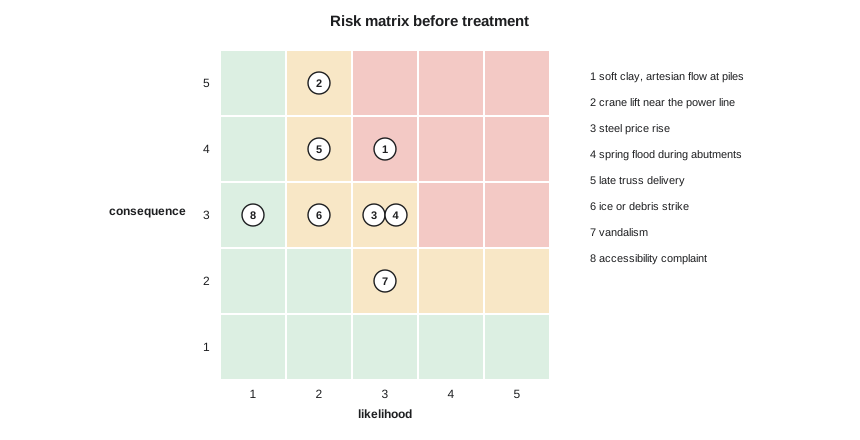
The risk register lists what could go wrong, how likely it is, how bad it would be and what the team will do about it. Likelihood and consequence are scored from 1 to 5 against descriptions agreed with the client, so that a 4 for consequence means the same thing to everyone: for this project, a delay of more than a month, a cost increase of more than 10 % or a serious injury. The product of the two scores ranks the risks.
# Risk register scores and a 75-year life-cycle cost comparison of three superstructure finishes
UNITS = "US"
SI = UNITS == "SI"
cur = "CAD" if SI else "USD"
f = 1.0 if SI else 0.82
risks = [("Soft clay or artesian flow while driving piles", 3, 4), ("Steel price rise before the truss order", 3, 3),
         ("Truss delivery late for the erection window", 2, 4), ("Ice or debris strikes the bridge in a flood", 2, 3),
         ("Crane pick near the overhead line on Ridgeway Road", 2, 5), ("Vandalism of railings and lighting", 3, 2),
         ("Spring flood during abutment excavation", 3, 3), ("Accessibility complaint on the south approach", 1, 3)]
print(f"{'Risk':52s} L  C  score")
for n, l, c in sorted(risks, key=lambda r: -r[1] * r[2]):
    band = "high" if l * c >= 12 else "medium" if l * c >= 6 else "low"
    print(f"{n:52s} {l}  {c}  {l * c:2d} {band}")
# life-cycle cost, present value at a real discount rate
r, years = 0.03, 75
def pv(capital, annual, events):
    tot = capital + sum(annual / (1 + r) ** t for t in range(1, years + 1))
    for every, cost in events:
        tot += sum(cost / (1 + r) ** t for t in range(every, years + 1, every))
    return tot * f
opts = {"weathering steel": pv(690000, 2500, [(25, 40000)]),
        "galvanized and painted steel": pv(760000, 2500, [(30, 180000)]),
        "glulam with steel connections": pv(820000, 4000, [(20, 60000), (40, 260000)])}
print(f"\nPresent value over {years} years at {r:.0%} real ({cur}):")
for n, v in sorted(opts.items(), key=lambda x: x[1]):
print(f" {n:32s} {v:>12,.0f}")Risk L C score Soft clay or artesian flow while driving piles 3 4 12 high Crane pick near the overhead line on Ridgeway Road 2 5 10 medium Steel price rise before the truss order 3 3 9 medium Spring flood during abutment excavation 3 3 9 medium Truss delivery late for the erection window 2 4 8 medium Ice or debris strikes the bridge in a flood 2 3 6 medium Vandalism of railings and lighting 3 2 6 medium Accessibility complaint on the south approach 1 3 3 low Present value over 75 years at 3% real (USD): weathering steel 653,410 galvanized and painted steel 769,951 glulam with steel connections 885,854
The highest risk is the ground: soft clay and artesian water could slow pile driving, cause water to rise around the piles, or lead to early refusal on boulders. The response is already in the design: driven piles rather than drilled shafts, test piles with dynamic monitoring, a procedure for refusal, a unit price for added piles and a piezometer reading before driving starts. Close behind are the crane lift near the overhead line, the steel price before the truss is ordered, and a spring flood during the abutment work. Each has an owner, a response and a trigger for action, and the register is a living document that the contractor's and the city's risk registers will inherit.
| Risk | Response | Owner |
|---|---|---|
| Soft clay or artesian flow while driving piles | driven piles; test piles; refusal procedure; unit price for added piles | designer, then contractor |
| Crane pick near the overhead line | line de-energized or relocated for the lift, confirmed in writing; lift plan by the contractor | designer and utility, then contractor |
| Steel price rise before the truss order | early order after award; price adjustment clause for steel | city |
| Spring flood during abutment work | start abutments after the spring flood; erosion controls; flood response plan | contractor |
| Truss delivery late | pre-qualified suppliers; early procurement option; schedule float in site work | city and contractor |
| Ice or debris strikes the bridge | freeboard above the climate-check level; no piers in the flow | designer |
Safety in design
Under OSHA rules, employers on the site are responsible for their workers' safety, and the construction management course explained the multi-employer duties. But designers make decisions that create or remove hazards long before a contractor arrives, and good practice, set out in the ANSI/ASSP prevention through design standard, is to look for those hazards in the design and remove them where possible. Prevention through design applies the hierarchy of controls at the drawing board: eliminate the hazard, substitute something less hazardous, add engineering controls, and only then rely on procedures and protective equipment.
The team's design review for safety, held with the constructability reviewer, produces a short list of decisions. The overhead line hazard is eliminated by requiring the line to be de-energized or relocated for the lift. Work over water is reduced by splicing the truss on land and lifting it complete, rather than assembling it over the creek on falsework. Work at height on the deck edge is controlled by detailing the railing posts so that they are installed on the truss before it is lifted, giving edge protection from the first day on the deck. Confined space entry is avoided by designing the bioretention underdrain with cleanouts that can be flushed from the surface, so that no one needs to enter a structure to maintain it. The pile-driving zone is set out so that the rig never works under the overhead line.
Safety in design continues into operation and maintenance. The bridge is inspected regularly for its whole life, and the inspection crew needs to see and reach the bearings, the bottom chord connections and the deck underside. The abutment seats have a level ledge wide enough to stand on and inspect the bearings, and the truss has no closed boxes where water can collect unseen. The maintenance manual records these features, so that the people who look after the bridge in 30 years know what the designers intended.
Public safety in use
Some risks belong to the finished bridge rather than its construction. A pedestrian bridge near a high school will be used in ways its designers would not choose: by cyclists at speed, by groups jumping in time, by people climbing on the railings, and occasionally by someone in distress. The team's responses are modest and practical. The railing is tall enough for cyclists, with vertical pickets that are hard to climb and gaps too small for a child to slip through. The deck surface is slip-resistant and drains quickly so that it does not glaze with ice. The vibration criterion from lesson 5 was set with groups of young people in mind. And the city's parks department asked for clear sight lines from the pavilion and the road, so that the bridge feels watched and safe at dusk; the planting plan keeps tall shrubs away from the approaches for that reason.
The team also considers vandalism and graffiti, which scored medium in the register. Weathering steel hides minor marks well, the railing fixings are tamper-resistant, and the lighting specification uses fixtures that are hard to reach. These are small choices, but the parks staff were clear that a bridge that looks neglected quickly attracts more damage, and that easy repairs matter more than clever details.
Life-cycle cost
The cheapest bridge to build is rarely the cheapest to own. A life-cycle cost analysis adds the capital cost to the present value of maintenance, repair and replacement over the design life, discounted to today at a real discount rate:
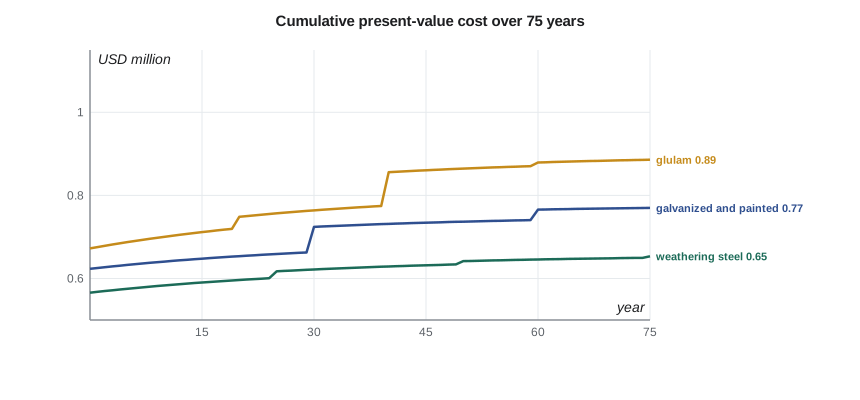
The team compares three superstructure finishes over 75 years at a real discount rate of 3 %. Weathering steel needs routine cleaning and an inspection-driven touch-up of its most exposed parts every 25 years. Galvanized and painted steel costs a little more to build and needs a major recoating at about 30 years. Glulam, from concept B, costs more to build, needs more frequent inspection and protective treatment, and is likely to need significant replacement of exposed members at about 40 years. The values are indicative, from the city's records and published experience, and are labeled so in the report.
Worked problem
Present value of a repeated cost
A recoating costing USD 147,600 is needed at years 30 and 60. What is its present value at a 3 % real rate?
Show solution
- \[PV = \frac{147600}{1.03^{30}} + \frac{147600}{1.03^{60}}\]
- \[PV = 60{,}810 + 25{,}050 = 85{,}860\]
Answer: Discounting makes distant costs small, which is why the choice of discount rate matters; at 1 % the same recoatings would be worth about twice as much today.
The weathering steel option has the lowest present value, at about USD 0.65 million for the superstructure over 75 years, against USD 0.77 million for galvanized and painted steel and USD 0.89 million for glulam. The ranking holds for discount rates from 1 % to 5 %. Life-cycle cost confirms the concept choice and the finish, and it supports requirement R7 in the register: lowest 75-year cost with no repainting.
Climate resilience
The design already uses the master plan's climate-check flow, a third higher than the 100-year flow, for the soffit clearance. The team goes one step further with a simple stress test in the spirit of the vulnerability assessment frameworks used by FHWA and by Canadian practice, which ask how each component of an infrastructure system responds to each climate hazard. For the trail link the hazards are higher flood flows, more intense rain on the parking lot, more freeze-thaw cycles and hotter summers. The bridge has about 2.6 ft of clearance above the climate-check level; flows half again larger than the 100-year flow would still pass below the low chord, because the floodplain absorbs extra flow with little rise. The bioretention overflow passes large storms safely. Freeze-thaw is addressed by air-entrained deck concrete. Heat is addressed by the expansion joint's range, which allows for higher summer steel temperatures.
The weakest link is not the bridge but the south approach, where it meets the Ridgeway Road path on the edge of the floodplain. In an extreme flood, water would reach the bottom of the approach embankment. The team raises the first 65 ft of the path slightly and protects the toe of the embankment with stone, a small change that keeps the trail usable when the creek is high, and records the remaining residual risk.
Practical points
- Score risks against descriptions agreed with the client, and give each an owner and a response.
- Apply the hierarchy of controls in design: eliminate hazards before managing them.
- Design for the people who will inspect and maintain the structure.
- Compare options by life-cycle cost and test the ranking against the discount rate.
- Stress-test the design against climate hazards and find its weakest link.
Common mistakes
MistakeListing risks without owners or responses.
InsteadGive each risk an owner, a response and a trigger, and keep the register current.
MistakeAssuming site safety is only the contractor's job.
InsteadDesigners create or remove hazards; remove them in the design where possible.
MistakeChoosing a finish on capital cost alone.
InsteadCompare present-value life-cycle costs over the design life.
MistakeTesting only the structure against climate change.
InsteadCheck the whole system, including approaches, drainage and joints.
Summary and key terms
- The risk register ranks eight risks; the ground during pile driving scores highest.
- Safety in design eliminated the overhead line hazard, reduced work over water and gave early edge protection.
- Inspection and maintenance access is designed in and recorded in the maintenance manual.
- Weathering steel has the lowest 75-year life-cycle cost, and the ranking holds from 1 % to 5 % discount rates.
- The bridge passes flows well above the climate-check flow because the floodplain absorbs extra flow.
- The south approach is the weakest link and is raised and protected.
- Risk register
- A list of risks with likelihood, consequence, response, owner and trigger.
- Hierarchy of controls
- Elimination, substitution, engineering controls, administrative controls and protective equipment, in order of preference.
- Safety in design
- Identifying and removing hazards during design, before construction or operation.
- Life-cycle cost analysis
- Comparison of options by the present value of all costs over the design life.
- Real discount rate
- A discount rate that excludes inflation, used with costs in today's money.
- Present value
- The value today of future costs, found by discounting.
- Climate stress test
- Checking how a design performs under climate conditions beyond the design values.
- Residual risk
- The risk that remains after responses are in place.
Practice problems
Work each problem on paper first, then reveal the answer to check.
A risk has likelihood 4 and consequence 3. What is its score, and which band is it in?
Show answer
12, in the high band (12 or more).
What is the present value of 40,000 at year 25 at a 3 % real rate?
Show answer
40,000 / 1.03²⁵ = 19,100.
Why is the truss spliced on land and lifted complete?
Show answer
It avoids assembling the truss over the creek, removing work over water and falsework in the floodplain.
Why does a 50 % increase in flow barely raise the water level at the bridge?
Show answer
Above bankfull, the wide floodplain adds conveyance quickly, so the depth rises slowly.
Lesson quiz · 5 questions
Score 60% or more to complete this lesson.
Create a free account to save your progress, take quizzes and earn a certificate.