
CIV-341 · Lesson 8 of 12 · 20 min
Deep foundations: types and selection
The municipality has approved a second phase at Kestrel Bay: a fleet storage building north of the garage, where snowplows, graders and loaders will be stored and serviced, with a mezzanine for parts and offices and a 10-ton bridge crane. Its interior columns carry about \(D = 425\) kips and \(L = 250\) kips, and it stands on the same sand, clay and artesian till as the garage. Preloading made spread footings acceptable for the garage. For the fleet building, with heavier columns and a crane that is sensitive to differential movement, Dr. Kowalczyk recommends deep foundations. This lesson surveys the types available, how they work and how to choose among them.
When deep foundations are needed
Deep foundations transfer load through weak or compressible soil to stronger soil or rock at depth, or spread it along their length by friction. They are used when shallow foundations would have inadequate bearing resistance, when settlement or differential settlement would be excessive, when the foundations must resist large uplift or lateral loads, when scour or erosion could undermine shallow foundations, as at bridges, or when future excavation next to the structure would remove the support of shallow footings. On the Kestrel Bay site, a spread footing under a fleet building column would stress the whole clay layer, and lesson 6 has shown what that means.
How a pile carries load
A pile carries axial load in two ways: by shaft resistance, the shear stress mobilized along its sides, and by toe resistance, the bearing pressure under its tip. The proportions depend on the soil and the pile. A pile driven through soft clay into dense till carries most of its load at the toe; a pile embedded in a thick stiff clay carries most along the shaft. The two components mobilize at very different movements. Shaft resistance reaches its peak at a movement of only a few millimeters, about 0.5 to 1 % of the diameter, while toe resistance continues to increase until the toe has moved by about 10 % of its diameter. Under working loads, therefore, much of the load is carried by the shaft even when the toe resistance is large at failure, a point that matters for the downdrag analysis of lesson 10.
Classification of piles
Piles are classified in several ways. By installation, they are displacement piles, driven or pushed into the ground and displacing the soil sideways, or replacement piles, installed in a hole drilled or excavated beforehand. Small-displacement piles such as open-ended pipes and H-piles lie between. Displacement increases the horizontal stress around the pile and therefore its shaft resistance in sand; replacement relaxes the ground and reduces it. By material, they are steel, concrete (precast, cast in place or grouted) or timber. And by function, they are end-bearing piles, friction piles, tension piles resisting uplift, or laterally loaded piles.
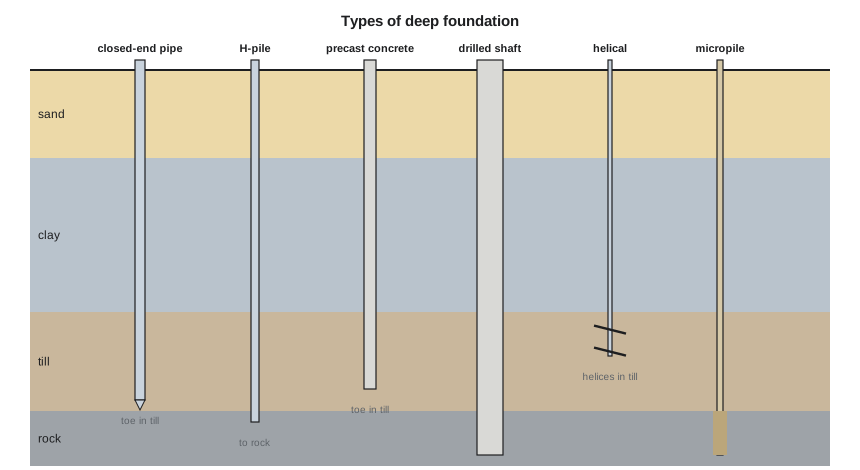
Driven piles
Driven piles are installed with impact hammers (drop, diesel or hydraulic) or vibratory hammers. Their great advantage is that every pile is load tested, in a sense, as it is driven: the resistance to driving, measured as the number of blows per unit penetration, reflects the capacity, and dynamic monitoring can quantify it, as lesson 11 shows.
- Steel H-piles are small-displacement piles that penetrate dense soils and can be driven to refusal on rock. They are easily spliced and cut, and are common in Canada and the northern United States for end bearing on rock. They can be bent or deflected by boulders, and their toes are often reinforced with cast steel points.
- Steel pipe piles are driven closed-ended, with a plate or conical point, or open-ended. Closed-ended pipes are full-displacement piles; after driving they are inspected inside and filled with concrete. Open-ended pipes may plug with soil and behave like closed-ended piles, or core through it.
- Precast prestressed concrete piles, square or octagonal, are economical where lengths can be predicted, but splicing is difficult and they can be damaged by hard driving or tension waves.
- Timber piles are cheap and durable below the water table, but limited in length and capacity; they are still used for light structures and marine work.
Driving causes noise and vibration, can densify loose sands and heave the ground and nearby piles in clays, and may disturb sensitive neighbors. Near the garage, Dr. Kowalczyk will specify vibration monitoring.
Drilled shafts
Drilled shafts, also called bored piles, caissons or drilled piers, are formed by drilling a hole, usually 0.6 to 3 m in diameter, placing a reinforcing cage and filling it with concrete. Single shafts can carry very large loads, and they can be socketed into rock. Their installation is quiet and vibration-free. But the quality of the shaft depends on the drilling: in water-bearing sands the hole must be supported by temporary casing or by drilling slurry, the base must be cleaned of loose cuttings, and the concrete must be placed by tremie without mixing with the slurry. Under artesian pressure, as in the till at Kestrel Bay, water can flow up the hole, loosen the base and wash cement from the concrete; the hole must then be kept full of water or slurry above the artesian level. Integrity testing, by crosshole sonic logging or thermal methods, checks the finished shafts.
Other types
Continuous flight auger (CFA) piles, also called auger cast-in-place piles, are drilled with a hollow-stem auger and grouted through the stem as the auger is withdrawn; they are fast and quiet but need careful monitoring of the grout pressure and volume. Helical piles, steel shafts with one or more helical plates screwed into the ground, are light and quick to install, and suit light buildings, additions with restricted access and tension loads. Micropiles, small-diameter drilled and grouted piles with steel bars or casings, can be installed with small rigs inside existing buildings and through obstructions, and are used for underpinning. Drilled displacement piles combine drilling with lateral displacement of the soil.
Selection
Choosing a pile type is a balance between technical suitability and cost. The main technical questions are whether the pile can be installed through the ground to the bearing layer, whether it can develop the required resistance there, and whether its installation will harm the surroundings. Cost depends on the price per unit of capacity, the number of piles and the size of the pile caps, the equipment available locally and the schedule. Local practice matters greatly: a contractor who drives pipe piles every week will price them better than drilled shafts, and the designer should consult contractors early.
At the fleet building, the relevant facts are these. The sand and clay above the till offer modest resistance. The till is very dense, with cobbles and boulders, and artesian; it is the natural bearing layer, about 4 m thick. Beneath it, the bedrock is at 15.5 m (51 ft). The existing garage is about 60 m (200 ft) away.
Worked problem
Why not a spread footing?
Size a spread footing for the fleet building column at the 4.4 ksf used for the garage, and judge whether it could work.
Show solution
- \[A = \frac{D + L}{q} = \frac{425 + 250}{4.4} = 153\ \text{ft}^2 \qquad B = 12.4\ \text{ft}\]
- The footing would be larger than the garage footings, with neighbors on a 30 ft grid. The lesson 6 method gives a consolidation settlement of about 3.6 in. under an interior column, and the crane rails would see the full distortion between columns.
Answer: Preloading could help, but the crane tolerances are tight and the yard fill around the building will add its own settlement. Deep foundations to the till remove the clay from the problem.
Sofia's script makes a first comparison of four candidate types, using preliminary unit resistances for each layer, and a weighted selection matrix agreed with the team.
# Fleet storage building: why piles, and a first comparison of deep foundation types
from math import pi
D, L = 425.0, 250.0                           # service loads on a typical interior column (kips)
Pu, Ps = 1.2*D + 1.6*L, D + L
print(f"Typical column: D = {D:.0f} kips, L = {L:.0f} kips, Ps = {Ps:.0f} kips, Pu = {Pu:.0f} kips")
A = Ps/4.4
print(f"A spread footing at 4.4 ksf would need {A:.0f} ft2 ({A**0.5:.1f} ft square), its pressure bulb")
print("reaching the whole clay layer: about 3.6 in. of settlement by the lesson 6 method on a 30 ft grid.\n")
# preliminary unit resistances for comparison only (psf): shaft by layer, toe in the bearing layer
layers = [('sand', 0.0, 13.0), ('clay', 13.0, 36.0), ('till', 36.0, 51.0)]
options = {
  'Driven closed-end pipe 16 in. to 49 ft': dict(D=16/12, tip=49.0, fs={'sand': 520, 'clay': 730, 'till': 1880}, qt=188000, toe_area=None),
  'Driven H-pile HP12x74 to basalt, 52 ft': dict(D=12/12, tip=52.0, fs={'sand': 420, 'clay': 630, 'till': 1670, 'rock': 0}, qt=250000, toe_area=21.8/144),
  'Drilled shaft 36 in., 6.5 ft rock socket': dict(D=3.0, tip=57.5, fs={'sand': 420, 'clay': 630, 'till': 1250, 'rock': 8350}, qt=62700, toe_area=None),
  'Helical pile, 2 x 14 in. plates in the till': dict(D=4.5/12, tip=43.0, fs={}, qt=31300, toe_area=2*pi*(7/12)**2),
}
FS = 3.0                                      # factor of safety for capacity by static analysis
print(f"{'Option':44s} {'Qs':>6s} {'Qt':>6s} {'Qu':>6s} {'Qu/FS':>6s} {'per column':>10s}")
for name, o in options.items():
    per = pi*o['D']
    lay = layers + ([('rock', 51.0, o['tip'])] if o['tip'] > 51.0 else [])
    Qs = sum(per*o['fs'].get(n, 0)*max(0.0, min(b, o['tip']) - a) for n, a, b in lay)/1000
    At = o['toe_area'] if o['toe_area'] else pi*o['D']**2/4
    Qt = o['qt']*At/1000; Qu = Qs + Qt
    n = -(-Ps // (Qu/FS))
    print(f"{name:44s} {Qs:6.0f} {Qt:6.0f} {Qu:6.0f} {Qu/FS:6.0f} {int(n):10d}")

# weighted selection matrix (scores 1 to 5, 5 best)
crit = [('capacity per element', 0.20), ('reliability in boulders/artesian till', 0.25), ('vibration near garage', 0.10),
        ('cost per kip', 0.30), ('schedule', 0.15)]
score = {'pipe pile': [3, 4, 3, 5, 5], 'H-pile': [4, 4, 3, 4, 4], 'drilled shaft': [5, 2, 5, 3, 3], 'helical': [1, 2, 5, 3, 4]}
print("\nWeighted scores:", ", ".join(f"{k} {sum(w*s for (c, w), s in zip(crit, v)):.2f}" for k, v in score.items()))Typical column: D = 425 kips, L = 250 kips, Ps = 675 kips, Pu = 910 kips A spread footing at 4.4 ksf would need 153 ft2 (12.4 ft square), its pressure bulb reaching the whole clay layer: about 3.6 in. of settlement by the lesson 6 method on a 30 ft grid. Option Qs Qt Qu Qu/FS per column Driven closed-end pipe 16 in. to 49 ft 201 262 464 155 5 Driven H-pile HP12x74 to basalt, 52 ft 141 38 179 60 12 Drilled shaft 36 in., 6.5 ft rock socket 876 443 1319 440 2 Helical pile, 2 x 14 in. plates in the till 0 67 67 22 31 Weighted scores: pipe pile 4.15, H-pile 3.90, drilled shaft 3.35, helical 2.70
Reading the results
The preliminary values, which are deliberately rough, show the character of each option. A 16 in. closed-end pipe pile driven to 49 ft has an ultimate capacity of about 460 kips, more than half of it at the toe in the dense till; five piles would carry a column with \(FS = 3\). An HP12×74 driven to the basalt gains little in the soft layers and, on its small steel toe area, needs 12 piles, unless it is driven hard onto the rock. A 36 in. drilled shaft socketed 6.5 ft into the basalt carries a column on two shafts, but drilling through the artesian till with boulders is risky and slow. Helical piles cannot develop enough capacity in the till for these loads. The weighted matrix favors the pipe pile, with the H-pile second.
Dr. Kowalczyk selects closed-end steel pipe piles, driven into the till with a reinforced conical toe to push past cobbles, inspected internally and filled with concrete. She notes two risks to manage: boulders that stop a pile short of the design toe level, for which the specification will allow a pile to be redriven or replaced, and the possibility that the rock surface rises locally, giving a short pile with a hard toe, which is acceptable for capacity. Lesson 9 now calculates the capacity of the chosen pile properly.
Pile caps and layout
Piles under a column are joined by a reinforced concrete pile cap, which spreads the column load to the piles. Piles are usually spaced at about 2.5 to 3.5 diameters: closer spacing makes driving difficult, causes heave and reduces group efficiency; wider spacing makes the cap larger and more expensive. Layouts for two to nine piles under a column are standard. The cap is designed for flexure and shear like a deep footing, with the piles as supports, and its weight is part of the load on the piles. Piles are installed with a positional tolerance, typically about 75 mm (3 in.) in plan, and the cap and the piles must be checked for the eccentricity that results.
Practical points
- Consider deep foundations when shallow foundations would fail, settle too much, or be undermined.
- Remember that shaft resistance mobilizes at small movement and toe resistance at large movement.
- Choose the pile type for installability, resistance, effect on neighbors and cost, with local contractors' experience in mind.
- For drilled shafts in water-bearing or artesian soils, specify casing or slurry and integrity testing.
- Plan for obstructions such as boulders in till.
Common mistakes
MistakeChoosing a drilled shaft in artesian water-bearing till without casing or slurry.
InsteadKeep the hole full above the artesian level with casing or slurry, or choose a driven pile.
MistakeComparing pile types by capacity per pile alone.
InsteadCompare cost per unit of capacity, including caps and installation risk.
MistakeAssuming the toe carries its share of the working load.
InsteadAt working load the shaft carries more, because it mobilizes at small movement.
MistakeSpacing piles at less than about 2.5 diameters.
InsteadUse 2.5 to 3.5 diameters to limit heave, driving problems and group effects.
Summary and key terms
- Deep foundations carry load by shaft and toe resistance through weak soil to stronger soil or rock.
- Displacement piles raise horizontal stress; replacement piles relax it.
- Driven piles: H-piles, pipe piles, precast concrete, timber; drilled shafts; CFA, helical and micropiles.
- Selection balances installability, resistance, effect on neighbors and cost.
- For the fleet building, closed-end 16 in. pipe piles driven into the dense till are selected.
- Shaft resistance
- The resistance mobilized by shear along the sides of a pile.
- Toe resistance
- The bearing resistance mobilized under the tip of a pile.
- Displacement pile
- A pile that pushes the soil sideways as it is installed.
- Drilled shaft
- A cast-in-place concrete pile formed in a drilled hole.
- Rock socket
- The part of a drilled shaft drilled into rock.
- Helical pile
- A steel shaft with helical plates screwed into the ground.
- Micropile
- A small-diameter drilled and grouted pile reinforced with steel.
- Pile cap
- A reinforced concrete block that connects a group of piles to a column.
Practice problems
Work each problem on paper first, then reveal the answer to check.
Why does a closed-ended pipe pile develop more shaft resistance in sand than a drilled shaft of the same diameter?
Show answer
It displaces the sand and increases the horizontal stress, whereas drilling relaxes it.
Give two reasons to avoid drilled shafts in the artesian till at Kestrel Bay.
Show answer
Water can flow up the hole and loosen the base, and boulders make drilling slow; casing or slurry would be needed.
A column carries a service load of 600 kips. Piles have an ultimate capacity of 350 kips with \(FS = 3\). How many piles are needed?
Show answer
\(600/116.7 = 5.1\), so 6 piles.
At what movement is shaft resistance fully mobilized, compared with toe resistance?
Show answer
Shaft: a few millimeters (about 0.5 to 1 % of the diameter); toe: about 10 % of the diameter.
Lesson quiz · 5 questions
Score 60% or more to complete this lesson.
Create a free account to save your progress, take quizzes and earn a certificate.