
CIV-341 · Lesson 4 of 12 · 21 min
Bearing capacity: eccentric loads, layered soils and groundwater
The bearing capacity equation of lesson 3 assumed a vertical, central load on a uniform, dry soil. Real footings are rarely so obliging. Columns carry moments from wind and unbalanced spans, retaining wall footings carry horizontal thrust, the water table may rise to the footing base, and, as at Kestrel Bay, a strong layer may lie only a short distance above a weak one. This lesson extends the theory to these cases and completes the bearing check of the garage footings, including an exterior footing that carries a moment and a horizontal load.
Groundwater
Water affects bearing capacity through the effective unit weight of the soil. In a drained analysis, the soil below the water table contributes its buoyant weight \(\gamma' = \gamma_{sat} - \gamma_w\), about half its total weight. Three cases arise.
- Water table above the footing base, at depth \(D_w < D_f\): the surcharge is the effective stress at the base, \(q = \gamma D_w + \gamma'(D_f - D_w)\), and \(\gamma'\) is used in the \(N_\gamma\) term.
- Water table below the base by a distance \(d < B\): the surcharge is unaffected, and a weighted unit weight is used in the \(N_\gamma\) term, a common approximation being \(\bar\gamma = \gamma' + (d/B)(\gamma - \gamma')\).
- Water table deeper than about \(B\) below the base: no effect.
A rise of the water table from deep to the ground surface roughly halves the bearing capacity of a footing on sand. The design must therefore use the highest water level expected in the life of the structure, including spring thaw, flood levels and the effect of any future change in drainage. For undrained analyses of clay, the water table does not enter the bearing capacity at all, because total stresses are used.
Eccentric loads and the effective area
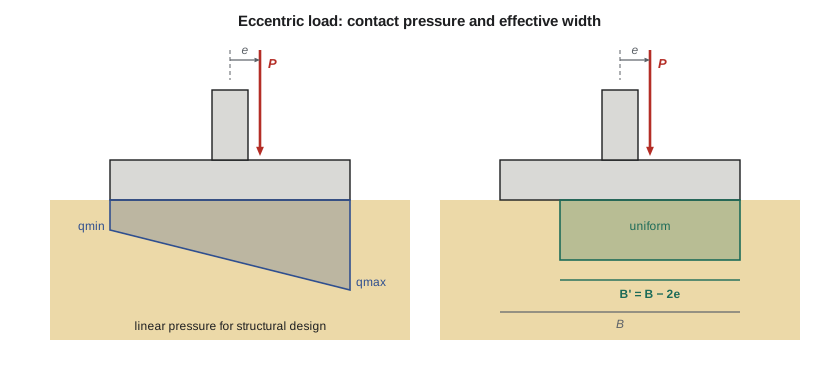
When a footing carries a vertical load \(P\) and a moment \(M\), the resultant acts at an eccentricity \(e = M/P\) from the center. If \(e \le B/6\), the contact pressure under a rigid footing is usually assumed to vary linearly, with
If \(e > B/6\), part of the footing lifts off the ground. For the structural design of the footing, the linear distribution is used. For bearing capacity, Meyerhof proposed a simpler and more realistic approach: the load is assumed to act uniformly on an effective area whose centroid coincides with the load. For eccentricity in the \(B\) direction,
The bearing capacity is calculated with \(B'\) and \(L'\) in place of \(B\) and \(L\) in all terms and shape factors, and the ultimate load is \(Q_u = q_u A'\). The method is accepted in the AASHTO specifications and most other codes and manuals, and it penalizes eccentricity strongly: an eccentricity of \(B/6\) reduces the effective width by a third.
Inclined loads
A horizontal load \(H\) acting together with the vertical load \(V\) reduces the bearing capacity, because the soil must resist shear as well as compression and the failure mechanism develops on one side only. Meyerhof's inclination factors, with \(\alpha = \tan^{-1}(H/V)\) in degrees, are
Hansen and Vesić gave more elaborate factors that depend on \(H\), \(V\), the footing area and the cohesion. A footing with a significant horizontal load must also be checked for sliding along its base, where the resistance is \(V\tan\delta\) for a drained frictional soil, with \(\delta\) the base friction angle, or \(s_u A'\) for an undrained clay.
Layered soils
The bearing capacity theory assumes that the failure zone lies entirely in one soil. Beneath a footing of width \(B\), the general shear mechanism extends to a depth of about \(B\) for sand and somewhat less for clay. If a different soil lies within that depth, the bearing capacity can be very different from that of either layer alone.
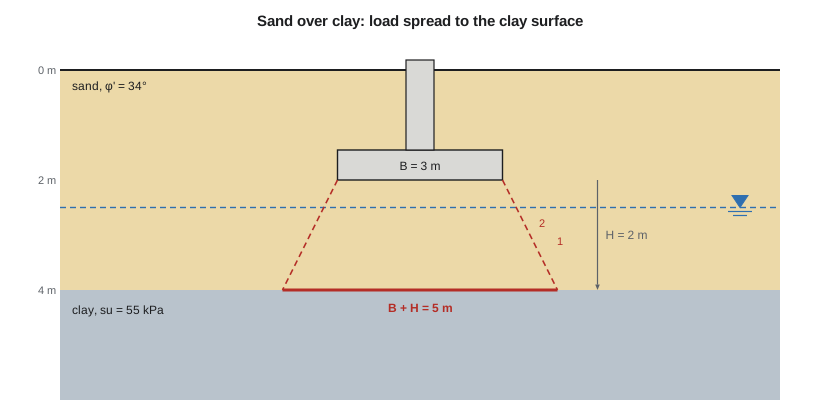
When a strong layer overlies a weak one, the critical case at Kestrel Bay, the footing may punch through the strong layer and then fail the weak one. Meyerhof and Hanna analyzed this mechanism in the 1970s. Their solution adds to the bearing capacity of the weak layer the shear resistance along the vertical punching surfaces through the strong layer, using a punching shear coefficient read from charts. A simpler approach, widely used for design checks, is the load-spread method: the load is assumed to spread through the strong layer at a slope of two vertical to one horizontal onto an imaginary footing of width \(B + H\) at the top of the weak layer, whose bearing capacity is then checked. The method neglects the shear strength of the strong layer along the punching surfaces, so it is conservative when the strong layer is thick and dense. The true bearing capacity is the lesser of the capacity of the strong layer alone and the capacity governed by the weak layer.
When a weak layer overlies a strong one, the bearing capacity is controlled mainly by the weak layer, but the strong layer below limits the depth of the failure zone and can increase the capacity of a thin weak layer. Settlement, rather than bearing failure, usually governs that case.
Worked problem
The garage footing on sand over clay
The clay surface is 8 ft below the footing base, at 13 ft. Check the bearing capacity of the clay by the load-spread method, with \(s_u = 1{,}150\) psf.
Show solution
- Width of the spread area at the clay surface:
- \[B + H = 10 + 8 = 18\ \text{ft}\]
- Skempton's factor for a square footing at a depth of 13 ft:
- \[N_c = 5\Big(1 + 0.2\frac{13}{18}\Big)(1.2) = 6.87 \qquad q_{u,net} = 6.87(1150) = 7{,}900\ \text{psf}\]
- The net load the clay can carry, converted back to a pressure on the 10 ft footing and adding the overburden at the footing base:
- \[q_u = 7{,}900\Big(\frac{18}{10}\Big)^2 + 115(5) = 25{,}590 + 575 = 26{,}160\ \text{psf}\]
- The sand alone, with the water table 3 ft below the base, gives 41,800 psf. The clay governs:
- \[FS = \frac{26{,}160}{6{,}063} = 4.3 \ge 3\]
Answer: The clay reduces the bearing capacity to 63 % of the value for the sand alone, but the footing still has a factor of safety of 4.3, and the allowable bearing pressure is 8.7 ksf.
The exterior footing
The exterior columns along grid line 1 carry wind moments as well as vertical loads. Their footings are 8 ft square at 5 ft. The governing ASD wind combination, \(D + 0.6W\), gives \(P = 300\) kips, \(M = 98\) kip-ft and a horizontal load \(H = 18\) kips. The eccentricity is 0.33 ft, well within the kern, and the effective width is 7.35 ft.
Sofia's script checks the interior footing for three water levels and for the clay, and then the exterior footing with its effective area, inclination factors and the clay check.
# Garage footings: groundwater, sand over clay, and an eccentric, inclined load
from math import tan, sin, exp, pi, radians, degrees, atan
def NqNg(phi):
    f = radians(phi); Nq = exp(pi*tan(f))*tan(radians(45 + phi/2))**2
    return Nq, 2*(Nq + 1)*tan(f)
def qu_sand(B, L, Df, phi, q, gbar, iq=1.0, ig=1.0):
    f = radians(phi); Nq, Ng = NqNg(phi)
    sq, sg = 1 + (B/L)*tan(f), 1 - 0.4*B/L
    dq = 1 + 2*tan(f)*(1 - sin(f))**2*min(Df/B, 1.0)
    return q*Nq*sq*dq*iq + 0.5*gbar*B*Ng*sg*ig
g, gsat, gw, phi = 115.0, 126.0, 62.4, 34.0
B, Df, dw = 10.0, 5.0, 3.0                    # interior footing; water table 3 ft below the base
gp = gsat - gw
gbar = gp + min(dw, B)/B*(g - gp)              # weighted unit weight within B below the base
qu_dry = qu_sand(B, B, Df, phi, g*Df, g)
qu_wt = qu_sand(B, B, Df, phi, g*Df, gbar)
qu_flood = qu_sand(B, B, Df, phi, gp*Df, gp)   # water table at grade (extreme spring flood)
print(f"Interior footing on sand: dry {qu_dry:,.0f} psf, water table at 8 ft {qu_wt:,.0f} psf "
      f"(gamma_bar {gbar:.1f}), water at grade {qu_flood:,.0f} psf")

# sand over clay: the load spreads 2V:1H through H = 8 ft of sand and must not punch into the clay
H, su = 13.0 - Df, 1150.0
Bp = B + H
Nc = min(5*(1 + 0.2*(Df + H)/Bp)*(1 + 0.2), 7.5)  # Skempton, square, at the clay surface
qnet_clay = Nc*su
qnet_ftg = qnet_clay*Bp**2/B**2
qu_layer = qnet_ftg + g*Df
print(f"Clay check: Nc = {Nc:.2f}, net {qnet_clay:,.0f} psf over {Bp:.0f} ft square -> qu = {qu_layer:,.0f} psf at the footing")
qu = min(qu_wt, qu_layer)
qs, qlrfd = 6063.0, 7916.0                      # gross service and factored pressures from lesson 1
print(f"Governing qu = {qu:,.0f} psf; ASD FS = qu / q = {qu/qs:.2f}; allowable qu/3 = {qu/3:,.0f} psf")
print(f"LRFD check: 0.45 qu = {0.45*qu:,.0f} psf vs {qlrfd:,.0f} psf -> utilization {qlrfd/(0.45*qu):.2f}")

# exterior footing: 8 ft square at 5 ft, service P, M and H from the wind combination D + 0.6W
Bx, P, M, Hh = 8.0, 300.0, 98.0, 18.0          # kips, kip-ft, kips
e = M/P; Bp_ = Bx - 2*e
a = degrees(atan(Hh/P)); iq, ig = (1 - a/90)**2, (1 - a/phi)**2
print(f"\nExterior footing: e = {e:.2f} ft (B/6 = {Bx/6:.2f}), B' = {Bp_:.2f} ft, load inclination {a:.1f} deg, "
      f"iq = {iq:.3f}, i_gamma = {ig:.3f}")
print(f"Contact pressure (linear): q_max = {P/Bx**2*(1 + 6*e/Bx)*1000:,.0f} psf, q_min = {P/Bx**2*(1 - 6*e/Bx)*1000:,.0f} psf")
qu_x = qu_sand(Bp_, Bx, Df, phi, g*Df, gp + min(dw, Bp_)/Bp_*(g - gp), iq, ig)
Bpp = Bp_ + H; Lpp = Bx + H
Ncx = min(5*(1 + 0.2*(Df + H)/Bpp)*(1 + 0.2*Bpp/Lpp), 7.5)
qu_xc = Ncx*su*Bpp*Lpp/(Bp_*Bx) + g*Df
Qult = min(qu_x, qu_xc)*Bp_*Bx/1000
print(f"On B' x L = {Bp_:.2f} x {Bx:.0f} ft: sand qu = {qu_x:,.0f} psf, clay punching qu = {qu_xc:,.0f} psf")
print(f"Ultimate capacity on A' = {Qult:,.0f} kips; FS = {Qult/P:.2f} vs required 3.0 -> {'OK' if Qult/P >= 3 else 'NOT OK'}")Interior footing on sand: dry 46,228 psf, water table at 8 ft 41,796 psf (gamma_bar 79.0), water at grade 25,566 psf Clay check: Nc = 6.87, net 7,897 psf over 18 ft square -> qu = 26,160 psf at the footing Governing qu = 26,160 psf; ASD FS = qu / q = 4.31; allowable qu/3 = 8,720 psf LRFD check: 0.45 qu = 11,772 psf vs 7,916 psf -> utilization 0.67 Exterior footing: e = 0.33 ft (B/6 = 1.33), B' = 7.35 ft, load inclination 3.4 deg, iq = 0.925, i_gamma = 0.808 Contact pressure (linear): q_max = 5,836 psf, q_min = 3,539 psf On B' x L = 7.35 x 8 ft: sand qu = 36,410 psf, clay punching qu = 34,057 psf Ultimate capacity on A' = 2,002 kips; FS = 6.67 vs required 3.0 -> OK
Reading the results
For the interior footing, the water table at 8 ft reduces the bearing capacity of the sand from 46.2 to 41.8 ksf; a water table at the ground surface would cut it to 25.6 ksf. The clay, however, governs, at 26.2 ksf, and the factor of safety is 4.3. For the exterior footing, the eccentricity reduces the area by 8 % and the inclination factors reduce the overburden and weight terms by 8 and 19 %. The sand capacity on the effective area is 36.4 ksf and the clay capacity is 34.1 ksf, higher than for the interior footing because a smaller footing spreads its load over a relatively larger area of clay. The ultimate capacity of 2,000 kips gives a factor of safety of 6.7.
Owen points out that the bearing checks pass comfortably and wonders why the soils report spent so much effort on the clay. Dr. Kowalczyk reminds him that the clay was never likely to fail under these footings; its danger lies in compression, and lessons 5 and 6 will show that settlement, not bearing, controls the garage foundation.
Other factors
Several other conditions reduce bearing capacity and should be considered when they apply. A footing near the crest of a slope loses part of its passive resistance on the slope side; Meyerhof and others give reduced factors, and many codes require a minimum setback. A footing on an inclined base, as at a stepped foundation, uses base inclination factors. Repeated or dynamic loads from machinery or earthquakes may reduce the strength of loose saturated sands, which can liquefy. Footings close together interact, which usually increases the bearing capacity slightly but increases settlement. And footings next to a future excavation lose their surcharge when the excavation is made, which is a common reason to ignore depth factors.
Practical points
- Use the highest credible water table for the life of the structure.
- Use Meyerhof's effective area for eccentric loads, in all terms of the equation.
- Include inclination factors and a sliding check for footings with horizontal loads.
- When a weak layer lies within about one to two footing widths of the base, check punching into it.
- Keep the structural design pressure (linear distribution) separate from the bearing capacity check (effective area).
Common mistakes
MistakeIgnoring a clay layer 2 m below a footing on dense sand.
InsteadCheck punching or load spread into the weak layer.
MistakeUsing the full footing area with an eccentric load.
InsteadUse the effective area \(A' = B'L'\).
MistakeDesigning for the water level measured on the day of drilling.
InsteadDesign for the highest credible level, including floods and spring thaw.
MistakeChecking bearing under a horizontal load but not sliding.
InsteadCheck sliding on the base as a separate limit state.
Summary and key terms
- A water table at the base roughly halves the \(N_\gamma\) term; at the surface it also halves the surcharge term.
- Eccentric loads: \(B' = B - 2e\); bearing capacity on the effective area \(A'\).
- Inclined loads: \(i_q = (1 - \alpha/90^\circ)^2\), \(i_\gamma = (1 - \alpha/\phi')^2\); also check sliding.
- Strong over weak: check the weak layer, for example by the load-spread method with area \((B + H)(L + H)\).
- The garage interior footing is governed by the clay: \(q_u = 26.2\) ksf, \(FS = 4.3\).
- Buoyant unit weight
- The unit weight of saturated soil less the unit weight of water.
- Eccentricity
- The distance from the centroid of a footing to the line of action of the resultant load.
- Kern
- The central zone of a footing within which the resultant keeps the whole base in compression, e ≤ B/6 for a rectangle.
- Effective area
- The reduced footing area, centered on the load, used in Meyerhof's method for eccentric loads.
- Inclination factor
- A factor reducing bearing capacity for a load inclined to the vertical.
- Punching shear
- Failure of a strong upper layer by shearing around the footing perimeter into a weaker layer below.
- Load-spread method
- An approximation in which the load spreads at a fixed slope through an upper layer onto a lower layer.
- Sliding
- A limit state in which a footing moves horizontally along its base.
Practice problems
Work each problem on paper first, then reveal the answer to check.
A 7 ft square footing carries \(P = 180\) kips and \(M = 90\) kip-ft. Find \(e\), \(B'\) and the linear contact pressures.
Show answer
\(e = 0.50\) ft; \(B' = 6.0\) ft; \(q = 3.67(1 \pm 0.43) = 5.25\) and 2.10 ksf.
A load has \(H/V = 0.15\). Find the Meyerhof inclination factors for \(\phi' = 32^\circ\).
Show answer
\(\alpha = 8.5^\circ\): \(i_q = (1 - 8.5/90)^2 = 0.82\); \(i_\gamma = (1 - 8.5/32)^2 = 0.54\).
A footing on sand has the water table 3 ft below its 6 ft wide base. Find \(\bar\gamma\) for \(\gamma = 115\) and \(\gamma' = 63\) pcf.
Show answer
\(63 + 0.5(52) = 89\) pcf.
Why is the load-spread method conservative for a thick, dense sand over clay?
Show answer
It ignores the shear resistance of the sand along the punching surfaces.
Lesson quiz · 5 questions
Score 60% or more to complete this lesson.
Create a free account to save your progress, take quizzes and earn a certificate.