
CIV-341 · Lesson 11 of 12 · 21 min
Lateral loading and pile load testing
Piles must resist horizontal loads as well as vertical ones: wind and earthquake forces on the building, braking of the crane, the thrust of earth against walls, and the impact of vehicles. They must also be shown to have the resistance the design assumed, because the static methods of lesson 9 are uncertain by a factor of about two. This lesson covers both: the analysis of laterally loaded piles, by Broms' method for ultimate resistance and by the subgrade reaction approach for deflection, and the testing of piles, from the static load test to dynamic monitoring and the dynamic formulas that preceded it.
How a laterally loaded pile works
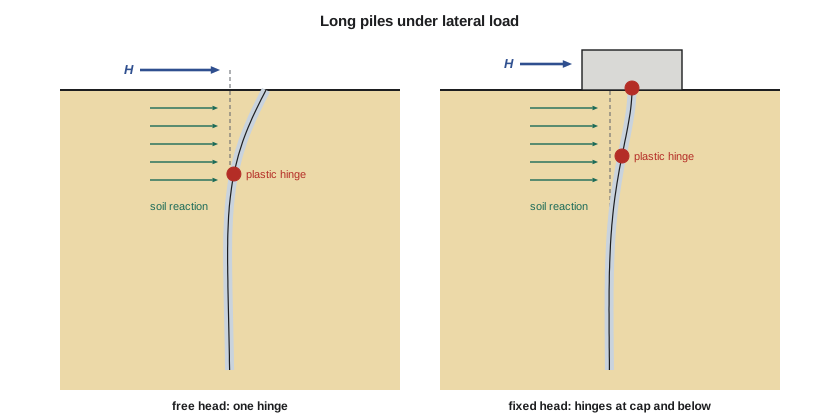
A horizontal load at the head of a pile is resisted by the soil pressing against the pile near the surface. Because the near-surface soil does nearly all the work, the lateral behavior of a pile depends mainly on the soil in the upper five to ten diameters and on the bending stiffness of the pile, and hardly at all on the soil near the toe. Two kinds of failure are possible. A short, stiff pile rotates as a rigid body, the soil failing along its whole length. A long, flexible pile fails by forming a plastic hinge at the depth of maximum moment, the soil below remaining largely intact. The condition at the head matters greatly: a free-head pile, such as a sign post, can rotate; a fixed-head pile, cast into a stiff cap, cannot, and its head moment reverses the curvature, roughly doubling its lateral resistance and reducing its deflection.
Broms' method
In 1964, Bengt Broms published simple solutions for the ultimate lateral resistance of piles in cohesive and cohesionless soils, for short and long piles and for free and fixed heads. For a long pile in cohesionless soil, he assumed a passive pressure of three times the Rankine value, \(3K_p\gamma' z D\), acting on the pile width. For a free-head pile with the load at the ground surface, the maximum moment occurs at the depth \(f\) where the shear in the pile is zero:
Failure occurs when \(M_{max}\) equals the plastic moment \(M_y\) of the pile section. For a fixed-head long pile, a second hinge forms at the cap, and \(H_u f = 2M_y/0.67\) to a close approximation. The solution is solved by iteration because \(f\) depends on \(H_u\). Broms' cohesive-soil solutions assume a soil resistance of \(9s_u D\) below a depth of \(1.5D\), with zero resistance above it. The method is valuable as a check on more sophisticated analyses and for small projects.
Deflection: subgrade reaction and p-y analysis
Under working loads, the question is usually deflection rather than failure: a pile cap that moves 25 mm (1 in.) may be unacceptable for a crane or a bridge bearing even if the piles are far from failure. The classical approach treats the soil as a bed of springs whose stiffness increases linearly with depth, \(k_h = n_h z\), where \(n_h\) is the coefficient of subgrade reaction. For a long pile, the solution of the beam on elastic foundation by Matlock and Reese gives the deflection at the head in terms of a relative stiffness length \(T\):
and the fixed-head moment is about \(0.93HT\). A pile is long if its embedded length exceeds about \(4T\). Terzaghi gave typical values of \(n_h\) for sands; for medium dense sand above the water table, a value of about 42 kcf (24 lb/in.³) is commonly quoted, and roughly 60 % of that below the water table.
Modern practice uses p-y analysis, in which the soil is represented by nonlinear springs whose resistance \(p\) per unit length depends on the deflection \(y\) according to curves developed from instrumented load tests by Matlock, Reese, O'Neill and others for soft clay, stiff clay, sand and rock. The pile is analyzed as a beam on these springs by finite differences, with commercial software that also handles layered soils, cyclic loading and group effects, the latter through the p-multipliers mentioned in lesson 10. For the fleet building, with modest lateral loads, the subgrade reaction solution is adequate.
Worked problem
Lateral resistance of the fleet building pile
The pile is a 16 × 0.5 in. steel pipe (\(F_y = 50\) ksi) filled with concrete, in sand with \(\phi' = 34^\circ\) and an average effective unit weight of 96 pcf over the upper 13 ft. Find the plastic moment of the steel pipe and set up Broms' equation for a free head.
Show solution
- Plastic section modulus of the tube, with \(d = 16 - 2(0.5) = 15\) in.:
- \[Z = \frac{D^3 - d^3}{6} = \frac{16^3 - 15^3}{6} = 120.2\ \text{in.}^3 \qquad M_y = 50(120.2)/12 = 501\ \text{kip-ft}\]
- \[K_p = \tan^2(45^\circ + 17^\circ) = 3.54\]
- \[f = 0.82\sqrt{\frac{H_u}{0.096(1.333)(3.54)}} \qquad 0.67\,H_u f = 501\]
- Iteration gives \(H_u = 72\) kips with \(f = 10.4\) ft.
Answer: The concrete fill adds stiffness and some strength; ignoring it in the plastic moment is conservative.
Pile load testing
Load tests are the most reliable way to determine pile capacity, and codes reward them with higher resistance factors or lower factors of safety. Three families of test are in common use.
- Static load tests apply a load to the pile head with a hydraulic jack reacting against a frame anchored by tension piles or a dead load, and measure the movement. The procedures are standardized in ASTM D1143 for compression, D3689 for tension and D3966 for lateral load. In the quick maintained-load test, increments of about 5 % of the expected capacity are held for a few minutes each until failure or a specified maximum. Instrumented tests, with strain gauges along the shaft, separate the shaft and toe resistance and show the load distribution, which is invaluable for calibrating the design methods. Bidirectional tests, with a sacrificial jack cell cast into the pile, load the upper and lower parts against each other and can test very large drilled shafts without a reaction frame.
- Dynamic tests measure the strain and acceleration near the pile head during a hammer blow, with a pile driving analyzer (PDA), following ASTM D4945. Wave equation analysis of the measured signals by signal matching, with programs such as CAPWAP, gives the static resistance and its distribution along the pile. Dynamic tests are quick and cheap and can be performed on many production piles, at the end of driving and on restrike after setup.
- Rapid load tests apply a load lasting about a tenth of a second, longer than a hammer blow but much shorter than a static test, by burning a propellant or dropping a mass on springs, and are interpreted with corrections for rate effects.
Interpreting a static test: Davisson's offset limit
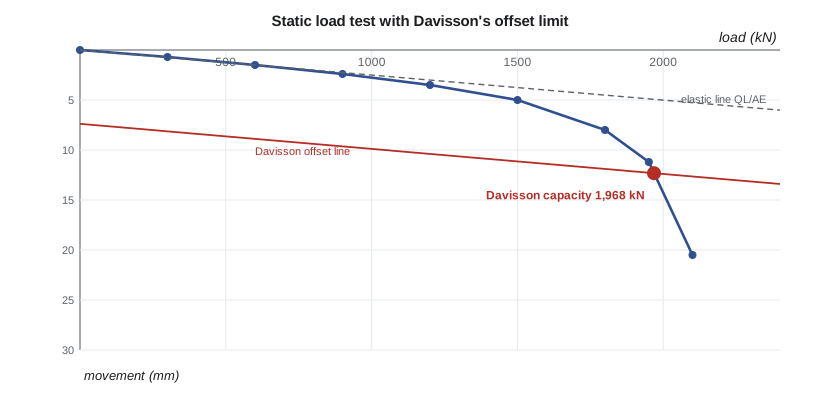
A pile rarely plunges at a clear failure load; the load-movement curve bends gradually. A definition of capacity is therefore needed. The most widely used for driven piles in North America is Davisson's offset limit, proposed in 1972: the capacity is the load at which the movement exceeds the elastic compression of the pile, treated as a free column, by an offset of 4 mm plus \(D/120\):
Other criteria include Chin's hyperbolic extrapolation, Brinch Hansen's 80 % criterion, and a movement of 10 % of the diameter, often used for drilled shafts. Davisson's criterion tends to give conservative values for large-diameter piles, because their toe needs large movement to mobilize.
Dynamic formulas and the wave equation
Before dynamic monitoring, engineers estimated pile capacity from the set per blow with dynamic formulas, which equate the energy of the hammer to the work done by the soil resistance over the set, less losses. The Engineering News formula of 1888, the Hiley formula and many others were used for a century. Comparisons with load tests show that most dynamic formulas are unreliable, with errors of a factor of two or three, because they cannot represent the stress wave that travels down the pile during a blow. The FHWA-modified Gates formula performs better than most and is still used, with a low resistance factor, where no dynamic testing is available. The wave equation analysis, introduced by Smith in 1960, models the hammer, cushion, pile and soil as masses and springs and follows the stress wave in time steps. It is used before construction to choose a hammer that can drive the pile without overstressing it, and to set the driving criterion: the blow count that indicates the required capacity.
Sofia's script calculates the lateral resistance and deflection of the pile, interprets the static test with Davisson's criterion, and compares the results of dynamic testing and the Gates formula.
# Lateral load on the fleet building piles (Broms and elastic subgrade) and the test pile results
from math import pi, tan, radians, sqrt, log10
D_in, t_in, fy = 16.0, 0.5, 50.0                 # pipe diameter and wall (in.), steel yield (ksi)
d_in = D_in - 2*t_in; D = D_in/12
Is = pi/64*(D_in**4 - d_in**4); Ic = pi/64*d_in**4
EI = (29000*Is + 0.4*3600*Ic)/144                # kip-ft2; concrete fill at 40 % for cracking
My = fy*(D_in**3 - d_in**3)/6/12                 # plastic moment of the steel pipe alone (kip-ft)
gamma, phi = 0.096, 34.0                         # average effective unit weight over the upper 13 ft (kcf)
Kp = tan(radians(45 + phi/2))**2
def broms_long(My, head):
    """Ultimate lateral load of a long pile in sand (Broms), e = 0; solved by iteration."""
    Hu = 20.0
    for _ in range(100):
        f = 0.82*sqrt(Hu/(gamma*D*Kp))           # depth of maximum moment (ft)
        Hu = (1.0 if head == 'free' else 2.0)*My/(0.67*f)
    return Hu, f
print(f"EI = {EI:,.0f} kip-ft2, My = {My:.0f} kip-ft, Kp = {Kp:.2f}")
for head in ('free', 'fixed'):
    Hu, f = broms_long(My, head)
    print(f"Broms, {head}-head long pile: Hu = {Hu:.0f} kips (maximum moment at {f:.1f} ft); allowable Hu/2.5 = {Hu/2.5:.0f} kips")
nh = 42.0                                        # coefficient of subgrade reaction, medium dense sand above the water (kcf)
T = (EI/nh)**0.2
H = 7.0                                          # service lateral load per pile (kips)
print(f"Relative stiffness length T = {T:.2f} ft; L/T = {49.0/T:.1f} (long pile if > 4)")
print(f"Head deflection under {H:.0f} kips: free head {12*2.43*H*T**3/EI:.2f} in., fixed head {12*0.93*H*T**3/EI:.2f} in.; "
      f"fixed-head moment {0.93*H*T:.0f} kip-ft")

# static load test (ASTM D1143 quick test) on the test pile, with Davisson's offset limit
L, AE = 49.0*12, 29000*pi*15.5*0.5 + 3600*pi*15.0**2/4
data = [(0, 0.0), (70, 0.03), (135, 0.06), (200, 0.09), (270, 0.14), (340, 0.20), (405, 0.31), (440, 0.45), (470, 0.76), (495, 2.31)]
off = lambda P: P*L/AE + 0.15 + D_in/120
for (p1, d1), (p2, d2) in zip(data, data[1:]):
    g1, g2 = d1 - off(p1), d2 - off(p2)
    if g1 < 0 <= g2:
        Pd = p1 + (p2 - p1)*(-g1)/(g2 - g1); break
print(f"\nDavisson capacity of the test pile: {Pd:.0f} kips (prediction by static analysis 401 kips, ratio {Pd/401:.2f})")
print("PDA with signal matching: 333 kips at end of driving, 432 kips at the 7-day restrike (setup in the clay)")
Er, Nb = 51600, 8                                # rated hammer energy (ft-lb), final set in blows per inch
print(f"FHWA-modified Gates formula: Qu = 1.75 sqrt(Er) log(10 Nb) - 100 = {1.75*sqrt(Er)*log10(10*Nb) - 100:.0f} kips")EI = 172,255 kip-ft2, My = 501 kip-ft, Kp = 3.54 Broms, free-head long pile: Hu = 72 kips (maximum moment at 10.4 ft); allowable Hu/2.5 = 29 kips Broms, fixed-head long pile: Hu = 115 kips (maximum moment at 13.0 ft); allowable Hu/2.5 = 46 kips Relative stiffness length T = 5.28 ft; L/T = 9.3 (long pile if > 4) Head deflection under 7 kips: free head 0.17 in., fixed head 0.07 in.; fixed-head moment 34 kip-ft Davisson capacity of the test pile: 443 kips (prediction by static analysis 401 kips, ratio 1.10) PDA with signal matching: 333 kips at end of driving, 432 kips at the 7-day restrike (setup in the clay) FHWA-modified Gates formula: Qu = 1.75 sqrt(Er) log(10 Nb) - 100 = 657 kips
Reading the results
Laterally, the fixed-head pile has an ultimate capacity of 115 kips by Broms; with a factor of safety of 2.5, its allowable lateral load is 46 kips, more than six times the service lateral load of 7 kips per pile. Under that load, the fixed head deflects only 0.07 in., and the head moment of 34 kip-ft is small. The relative stiffness length is 5.3 ft, so the pile, at more than nine times that length, behaves as a long pile.
The static test reached 495 kips, where the pile plunged. The Davisson capacity is 443 kips, 10 % more than the static analysis predicted. The PDA tests show the effect of setup in the clay: 333 kips at the end of driving and 432 kips on restrike seven days later, close to the static result. The Gates formula gives 657 kips, half as much again as the true value, a reminder of why dynamic formulas are no longer relied on when better methods are available.
With the static test confirming the predicted capacity, the design may use the higher resistance or the lower factor of safety of lesson 9, and four piles per column. Dr. Kowalczyk adds two requirements for construction: every production pile must reach the design toe level in the till with a final set not less than the driving criterion established by wave equation analysis and confirmed by the PDA on the test pile, and at least 5 % of the production piles must be tested dynamically on restrike.
Practical points
- Lateral pile behavior depends on the upper five to ten diameters of soil and on the head fixity.
- Use Broms for ultimate lateral resistance and subgrade reaction or p-y analysis for deflection.
- Test piles before production when the savings justify it; instrument test piles where possible.
- Interpret static tests with a stated criterion, such as Davisson's offset limit.
- Use dynamic testing with signal matching on production piles; do not rely on dynamic formulas.
Common mistakes
MistakeJudging a pile's lateral resistance from the soil near its toe.
InsteadLateral resistance comes from the soil near the surface.
MistakeTreating a pile cast into a stiff cap as free-headed.
InsteadFixed heads roughly double the resistance and reduce deflection; analyze the actual fixity.
MistakeTaking the maximum test load as the capacity.
InsteadApply a defined failure criterion to the load-movement curve.
MistakeTesting a pile in clay only at the end of driving.
InsteadRestrike after setup to measure the long-term capacity.
Summary and key terms
- Lateral loads are resisted by near-surface soil; long piles fail by plastic hinges.
- Broms, long pile in sand: \(f = 0.82\sqrt{H_u/(\gamma'DK_p)}\), \(0.67H_uf = M_y\) (free head) or \(2M_y\) (fixed head).
- Deflection of a long pile: \(T = (EI/n_h)^{1/5}\), \(y_0 = 2.43HT^3/EI\) free, \(0.93HT^3/EI\) fixed.
- Davisson's offset: movement equal to \(QL/AE\) plus 4 mm (0.15 in.) plus \(D/120\).
- Fleet building test pile: Davisson capacity 443 kips, 10 % above the prediction; PDA restrike 432 kips.
- Free-head pile
- A pile whose head is free to rotate under lateral load.
- Fixed-head pile
- A pile whose head is restrained from rotating by a stiff cap.
- Coefficient of subgrade reaction
- The rate of increase with depth of the horizontal spring stiffness of the soil.
- p-y curve
- A nonlinear relation between soil resistance per unit length and lateral deflection of a pile.
- Static load test
- A test in which a pile is loaded slowly with a jack and its movement measured.
- Pile driving analyzer
- An instrument that records strain and acceleration at the pile head during driving to evaluate capacity.
- Davisson offset limit
- A failure criterion defined by an offset from the elastic compression line of the pile.
- Wave equation analysis
- A numerical model of stress wave propagation in a pile during driving.
Practice problems
Work each problem on paper first, then reveal the answer to check.
A pile has \(EI = 120{,}000\) kip-ft² in sand with \(n_h = 30\) kcf. Find T and the free-head deflection under 6 kips.
Show answer
\(T = 4000^{0.2} = 5.25\) ft; \(y_0 = 2.43(6)(145)/120{,}000 = 0.0176\) ft = 0.21 in.
Find Davisson's offset for a 12.75 in. pile.
Show answer
\(0.15 + 12.75/120 = 0.256\) in., added to the elastic line.
Why do dynamic formulas give unreliable capacities?
Show answer
They treat the blow as a rigid-body energy balance and cannot represent the stress wave in the pile or the dynamic soil resistance.
What does a restrike test reveal in clay?
Show answer
The setup: the increase in capacity as pore pressures from driving dissipate.
Lesson quiz · 5 questions
Score 60% or more to complete this lesson.
Create a free account to save your progress, take quizzes and earn a certificate.