
CIV-341 · Lesson 10 of 12 · 21 min
Pile groups, settlement and downdrag
Piles rarely work alone. Under each fleet building column, four piles will share the load through a cap, and the yard around the building will be raised by a fill that will settle the clay through which the piles pass. This lesson examines how piles behave in groups, how much a pile group settles, and what happens when the soil around a pile settles more than the pile itself, dragging it down. That last phenomenon, downdrag, has caused more misunderstanding than almost any other topic in foundation engineering, and the modern treatment, the unified method developed by Fellenius, is presented in detail.
Group efficiency
The capacity of a group of piles is not necessarily the sum of the capacities of its individual piles. The ratio of the two is the group efficiency \(\eta\). Several empirical formulas exist; the best known, the Converse-Labarre formula, depends only on geometry:
for a group of \(m\) rows of \(n\) piles of diameter \(D\) at spacing \(s\). It predicts efficiencies of 0.7 to 0.8 at typical spacings, but it has no basis in mechanics and does not agree with load tests in sand. Driven piles in sand compact the soil between them, and groups of driven piles in loose to medium dense sand commonly have efficiencies greater than one. In practice, the capacity of a group of driven piles in sand or till is taken as the sum of the individual capacities, and the formula is mainly of historical interest.
Block failure in clay
In clay, closely spaced piles may fail together as a block, the soil between them moving with the piles. The block capacity is the shear resistance on the perimeter of the block plus the bearing capacity of its base:
with \(N_c\) up to 9 for a deep block. The group capacity is the lesser of the block capacity and the sum of the individual capacities. Block failure governs only for closely spaced piles in clay, typically at spacings below about two to three diameters, and for groups whose toes are also in clay. For the fleet building, the piles end in dense till, and the block capacity is about twice the sum of the individual capacities.
Settlement of pile groups
Even when the capacity of a group is the sum of its parts, its settlement is not. A single pile under its working load settles a few millimeters. A group settles more, because the stresses from all the piles overlap in the soil below the toes, stressing a much larger and deeper volume. Terzaghi and Peck proposed a simple and still widely used model, the equivalent footing. For piles that pass through soft soil into a firm bearing layer, the group load is assumed to act on an imaginary footing the size of the group, located at two thirds of the depth of penetration into the bearing layer, and to spread below it at 2:1. The settlement of the equivalent footing is calculated by the methods of lessons 5 and 6, and the elastic shortening of the piles above it is added:
For friction piles in a uniform clay, the equivalent footing is placed at two thirds of the pile length. More refined methods based on elastic interaction factors, developed by Poulos and Davis, and numerical analyses are used for large groups and piled rafts.
Negative skin friction and downdrag
When the soil around a pile settles relative to the pile, the shear stress on the pile shaft reverses: instead of supporting the pile, the soil drags it down. This is negative skin friction. It arises when a fill is placed on soft ground around piles, when the water table is lowered, when a soft clay is still consolidating under its own weight or a recent fill, or when a loose fill is wetted or vibrated. The load it adds to the pile is called the drag force, and the settlement it causes is called downdrag.
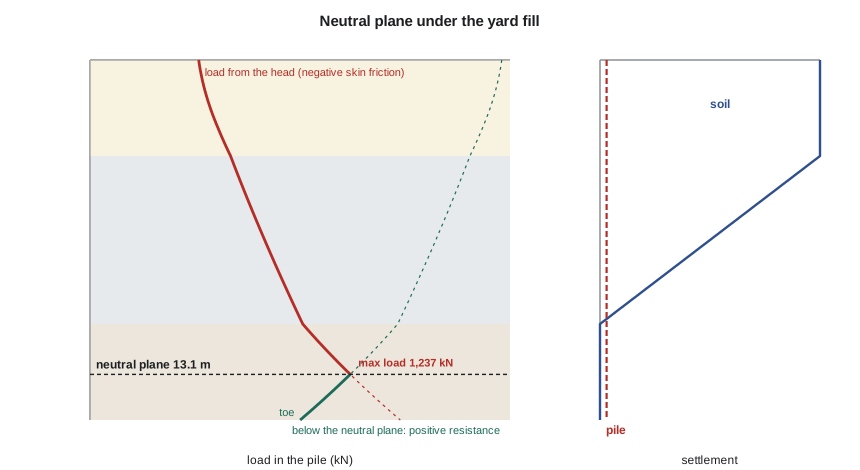
For many years, designers treated the drag force as an additional load to be added to the structural load and carried by the positive resistance below the settling layer, with a factor of safety on both. Load tests and instrumented piles showed that this view is wrong. Fellenius, Bozozuk and others measured the forces in piles over many years and found that negative skin friction develops along the upper part of a pile and positive resistance along the lower part, and that the two meet at a depth called the neutral plane. At the neutral plane, there is no relative movement between the pile and the soil, the load in the pile is greatest, and the pile and soil settle by the same amount.
The unified method
The unified method, now reflected in many design guides, separates three questions.
- Geotechnical capacity. The drag force is not a load that can cause the pile to plunge, because it disappears as soon as the pile moves down relative to the soil. The ultimate limit state is checked with the structural loads only, against the full positive shaft and toe resistance, as in lesson 9.
- Structural strength. The maximum load in the pile, at the neutral plane, is the sustained load plus the drag force. The pile material must carry it; transient live loads are not added, because they temporarily reduce the drag.
- Settlement. The pile head settles as much as the soil at the neutral plane, plus the elastic shortening of the pile. If the neutral plane lies in the bearing layer, where the soil settles little, downdrag is negligible even if the drag force is large. If it lies in a settling clay, the pile will follow the clay down.
The neutral plane is found by plotting two curves: the load in the pile from the head downward, starting with the sustained load and adding the negative skin friction, and the resistance from the toe upward, starting with the mobilized toe resistance and adding the positive shaft resistance. They intersect at the neutral plane. Its depth depends on how much toe resistance is mobilized, which depends on the toe movement; the more the toe moves, the more resistance it develops and the lower the neutral plane.
Worked problem
Drag force on the fleet building piles
The yard fill adds 500 psf to the effective stress everywhere. Each pile carries a sustained dead load of 116 kips, including its share of the cap. Explain how the neutral plane is found, and why the toe resistance matters.
Show solution
- Downward from the head, the load in the pile grows by the unit shaft resistance acting downward:
- \[Q(z) = Q_d + \int_0^z p\,f_s\,dz\]
- Upward from the toe, the resistance grows from the mobilized toe resistance:
- \[Q_r(z) = Q_{t,mob} + \int_z^{L} p\,f_s\,dz\]
- At the neutral plane \(z_n\), \(Q(z_n) = Q_r(z_n)\). The drag force is \(Q(z_n) - Q_d\).
- With the full toe resistance of 226 kips, the curves cross deep in the till; with half of it, higher up, near the base of the clay.
Answer: The same unit shaft resistance acts downward above the neutral plane and upward below it, because in the long term the soil has moved relative to the pile in opposite directions on either side of the plane.
Sofia's script checks the group efficiency and block capacity, estimates the group settlement with the equivalent footing, and finds the neutral plane for full and half mobilization of the toe resistance under the yard fill.
# Four-pile group: efficiency, block check, group settlement and downdrag from the yard fill
from math import pi, sin, tan, radians, sqrt, atan, degrees, log10
D, tip, s, n, m = 16/12, 49.0, 4.0, 2, 2          # pile diameter, tip depth, spacing 3D (ft), 2 x 2 group
theta = degrees(atan(D/s))
E = 1 - theta*((n - 1)*m + (m - 1)*n)/(90*m*n)
print(f"Converse-Labarre efficiency (for comparison only): theta = {theta:.1f} deg, E = {E:.2f}")
# block failure through the clay: perimeter shear on su plus bearing on the till at the block base
Bb = s + D
Q_block = (4*Bb*23.0*1150.0 + 4*Bb*13.0*2500.0 + Bb**2*9.0*8350.0)/1000   # clay su, till average shaft, till base
print(f"Block width {Bb:.2f} ft: block capacity about {Q_block:,.0f} kips vs 4 single piles 4 x 401 = {4*401:,} kips")

# group settlement: equivalent footing at 2/3 of the penetration into the till, load spread 2V:1H
z_eq = 36.0 + 2/3*(tip - 36.0); Q_sus = 425.0 + 0.5*250.0 + 37.0     # sustained load incl. cap (kips)
sett = 0.0; z = z_eq
while z < z_eq + 65.0:
    dz = 0.25; Es = 2090e3 if z < 51.0 else 20900e3                    # till about 2,090 ksf, basalt 20,900 ksf (psf)
    sett += Q_sus*1000/(Bb + (z - z_eq + dz/2))**2*dz/Es; z += dz
EA = 29000*pi*15.5*0.5 + 3600*pi*15.0**2/4        # steel pipe plus concrete fill (kips)
elastic = (Q_sus/4)*(tip*0.6*12)/EA                # pile shortening (in.), effective length about 0.6 L
print(f"Equivalent footing at {z_eq:.1f} ft: settlement below it {12*sett:.2f} in., pile shortening {elastic:.2f} in.")

# downdrag: 4 ft of yard fill (500 psf) consolidates the clay; find the neutral plane (unified method)
def eff(z, fill=500.0):
    s_ = 115.0*min(z, 8.0) + 126.0*max(0.0, min(z, 13.0) - 8.0) + 115.0*max(0.0, min(z, 36.0) - 13.0) + 137.0*max(0.0, z - 36.0)
    u = 62.4*max(0.0, z - 8.0) if z <= 13.0 else 312.0 + 1622.0*(z - 13.0)/23.0 if z <= 36.0 else 62.4*(z - 5.0)
    return s_ - u + fill
def fs(z):
    se = eff(z)
    if z < 13.0: return tan(radians(0.8*34))*se
    if z < 36.0: return min(1.0, 0.5*(1150/se)**-0.5 if 1150/se <= 1 else 0.5*(1150/se)**-0.25)*1150
    return tan(radians(0.8*38))*se
per, dz = pi*D, 0.1
zs = [k*dz for k in range(int(round(tip/dz)) + 1)]
Qd = (425.0 + 37.0)/4*1000                      # dead load per pile (lb); transient live load does not add to drag
Qt_full = 50*(eff(tip) - 500.0)*pi*D**2/4
for frac in (1.0, 0.5):
    Qt = frac*Qt_full
    down = [Qd]; up = [0.0]*len(zs); up[-1] = Qt
    for z in zs[1:]: down.append(down[-1] + fs(z - dz/2)*per*dz)
    for k in range(len(zs) - 2, -1, -1): up[k] = up[k + 1] + fs(zs[k] + dz/2)*per*dz
    k = min(range(len(zs)), key=lambda i: abs(down[i] - up[i]))
    print(f"Toe mobilized {100*frac:.0f} %: neutral plane at {zs[k]:.0f} ft, drag force {(down[k] - Qd)/1000:.0f} kips, "
          f"maximum load in the pile {down[k]/1000:.0f} kips")
def clay_settlement_below(zn):
    t = 0.0; dz = 0.25
    for k in range(92):
        z = 13.0 + dz*(k + 0.5)
        if z < zn: continue
        s0 = eff(z, 0.0); sp = s0 + 800.0; sf = s0 + 500.0
        t += dz*(0.047/2.06*log10(sf/s0) if sf <= sp else (0.047*log10(sp/s0) + 0.316*log10(sf/sp))/2.06)
    return 12*t
print(f"Fill settlement of the ground surface {clay_settlement_below(0):.1f} in.; of the soil at 36 ft and below: "
f"{clay_settlement_below(36.0):.1f} in.; below 35 ft: {clay_settlement_below(35.0):.2f} in.")Converse-Labarre efficiency (for comparison only): theta = 18.4 deg, E = 0.80 Block width 5.33 ft: block capacity about 3,395 kips vs 4 single piles 4 x 401 = 1,604 kips Equivalent footing at 44.7 ft: settlement below it 0.37 in., pile shortening 0.04 in. Toe mobilized 100 %: neutral plane at 43 ft, drag force 162 kips, maximum load in the pile 278 kips Toe mobilized 50 %: neutral plane at 35 ft, drag force 106 kips, maximum load in the pile 222 kips Fill settlement of the ground surface 0.7 in.; of the soil at 36 ft and below: 0.0 in.; below 35 ft: 0.02 in.
Reading the results
The Converse-Labarre formula gives an efficiency of 0.80, which Dr. Kowalczyk notes but does not use, because the piles are driven displacement piles ending in dense till. The block capacity is about twice the sum of the four single piles, so block failure does not govern. The equivalent footing at 44.7 ft, two thirds of the way into the till, settles 0.37 in. under the sustained load of 587 kips, and the piles shorten by about 0.04 in.: the group settles about 0.4 in., an order of magnitude less than spread footings would.
With the full toe resistance mobilized, the neutral plane is at 43 ft in the till and the drag force is 162 kips, so the maximum load in the pile is 278 kips. With only half the toe resistance mobilized, the neutral plane rises to 35 ft, near the base of the clay, and the drag force is 106 kips. In either case the soil at the neutral plane settles by less than 0.05 in. under the fill, although the ground surface settles 0.7 in. The piles will therefore not suffer downdrag, and the maximum load is far below the structural design strength of about 1,600 kips. The ground around the building, however, will settle relative to the building, and the floor slab, the aprons and the service connections must be detailed for it.
Owen asks what would have happened if the piles had been friction piles ending in the clay. The neutral plane would then lie in the clay, the piles would settle with the clay, and the building would settle almost as much as the yard. That is the classic downdrag failure: piles that have adequate capacity on paper but follow the consolidating soil down. Ending the piles in a stratum that does not settle is the most reliable cure.
Reducing drag force
Where the drag force would overload a pile structurally, or where the neutral plane would lie in settling soil, several measures help. Bitumen coatings on the pile shaft through the settling layers reduce negative skin friction substantially, as long as the coating survives driving. Placing and consolidating the fill before the piles are installed, with vertical drains to speed the process, removes the cause. Lightweight fills, such as expanded polystyrene blocks, lightweight aggregate or foamed concrete, reduce the stress increase. Increasing the toe resistance, by driving the piles deeper into the bearing layer, lowers the neutral plane. And a pile can be sleeved through the settling soil, though this also gives up the positive resistance of that soil.
Uplift and lateral effects of groups
A group resisting uplift can fail by pulling out a block of soil if the piles are close together, and its capacity is the lesser of the sum of the individual tension capacities and the weight of the block plus the shear on its perimeter. Under lateral loads, piles in a group shadow one another: a pile in a trailing row pushes against soil already loaded by the leading row, and carries less load at a given deflection. Group reduction factors, called p-multipliers, are applied in lateral analyses, as lesson 11 notes.
Practical points
- Take the capacity of driven pile groups in sand and till as the sum of the individual capacities; check block failure for close groups in clay.
- Estimate group settlement with an equivalent footing in the bearing layer, plus elastic shortening.
- Treat the drag force as a structural load and a settlement issue, not as a reduction of geotechnical capacity.
- Find the neutral plane by the unified method and check the settlement of the soil there.
- End piles in a stratum that does not settle wherever fills, dewatering or consolidation will occur.
Common mistakes
MistakeAdding the drag force to the structural load and requiring the positive resistance to carry both with a factor of safety.
InsteadCheck capacity with the structural loads only; check the maximum load structurally and the settlement at the neutral plane.
MistakeUsing the Converse-Labarre formula to reduce the capacity of driven piles in sand.
InsteadGroups of driven piles in sand usually have efficiencies of one or more.
MistakeAssuming a pile group settles as much as a single pile.
InsteadGroup settlement is larger because the stresses overlap below the toes.
MistakeAdding transient live load to the drag force for the structural check.
InsteadUse the sustained load; transient load reduces the drag.
Summary and key terms
- Group efficiency formulas are empirical; driven groups in sand and till are taken at the sum of their parts.
- Block failure: perimeter shear plus base bearing; governs only for close groups in clay.
- Equivalent footing at two thirds of the penetration into the bearing layer, spreading at 2:1.
- Negative skin friction above the neutral plane, positive resistance below; the pile settles with the soil at the neutral plane.
- The fleet building piles: drag force 106 to 162 kips, maximum load 278 kips, settlement at the neutral plane under 0.05 in., group settlement about 0.4 in.
- Group efficiency
- The ratio of the capacity of a pile group to the sum of the capacities of its piles.
- Block failure
- Failure of a pile group and the soil between its piles as a single unit.
- Equivalent footing
- An imaginary footing used to estimate the settlement of a pile group.
- Negative skin friction
- Downward shear on a pile from soil that settles relative to it.
- Drag force
- The load added to a pile by negative skin friction.
- Downdrag
- Settlement of a pile caused by settlement of the surrounding soil.
- Neutral plane
- The depth at which there is no relative movement between the pile and the soil and the pile load is greatest.
- Unified method
- Fellenius's approach that treats capacity, drag force and downdrag settlement as separate checks.
Practice problems
Work each problem on paper first, then reveal the answer to check.
Find the Converse-Labarre efficiency of a 3 × 3 group with s = 3D.
Show answer
\(\theta = 18.4^\circ\); \(\eta = 1 - 18.4(6 + 6)/(90 \times 9) = 0.73\).
A pile's neutral plane is in a settling clay that settles 30 mm (1.2 in.) at that depth. How much will the pile head settle?
Show answer
About 30 mm (1.2 in.) plus the elastic shortening of the pile above the neutral plane.
Give three ways to reduce drag force on piles.
Show answer
Bitumen coating, preloading the fill before piling, lightweight fill, or deeper toes to lower the neutral plane.
Why is the drag force not added to the load when checking geotechnical capacity?
Show answer
If the pile starts to plunge, it moves down relative to the soil and the negative skin friction turns into positive resistance; the drag cannot cause plunging failure.
Lesson quiz · 5 questions
Score 60% or more to complete this lesson.
Create a free account to save your progress, take quizzes and earn a certificate.