
CIV-331 · Lesson 7 of 12 · 19 min
Shear, web strength and concentrated loads
The web of a beam carries the shear and resists the concentrated forces at supports and under point loads. In most rolled beams under uniform load the web is so generous that shear barely registers, but there are important exceptions: short heavily loaded beams, coped beam ends, deep plate girders with thin webs, and beams resting on walls or carrying columns. This lesson covers shear yielding and shear buckling, the local limit states of the web under concentrated loads, and the stiffeners that strengthen webs when they are needed.
Shear stress in an I-section
Elementary beam theory gives the shear stress at a level in a cross-section as \(\tau = VQ/(It)\), where \(Q\) is the first moment of the area beyond that level and \(t\) is the width there. In a rectangle the stress is parabolic, with a maximum of 1.5 times the average. In an I-section the flanges are wide, so the shear stress in them is small, while the web carries almost the whole shear at a nearly uniform stress. The maximum, at the neutral axis, is only 5 to 15 percent above the average over the web area. Design therefore treats the web as carrying the shear uniformly over an area equal to the full depth times the web thickness.
Shear yielding occurs when the shear stress reaches the shear yield stress, which by the von Mises criterion is \(F_y/\sqrt 3 = 0.577F_y\). Strain hardening and the small contribution of the flanges allow a little more in practice.
Shear strength of rolled shapes
AISC 360 Section G2 gives the design shear strength of a web as
The limit is \(h/t_w = 53.9\) at 50 ksi, and nearly all rolled W shapes meet it. For webs above it, \(\phi_v = 0.90\) and \(C_{v1}\), the ratio of the shear buckling stress to the shear yield stress, is computed from the web slenderness with the buckling coefficient \(k_v = 5.34\) for unstiffened webs; transverse stiffeners raise \(k_v\). The value \(0.6F_y\) is close to the von Mises shear yield stress \(0.577F_y\), increased slightly for strain hardening.
Worked problem
Shear in the mezzanine beams and girders
Check the W21x44 beam (\(d = 20.7\), \(t_w = 0.350\) in., \(h/t_w = 53.6\)) for \(V_u = 42.5\) kips and the W21x62 girder (\(d = 21.0\), \(t_w = 0.400\) in., \(h/t_w = 46.9\)) for \(V_u = 43.6\) kips.
Show solution
- Beam: \(h/t_w = 53.6 < 53.9\), so \(\phi_v = 1.00\) and \(C_{v1} = 1.0\):
- \[\phi_vV_n = 1.00(0.6)(50)(20.7)(0.350) = 217\ \text{kips} \ge 42.5\]
- Girder: \(h/t_w = 46.9 < 53.9\):
- \[\phi_vV_n = 1.00(0.6)(50)(21.0)(0.400) = 252\ \text{kips} \ge 43.6\]
Answer: Shear uses only 20 percent of the beam's strength and 17 percent of the girder's. This is typical of rolled beams under distributed loads.
Shear matters more in short spans with heavy loads, in transfer beams carrying columns, in coped ends where part of the web is removed, and at connections, where the web is checked again for block shear and for bearing of the bolts (lesson 9).
Coped beam ends
When a beam frames into a girder of the same depth, the top flange of the beam, and sometimes the bottom, is cut away so that it clears the girder flange. The cope removes the flange and part of the web at the end of the beam. The reduced section must carry the end shear and the small moment caused by the shear acting over the length of the cope, and a long cope can let the remaining web buckle locally. The block shear check in lesson 9 often governs coped ends, and stiffening or a deeper connection is used for long, deep copes.
For the mezzanine beams a 1.5 in. cope leaves a depth of 19.2 in. and a shear strength of 202 kips, still far above the 42.5 kip reaction.
Web strength under concentrated loads
Where a beam sits on a support or carries a point load on its flange, the force passes through the flange into the web over a short length. Three things can happen to an unstiffened web:
- Web yielding: the web just below the flange yields in compression over the length on which the force spreads.
- Web crippling: the thin web buckles locally and folds just below the loaded flange.
- Web compression buckling and sidesway web buckling: under forces applied to both flanges, or with the compression flange free to move sideways, the whole web depth buckles. These are checked for deep beams and for columns in moment connections.
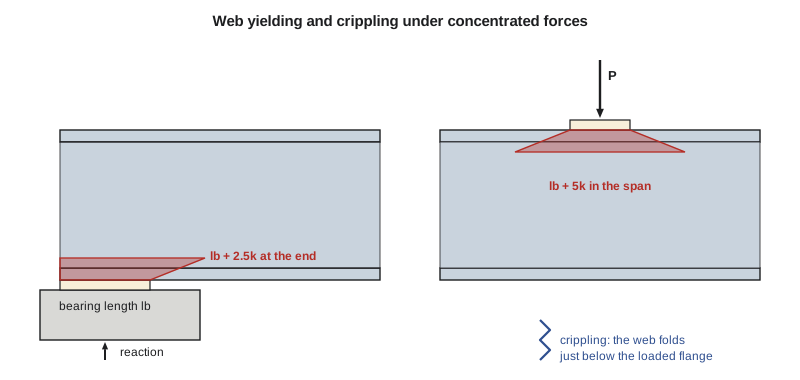
AISC 360 Section J10 gives the strengths for web local yielding and web crippling:
where \(l_b\) is the length of bearing and \(k\) the distance from the outer face of the flange to the web toe of the fillet. Web crippling, with \(\phi = 0.75\), is \(0.80t_w^2\big[1 + 3(l_b/d)(t_w/t_f)^{1.5}\big]\sqrt{EF_yt_f/t_w}\) for interior loads, and \(0.40t_w^2\) times a similar bracket for loads near the end, where the bracket becomes \(1 + (4l_b/d - 0.2)(t_w/t_f)^{1.5}\) when \(l_b/d > 0.2\).
Worked problem
Beam bearing on the concrete wall
At the end wall of the maintenance bay, the mezzanine beams rest on 6 in. steel bearing plates on the concrete wall. Check the W21x44 web (\(k = 0.950\) in., \(t_f = 0.450\) in.) for the end reaction \(V_u = 42.5\) kips, and check an interior storage rack post that delivers 27 kips through a 4 in. cap plate.
Show solution
- End, web local yielding:
- \[\phi R_n = 1.00(50)(0.350)(2.5 \times 0.950 + 6) = 147\ \text{kips}\]
- End, web crippling, with \(l_b/d = 0.29 > 0.2\):
- \[\phi R_n = 0.75(0.40)(0.350)^2\big[1 + (4 \times 0.29 - 0.2)(0.778)^{1.5}\big]\sqrt{\frac{29{,}000(50)(0.450)}{0.350}} = 83\ \text{kips} \ge 42.5\]
- Interior, yielding and crippling:
- \[\phi R_n = 50(0.350)(5 \times 0.950 + 4) = 153\ \text{kips} \qquad \phi R_n = 140\ \text{kips} \ge 27\]
Answer: Web crippling at the end, 83 kips, governs, and the web needs no stiffeners. The bearing plate is sized for the concrete: \(A_1 = 42.5/(0.65 \times 0.85 \times 3.0) = 25.6\) in², so a 6 × 8 in. plate is ample.
Sofia's program runs every shear and bearing check in this lesson so they can be rerun if the reactions change.
import math
# Shear and web local yielding / crippling, AISC 360 Sections G2 and J10
E, Fy = 29000.0, 50.0

def phiVn(d, tw, h_tw):
    # h/tw is taken from the Manual (clear depth less the fillets)
    kv = 5.34
    if h_tw <= 2.24 * math.sqrt(E / Fy):
        phi, Cv1 = 1.00, 1.0
    else:
        phi = 0.90
        lim = 1.10 * math.sqrt(kv * E / Fy)
        Cv1 = 1.0 if h_tw <= lim else lim / h_tw
    return phi * 0.6 * Fy * d * tw * Cv1, phi

print(f"Limit for phi = 1.00: h/tw <= {2.24 * math.sqrt(E / Fy):.1f}")
for name, (d, tw, h_tw, Vu) in {"W21x44 beam": (20.7, 0.350, 53.6, 42.5),
                                 "W21x62 girder": (21.0, 0.400, 46.9, 42.5 + 1.2 * 0.062 * 15)}.items():
    v, phi = phiVn(d, tw, h_tw)
    print(f"{name}: h/tw = {h_tw}, phi = {phi:.2f}, phiVn = {v:.0f} kips, Vu = {Vu:.1f} kips, ratio {Vu/v:.2f}")

# Top flange cope 1.5 in. deep at the beam end
d, tw, dc = 20.7, 0.350, 1.5
print(f"Coped W21x44: phiVn = {1.0*0.6*Fy*(d-dc)*tw:.0f} kips on the reduced depth")

# Web local yielding and crippling at the end support on the concrete wall: lb = 6 in.
d, tw, tf, k, lb = 20.7, 0.350, 0.450, 0.950, 6.0
wly_end = 1.0 * Fy * tw * (2.5 * k + lb)
r = lb / d
f = (4 * r - 0.2) if r > 0.2 else 3 * r
crip_end = 0.75 * 0.40 * tw**2 * (1 + f * (tw / tf)**1.5) * math.sqrt(E * Fy * tf / tw)
print(f"End bearing: web local yielding {wly_end:.0f} kips, web crippling {crip_end:.0f} kips, Vu = 42.5 kips")

# Interior concentrated load from a storage rack post: 27 kips on lb = 4 in.
lb, P = 4.0, 27.0
wly_int = 1.0 * Fy * tw * (5 * k + lb)
crip_int = 0.75 * 0.80 * tw**2 * (1 + 3 * (lb / d) * (tw / tf)**1.5) * math.sqrt(E * Fy * tf / tw)
print(f"Interior load: web local yielding {wly_int:.0f} kips, web crippling {crip_int:.0f} kips, Pu = {P:.0f} kips")

# Bearing plate on concrete, f'c = 3,000 psi, A2/A1 taken as 1
fc = 3.0
A1 = 42.5 / (0.65 * 0.85 * fc)
print(f"Bearing plate area needed = {A1:.1f} in2, e.g. 6 x {A1/6:.1f} in.; use 6 x 8 in.")Limit for phi = 1.00: h/tw <= 53.9 W21x44 beam: h/tw = 53.6, phi = 1.00, phiVn = 217 kips, Vu = 42.5 kips, ratio 0.20 W21x62 girder: h/tw = 46.9, phi = 1.00, phiVn = 252 kips, Vu = 43.6 kips, ratio 0.17 Coped W21x44: phiVn = 202 kips on the reduced depth End bearing: web local yielding 147 kips, web crippling 83 kips, Vu = 42.5 kips Interior load: web local yielding 153 kips, web crippling 140 kips, Pu = 27 kips Bearing plate area needed = 25.6 in2, e.g. 6 x 4.3 in.; use 6 x 8 in.
Bearing stiffeners
If the web cannot carry a concentrated force, pairs of bearing stiffeners are welded to both sides of the web under the load and fitted tightly to the loaded flange. They act with a strip of the web as a short column. The stiffener outstands must meet a local buckling limit, the bearing area of the stiffener ends must carry the force without crushing, and the stiffener-web column, with an effective length of about three quarters of the web depth, must not buckle. Stiffeners are expensive because of the fitting and welding, so designers often prefer a longer bearing plate, which raises the yielding and crippling resistances, or a heavier beam.
Plate girders and tension field action
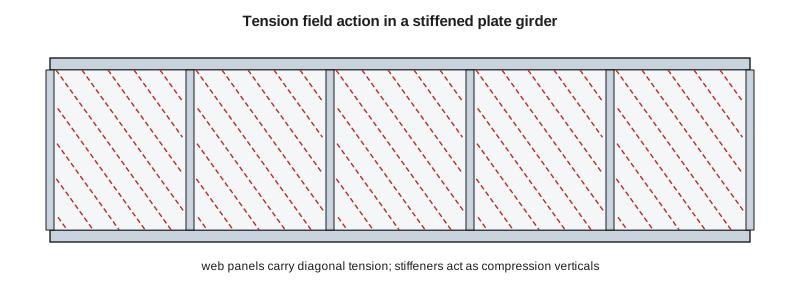
When spans or loads are too large for rolled shapes, girders are built up from plates welded together. Their webs are deep and thin to save weight, and shear buckling becomes the governing concern. A thin web panel between transverse stiffeners does not collapse when it buckles: the buckled web carries diagonal tension like the diagonals of a Pratt truss, while the stiffeners act as the verticals. This tension field action raises the post-buckling shear strength well above the buckling load. Both standards allow it for interior panels with stiffeners at suitable spacing, and the shear resistance then depends on the panel aspect ratio and the web slenderness. Plate girders also need checks for flange-induced web buckling and for interaction of shear and moment in some cases.
Shear and moment together
A simply supported beam has its largest shear at the supports, where the moment is zero, and its largest moment at midspan, where the shear is small, so the two rarely interact. They meet at the interior supports of continuous beams, at the ends of cantilevers and under heavy point loads close to a support. For rolled shapes with stocky webs, tests show little reduction in plastic moment until the shear exceeds about 60 percent of the shear capacity, and neither standard requires an interaction check for them. Plate girders that rely on tension field action are different: the tension field and the flanges share the web, and the standards limit the combination. A quick test for any beam is to compare the factored shear with about 0.6 of the shear resistance at the sections of high moment; if it is lower, as it is for every member in the mezzanine, the two checks are independent.
Practical points
- Check shear in short, heavily loaded beams and at coped ends; for typical floor beams it rarely governs.
- Give beams adequate bearing length on walls and use bearing plates sized for the concrete or masonry.
- Where a column bears on a beam, check web yielding and crippling, and consider bearing stiffeners or a heavier web.
- Avoid stiffeners where a slightly heavier rolled section would do; fabrication time costs more than steel weight.
Common mistakes
MistakeUsing only the web clear depth for shear area in a rolled shape.
InsteadAISC takes \(A_w = dt_w\), the full depth times web thickness.
MistakeChecking web yielding but not crippling.
InsteadCrippling often governs at beam ends, especially for thin webs.
MistakeForgetting that a cope reduces both shear area and flexural strength at the beam end.
InsteadCheck the coped section and block shear at the connection.
MistakeAdding stiffeners by habit.
InsteadA longer bearing or a heavier section is often cheaper.
Summary and key terms
- In an I-section the web carries nearly all the shear at an almost uniform stress.
- AISC: \(\phi_vV_n = 0.6F_yA_wC_{v1}\), with \(\phi_v = 1.00\) for most rolled I-shapes.
- Under concentrated loads, webs are checked for yielding and crippling; crippling often governs at ends.
- Bearing stiffeners act as short columns; longer bearings or heavier sections are alternatives.
- Thin plate girder webs develop tension field action between stiffeners after buckling.
- The mezzanine beam end, W21x44 on a 6 in. plate, has a crippling strength of 83 kips against 42.5 kips.
- Shear yielding
- Yielding of the web under shear stress near Fy/√3.
- Shear buckling
- Buckling of a thin web panel under shear.
- Web crippling
- Local folding of the web just below a concentrated load.
- Web local yielding
- Compressive yielding of the web over the length on which a concentrated force spreads.
- Bearing stiffener
- A plate welded to the web under a concentrated load to act with the web as a column.
- Cope
- A cutout at the end of a beam that removes part of a flange and web to clear another member.
- Tension field action
- Post-buckling shear resistance of a stiffened web through diagonal tension.
- Plate girder
- A girder built up from plates welded together.
Practice problems
Work each problem on paper first, then reveal the answer to check.
Find \(\phi_vV_n\) for a W16x26 (\(d = 15.7\) in., \(t_w = 0.250\) in., \(h/t_w = 56.8\)).
Show answer
\(56.8 > 53.9\), so \(\phi_v = 0.90\); \(1.10\sqrt{5.34(29{,}000)/50} = 61.2 > 56.8\), so \(C_{v1} = 1.0\) and \(\phi_vV_n = 0.90(0.6)(50)(15.7)(0.250) = 106\) kips.
Why does crippling depend on the web thickness squared?
Show answer
It is a plate buckling problem, and plate buckling strength grows with the square of thickness.
How long a bearing would make end web local yielding of the W21x44 equal to 100 kips?
Show answer
\(100 = 50(0.350)(2.375 + l_b)\), so \(l_b = 3.34\) in.
In tension field action, what plays the role of the truss verticals?
Show answer
The transverse stiffeners, which carry compression.
Lesson quiz · 5 questions
Score 60% or more to complete this lesson.
Create a free account to save your progress, take quizzes and earn a certificate.