
CINE-320 · Lesson 9 of 12 · 25 min
Ethics, consent and safety
Documentary cinematography involves real people whose lives continue after the film is finished. A drama actor goes home at the end of the day; a documentary subject may face consequences for years, in their family, community, workplace or legal situation, because of what the camera recorded and how it was used. The person behind the camera is often the one who decides, in the moment, whether to keep filming someone in distress, whether to enter a room, whether to capture a face in a crowd. This lesson covers the ethical principles that guide those decisions, consent and releases, the legal framework of privacy, publicity and defamation in Canada and the United States, errors and omissions insurance, trauma-informed practice, and physical safety planning for crews and subjects.
Ethical principles
Documentary ethics has no single binding code, but filmmakers, broadcasters and professional organizations broadly agree on several principles:
- Truthfulness: do not misrepresent events, people or chronology in ways that mislead the audience. Disclose re-enactments, staging and composites.
- Informed consent: participants should understand what the film is about, how they may appear and where it will be shown before agreeing.
- Do no undue harm: weigh the public value of what you film against the harm it may cause to participants, especially vulnerable people.
- Respect for dignity and privacy: avoid gratuitous exposure of suffering, nudity, illness or grief, and respect cultural norms about images.
- Accountability: be open about methods, funding and relationships, and give participants a way to raise concerns.
- Fairness: give people who are criticized an opportunity to respond.
In recent years, documentary communities have paid increasing attention to the power imbalance between filmmakers and participants. In the United States, the Documentary Accountability Working Group published a framework in 2023 that encourages filmmakers to consider their responsibilities to participants, communities and audiences throughout production. Indigenous communities in Canada and the United States have articulated protocols for filming Indigenous peoples, places and knowledge, including community consent, ownership of cultural material and benefit sharing; Canadian funders and broadcasters increasingly expect productions to follow them, and the Indigenous Screen Office has published guidance on working with Indigenous communities and content.
The camera operator's ethical role
The cinematographer makes ethical decisions every day. Choosing a long lens to film someone who does not know they are being filmed, zooming into a grieving face, continuing to roll when someone asks to stop, or filming a person in crisis rather than helping them are all choices with ethical weight. Practical guidelines many documentary operators follow include: identify yourself and your purpose whenever practical; stop filming when asked, and discuss later whether material can be used; never trade help for footage, and intervene when someone's safety is at risk; avoid filming bystanders' faces in sensitive situations, such as outside clinics, shelters or courts, unless they consent or the story requires it; and think about how images may be used out of context once published.
Consent and releases
Releases are written agreements in which participants grant the production permission to use their image, voice and statements. Typical releases identify the production, describe the use broadly enough to cover future distribution, and are signed and dated, with a parent or guardian signing for minors. Location releases grant permission to film on private property, and materials releases cover photographs, documents or footage supplied by participants.
A signature is not the same as informed consent. Ethical practice means explaining the film in plain language, giving people time to consider, providing copies of documents, translating where necessary and making clear that participation is voluntary. Some productions offer participants the chance to view their scenes before release, not to grant editorial control but to check facts and raise safety concerns. People with diminished capacity, people in crisis, children and people in institutions require particular care. For crowds and public events, productions commonly post visible filming notices, which inform people but do not replace consent where the law or ethics require it.
| Release | Grants | Signed by |
|---|---|---|
| Appearance or personal release | Use of image, voice and statements | Participant, or parent or guardian for minors |
| Location release | Filming on private property | Owner or authorized occupant |
| Materials release | Use of supplied photos, footage or documents | Owner of the material |
| Group or crowd notice | Notice of filming in an area | Posted by the production |
| Music or artwork clearance | Use of copyrighted works in frame | Rights holder |
Privacy, publicity and defamation
In the United States, privacy and publicity rights are mostly matters of state law. Most states recognize a right of publicity that prevents unauthorized commercial use of a person's name or likeness, but courts generally protect documentaries and news reporting as expressive works on matters of public interest, so documentaries can often depict real people without their consent. Productions still need releases where practical because distributors, broadcasters and insurers expect them.
The privacy torts recognized in many states include intrusion upon seclusion, public disclosure of private facts, false light and appropriation of likeness. Defamation requires a false statement of fact that harms reputation; public officials and public figures must prove actual malice under New York Times Co. v. Sullivan (1964). Federal law allows recording a conversation with the consent of one party, but about a dozen states, including California, Florida, Illinois, Maryland, Massachusetts, Pennsylvania and Washington, require the consent of all parties for many private conversations, so the rules where filming occurs must be checked.
Errors and omissions insurance
Broadcasters, streamers and distributors almost always require errors and omissions (E&O) insurance before accepting a documentary. E&O covers claims of defamation, invasion of privacy, infringement of copyright or trademark and similar errors in content. Insurers require productions to follow clearance procedures: obtaining releases, licensing music and archival material, checking titles, documenting fair dealing or fair use decisions (Lesson 10) and having the final cut reviewed by a media lawyer. The camera team supports this by collecting releases on location, noting who appears in footage, avoiding unnecessary logos and artwork in frame, and recording clear notes when people decline to be filmed.
Trauma-informed practice
Many documentaries involve people who have experienced violence, loss, illness or disaster. Trauma-informed practice aims to avoid re-traumatizing participants and to support crews who witness distressing events. Principles drawn from journalism and mental health organizations such as the Dart Center for Journalism and Trauma include: giving participants control over the pace, location and content of interviews; explaining questions in advance; allowing breaks and the right to stop; avoiding sensational framing of distress; checking in after difficult sessions; and connecting participants with support. Crews also experience vicarious trauma, especially when filming conflict, abuse or disaster; productions should plan debriefs and access to counseling.
Physical safety
Documentary crews film in dangerous places: protests, conflict zones, disaster areas, industrial sites, remote wilderness, extreme weather and on the water. Safety planning starts with a written risk assessment that identifies hazards, estimates their likelihood and severity, and sets out controls: training, protective equipment, local fixers and security advisers, communication plans, evacuation routes and medical support. Hostile environment and first aid training (often called HEFAT) is standard for crews working in conflict or civil unrest. The ACOS Alliance's freelance journalist safety principles encourage news organizations and freelancers to share responsibility for safety.
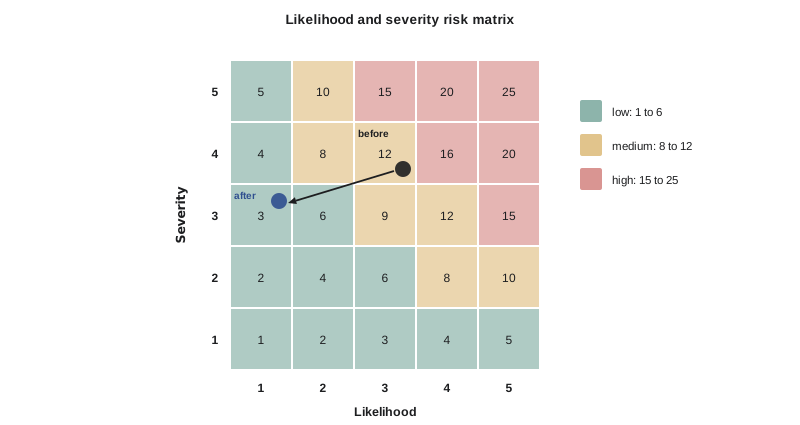
One common approach scores risk by multiplying likelihood and severity, each on a scale from 1 to 5:
Worked problem
Scoring and reducing a filming risk
A crew plans to film a protest that may turn confrontational. They rate the likelihood of a crew member being injured in a crowd surge as 3 (possible) and the severity as 4 (serious injury). After adding controls, including a dedicated safety lookout, a pre-agreed exit route, filming from the edge of the crowd, protective equipment and a buddy system, they reassess the likelihood as 1 and the severity as 3. What are the scores before and after, and what do they mean on a scale where 1 to 6 is low, 8 to 12 medium and 15 to 25 high?
Show solution
- Before controls: \( 3 \times 4 = 12 \), medium risk requiring controls.
- After controls: \( 1 \times 3 = 3 \), low risk.
- The remaining risk should be accepted by an appropriate person, typically the producer, and reviewed if conditions change.
Answer: The score falls from 12 (medium) to 3 (low) with the planned controls.
In the United States, employers have duties under the Occupational Safety and Health Act, including the general duty clause, and state plans, and the industry's joint labor-management safety committee publishes safety bulletins for film and television production. Freelancers should confirm who is responsible for safety and insurance on each job.
Safety of subjects and data
Footage itself can endanger people. Images of activists, whistleblowers, migrants, survivors or people in authoritarian countries can expose them to retaliation if cards are seized or files leaked. Protect identities by blurring faces and altering voices when necessary, encrypt drives, avoid uploading sensitive footage to insecure cloud services, minimize identifying metadata such as GPS tags, and plan what to do if equipment is confiscated at a border. Anonymity promises must be kept through every stage of post-production and distribution.
Filming vulnerable people and children
Children, people with cognitive disabilities, people in mental health crisis, patients, prisoners and others in vulnerable situations need particular protection. Consent must come from a parent, guardian or other authorized person, and assent from the person themselves should be sought in terms they can understand. Consider whether filming is in their interest, how the film might affect them in the future, and whether identifying details should be concealed. Institutions such as schools, hospitals and prisons have their own permission procedures, which must be followed. Broadcasters' journalistic standards in both countries include specific guidance for such situations, and it is wise to consult them early.
After the film is released
Ethical responsibilities continue after release. Participants may face public attention, online harassment or legal consequences. Good practice includes informing participants about release dates, preparing them for publicity, offering support if problems arise, and keeping promises about anonymity and the use of material. Some filmmakers maintain relationships with participants for years and share festival invitations or revenues where appropriate.
Payment and participation
Documentary traditions in both countries generally discourage paying participants for their stories, because payment can create pressure, shape testimony and undermine credibility. At the same time, many filmmakers recognize that participants give time and labor and may incur costs. Common compromises include reimbursing expenses, paying for time spent on production tasks such as travel to an interview, and paying fees for supplied materials such as photographs and home movies. Whatever approach is chosen should be consistent, documented and disclosed to broadcasters when relevant.
Indigenous protocols in practice
When filming with Indigenous communities, productions typically begin with relationship building and community engagement long before the camera arrives. Communities may set conditions on what can be filmed, such as ceremonies or sacred places, who may speak on behalf of the community, and how footage is stored and shared. Some projects establish agreements that give communities rights to review material, retain copies of footage for their own archives or share in revenues. Following these protocols is both an ethical obligation and a practical requirement for many funders and broadcasters.
Common mistakes
MistakeTreating a signed release as complete ethical consent.
InsteadExplain the film clearly and ensure participants understand before they agree.
MistakeContinuing to film when asked to stop.
InsteadStop, and discuss later whether material can be used.
MistakeAssuming the same privacy rules apply everywhere.
InsteadCheck provincial or state law where filming takes place.
MistakeFilming dangerous situations without a risk assessment.
InsteadAssess hazards, plan controls and train the crew.
MistakeStoring sensitive footage carelessly.
InsteadEncrypt, minimize metadata and protect identities.
Summary and key terms
- Documentary ethics centers on truthfulness, informed consent, minimizing harm, dignity and accountability.
- Releases document permission, but informed consent requires understanding.
- Privacy, image rights and recording laws vary by province or state.
- E&O insurance requires careful clearance and documentation.
- Trauma-informed practice gives participants control and supports crews.
- Risk assessments score likelihood times severity and set controls.
- Footage and data must be protected when participants could face retaliation.
- Informed consent
- Agreement given with full understanding of what participation involves.
- Appearance release
- A document granting use of a person's image and voice.
- Location release
- Permission to film on private property.
- Right of publicity
- Protection against unauthorized commercial use of identity.
- Intrusion upon seclusion
- A privacy tort for intentional intrusion into private affairs.
- Defamation
- A false statement that harms someone's reputation.
- E&O insurance
- Errors and omissions insurance covering content claims.
- Trauma-informed practice
- An approach that avoids re-traumatizing participants.
- Risk assessment
- A documented evaluation of hazards and controls.
- HEFAT
- Hostile environment and emergency first aid training.
Practice problems
Work each problem on paper first, then reveal the answer to check.
Name four documentary ethical principles.
Show answer
Truthfulness, informed consent, minimizing harm, dignity, accountability, fairness.
Who signs a release for a minor?
Show answer
A parent or guardian.
What does E&O insurance cover?
Show answer
Defamation, privacy, copyright and similar content claims.
Name two trauma-informed practices.
Show answer
Participant control over pace, breaks, explaining questions, check-ins.
Risk score for likelihood 4 and severity 4?
Show answer
16, high.
Risk score for likelihood 2 and severity 3?
Show answer
6, low.
Why blur faces of some participants?
Show answer
To protect them from retaliation or harm.
What is HEFAT?
Show answer
Hostile environment and first aid training.
What is a location release?
Show answer
Permission to film on private property.
Why note people who decline to be filmed?
Show answer
So editors avoid using them and clearance is documented.
Lesson quiz · 5 questions
Score 60% or more to complete this lesson.
Create a free account to save your progress, take quizzes and earn a certificate.