
CINE-320 · Lesson 3 of 12 · 25 min
Cameras, lenses and kit for run-and-gun
Run-and-gun is the documentary term for shooting on the move, reacting to events with whatever is in your hands. The phrase captures the essence of documentary kit: it must be fast to operate, reliable in bad conditions, light enough to carry all day and good enough to deliver to a broadcaster or streamer. This lesson surveys the camera types, lenses, codecs, media, power and accessories that suit documentary, and shows how to calculate storage needs. CINE-202 covered sensors, log encoding and codecs in depth; here we apply that knowledge to the specific demands of documentary. Models change every year, so this lesson describes types and features rather than recommending products. Check current specifications, approved-camera lists and rental availability when you choose.
What documentary cameras need
A camera that is excellent for drama may be frustrating for documentary. A camera built for documentary should offer:
- Built-in ND filters, ideally variable, so exposure can be adjusted instantly when moving between indoors and outdoors without changing aperture or adding glass to the lens.
- Good low-light performance, often through dual native ISO, because documentary rarely has the luxury of lighting every scene.
- Ergonomics for long handheld use: balanced weight, a comfortable grip, controls that can be reached without looking, a flexible monitor or viewfinder and a top handle.
- Reliable autofocus and focus aids such as face detection, peaking and magnification, because operators pull their own focus while following action.
- Professional audio: XLR inputs with phantom power, physical gain controls, and support for wireless receivers.
- Timecode input and output, so cameras and recorders can be synchronized.
- Efficient, robust codecs with internal recording to affordable media, and long continuous recording without overheating.
- Long battery life and the ability to power from external batteries.
- Weather resistance, quiet fans and fast start-up.
Camera types used in documentary
- Compact cinema cameras: Super 35 or full-frame cameras with built-in ND, professional audio, timecode and modular rigging. They are the workhorse of current streaming documentaries and many broadcast series.
- Shoulder-mount cinema cameras: larger bodies designed to sit on the shoulder, with full-size viewfinders and extensive connectivity; common for high-end observational and multi-camera work.
- Full-frame mirrorless hybrid cameras: small, light, excellent in low light and inexpensive, but often lacking built-in ND, full-size audio inputs and long recording times without accessories. They are popular as second cameras, for gimbals and for discreet shooting.
- Camcorders: integrated zoom lenses, servo zoom rockers, built-in ND, XLR audio and long recording times. Their small sensors make them less cinematic but very practical for news, current affairs and long events.
- Action and 360 cameras: tiny, rugged cameras for mounting on vehicles, bodies or in dangerous places.
- Smartphones: increasingly capable, discreet and always available, with log recording and professional apps; useful for access-restricted situations and participatory projects.
Many broadcasters and streamers publish technical requirements. Some streaming services require originals to be shot predominantly on cameras from an approved list that meets resolution, sensor and codec standards, with allowances for archival, specialty and found footage. Documentary productions should check the commissioning platform's current delivery specifications before choosing the main camera.
Lenses for documentary
Lens choice is a trade-off between flexibility and image quality. Zoom lenses dominate documentary because they let the operator reframe without moving or changing lenses, which matters when action is unpredictable and changing lenses means missing moments. Common choices include a standard zoom covering wide to short telephoto (about 24–70 mm on full frame, or 18–50 mm on Super 35), a longer servo zoom for events, and a wide zoom for tight spaces. Constant-aperture zooms keep exposure steady while zooming; lenses with smooth, non-breathing focus and internal stabilization help handheld work. Primes, often fast lenses around 24, 35 and 50 mm, are used for interviews, low light and a more intimate look.
Focal length shapes the relationship with the subject. Wide lenses used close to people put the viewer in the room and make handheld shake less visible; long lenses observe from a distance, compressing space and isolating subjects but also exaggerating shake and implying surveillance. Many observational cinematographers prefer to stay physically close with a wide or normal lens, which encourages intimacy and honesty, rather than zooming in from across the room.
| Type | Strengths | Limitations | Typical use |
|---|---|---|---|
| Compact cinema camera | ND, audio, timecode, image quality | Needs rigging and accessories | Streaming features and series |
| Shoulder-mount cinema camera | Balance, connectivity, viewfinder | Larger, more conspicuous | Observational, multi-camera |
| Mirrorless hybrid | Small, light, low light, cost | Limited ND, audio and run time | Second camera, gimbal, discreet |
| Camcorder | Servo zoom, long run time, all-in-one | Small sensor look | News, events, current affairs |
| Action camera | Tiny, rugged, mountable | Limited control and quality | Vehicles, points of view |
| Smartphone | Always available, discreet | Small sensor, heat, storage | Access-restricted, participatory |
Codecs and recording formats
Documentary codecs balance image quality, file size and post-production convenience. Intraframe codecs such as Apple ProRes and other all-intra formats compress each frame independently, making editing smooth but files large. Long-GOP codecs such as H.264 and H.265 (HEVC) compress across groups of frames, producing much smaller files but demanding more processing in editing, which is usually handled with proxy files. Raw formats offer the most latitude for grading but create the largest files and the heaviest data management load, so they are used selectively for high-end documentaries, landscapes or specialty shots. Many documentaries shoot a 10-bit log or wide-gamut profile in an efficient codec for the bulk of observational footage and use higher-quality settings for interviews and key scenes.
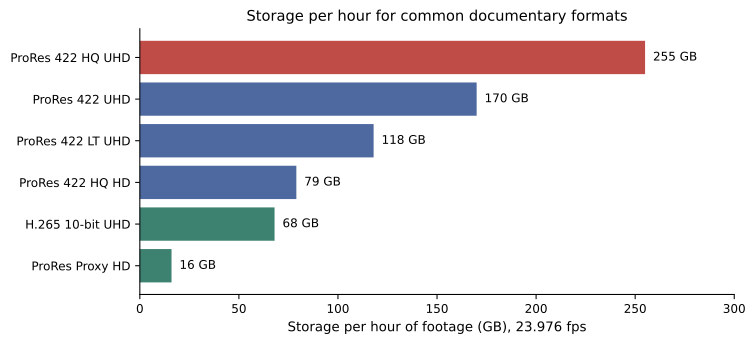
Data rate is the key number for storage planning. It is usually expressed in megabits per second (Mb/s). Because there are 8 bits in a byte, 3,600 seconds in an hour and 1,000 megabytes in a gigabyte, storage per hour is:
| Format | Approximate data rate | Storage per hour |
|---|---|---|
| ProRes 422 HQ | 566 Mb/s | about 255 GB |
| ProRes 422 | 377 Mb/s | about 170 GB |
| ProRes 422 LT | 262 Mb/s | about 118 GB |
| 10-bit H.265 long-GOP | 150 Mb/s | about 68 GB |
| ProRes 422 HQ, HD 1080p | 176 Mb/s | about 79 GB |
| ProRes Proxy, HD 1080p | 36 Mb/s | about 16 GB |
Data rates rise roughly in proportion to frame rate: the same ProRes flavor at 29.97 fps is about 25 % higher than at 23.976 fps, and high-frame-rate recording multiplies storage accordingly. Always confirm the exact figures for your camera and settings in the manufacturer's documentation.
Worked problem
Media for a shoot day
A DP expects to record 4 hours of observational footage in ProRes 422 UHD at 23.976 fps (377 Mb/s) and 1 hour of interview in ProRes 422 HQ UHD (566 Mb/s). Each card holds 512 GB, of which about 480 GB is usable. How much storage is needed for the day, and how many cards should be carried if each card is offloaded and reused only after two verified copies exist?
Show solution
- Observational: \( 0.45 \times 377 \times 4 \approx 679 \) GB.
- Interview: \( 0.45 \times 566 \times 1 \approx 255 \) GB.
- Total: \( 679 + 255 = 934 \) GB, about 1 TB per day.
- Cards: \( 934 \div 480 \approx 1.95 \), so two cards fill in a day. Because offloads may be delayed, carry at least three or four cards so that you never have to format a card before it is backed up.
- Backup drives: two copies of 934 GB require about 1.9 TB of drive space per day.
Answer: About 0.93 TB per day; carry three or four 512 GB cards and at least 2 TB of backup drive space per shoot day.
Media and power
Recording media must be fast enough for the codec's data rate and reliable. Use cards from reputable suppliers and the camera manufacturer's recommended list, format cards in camera, label them clearly and never mix used and fresh cards in the same pouch. A simple system, such as turning cards face down or using red tape once they are full, prevents accidental formatting.
Power is a constant concern. Compact cinema cameras, wireless audio, monitors and lights all consume power, and documentary crews may be away from mains power for hours. External batteries in V-mount or Gold Mount formats are common, along with the camera's own smaller batteries for lightweight configurations. Battery capacity is measured in watt-hours (Wh): a 98 Wh battery can, in principle, supply 98 W for one hour or 25 W for nearly four hours. In practice, about 80 to 90 % of rated capacity is usable, and cold weather reduces it further. Lesson 4 includes a full battery calculation for a shoot day.
Air travel restricts lithium-ion batteries. Under rules followed by major airlines and aviation regulators, spare batteries must be carried in cabin baggage with terminals protected. Batteries up to 100 Wh are generally allowed without approval, batteries over 100 Wh and up to 160 Wh normally require airline approval and are limited to two spares per person, and larger batteries are generally prohibited on passenger aircraft. Check the airline's current rules before traveling.
Essential accessories
- A monitor or electronic viewfinder that works in bright sunlight, with false color, waveform and focus peaking.
- Rigging: a top handle, cage, shoulder pad, rods and quick-release plates that allow fast changes between handheld, shoulder and tripod.
- A lightweight tripod with a fluid head and a monopod for long events.
- Wireless video transmission so the director can watch without crowding the operator.
- Weather protection: rain covers, lens hoods, desiccant packs and lens cloths.
- A small toolkit, gaffer tape, spare cables and a flashlight.
- A camera bag or backpack that allows the camera to be carried ready to shoot.
Choosing a package
The best documentary package is the one that the operator can use instinctively. Many experienced DPs spend days configuring button assignments, menus and rigging so that every common function, from ND to audio levels to magnification, can be reached by touch. A camera that is technically superior but slow to operate will miss the moments that matter. When choosing, balance image quality against size, weight, speed, reliability, cost and the platform's delivery requirements, and always test the package thoroughly before the first shoot day, including battery life, overheating, audio and the full workflow into editing.
Testing and preparing the package
Before any documentary shoot, prepare the package as carefully as you would for a drama. Update firmware only when you have time to test it, because new firmware can change menus or introduce bugs. Set and save user presets for common situations, such as interior daylight, exterior sun and night, and label custom buttons on tape until they become second nature. Shoot a short test through the entire workflow: record on every codec you plan to use, offload, import into the editing system, apply the LUT and check sound sync. This test often reveals problems, such as unsupported codecs, wrong frame rates or audio routed to the wrong tracks, while there is still time to fix them.
Finally, consider how the package looks to the people you film. A large, heavily rigged camera can signal a professional production and reassure institutions, but it can also intimidate participants in their homes. Some cinematographers strip their camera down for intimate scenes and build it up for interviews and events.
Common mistakes
MistakeChoosing a camera only for image quality.
InsteadWeigh ergonomics, ND, audio, run time and reliability as heavily as image quality.
MistakeIgnoring platform delivery specifications.
InsteadCheck approved cameras, resolution and codec requirements before the shoot.
MistakeUnderestimating storage.
InsteadCalculate GB per hour from data rate and plan cards and drives with margin.
MistakeFormatting cards before they are backed up.
InsteadUse a strict card-handling system and two verified copies.
MistakePacking large batteries in checked luggage.
InsteadCarry spares in the cabin and follow airline Wh limits.
Summary and key terms
- Documentary cameras need built-in ND, low-light performance, ergonomics, pro audio and timecode.
- Compact cinema cameras dominate streaming documentaries; hybrids, camcorders and phones fill other roles.
- Zoom lenses give flexibility; wide lenses used close encourage intimacy.
- Intraframe codecs edit easily but create large files; long-GOP codecs are compact.
- Storage per hour in GB is about 0.45 times the data rate in Mb/s.
- Cards, drives and batteries must be planned with margin and handled systematically.
- Airline rules limit lithium-ion batteries, with 100 Wh and 160 Wh thresholds common.
- Run-and-gun
- Shooting on the move, reacting to events as they happen.
- Variable ND
- A built-in neutral density filter with continuously adjustable strength.
- Dual native ISO
- A sensor design with two optimized base sensitivities.
- Intraframe codec
- A codec that compresses each frame independently.
- Long-GOP codec
- A codec that compresses across groups of frames.
- Data rate
- The amount of data recorded per second, usually in Mb/s.
- Proxy
- A smaller copy of footage used for editing.
- Watt-hour
- A unit of battery energy, one watt for one hour.
- V-mount
- A common professional battery mount.
- Approved camera list
- A platform's list of cameras accepted for original productions.
Practice problems
Work each problem on paper first, then reveal the answer to check.
Why is built-in ND valuable in documentary?
Show answer
It allows instant exposure changes without changing aperture.
Why do zooms dominate documentary?
Show answer
They reframe quickly without changing lenses.
Storage per hour at 200 Mb/s?
Show answer
90 GB.
Storage for 3 hours at 377 Mb/s?
Show answer
About 509 GB.
Why carry more cards than needed?
Show answer
So no card is formatted before it is backed up.
Runtime of a 98 Wh battery at 30 W, 85 % usable?
Show answer
About 2.8 hours.
Airline limit for batteries without approval?
Show answer
Generally up to 100 Wh.
What do long lenses imply in observation?
Show answer
Distance, compression and sometimes surveillance.
Name three essential documentary accessories.
Show answer
Sunlight-readable monitor, rigging, tripod, rain cover, wireless video.
What should you test before the first shoot day?
Show answer
Battery life, overheating, audio and the editing workflow.
Lesson quiz · 5 questions
Score 60% or more to complete this lesson.
Create a free account to save your progress, take quizzes and earn a certificate.