
CINE-301 · Lesson 9 of 12 · 25 min
Eyelines, matching and continuity
For a scene to cut together seamlessly, many details must match across shots filmed at different times, from different angles, often hours or days apart. Eyelines must make characters appear to look at each other; actions must continue across cuts; props, costumes, hair and lighting must remain consistent; and performances must align in timing and intensity. This lesson covers eyelines and how close to the lens they sit, matching eyelines in coverage, matching action and cutting on action, continuity of props, wardrobe and makeup, lighting continuity, performance continuity, the role of the script supervisor, and when continuity can be relaxed.
Eyelines
An eyeline is the direction in which a character looks. In coverage, the audience infers what characters are looking at from their eyelines: if a character looks camera left and the next shot shows another character looking camera right, we understand that they are looking at each other. For this to work, eyelines must be consistent with the geography established in wider shots, respect the 180-degree line, and be at the correct height: a standing character talking to a seated one looks down, and the seated character looks up. Directors and operators manage eyelines by placing the off-camera actor, or a mark, at the correct position next to the lens.
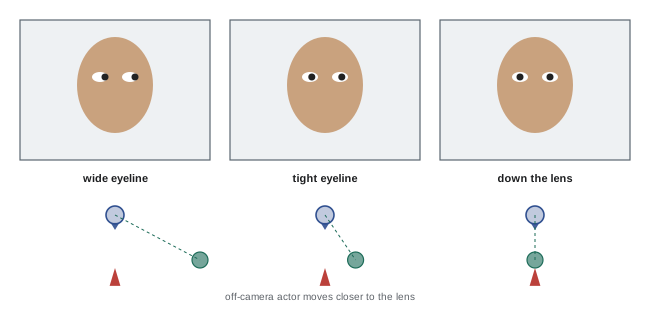
How close to the lens
How close to the lens a character looks has a strong effect on intimacy. A wide eyeline, the character looking well off to the side of the camera, feels distant and observational; a tight eyeline, looking just beside the lens, brings the audience close to the character's gaze and makes the shot more intimate and intense. In coverage of intense conversations, directors often bring the eyelines tighter as the scene progresses, sometimes asking the off-camera actor to stand right next to the matte box. Looking directly into the lens breaks the convention of the invisible camera: it addresses the audience, as in comedies, documentaries and films such as Moonlight (2016), which uses direct gazes at key moments to create startling intimacy. Accidental glances at the lens are usually avoided because they break the illusion.
Matching eyelines in coverage
For singles to cut together, the eyelines on each side must match in direction and closeness. If character A's single has a tight eyeline just camera right, character B's reverse should have a similarly tight eyeline camera left, unless the difference is deliberate. Height must match too: if A is taller, B's eyeline points up slightly, and A's points down. When the off-camera actor is not available, a stand-in, a tennis ball on a stand or a piece of tape marks where the character should look, and the script supervisor notes the position. In multi-camera cross-coverage, both actors give eyelines to each other naturally, but camera positions must be planned so the eyelines look correct in each single.
Matching action and cutting on action
When a movement spans a cut, such as a character sitting down, opening a door or picking up a cup, the action must be performed the same way in each shot so the editor can cut in the middle of it. Cutting on action, cutting during a movement rather than before or after, hides the cut because the eye follows the motion. To make this possible, actors repeat actions consistently in every setup, with the same timing, hand and position, and setups overlap the action, starting a little before and ending a little after the cut point. The script supervisor notes which hand held the cup, at which line the character stood up, and so on.
Worked problem
Overlapping action for a cut
In a scene, a character stands up from a chair on the line "I'm leaving." The director plans to cut from a medium shot to a wide shot as she stands. How should the action be filmed in each setup?
Show solution
- In the medium shot, the actor plays the line and stands up fully, continuing the movement until she is upright and starting to turn.
- In the wide shot, the actor begins seated a few lines before, plays the line and stands in the same way and at the same moment.
- Both setups contain the complete movement, so the editor can choose the cut point during the rise.
- The script supervisor notes which hand she uses on the armrest and the timing relative to the line.
Answer: Perform the full standing action identically in both setups, overlapping before and after the cut point, and note details for continuity.
Props, wardrobe, hair and makeup
Physical continuity covers everything visible: the level of a drink, the position of a cigarette and how much has burned, the state of food on a plate, open or closed doors, the position of furniture, the folding of a newspaper, clothing buttons and sleeves, jewelry, hair, sweat, blood and dirt. Departments track their own continuity: props, set decoration, costume, hair and makeup take reference photographs at each setup and maintain continuity notes. Errors become obvious in editing and can force editors to choose worse takes for continuity reasons. Some details, such as drinks and cigarettes, are notoriously difficult; actors and directors may simplify business, such as having a character drink only at specific moments, to make continuity manageable.
Lighting continuity
Lighting must match across shots in a scene: the direction, quality and color of light on faces, the brightness of windows and practicals, and the time of day implied. Exteriors are challenging because natural light changes through the day; a scene shot over several hours may begin in morning light and end in afternoon light. Cinematographers manage this by controlling sunlight with silks and flags, scheduling shots with the sun in consistent positions, adding light to match, and shooting reverses at times when the light is similar (CINE-221). Inside, cheating light for coverage is common: the key light may move between setups to give each character attractive light, as long as the overall logic of the scene's sources stays plausible. Color grading can smooth small differences, but large mismatches remain visible.
| Continuity area | Examples | Who tracks it |
|---|---|---|
| Eyelines and screen direction | Look direction, height, closeness to lens | Director, DP, script supervisor |
| Action | Hands, timing, positions, movement | Actors, script supervisor |
| Props and set | Drinks, food, furniture, doors | Props, set decoration |
| Wardrobe, hair, makeup | Buttons, sleeves, hair, sweat, blood | Costume, hair and makeup |
| Lighting | Direction, quality, color, time of day | DP, gaffer |
| Performance | Pace, intensity, overlaps | Director, actors, script supervisor |
Performance continuity
Performances must also match across setups: the intensity of emotion, the pace of dialogue, pauses and overlaps. If an actor plays a line angrily in the master and gently in the close-up, the editor cannot cut between them without the scene feeling inconsistent. Directors guide actors to keep performances consistent across coverage, or to give variations in each setup so the editor has options. Overlapping dialogue, where characters speak over each other, creates natural energy but complicates editing, because an overlapping line in one shot may prevent cutting to another; many productions ask actors to avoid overlaps in singles while preserving them in the master, or use multi-camera coverage to capture overlaps in sync.
The script supervisor
The script supervisor is the guardian of continuity and the editor's representative on set. Their responsibilities include recording every take, its scene and shot number, its timing and the director's preferences; marking the lined script to show which setups cover which lines; tracking eyelines, screen direction and the line; noting continuity of action, props and dialogue changes; recording lens, camera settings and slate information; and alerting the director and DP to problems before they become costly. Their notes, combined with camera and sound reports, are sent to the editor every day. On many productions, script supervisors use specialized software and tablets to take notes and photographs.
When continuity can be relaxed
Perfect continuity is not always necessary. Audiences watching an emotionally gripping scene rarely notice small errors, such as a glass at slightly different levels, and editors often choose the best performance over the best continuity. Some styles, such as handheld documentary-style drama or films that embrace jump cuts, relax continuity deliberately. Montage sequences, dreams and flashbacks have their own logic. The guiding principle is that continuity serves clarity and immersion: errors that confuse the audience or break immersion matter; errors that no one notices do not. Knowing which details matter most, eyelines, screen direction and major props, helps crews focus their attention.
Continuity and digital tools
Digital tools have changed continuity work. Script supervisors use tablet applications that combine the lined script, take notes and continuity photographs; departments share photos instantly through cloud folders; and video assist systems allow playback of previous takes on set, so that actors and departments can check exactly how a line was delivered or where a prop sat. On-set editors on larger productions can cut scenes together during the shoot, revealing continuity or coverage problems while there is still time to fix them. These tools help, but they do not replace the attention of experienced crew members who know what to watch for.
Matching across units and days
Scenes are often shot across several days, locations or units, such as a main unit shooting dialogue and a second unit shooting inserts or exteriors. Matching across units requires shared references: continuity photos, lens and camera settings, lighting notes and diagrams, and sometimes frame grabs from the main unit for the second unit to match. When a scene is split across days, departments must recreate wardrobe, hair, makeup and set details exactly, and the DP must recreate lighting, which is easier when lighting plans are documented with photographs and diagrams. Weather and natural light are the hardest elements to match, and schedules often group such shots to minimize gaps.
Continuity errors that matter
Some continuity errors matter far more than others. Errors that confuse the audience about where characters are, who is looking at whom, or what has happened, such as eyelines that seem to look at the wrong person or a weapon that appears in the wrong hand during a fight, damage clarity. Errors that break immersion in close-ups, such as a sudden change of hair or a missing scar, are noticed by many viewers. Small background changes are usually unnoticed. Training attention on the errors that matter, and accepting small imperfections where performance is stronger, reflects the priorities of experienced editors and directors.
Eyelines in special situations
Some situations need special eyeline planning. When characters talk on the telephone or by video call from different locations, filmmakers usually give them opposite eyelines, one looking left of camera and one looking right, so that when intercut they seem to face each other across the distance. When a character talks to a visual effect or a creature that will be added later, a tennis ball on a stick, a laser dot or a stand-in in a gray suit provides a consistent eyeline, and the script supervisor records its height and position. When a character looks at a crowd, an object or a landscape, the subsequent POV shot must match the direction and height of the look. Children and animals present eyeline challenges, as their attention is hard to direct; experienced crews place handlers or parents beside the lens.
Matching lenses and sizes for continuity
Continuity also includes visual consistency between shots: similar lenses for matching sizes, consistent camera heights for each character, and consistent depth of field. If one single is shot at T2 with a soft background and the reverse at T8 with a sharp background, the cut may feel like a jump between styles. DPs keep records of lenses, stops, filters and heights for each setup, so that pickups and reverse shots filmed later can match.
Common mistakes
MistakeInconsistent eyeline closeness between reverse singles.
InsteadMatch how close to the lens each actor looks.
MistakeStarting and stopping actions exactly at the cut point.
InsteadOverlap the action in each setup.
MistakeNo reference photos of props and wardrobe.
InsteadPhotograph continuity at each setup.
MistakePerformances that vary wildly between setups.
InsteadKeep intensity consistent or offer deliberate variations.
MistakeObsessing over details no viewer will notice.
InsteadFocus on eyelines, direction and story-critical details.
Summary and key terms
- Eyelines tell the audience what characters are looking at.
- Tighter eyelines feel more intimate; looking into the lens addresses the audience.
- Reverse singles need matching eyeline direction, height and closeness.
- Overlapping action allows cutting on action.
- Props, wardrobe, hair, makeup and lighting must match.
- Performance continuity keeps intensity and pacing consistent.
- The script supervisor tracks continuity; relax it only where it does not matter.
- Eyeline
- Direction in which a character looks.
- Tight eyeline
- Look placed just beside the lens.
- Direct address
- Character looking into the lens.
- Eyeline match
- Cut showing what a character is looking at.
- Cutting on action
- Editing in the middle of a movement.
- Overlapping action
- Repeating movement before and after the cut point.
- Continuity
- Consistency of details across shots.
- Continuity photos
- Reference photographs of props and wardrobe.
- Overlapping dialogue
- Characters speaking at the same time.
- Lined script
- Script marked to show coverage.
Practice problems
Work each problem on paper first, then reveal the answer to check.
What does an eyeline tell the audience?
Show answer
What or whom a character is looking at.
What effect does a tight eyeline have?
Show answer
More intimacy and intensity.
Name a film using direct gazes into the lens.
Show answer
Moonlight (2016).
What can substitute for an absent off-camera actor?
Show answer
A stand-in or a mark such as a tennis ball.
Why cut on action?
Show answer
The eye follows the motion, hiding the cut.
Name three physical continuity details.
Show answer
Drinks, cigarettes, buttons, hair, doors, furniture.
How is exterior lighting continuity managed?
Show answer
Silks, scheduling, matching light, grading.
Why avoid overlaps in singles?
Show answer
They prevent clean cuts.
Name three script supervisor duties.
Show answer
Take notes, lined script, eyelines, continuity, reports.
When can continuity be relaxed?
Show answer
When errors would not confuse or be noticed.
Lesson quiz · 5 questions
Score 60% or more to complete this lesson.
Create a free account to save your progress, take quizzes and earn a certificate.